
Listen to this podcast in the app for free: Download for free in the App Store
radio.net
Sleep timer
Save favourites
84 episodes
How Many Calories Should You Actually Eat? A Dietitian Explains
16/11/2026 | 32 mins.Ever wondered whether you're actually eating the right number of calories?
Maybe you're strength training, prioritizing protein, and doing everything you think you're supposed to do, but you're still not seeing the results you want.
You might turn to Google to learn how to calculate macros, search for the best macro calculator, or wonder, "how many calories should I eat to gain muscle?" But here's the problem: a calculator can't tell you whether fat loss is the right goal, whether you're already under-fueling, or whether your health history changes the plan.
In this episode, I'm taking you behind the scenes of how I calculate calorie and macro targets for my clients. We'll walk through the five decisions I make before recommending numbers, including when a healthy calorie deficit makes sense and when eating at maintenance might be the better move.
In this episode, you'll learn:
Why how to calculate macros isn't just a math problem, and what I consider before choosing a calorie target.
Why even the best macro calculator can't account for your dieting history, recovery, health conditions, and everyday activity.
How I determine whether a healthy calorie deficit supports your goals or whether maintenance and muscle building deserve your attention first.
What to consider when asking "how many calories should I eat to gain muscle," especially if your real goal is improved body composition.
If you've been following the same calorie target for years, this episode will help you understand why it might be time to reassess.
You don't need to find the lowest number of calories you can tolerate. You need a strategy that fits your body, your goals, and your life.
Ready for personalized numbers?
If you've been searching for the best macro calculator or trying to figure out how to calculate macros on your own, my Custom Macro Calculation service takes a more individualized approach.
And if you're still asking "how many calories should I eat to gain muscle" or whether a healthy calorie deficit is right for you, tune in to Episode 84 for a clearer understanding of what your body actually needs.
RESOURCES MENTIONED IN THIS EPISODE:
Custom Macro Calculation
Access free and low cost resources and services from this episode HERE!
Read the full show notes for this episode HERE!
CONNECT WITH EMILY FIELD RD:
Instagram
Website
FacebookStop Being Good at Dieting. Start Getting Good at Eating.
02/11/2026 | 36 mins.Have you ever said, "I was so good all week, but I was bad this weekend"?
Bad? What did you do? Oh, you ate dessert?
Somewhere along the way, we started treating food choices like character traits. And that food morality can turn an ordinary meal into guilt after eating, even when you haven't done anything wrong.
But here's the thing: you can care about nutrition without dividing everything into bad food and good food.
In this episode, I'm talking about why following a diet perfectly isn't the same as knowing how to feed yourself. Especially with Thanksgiving, holiday parties, and travel coming up, it's time to replace rigid rules and food shame with skills that actually work in real life.
In this episode, you'll learn:
Why food morality makes it harder to learn from your eating habits instead of judging them.
How to move beyond the bad food and good food mindset while still making choices that support your health and body composition goals.
What to do after eating more than you planned, without letting guilt after eating turn one meal into an entire weekend of restriction or frustration.
You don't need to earn a gold star for hitting your macros or punish yourself for eating Christmas cookies. And you don't need to let food shame convince you that one unplanned meal has ruined your progress.
Instead of asking whether you were good or bad today, ask yourself what nutrition skill you practiced.
Because food morality doesn't teach you how to eat, and sorting meals into bad food and good food won't help you navigate real life. Learning to make informed decisions will.
If you're tired of the cycle of guilt after eating and food shame, this episode is for you.
RESOURCES MENTIONED IN THIS EPISODE:
Access free and low-cost resources and services from this episode HERE!
Read the full show notes for this episode HERE!
CONNECT WITH EMILY FIELD RD:
Instagram
Website
FacebookFood Noise Is a Lie: What Your Cravings Are Really Telling You
19/10/2026 | 29 mins.You're eating healthier, staying consistent, and working toward fat loss. But by 8 PM, you're standing in the kitchen wondering why you can't stop thinking about something sweet.
Sound familiar?
If you're learning how to lose fat and keep muscle, your cravings might be telling you something important about how you're fueling your body.
In this episode,, I'm breaking down three common drivers of cravings and how to respond without guilt or unnecessary restriction.
Here's what we'll cover:
Why undereating during the day can trigger intense evening cravings.
How balanced meals support how to maintain muscle while losing weight.
Why stress, habits, and routines can trigger cravings even when you're not hungry.
How strength training for fat loss and adequate nutrition work together.
Why energy, recovery, and signs of gaining muscle and losing fat matter beyond the scale.
If you're wondering how to lose fat and keep muscle, eating less isn't always the answer. Getting enough protein, carbohydrates, fats, and total calories matters, especially when you're doing strength training for fat loss.
And while you're watching for signs of gaining muscle and losing fat, don't overlook persistent hunger, low energy, or poor recovery. Understanding how to maintain muscle while losing weight means paying attention to what your body needs.
Before trying to stop a craving, ask what's causing it.
Sometimes you need a more substantial lunch. Sometimes you need a break. And sometimes you simply want chocolate!
Listen to learn how to understand your cravings, fuel your body, and support sustainable fat loss.
RESOURCES MENTIONED IN THIS EPISODE:
Access free and low cost resources and services from this episode HERE!
Read the full show notes for this episode HERE!
CONNECT WITH EMILY FIELD RD:
Instagram
Website
FacebookWhat to Eat on a GLP-1 to Protect Your Muscle and Energy
05/10/2026 | 30 mins.Your appetite is lower. You're eating less. The scale is moving.
But are you actually giving your body what it needs?
If you're trying to figure out what to eat on GLP-1, it's easy to focus entirely on eating fewer calories. But appetite suppression doesn't automatically mean you're getting enough protein, fiber, fluids, vitamins, minerals, or energy to support your body while you lose weight.
And if you're dealing with GLP-1 fatigue, struggling to fuel your workouts, or wondering whether there are specific GLP-1 foods to avoid, it may be time to look beyond how much you're eating and pay more attention to what you're getting from the food you can tolerate.
In this episode, I'm breaking down how to make your nutrition work harder when you have less appetite and fewer calories to work with.
You'll learn:
What to eat on GLP-1 when your appetite is low but your body still needs adequate nutrition.
Why GLP-1 fatigue deserves a closer look at your overall food intake, training, and recovery instead of assuming eating less is always better.
How to choose GLP-1 foods for weight loss that give you more nutritional value when you don't have much appetite to work with.
Why I don't believe in a rigid list of GLP-1 foods to avoid, and what to pay attention to instead.
One of the biggest benefits of GLP-1 medications is that they can make eating less dramatically easier.
But that's also where a nutritional blind spot can develop.
So if you've been searching for what to eat on GLP-1, the answer isn't simply a perfect meal plan or a list of GLP-1 foods to avoid.
It's learning how to build an eating pattern that meets your nutritional needs even when your appetite is significantly smaller.
Listen to the full episode for a deeper look at GLP-1 foods for weight loss, what may contribute to GLP-1 fatigue, and how to make your nutrition support the body you want to have when the weight comes off.
And if you want more support putting all of this into practice, registration for GLP-1 Strong is open.
Inside GLP-1 Strong, we'll go deeper into nutrition strategy, muscle preservation, strength training, common side effects, and the habits you need during and after medication-assisted weight loss.
RESOURCES MENTIONED IN THIS EPISODE:
GLP-1 Strong
Access free and low cost resources and services from this episode HERE!
Read the full show notes for this episode HERE!
CONNECT WITH EMILY FIELD RD:
Instagram
Website
FacebookIs It Harder to Lose Weight After 40? Let's Talk About It
21/09/2026 | 47 mins.You're eating pretty well. You're working out consistently. Maybe your weight hasn't even changed that much.
So why does your body suddenly look and feel so different?
If you've wondered is it harder to lose weight after 40, blamed your changing body on a "broken" metabolism, or searched for ways to speed up metabolism after 40, this episode is for you.
Because there are real changes happening in midlife.
Perimenopause and menopause can affect where you store body fat. Muscle can become easier to lose if you're not actively protecting it. Sleep and recovery can change. Daily activity can quietly decrease. And the strategies you relied on in your 20s and 30s may not work exactly the same way anymore.
But that doesn't mean your metabolism suddenly crashed.
In this episode, I'm breaking down what's really happening with menopause and weight gain, why fat loss may feel different in your 40s and 50s, and how to combat menopause weight gain without automatically resorting to more restriction and more exercise.
You'll learn:
Is it harder to lose weight after 40, and what may actually be making fat loss feel different in midlife?
Why trying to speed up metabolism after 40 may be the wrong goal - and what to focus on instead.
How menopause and weight gain are connected, including why your waist and body composition can change even when the scale barely moves.
How to combat menopause weight gain by focusing on the factors you can still meaningfully influence.
When we talk about menopause and weight gain, there's a lot of room between pretending nothing changes and believing everything is outside your control.
Your hormonal environment may be different. Your body may store fat differently. Your recovery capacity may have changed. And yes, those things can help explain is it harder to lose weight after 40 for many women.
But different isn't the same as broken.
If you're trying to figure out how to combat menopause weight gain, the answer isn't necessarily another restrictive diet, metabolism supplement, or aggressive workout plan.
And instead of trying to speed up metabolism after 40, I want you to understand what your body actually needs now.
That may look like building and protecting muscle, prioritizing protein, moving more throughout the day, understanding your actual calorie needs, protecting sleep and recovery, and giving a reasonable strategy enough time to work.
Because menopause and weight gain may be connected, but menopause doesn't make you powerless over what happens next.
So, is it harder to lose weight after 40? The answer is more nuanced than the internet would have you believe.
You don't need to speed up metabolism after 40 or punish your body into behaving like it did at 25.
You need to understand the body you have now well enough to support it.
Listen to the full episode to learn what's actually changing, how to combat menopause weight gain with a smarter approach, and why midlife is a change in context - not a metabolic emergency.
RESOURCES MENTIONED IN THIS EPISODE:
Access free and low cost resources and services from this episode HERE!
Read the full show notes for this episode HERE!
Custom Macro Calculation
Episode 79: Muscle Is Your Retirement Account
CONNECT WITH EMILY FIELD RD:
Instagram
Website
Facebook
More Education podcasts






Trending Education podcasts




















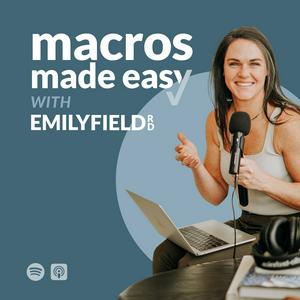
About Macros Made Easy with Emily Field RD
Welcome to Macros Made Easy, the podcast that simplifies the world of macros. If you're overwhelmed by the concept of tracking your macros, or wondering how you might use the approach in your full, busy life, you're not alone. This show is designed to make it easy for you to understand and implement a macro balanced eating pattern and put you in the driver's seat of how you look, feel and perform.
Your host, Emily Field is a Registered Dietitian with nearly a decade of experience using the macros approach with her clients. She knows the power that a macros approach can have - such as an improved metabolism, easy and painless fat loss and enhanced food freedom.
Join Emily for each episode as she makes macros easy while helping you reach your health goals with ease.
Connect with Emily:
www.emilyfieldrd.com
Instagram & Facebook @emilyfieldrd
Podcast websiteListen to Macros Made Easy with Emily Field RD, 6 Minute English and many other podcasts from around the world with the radio.net app
Get the free radio.net app
- Stations and podcasts to bookmark
- Stream via Wi-Fi or Bluetooth
- Supports Carplay & Android Auto
- Many other app features
 Ireland