

Listen to this podcast in the app for free: Download for free in the App Store
radio.net
Sleep timer
Save favourites
News of the Times - Unlocking the vaults of historical crime
Robin Coles
Latest episode
783 episodes
The Putney Mystery: The Death of Ellen Matilda Franklin (1892)
18/03/2026 | 49 mins.In October 1892, a young woman arrived quietly at a respectable house in Putney.
Within four days she was dead.
The death certificate appeared entirely straightforward — embolism, thrombosis, and chronic kidney disease. Natural causes. The body was buried, and the matter might easily have ended there.
But suspicion soon began to grow.
Within weeks the Home Secretary ordered the grave to be opened, and what Victorian forensic surgeons discovered during the post-mortem revealed that the medical certificate had told a very different story.
A doctor and his wife were arrested.
An undertaker was accused of helping conceal the truth.
And the man believed to have carried out the fatal operation — Dr Richard Freeman — had already vanished.
The newspapers soon gave the case a name:
The Putney Mystery.
Tonight we explore the strange death of Ellen Matilda Franklin — the hurried burial, the evidence hidden inside the coffin, and the sensational Old Bailey trial that followed when Victorian forensic science began to expose what had really happened in a quiet house in Chelverton Road.The Cambridge Pudding Mystery: The Suspected Poisoning of Henry Day | True Crime 1871
13/03/2026 | 53 mins.Today we travel to Cambridge in the summer of 1871, where a young labourer collapsed after his morning meal and died within hours.
The symptoms pointed unmistakably to poison.
The chemistry insisted there was none.
And between the two, a newly married wife found herself facing the full weight of public suspicion.
This is the story of Henry Day — a sudden death that baffled doctors, divided neighbours, and revealed just how uncertain early forensic science could be.
A case of meat pudding, mixed evidence, and a courtroom struggling to make sense of answers that simply refused to align.
If you enjoy these deeper Victorian mysteries, we’d be delighted to have you join us over on Patreon, where we keep our longer investigations, early releases, and a great deal more from the archives.
Settle in — Cambridge awaits.The Death of Ellen Warder: A Victorian Poisoning Mystery | True Crime 1866
11/03/2026 | 1h 10 mins.Tonight we travel to Brighton in the summer of 1866, where the sudden illness of a newly married woman set in motion one of the most troubling Victorian inquests of the decade.
Ellen Warder’s decline was abrupt, her symptoms baffling, and every doctor who attended her agreed on one unsettling point: nothing about her illness could be explained by natural causes.
But it was only when investigators began looking more closely at her husband’s past that the real unease began. For Ellen was not his first wife to die suddenly. Nor his second.
As the evidence gathered pace — and as the era’s leading toxicologist was called to examine her organs — the case widened into a far darker question:
How many tragic “misfortunes” can surround a single man before coincidence becomes impossible?
If you enjoy our Victorian true-crime investigations and would like access to our full archive, plus early ad-free episodes and bonus material, you can find all of that on Patreon, where we post additional stories that never appear elsewhere.
Settle in, and let’s step back to Brighton, 1866.The Blue Anchor Inn Mystery | True Crime 1924
09/03/2026 | 53 mins.A quiet Surrey hotel. A routine morning remedy. And within minutes, a respected publican is dead on the floor in violent convulsions. When the doctor arrives, nothing makes sense: the salts taste bitter, the bottle has been mysteriously rinsed clean, and strange white crystals are scattered across the bar parlour.
This is the Byfleet Poisoning of 1924 — a case that led detectives from a village inn to a French chemist’s shop, a Biarritz hotel, and finally to one of the most dramatic murder trials of the decade. Was Alfred Jones the victim of accident, jealousy, desperation… or a calculated plan carried out under his own roof?
Tonight we follow the forensic trail, the conflicting testimonies, and the sudden appearance of a charming stranger whose arrival in England would change everything.
If you enjoy deep-dive historical true crime, you’ll find many more extended investigations and archive-only stories in our growing library over on Patreon — you’re very welcome to join us there for exclusive series, early releases, and long-form episodes.The Green Bicycle Mystery: The Murder of Bella Wright | True Crime 1919
06/03/2026 | 1h 5 mins.A quiet summer evening in 1919.
A country lane in Leicestershire.
A young woman found beside her bicycle… and a mystery that would grip Britain for the next year.
In this episode, we unravel the Green Bicycle Mystery — a case that began as a presumed cycling accident but quickly deepened into one of the most perplexing investigations of the early 20th century. A bullet overlooked for nearly a day, a vanished cyclist on a distinctive green B.S.A., and a courtroom battle led by the formidable Sir Edward Marshall Hall all combine to create one of the era’s most enduring puzzles.
Join us as we follow the investigation step by step: the forensic misjudgements, the conflicting witness accounts, the disappearance and dramatic recovery of the bicycle, and the question that still divides historians more than a century later — what truly happened on that quiet Leicestershire lane?
If you enjoy immersive historical true crime, you’ll find a great deal more waiting in our archive.
You’re warmly invited to join us on Patreon, where members receive early episodes, hundreds of additional investigations, and our full Victorian–Edwardian true-crime library — a quiet corner of the internet where curiosity is very much encouraged.
Settle in.
The lane is quiet, the evidence is troubling, and the mystery remains unsolved.
A young woman found beside her bicycle in 1919, a missing cyclist on a green B.S.A., and a bullet no one noticed for nearly a day — we unravel one of Britain’s most perplexing early forensic mysteries.
More Documentary podcasts
 The Documentary PodcastDocumentary, Society & Culture
 I’m Not a Monster Presents… Where is Austin Tice?Documentary, Society & Culture, True Crime
 Freakonomics RadioDocumentary, Society & Culture
 The Slow NewscastDocumentary, News, News Commentary, Society & Culture
 World of SecretsDocumentary, Society & Culture
 Unreliable Witness | StorycastDocumentary, News, Society & Culture, True Crime
 CriminalDocumentary, Society & Culture, True Crime
 The Diamond King | Telegraph InvestigatesDocumentary, News, Politics, Society & Culture
 Careless | Tortoise InvestigatesDocumentary, Society & Culture, True Crime
 Black Box: The ChatbotsDocumentary, News, Society & Culture
Trending Documentary podcasts



About News of the Times - Unlocking the vaults of historical crime
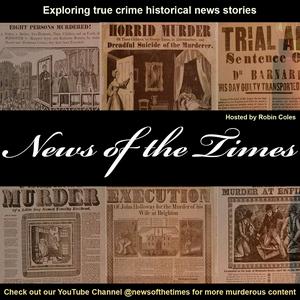
Welcome to News of the Times!Step into the shadowed alleyways and gaslit parlours of the 18th and 19th centuries with News of the Times — a meticulously curated journey through historical crime. Each episode draws from authentic reports and court records, bringing you the darkly fascinating tales that gripped Georgian, Victorian, and Edwardian Britain.With over 500 episodes and counting, we explore true accounts of mischief, murder, and mayhem from days gone by — all delivered with a wry nod and a love for the curious corners of the past.🕵️ For those with a taste for the peculiar, you may also enjoy our new side project: Volume 1: Slightly Unreliable Memoirs — a whimsical collection inspired by the lives (and occasional misadventures) of our research team. Think cravats, crumpets, and the occasional cactus on the lam. Intrigued? Find it here: 👉 https://ko-fi.com/s/b406f6f11e
Podcast websiteListen to News of the Times - Unlocking the vaults of historical crime, The Documentary Podcast and many other podcasts from around the world with the radio.net app
Get the free radio.net app
- Stations and podcasts to bookmark
- Stream via Wi-Fi or Bluetooth
- Supports Carplay & Android Auto
- Many other app features
Get the free radio.net app
- Stations and podcasts to bookmark
- Stream via Wi-Fi or Bluetooth
- Supports Carplay & Android Auto
- Many other app features

News of the Times - Unlocking the vaults of historical crime
Scan code,
download the app,
start listening.
download the app,
start listening.
 Ireland