
Listen to this podcast in the app for free: Download for free in the App Store
radio.net
Sleep timer
Save favourites
122 episodes
Economic Inequality
18/10/2026 | 44 mins.Money may not buy happiness. But it turns out that the way it’s distributed can affect everything from happiness and a sense of meaning to physical health and mortality.
On this episode, we’ll explore the role economic inequality plays in the wellbeing of individuals and societies, and ask how religion fits into the picture. We’ll talk to psychologist Keith Payne about how our sense of where we stand in society can influence our behavior, our health, and even how religious we are. And we’ll also talk to religious studies scholar Bart Ehrman about Christianity’s complicated relationship with wealth, from the teachings of the historical Jesus to the establishment of modern welfare institutions and the rise of Protestant movements like the Prosperity Gospel.
Keith Payne is a Professor of Psychology and Neuroscience at the University of North Carolina, Chapel Hill. He is the author of the books The Broken Ladder and Good Reasonable People. Learn more about his work on his website.
Bart Ehrman is the James A. Gray Distinguished Professor Emeritus of Religious Studies at the University of North Carolina at Chapel Hill, and the author or editor of over thirty books on Christianity and the New Testament, including Love Thy Stranger: How the Teachings of Jesus Transformed the Moral Conscience of the West. Find out more about his work on his website.One Nation... Under God?
04/10/2026 | 51 mins.The United States is a country founded on the separation of church and state. But what did the founders really mean by that? Should religion be banished from public life and policy debates? Or could it serve a purpose in the pursuit of happiness and freedom for all?
On this episode, recorded during the Aspen Ideas Festival, we'll explore what the US founding fathers really thought about the different roles religion could play in society, how that view has changed through history, and what it means for the upcoming US elections.
David French is an American political commentator and current opinion columnist for The New York Times. He is a senior fellow of the Trinity Forum, a former senior editor for The Dispatch, and former staff writer for National Review.
Jeffrey Rosen is CEO Emeritus of the National Constitution Center, a professor of law at the George Washington University Law School, and a contributing editor for The Atlantic.Rethinking Purpose
20/09/2026 | 41 mins.These days, it seems like advice for how to “find your purpose” is everywhere. But what if purpose isn’t some hidden answer waiting to be found? And what if anxiously searching for our one true calling actually makes it harder to live with purpose?
On this episode, we explore some other approaches to the problem. Clinical psychologist Ross White tells us about how psychological flexibility can help us form purpose over time, and stay connected to it, even as our lives change. And we talk to philosopher Edward Slingerland about what early Chinese thinkers like Confucius and Zhuangzi would have made of our modern obsession with inventing a meaningful path from scratch.
Ross White is an Honorary Professor of Clinical Psychology at Queen’s University, Belfast and the Founding Director of Strive2Thrive. He is the author of the book The Tree That Bends: How a flexible mind can help you thrive, as well as the article “Your purpose isn’t something you find, it’s something you form.”
Edward Slingerland is a Professor of Philosophy at the University of British Columbia and a Visiting Professor in the Department of Religion at Dartmouth. He is the author of many books, including Trying Not to Try and the forthcoming title, Learning to See: Literature, Moral Perception and Early Confucian Virtue Ethics. Find out more about his work on his website.Season 11 Trailer
13/09/2026 | 3 mins.Join us for Season 11 of How God Works, starting next week!HGW Presents: Oh God Now What
23/08/2026 | 45 mins.How God Works will be back with all new episodes in September. In the meantime, we're excited to feature an episode from our friends at Oh God Now What, hosted by Niala Boodhoo.
*
In the debut episode, "Voting Your Morals," host Niala Boodhoo welcomes public theologian Curtis Chang and Rabbi Jill Jacobs. Using their expertise as religious thought leaders, they help us navigate aligning beliefs with how we vote. And they offer perspective and tools for strengthening democracy outside of high-stakes elections.
Chang is the Executive Director of Good Faith, which helps politically ‘homeless’ Christians navigate a deeply divided world. Rabbi Jacobs is the CEO of T’ruah, which empowers rabbis and cantors to lead Jewish communities in advancing democracy and human rights.
More Philosophy podcasts

Trending Philosophy podcasts
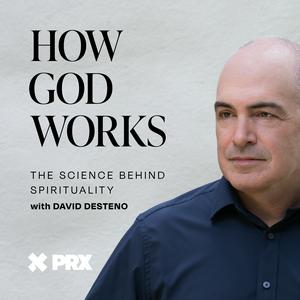
About How God Works: The Science Behind Spirituality
While religion and science often seem at odds, there’s one thing they can agree on: people who take part in spiritual practices tend to live longer, healthier, and happier lives. The big question is: Why? In How God Works, professor Dave DeSteno takes us on a journey to find out how spirituality impacts our minds and bodies, as well as the world in which we live.He speaks to leading scientists and philosophers, religious thinkers, and thought leaders to explore what we can learn from the world’s faith traditions to help us meet some of life’s biggest challenges. Along the way, he’ll look at how we can adapt and use spiritual practices in our own lives, whatever our beliefs, including none at all.It’s by working across the boundaries that usually divide us – science versus religion, one faith versus another – that we’ll find new ways to make life better for everyone.
Podcast websiteListen to How God Works: The Science Behind Spirituality, Philosophize This! and many other podcasts from around the world with the radio.net app
Get the free radio.net app
- Stations and podcasts to bookmark
- Stream via Wi-Fi or Bluetooth
- Supports Carplay & Android Auto
- Many other app features
Get the free radio.net app
- Stations and podcasts to bookmark
- Stream via Wi-Fi or Bluetooth
- Supports Carplay & Android Auto
- Many other app features

How God Works: The Science Behind Spirituality
Scan code,
download the app,
start listening.
download the app,
start listening.
How God Works: The Science Behind Spirituality: Podcasts in Family
 Ireland
