
Listen to this podcast in the app for free: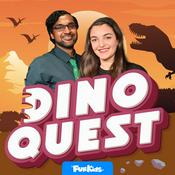 Download for free in the App Store
radio.net
Sleep timer
Save favourites
10 episodes
Dinosaurs had bones in their eyes, with Stephan Lautenschlager
27/10/2026 | 32 mins.Dinosaurs had bones in their eyes. You don’t, and nor does any other mammal, from dogs to whales to elephants. We’re the odd ones out. Birds, lizards, turtles and fish all have a ring of thin bony plates sitting in the white of the eye, holding a big eyeball steady so it can focus. Because it’s bone, it sometimes fossilises, and that matters, because the age of the dinosaurs lasted around 160 million years and roughly half of it happened in the dark.
This week’s word is sclerotic ring. Sclerotic comes from a Greek word meaning hard, and the ring is usually made of 10 to 15 overlapping plates, arranged like the stones in an archway. Measure the hole in the middle, like the hole in a Polo mint, and compare it with living animals. A big hole lets in lots of light, which suits an animal that was up at night. A small hole means a daytime animal. It works just like a camera.
Lauren and Cassius Morrison hear from Dr Stephan Lautenschlager, a palaeontologist at the University of Birmingham who uses computer models to work out how dinosaurs looked, lived and behaved. Bigger eyes mean bigger lenses and room for more light-sensing cells, so bigger eyes see better. The middle of a Jurassic night was probably busy, with some dinosaurs out in the day, some at night and some at dawn and dusk, which may have been ideal hunting conditions for meat-eaters. He explains why owls hear so well (one ear sits higher than the other), what the optic lobes in a dinosaur’s brain tell us, and admits that nobody knows how dinosaurs slept or what colour their eyes were.
Fresh from the Dig names the owl dinosaur: Shuvuuia, a chicken-sized dinosaur from the Mongolian desert with huge eyes and an inner ear to match a barn owl’s. Then a study that compared the eye rings of dozens of fossil animals with living ones: small meat-eaters were mostly out at night, big plant-eaters snacked around the clock, and big predators came out at dawn and dusk. And birds can see ultraviolet light that humans can’t, so dinosaurs may have been far more patterned than any picture shows. In the Dino-Mite Question, Noor, nine, from Birmingham, asks whether dinosaurs slept standing up or lying down. The best clue is Mei long, the “sleeping dragon”, a duck-sized fossil from China found curled up with its head tucked in, just like a bird.
Then it’s Build a Dino Lab. Week nine is the eyes: small, cheap daytime eyes, or big eyes, a wide sclerotic ring and big optic lobes for working in the dark. Big eyes win, with a twist. Our dinosaur’s reflective skin, chosen back in episode five, would shine like a headlight under the moon and stand out at midday, so it hunts at dawn and dusk, when the night animals are going to bed, the day animals are only just getting up, and everyone is half asleep. Lions and foxes do the same. Next week, arms.
See omnystudio.com/listener for privacy information.Why you can’t hide from a T. rex, with Jared Voris
19/10/2026 | 43 mins.The most important part of your nose is inside your brain. Your nose catches the smell, but it’s a lump at the front of your brain that works out what it is: sweet, horrible, or dangerous, like gas in the kitchen. Humans tend to put smell near the bottom of their list of senses. For most animals it’s essential, for marking territory, finding each other and sniffing out food.
This week’s word is olfactory bulb. That’s the lump. The bigger it is for your size, the better your nose, and because it takes up room in the skull, it leaves a space scientists can measure. But room in a head is a trade-off. A bigger bulb means a bigger head and a bigger brain, and a bigger brain needs more energy and more food.
Lauren and Cassius Morrison hear from Dr Jared Voris, a palaeontologist at the University of Calgary in Canada who studies T. rex and its relatives. When you rebuild a tyrannosaur’s brain, the smell bulbs run almost half its length, so T. rex could probably sniff out prey, a dead animal or anything else nearby, the way a wolf or a bear does today. Nobody has a real dinosaur brain, so long ago the American Museum of Natural History sawed a T. rex braincase in half to look inside. Now scientists put skulls through a CT scanner, a 3D X-ray, and rebuild the shape of the brain on a computer without breaking anything. Plant-eaters had good noses too, perhaps for finding water and telling which plants were safe to eat.
Fresh from the Dig starts with Jared’s own tyrannosaur, Thanatotheristes, the “reaper of death”, which had unusual ridges along its long face. It was found in Alberta by a family who spotted the bones, photographed them and told the museum instead of digging them up themselves. Then ankylosaurs, whose nasal passages loop round and round inside the skull and may have worked like air conditioning under all that armour. And the kiwi, which has its nostrils at the very tip of its beak and sniffs out worms on the forest floor at night. In the Dino-Mite Question, Ada, six, from Bristol, asks whether she could hide from a T. rex. Behind a tree it can’t see you, but it can smell you, and follow the trail you left ten minutes ago. Your best bet is to stand downwind.
Then it’s Build a Dino Lab. Week eight is the nose: huge T. rex-style smell bulbs that need a bigger skull and more food, or small bulbs and a hawk’s sharp eyes. Lauren picks the big bulbs. A hawk’s eyes work because it can fly and look down from above, and this dinosaur lives on the ground among the trees, where you can’t see very far and smell matters most. Next week, the lights go off.
See omnystudio.com/listener for privacy information.Dinosaur chicken nuggets with Jingmai O’Connor
12/10/2026 | 36 mins.Loads of dinosaurs had wings, but not many of them could fly. There’s a dinosaur in your garden right now, probably the one that keeps stealing your chips, because a seagull is a dinosaur, and so is every robin, pigeon and chicken. Feathers turn up again and again across the dinosaur family tree, and most of them had nothing to do with flying. Oviraptors spread their feathered arms over their nests to keep their eggs warm, and some parents have been found still sitting on them. Others used feathers for showing off and for keeping warm in the cool forests of north-east China.
This week’s word is primaries. Hold your arm out: shoulder, elbow, wrist, hand. The primaries are the big, long, stiff feathers that grow from the hand, and they do the hard work of flying. Every bird that flies, from a hummingbird to an albatross, has between nine and eleven of them. So if you find a fossil wing, you can count.
Lauren and Cassius Morrison hear from Dr Jingmai O’Connor, Associate Curator of Fossil Reptiles at the Field Museum in Chicago. She explains why Microraptor, with feathers on its arms and its legs, probably glided down from the trees like a flying squirrel, and why Anchiornis, with a skeleton almost exactly like Archaeopteryx, has 30 primaries and probably couldn’t fly at all. She also owns up to getting something wrong. She once wrote that Microraptor couldn’t cough up pellets, then looked again at a Microraptor with a whole lizard in its stomach. A skeleton that size can’t go all the way through, so it had to come back up, and she is now writing a paper to say so. As she puts it, saying “I don’t know” is the most powerful thing a scientist can say.
Fresh from the Dig starts with Jingmai’s own brand new dinosaur, Jian changmaensis, a barn-owl-sized, four-winged cousin of Microraptor from about 120 million years ago in the Changma Basin in north-west China. It might finally explain the little bundles of smashed-up early bird bones found there for years. Then Yi qi, whose name means strange wing, a tiny dinosaur with bat-like skin wings that looked a lot like a mini dragon. And how scientists worked out the real colours of a dinosaur: Anchiornis was grey and black with white stripes on its wings and a rusty red crest, a bit like a woodpecker. In the Dino-Mite Question, Jonah, eight, from Glasgow, asks whether a chicken nugget is a dinosaur nugget. It is. And the wishbone in your roast chicken is the same bone you’d find in T. rex.
Then it’s Build a Dino Lab. Week seven is the arms: four wings like Microraptor, or feathered arms only with bare scaly legs underneath. Lauren picks feathered arms with seven primaries and no leg wings. Seven is two short of what you need to fly, and that’s fine, because this dinosaur was built to run, big feathers on its legs would trip it up, and it’s already carrying a heavy tail, plates and a thagomizer. Jingmai would have chosen the same. Next week, our dinosaur gets a nose.
See omnystudio.com/listener for privacy information.Why dinosaurs never dragged their tails with Pasha van Bijlert
05/10/2026 | 33 mins.A dinosaur’s tail could be a third of the whole animal, about as heavy to lug around as a concrete block, and for well over a century people drew dinosaurs dragging theirs along the ground. They didn’t. Palaeontologists have found thousands of dinosaur footprints and almost no tail marks, so a healthy dinosaur held its tail up and out behind it. The tail-dragging monsters in old paintings and old films were what scientists thought at the time, and that’s fine. Being wrong and then finding out is how science works.
This week’s word is counterbalance. It’s the seesaw, the tightrope walker’s long pole, and the heavy block on the back of a tower crane that stops it tipping over. A long tail stopped a two-legged dinosaur falling flat on its face. But a crane’s counterweight just sits there, and a dinosaur’s tail didn’t. Underneath it ran an enormous muscle, a giant bottom muscle, that ran forwards from the tail and down on to the thigh bone and pulled the leg back with every single step. So the tail was a counterbalance and an engine.
Lauren and Cassius Morrison hear from Pasha van Bijlert, a PhD researcher at Utrecht University in the Netherlands, who builds dinosaurs inside a computer and teaches them to walk. He 3D-scans a skeleton, adds muscles using the rough patches where they once gripped the bone, then drops the whole thing into a physics simulator that works out for itself how to walk and run. To check it works, he built an emu the same way, as if it were a fossil, and it topped out at about 40 kilometres an hour. Then he went to the Australian outback to film real emus with drones, and two of them ran alongside the car at 45 kilometres an hour and simply kept going.
Fresh from the Dig starts with Pasha’s own team, who worked out how fast Tyrannosaurus rex walked from the way its tail bobbed. Everything that swings has a rhythm it prefers, like a playground swing, and the rhythm of a T. rex tail gives a walking speed of about four and a half kilometres an hour. That’s your walking speed too, which is not a reason to go for a stroll with one. Then Stegouros from Chile, a small, cute armoured dinosaur whose tail ended in seven pairs of flat bony plates locked together like a fern leaf, and was about as friendly as an Aztec war club. And the footprints that settled the tail question turn out to be trace fossils, the same family as fossil nests, last meals and dinosaur poo.
Then it’s Build a Dino Lab, where one real fact becomes one real piece of the perfect dinosaur. Week six is the tail: a long, heavy, muscular one held out straight, or a light little stump like a pigeon’s. Lauren picks the long, heavy tail held off the ground, because episode one promised this dinosaur could run, and without it there is nothing to swing the thagomizer. Next week, wings, for a dinosaur that can’t fly.
See omnystudio.com/listener for privacy information.Life in a super greenhouse with Kirsty Edgar
28/09/2026 | 31 mins.The dinosaurs had around 160 million years on Earth, so there was never just one dinosaur climate. There were deserts, volcanoes and jungles, and there were forests at the North and South Poles, because for most of that time there was no permanent ice anywhere on the planet. Britain was subtropical to tropical. If you were packing for a trip, you would want a raincoat and an autumn jumper, not a snowsuit.
This week’s word is super greenhouse. A greenhouse lets the sun’s heat in through the glass and makes it hard for it to get back out, and carbon dioxide in the air does the same thing to the whole planet. In the super greenhouse of the Cretaceous there was far more of it, sea levels were so high that a seaway split North America down the middle, and temperatures in some places may have reached 40 to 45 degrees. That is hotter than a hot bath.
Fresh from the Dig is all about where dinosaurs lived. The dinosaur highway in Oxfordshire, a 150-metre run of tracks made by long-necked sauropods and the meat-eaters following them, was laid down in a warm, muddy lagoon, exactly the kind of ground that holds on to a footprint. The Carnian Pluvial Episode, roughly two million years of rain in the Triassic, spread forests across the hot, dry supercontinent of Pangaea, and it is one of the leading ideas for why dinosaurs took over. And in northern Alaska, inside the Arctic Circle, palaeontologists have found baby dinosaurs far too young to have migrated, which means dinosaurs lived there all year round, through months of darkness and months of midnight sun.
Lauren and Cassius Morrison are joined by Professor Kirsty Edgar, a micropalaeontologist at the University of Birmingham, whose fossils are smaller than a grain of sand. She studies foraminifera, tiny plankton that build shells in the surface ocean and have been doing it for hundreds of millions of years. The oxygen in those shells comes in a lighter and a heavier form, and the mix a shell takes up depends on how warm the water is, so each one is a thermometer that never knew it was a thermometer. When they die the shells sink and pile up on the seabed in layers, oldest at the bottom. Kirsty has spent two-month research voyages drilling that seabed, from Tahiti to Hawaii and from Tasmania round to Perth, one of which set off straight into the tail end of a Southern Ocean storm.
Otis, who is six and from Cardiff, wants to know whether he could have gone swimming in a 45-degree sea. Sadly not: a warm swimming pool is about 30 degrees, a hot bath is about 40, and anything else in the water would have been bigger than him and a better swimmer. Then it is Build a Dino Lab, where one real fact becomes one real piece of the perfect dinosaur. Week five is skin, and Kirsty’s advice is to make it pale, for the same reason a white T-shirt keeps you cooler than a black one. Lauren picks skin that reflects the sun, even though it makes the dinosaur easier to spot, because with a thagomizer and steak-knife teeth it can look after itself, and nobody wants a dinosaur that cooks. Next week, a tail. Probably.
See omnystudio.com/listener for privacy information.
More Education for Kids podcasts








Trending Education for Kids podcasts




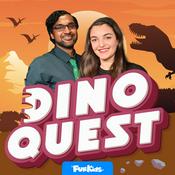
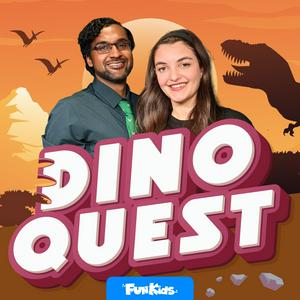
About Dino Quest
Dinosaurs were awesome. But no dinosaur ever got everything right.
Each episode, Lauren and Cassius pick one dinosaur speciality and dig into it. The fastest legs. The longest neck. The sharpest teeth.
They talk to the scientists who actually study this stuff – from the woman who found a dinosaur underneath a car park to the palaeontologist who builds them inside computers – and they make a choice: one real feature, from one real fossil, to add to the perfect dinosaur they're building across the series.
By the end, they'll have built a dinosaur that never existed, made entirely out of bits that did.
Dino Quest is from Fun Kids, the UK's children's radio station.
Podcast websiteListen to Dino Quest, Wow in the World and many other podcasts from around the world with the radio.net app
Get the free radio.net app
- Stations and podcasts to bookmark
- Stream via Wi-Fi or Bluetooth
- Supports Carplay & Android Auto
- Many other app features
Get the free radio.net app
- Stations and podcasts to bookmark
- Stream via Wi-Fi or Bluetooth
- Supports Carplay & Android Auto
- Many other app features
Dino Quest
Scan code,
download the app,
start listening.
download the app,
start listening.
Dino Quest: Podcasts in Family
 Ireland

