
Listen to this podcast in the app for free: Download for free in the App Store
radio.net
Sleep timer
Save favourites
500 episodes
Drawn to Rome, Part 5: Beauty (#490)
26/10/2026 | 32 mins.A glimpse of something beautiful can put you on the road before you have a name for the destination. In this episode Greg returns to the moment in The Lord of the Rings when Sam sees a white star through the shadow of Mordor, and to the way Tolkien and Lewis kept writing the same thing: beauty is not an ornament. It is a pathway. He traces that hunger through a childhood Christmas song, the Magi following a star, and the recognition that the Catholic house had kept that beauty and given it a face — Mary, the crucified Christ, stone and glass and a line of chant that was not performing an experience but letting you into one. The Catechism, John Paul II’s Letter to Artists, and Augustine all say the same thing in different words: created beauty never fully satisfies. It stirs a nostalgia it cannot finish. The draw is not that Catholics have better art. It is that this house is thick with it, and ordered toward the One who is beauty.
SUPPORT THIS SHOW Considering Catholicism is free and ad-free for everyone, thanks to listeners like you. Become a patron for a Q&A video every other week, the Podcast Albums (50 topical playlists), Deep Dive courses, and a monthly live session: https://patreon.com/consideringcatholicism
Or give a one-time or recurring gift with PayPal: https://www.paypal.com/donate/?hosted_button_id=5LGR5E89Z7Y2Y
CONNECT WITH US • Website & contact form: https://consideringcatholicism.com • Email: consideringcatholicism@gmail.com • Leave a comment on Patreon (I read every one!)
RATE & REVIEW If you enjoy the show, please leave a rating (and even better, a review) on Apple Podcasts, Spotify, or wherever you listen — it really helps new listeners find us.
SHARE THE SHOW Know someone who’s curious about Catholicism? Send them a link or share an episode on social media. Thank you!
Christus vincit, Christus regnat, Christus imperat.Drawn to Rome, Part 4: Maturity (#489)
19/10/2026 | 39 mins.Catholicism does not lower the bar to make the faith easier to swallow. It treats people as adults and expects them to grow up — in doctrine, in moral responsibility, in the seriousness of the sacraments, and in the long conversation the Church has been having with itself for two thousand years. In this conversation with Ed, Greg and Ed talk about what it feels like when a church stops trying to entertain you and starts expecting you to keep up. They look at the features that get criticized as bugs — the depth, the obligations, the refusal to let a sin remain a secret — and why those things can feel like a relief after years of being told that God does not really expect anything of you. The draw is not complexity for its own sake. It is the sense that Christianity, if it is true, is a serious thing, and that a grown-up faith calls people to take it seriously.
SUPPORT THIS SHOW Considering Catholicism is free and ad-free for everyone, thanks to listeners like you. Become a patron for a Q&A video every other week, the Podcast Albums (50 topical playlists), Deep Dive courses, and a monthly live session: https://patreon.com/consideringcatholicism
Or give a one-time or recurring gift with PayPal: https://www.paypal.com/donate/?hosted_button_id=5LGR5E89Z7Y2Y
CONNECT WITH US • Website & contact form: https://consideringcatholicism.com • Email: consideringcatholicism@gmail.com • Leave a comment on Patreon (I read every one!)
RATE & REVIEW If you enjoy the show, please leave a rating (and even better, a review) on Apple Podcasts, Spotify, or wherever you listen — it really helps new listeners find us.
SHARE THE SHOW Know someone who’s curious about Catholicism? Send them a link or share an episode on social media. Thank you!
Christus vincit, Christus regnat, Christus imperat.Drawn to Rome, Part 3: A Quiet Place (#488)
12/10/2026 | 37 mins.Nine or ten at night, fog on a mountain road, and a Catholic chapel the size of a tool shed. A crucifix, a couple of benches, a place to pray. It was the first Catholic building Greg ever walked into, and it was quiet. A lot of people describe the same pull. An empty church on a Tuesday that is full of glass and saints and stories, and dead quiet. Confession lines, a candle, a priest anointing someone before surgery, five silent minutes while the vessels are purified after Communion. Not a lower volume. A room, and a week, that are not trying to fill every gap. Hell, in Lewis’s picture, is noise that never stops, because if it stopped you might hear something. The Church kept the other thing on purpose, from Benedict rationing even good speech to a parish that agrees to wait.
SUPPORT THIS SHOW Considering Catholicism is free and ad-free for everyone, thanks to listeners like you. Become a patron for a Q&A video every other week, the Podcast Albums (50 topical playlists), Deep Dive courses, and a monthly live session: https://patreon.com/consideringcatholicism
Or give a one-time or recurring gift with PayPal: https://www.paypal.com/donate/?hosted_button_id=5LGR5E89Z7Y2Y
CONNECT WITH US • Website & contact form: https://consideringcatholicism.com • Email: consideringcatholicism@gmail.com • Leave a comment on Patreon (I read every one!)
RATE & REVIEW If you enjoy the show, please leave a rating (and even better, a review) on Apple Podcasts, Spotify, or wherever you listen — it really helps new listeners find us.
SHARE THE SHOW Know someone who’s curious about Catholicism? Send them a link or share an episode on social media. Thank you!
Christus vincit, Christus regnat, Christus imperat.Drawn to Rome, Part 2: The Search for the Source (#487)
08/10/2026 | 33 mins.A Christianity of new beginnings gets old. The megachurch was the recovery of real church, and before that the Jesus Movement, and before that some other return to the original, each one arriving as the source and aging into a period style. For a lot of people the pull toward Rome starts there: not in a proof about Peter, but in a wish to go upstream and find the water still moving. In the early 2000s that wish was unfashionable. Not arriving had become a spirituality, with books and sermons hung on an old U2 title, as if God sends people on a search he never means them to finish. Jesus says the opposite. Seek, and you will find. Once the thing you want is the source, most of the map goes quiet, and the only houses that can even scratch the itch are the ones that claim to be the thing still running from the apostles. This hour is about that draw — the weariness, the upstream instinct, and the moment the claim has an address.
SUPPORT THIS SHOW Considering Catholicism is free and ad-free for everyone, thanks to listeners like you. Become a patron for a Q&A video every other week, the Podcast Albums (50 topical playlists), Deep Dive courses, and a monthly live session: https://patreon.com/consideringcatholicism
Or give a one-time or recurring gift with PayPal: https://www.paypal.com/donate/?hosted_button_id=5LGR5E89Z7Y2Y
CONNECT WITH US • Website & contact form: https://consideringcatholicism.com • Email: consideringcatholicism@gmail.com • Leave a comment on Patreon (I read every one!)
RATE & REVIEW If you enjoy the show, please leave a rating (and even better, a review) on Apple Podcasts, Spotify, or wherever you listen — it really helps new listeners find us.
SHARE THE SHOW Know someone who’s curious about Catholicism? Send them a link or share an episode on social media. Thank you!
Christus vincit, Christus regnat, Christus imperat.Drawn to Rome, Part 1: No One Gets Argued into Love (#486)
05/10/2026 | 17 mins.Nearly five hundred episodes of this show have been about why the Catholic Church is true. That work was real, and it is not being retired. It was also incomplete. Most people do not start down the Road to Rome because they won an argument. They start because something draws them — a longing, a story, a seriousness, a beauty — before they can give the thing a name. In this short introduction to Drawn to Rome, Greg tells the part of his own conversion he usually leaves out: Tolkien, read as a kid who did not know the word Catholic, planted a hunger that Calvary Chapel, Calvin Seminary, and a long shelf of arguments never quite replaced. The books came later. They kept him from feeling crazy. They did not put his feet on the road. No one gets argued into love.
SUPPORT THIS SHOW Considering Catholicism is free and ad-free for everyone, thanks to listeners like you. Become a patron for a Q&A video every other week, the Podcast Albums (50 topical playlists), Deep Dive courses, and a monthly live session: https://patreon.com/consideringcatholicism
Or give a one-time or recurring gift with PayPal: https://www.paypal.com/donate/?hosted_button_id=5LGR5E89Z7Y2Y
CONNECT WITH US • Website & contact form: https://consideringcatholicism.com • Email: consideringcatholicism@gmail.com • Leave a comment on Patreon (I read every one!)
RATE & REVIEW If you enjoy the show, please leave a rating (and even better, a review) on Apple Podcasts, Spotify, or wherever you listen — it really helps new listeners find us.
SHARE THE SHOW Know someone who’s curious about Catholicism? Send them a link or share an episode on social media. Thank you!
Christus vincit, Christus regnat, Christus imperat.
More Christianity podcasts




Trending Christianity podcasts



About Considering Catholicism
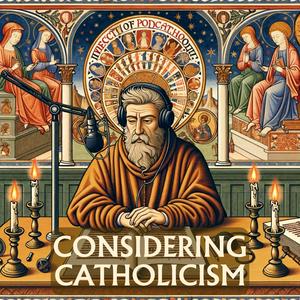
Considering Catholicism explains the beliefs, history, Scripture, and life of the Catholic Church clearly and charitably. It's for curious Protestants, seekers, people in OCIA, and Catholics who want to know and share their faith. Host Greg Smith spent decades serving across the Protestant world, which gives him an insider's understanding of the questions people bring. Faithful to the Catechism of the Catholic Church.
Podcast websiteListen to Considering Catholicism, 1 Timothy Meditations and many other podcasts from around the world with the radio.net app
Get the free radio.net app
- Stations and podcasts to bookmark
- Stream via Wi-Fi or Bluetooth
- Supports Carplay & Android Auto
- Many other app features
Get the free radio.net app
- Stations and podcasts to bookmark
- Stream via Wi-Fi or Bluetooth
- Supports Carplay & Android Auto
- Many other app features
Considering Catholicism
Scan code,
download the app,
start listening.
download the app,
start listening.
Considering Catholicism: Podcasts in Family
 Ireland