

Listen to this podcast in the app for free: Download for free in the App Store
radio.net
Sleep timer
Save favourites
56 episodes
52. Stories in Stone: Transatlantic Graves from Munster to Ontario
13/10/2026 | 1h 7 mins.During the 1820s the Peter Robinson Emigration Scheme saw large numbers of families leave Munster the begin new lives in Upper Canada. Two hundred years later, the headstones these families left behind in Peterborough County, Ontario and in Cork, Limerick and Tipperary are helping to tell their stories in a unique, innovative and intrguing way. Fin and Damian are joined by Dr John Tierney, Director of the Historic Graves Project and Patrick Leahy of the Douro Heritage Group in Ontario to discuss their incredible transatlantic Carved in Stone community heritage project, which is using archaeology and history to explore the graveyards that linked these people across the Atlantic.
The episode begins with John explaining how Historic Graves works, and his long experience of collaborating with local communities in Ireland to record their graveyards. Patrick then takes us through the story of Irish settlement in Douro, Ontario and some of the stories of those who crossed to Canada. The remainder of the show is given over to discissing how their transatlantic collaboration came about, their ongoing work on both sides of the water, and the incredible insights that is bringing for our knowledge of these communities, their origins, and their maintained connections with home.
Historic Graves Website
Historic Graves Youtube Channel
Duoro Heritage Group Facebook Page
Ballyhoura Development Peter Robinson Emigration Page
Carved in Stone Ballyhoura Development Project Page
Hosted on Acast. See acast.com/privacy for more information.51. Irish America & Slavery
04/10/2026 | 57 mins.Irish America's relationship with African Americans in the mid-19th century has long been a focus for historians, particularly those trying to understand racism and Irish opposition to emancipation. But what if part of the answer lies not in New York or Boston, but in Ireland itself? In this episode, Fin and Damian are joined by Dr Ian Delahanty, Associate Professor of History at Springfield College, Massachusetts. Ian's award-winning work has shed new light on some of the origins of Irish attitudes towards slavery, abolition and emancipation, and how they changed over time. As he explains, if we want to better understand them, we have to begin not in the United States, but in Ireland.
In this episode, Ian takes us back to the years around the Great Famine to explore Ireland's abolitionists, the influence of abolition on Irish politics, and how the tensions that resulted began to shape the views some Irish nationalists developed on abolition and emancipation during the 1840s. These political attitudes were carried across the Atlantic with Famine emigrants and nationalist leaders into a United States on the brink of war over the issue of slavery. We cross the Atlantic to follow that story, discussing how the political scenario in America shaped these pre-existing attitudes during the 1850s, and finally explore the major impact and influence the Civil War had on how Irish America came to view the question of emancipatiing enslaved African Americans.
Our discussion is based on Ian's book, Embracing Emancipation: A Transatlantic History of Irish Americans, Slavery and the American Union, 1840-1865 published by Forduham University Press. It was awarded the Lawrence J. McCaffrey Prize for the best book on Irish America in 2024.
Hosted on Acast. See acast.com/privacy for more information.50. Forest City Irish: The Story of Portland, Maine
27/09/2026 | 50 mins.Maine may not be the first place we think of when it comes to large Irish communities, but in the years after the Great Famine, the port city of Portland became home to a significant Irish population. The communities they developed began a strong connection between the city and Ireland that endures to this day, especially with the place most connected with its immigrants— Galway. In this episode, Fin and Damian are joined by historian, genealogist and author Matthew Jude Barker, the expert on the Portland Irish, to explore their story.
As well as discussing what brought the Irish to Portland, in this episode Matt tells us about the neighbourhoods they made their own during the 19th and early 20th centuries. We explore events like the impact events like the "Great Fire" of 1866 and "Rum Riot" of 1855 had on their lives, and how they navigated local politics and nativism. Along the way we meet people like the McGlinchy brewing family, some of the women who made their living as domestic servants, and the remarkable story of Bishop James Augustine Healy, who became the first African American Catholic bishop in the United States.
Matthew's latest books are a two volume set on the story of the Portland Irish, Becoming American: Portland, Maine's Irish and the Making of Immigrant America 1840-1861 andThe Blue and the Green: The Irish of Portland Maine During the Civil War Era 1861-1870. You can purchase them here.
Maine Irish Heritage Center
Matthew's Website
In the intro to this week's show Damian mentioned a three-week online course he will be running this October for the Celtic Junction Arts Center. If you would like to find out more about the course, or sign up, you can do so via this link.
Hosted on Acast. See acast.com/privacy for more information.49. Irish Domestic Servants in America
20/09/2026 | 51 mins.Throughout the 19th and early 20th centuries, tens of thousands Irish women worked as domestics. The "Irish Bridget" is one of the most recognisable stereotypes of Irish America, but what was life really like for these women, who were the subject of such extensive cariacture and discrimination?
In this episode, Fin and Damian are joined by Dr Catherine Healy, Historian-in-Residence at EPIC The Irish Emigration Museum and an expert on Irish domestic service. In the show we explore the reality of their hard working lives, and try and recover something of their lived experiences, both positive and negative. As well as discussing what these women did and the types of places they worked, we chat through things like vulnerabilities that came with live-in service, the prejudices they endured, and the pride they took in earning their own money and supporting families back in Ireland.
You can find Catherine's Website here: https://catherinehealy.org/
The link to Catherine's Book: Irish Domestic Servants in Transatlantic CUlture, c. 1870-1945
Epic: The Irish Emigration Museum
Hosted on Acast. See acast.com/privacy for more information.48. The Return of Transatlantic
14/09/2026 | 13 mins.Damian and Fin return after the summer break to talk over their summer and whats coming in Transatlantic in the coming months. Hosted on Acast. See acast.com/privacy for more information.
More Education podcasts









Trending Education podcasts

















About Transatlantic: An Irish American History Podcast
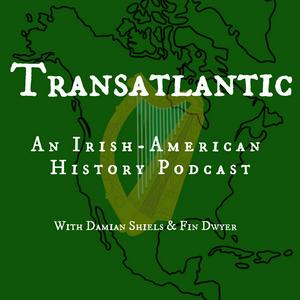
3,000 miles of ocean separate Ireland from the USA, but both countries share a deep and intertwined history. Links between North America and Ireland predate Columbus, stretching back over 1,000 years. Since then, Irish people have shaped the history of the United States. From Ann 'Goody' Glover, who was hanged as a witch in Boston in the 17th century, to JFK, the story of the Irish in the US is fascinating. Join historians Damian Sheils and Fin Dwyer as they join forces to explore the good, the bad, and the ugly of Irish American history.In Season 1 Fin and Damian explore fascinating topics includingWho was the first Irish person to cross the Atlantic?The Story of Goody Glover who was hanged as a witch in Boston.What was it like to emigrate during the Great Famine of the 1840s?How Irish people shaped the US Civil War?And much more...Subscribe and join Fin and Damian on this fascinating journey through our history. Hosted on Acast. See acast.com/privacy for more information.
Podcast websiteListen to Transatlantic: An Irish American History Podcast, Coffee Break Italian and many other podcasts from around the world with the radio.net app
Get the free radio.net app
- Stations and podcasts to bookmark
- Stream via Wi-Fi or Bluetooth
- Supports Carplay & Android Auto
- Many other app features
Get the free radio.net app
- Stations and podcasts to bookmark
- Stream via Wi-Fi or Bluetooth
- Supports Carplay & Android Auto
- Many other app features

Transatlantic: An Irish American History Podcast
Scan code,
download the app,
start listening.
download the app,
start listening.
 Ireland