
Listen to this podcast in the app for free: Download for free in the App Store
radio.net
Sleep timer
Save favourites
135 episodes
Episode 135: "The Ultimate Machine: What AI Still Can't Do (Your Body)"
27/10/2026 | 1h 7 mins.We spend plenty of time updating our technology. How much attention do we give the bodies operating it?
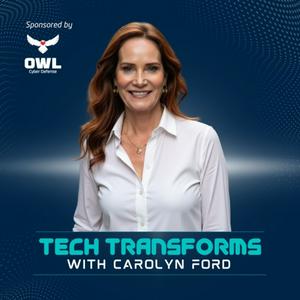
In this Halloween episode of Tech Transforms, Carolyn Ford goes off-script with her longtime physical therapist, Ned Dowling, director of the Cyclist Clinic at University of Utah Health. Together, they explore the remarkable machine that makes everything else possible: the human body.
Ned explains his approach to balancing the demands placed on the body with its capacity to handle them and why sitting through back-to-back meetings or pushing every workout to the limit can upset that balance. Drawing on Carolyn’s own experiences with cycling injuries and rehabilitation, they discuss workplace ergonomics, why recovery rarely follows a predictable schedule, and how wearable technology can help put training and recovery into perspective.
Along the way, they consider why standing desks still require movement, how small “exercise snacks” fit into a busy day, and what zombies are missing beyond decent posture.
In this episode:
• Why changing positions matters more than finding one perfect posture.
• How physical therapy builds the body’s capacity to handle everyday demands.
• Why recovery involves more than waiting for an injury to heal.
• Where heart rate and heart rate variability fit into understanding effort and stress.
• Why rest deserves a place alongside strength training and movement.
Ned’s parting advice is simple: change positions frequently. Preferably before you start moving like the walking dead.
Episode Notes:
Provider Profile: healthcare.utah.edu/find-a-doctor/nathan-dowling
Podcast - The Health Benefits of Cycling: healthcare.utah.edu/the-scope/.../health-benefits-of-cycling
Podcast - First Gear: A Physical Therapist's Advice on Getting Started with Cycling: healthcare.utah.edu/the-scope/.../first-gear...Episode 134: The Data Has to Move: Cross Domain, Cloud, and the Mission Gap Nobody Talks About
06/10/2026 | 1h 11 mins.Buying a cross-domain solution doesn’t guarantee your mission’s data will get where it needs to go. The harder work is understanding the architecture, risks, stakeholders and approvals that make secure information sharing possible.
In this episode of Tech Transforms, Carolyn Ford talks with John Spicer, VP of Technical Strategy and Co-founder at Nteligen, about why government programs need to approach cross-domain requirements as a mission planning challenge. John shares how overlooked architectural requirements can leave seven figures’ worth of hardware sitting unused—and why an existing, approved solution may sometimes meet a mission’s needs without a new purchase.
They also explore how cross-domain solutions complement zero trust, why cloud elasticity creates challenges for traditional cross-domain architectures, and the distinction between mitigating threats and making informed risk decisions. John explains why Raise the Bar (RTB) guidance supports secure system design but does not replace a mission-specific assessment of acceptable risk.
His advice for leaders: start with the data your mission needs to move, bring the right stakeholders into the conversation early, and build secure information sharing into your roadmap before acquisition begins.
Show Notes
Guest LinkedIn: https://www.linkedin.com/in/john-spicer-9993191/
Nteligen Website & Published Research: https://www.nteligen.com
National Cybersecurity Strategy (2023): https://www.whitehouse.gov/wp-content/uploads/2023/03/National-Cybersecurity-Strategy-2023.pdf
DoD Cyber Strategy Summary (2023): https://media.defense.gov/2023/Sep/12/2003299076/-1/-1/1/2023\_DOD\_Cyber\_Strategy\_Summary.PDF
Enterprise Security Magazine Top 10 Recognition: https://www.prweb.com/releases/nteligen\_named\_a\_top\_vulnerability\_management\_solution\_provider\_by\_enterprise\_security\_magazine/prweb15525982.htmEpisode 133: The Workflow Behind Agentic Course Development
22/09/2026 | 52 mins.When Sean Rugge set out to turn a lengthy Marine Corps mountain warfare manual into an interactive online course, he wanted to find out what AI could genuinely contribute to course development. The result was a proof of concept that combined AI-generated course structure, learning activities and media with an agentic browser that handled some of the repetitive work inside the learning management system.
In this episode of Tech Transforms, Sean, a senior educational technologist at Marine Corps University, walks Carolyn Ford through the course and the decisions behind it. He explains how AI helped organize source material and build a branching scenario—and how his own review caught an omitted chapter and unreliable claims about time savings. A Marine subject matter expert provided another essential check on the training content.
Carolyn and Sean also discuss a harder question: if an AI agent can take a course for a student, what should the course ask students to do? Sean makes the case for assignments that require learners to direct, assess and improve AI-generated work. It is a practical look at what AI can speed up, what educators still need to verify, and how training can develop critical thinking alongside AI skills.
Show Notes:
LinkedIn: https://www.linkedin.com/in/sean-rugge-1ba47a171/
The Phantom Tollbooth by Norton Juster.
Sean’s github repo with 2 of the prompts I use for analysis: The session analyzer and the discussion analyzer. https://github.com/seanrugg/local_lid/tree/main/promptsEpisode 132: Human First, AI Second: Why Connection Decides Whether Transformation Works
28/08/2026 | 40 mins.Organizations are investing heavily in artificial intelligence, but technology alone cannot deliver transformation. When employees feel anxious, exhausted, or uncertain about how AI will affect their jobs, even the most advanced tools can go unused—or be actively resisted.
In this episode of Tech Transforms, Carolyn Ford speaks with Arika Pierce Williams, CEO of Piercing Strategies, about why successful AI adoption depends on the human infrastructure surrounding the technology. Arika explains that organizations often focus on teaching employees how to use AI without preparing leaders to address the fear, uncertainty, and change fatigue that can prevent meaningful adoption.
Arika introduces three gaps that leaders must address: the knowledge gap, when leaders do not fully understand what AI transformation requires; the importance gap, when they understand the strategy but cannot connect it to their teams’ priorities; and the action gap, when leaders care but do not know what to do differently.
She also shares Piercing Strategies’ HUMAN-First framework: Hear, Understand, Motivate, Amplify, and Navigate. These familiar but often neglected leadership capabilities help create the trust, clarity, and psychological safety employees need to experiment with AI and understand how it can support their work and career development.
Carolyn shares lessons from taking her own team through Arika’s Trust Lab, including the value of stepping away from technology to reconnect as people. One simple practice—beginning weekly meetings by recognizing individual and team wins—helped strengthen an already close team and made amplification an intentional part of its culture.
The conversation also examines why younger employees may be more hesitant to embrace AI than leaders expect, how constant organizational change contributes to employee resistance, and why managers must be able to explain not only how AI should be used but why it matters. Arika makes the case that human-first and AI-first are not competing approaches. The organizations that succeed will be those whose leaders can combine technological fluency with trust, curiosity, communication, and genuine human connection.
Ultimately, AI transformation is not simply a technology initiative. It is a leadership challenge—and human connection may be one of an organization’s most valuable competitive capabilities.
Show Notes
Guest Email: Arika Pierce Williams arika@piercingstrategies.com
LinkedIn: https://www.linkedin.com/in/arikapierce/
Piercing Strategies Website: https://piercingstrategies.com/
Book recommendations:
Start With Yourself: A New Vision for Work & Life, Emma Grede
The Thin Book of Trust, Third Edition: An Essential Primer for Building Trust at Work by Charles FeltmanEpisode 131: Secure by Design: Rethinking Process, Control, and Adaptability
18/08/2026 | 39 mins.Digital transformation is often approached as a technology project: identify an outdated system, select a replacement, implement it, and move on. But as James Davies explains in this episode of Tech Transforms, true transformation requires a fundamentally different approach—one built around outcomes, adaptability, user experience, and continuous improvement.
Drawing on a career that began on the help desk and eventually led to running a software company, James shares how firsthand experience with users shaped his approach to technology leadership. He argues that organizations should begin modernization by understanding what employees and customers are actually trying to accomplish, rather than starting with a software platform.
Carolyn and James explore the value of composable architectures that allow organizations to integrate best-of-breed technologies and replace individual components as needs change. That flexibility becomes increasingly important as AI accelerates software development and introduces new capabilities that organizations may want to adopt without rebuilding their entire technology environment.
The conversation also examines one of the biggest sources of inefficiency inside large organizations: the handoffs between teams. Processes that cross HR, finance, procurement, IT, security, and other functions often rely on emails, spreadsheets, shared mailboxes, and disconnected systems. James explains how organizations can create a more unified user experience while allowing individual teams to continue working within the systems that support their functions.
Security is another critical part of the discussion. Rather than adding security requirements after a system has been designed, James advocates building security, governance, access controls, and auditability into the architecture from the beginning.
They also tackle shadow workflows and the continued reliance on spreadsheets. Instead of blaming employees for creating workarounds, James encourages leaders to understand why those tools emerged in the first place and use them as signals of where processes may need improvement.
Finally, the conversation turns to vendor lock-in and why it represents more than a financial concern. Organizations that become overly dependent on a single technology provider can lose the ability to respond quickly to new technologies, changing requirements, and emerging AI capabilities. A composable approach can help preserve that agility.
For leaders wondering where to begin, James offers a straightforward first step: inventory your processes, establish a baseline, understand the outcomes you want to achieve, and then determine where modernization can deliver the greatest impact.
Show Notes:
LinkedIn: https://www.linkedin.com/in/jameswdavies/
Website: https://kineticdata.com
More Government podcasts








Trending Government podcasts


















About Tech Transforms
Global technology is changing the way we live. Critical government decisions affect the intersection of technology advancement and human needs. This podcast talks to some of the most prominent influencers shaping the landscape to understand how they are leveraging technology to solve complex challenges while also meeting the needs of today's modern world.
Podcast websiteListen to Tech Transforms, Something Different with John and Sarah and many other podcasts from around the world with the radio.net app
Get the free radio.net app
- Stations and podcasts to bookmark
- Stream via Wi-Fi or Bluetooth
- Supports Carplay & Android Auto
- Many other app features
Get the free radio.net app
- Stations and podcasts to bookmark
- Stream via Wi-Fi or Bluetooth
- Supports Carplay & Android Auto
- Many other app features

Tech Transforms
Scan code,
download the app,
start listening.
download the app,
start listening.
 Ireland
