
Listen to this podcast in the app for free: Download for free in the App Store
radio.net
Sleep timer
Save favourites
146 episodes
126 - Motherhood, Fatherhood, and Procreation: Theology of the Body Part 6
02/11/2026 | 34 mins.How are motherhood and fatherhood connected to our identities as men and women, even if we never have children?
In this episode of Crash Course Catholicism, we continue our deep dive into St John Paul II's Theology of the Body, exploring the meaning of procreation, marriage, motherhood, and fatherhood.
In this episode, we discuss:
What it means to “know” another person via sexual union
John Paul II's concept of the "knowledge-generation cycle"
Why every new human life reflects the image of God
How procreation offers hope in a fallen world
How motherhood and fatherhood reveal the meaning of masculinity and femininity
Why the calling to motherhood and fatherhood extends beyond biological parenthood
At the heart of John Paul II's teaching is the idea that our bodies have a life-giving meaning. Whether or not we become biological parents, our capacity to nurture, love, and give life to others reveals something profound about who we are.
SUPPORT THE PODCAST
This podcast relies 100% on the generosity of viewers. If you have found these episodes helpful and would like to support the future of Crash Course Catholicism, please consider donating via the following links:
Donate via PayPal: https://www.paypal.com/donate/?hosted_button_id=6WSCLFHLCDXH2
Support on Patreon: https://www.patreon.comHalloween Special: Are Ghosts Real?
30/10/2026 | 12 mins.Are ghosts real? Can the souls of the dead appear to the living? And what should you do if you think your house is haunted?
In this episode of Crash Course Catholicism, we explore what the Catholic Church teaches about ghosts, spirits, and the supernatural. We consider whether souls from heaven, hell, or purgatory can appear to the living, how to approach claims of hauntings, and why the Church strongly warns against attempting to communicate with the dead through occult practices.
In this episode, we discuss:
What happens to souls after death
Whether ghosts and hauntings are compatible with Catholic teaching
What St Thomas Aquinas says about ghosts
Three possible kinds of ghosts
The difference between praying to saints and attempting to summon spirits
Why the Catholic Church condemns séances, divination, and occult practices
What to do if you think your house is haunted
SUPPORT THE PODCAST
This podcast relies 100% on the generosity of viewers. If you have found these episodes helpful and would like to support the future of Crash Course Catholicism, please consider donating via the following links:
Donate via PayPal: https://www.paypal.com/donate/?hosted_button_id=6WSCLFHLCDXH2
Support on Patreon: https://www.patreon.com125 - Should Catholics Celebrate Halloween?
26/10/2026 | 24 mins.Is Halloween a pagan festival or a Christian celebration? And is it okay for Catholics to dress up, go trick-or-treating, and celebrate Halloween?
In this episode of Crash Course Catholicism, we explore the history and origins of Halloween, its connections to All Saints' Day and All Souls' Day, and what the Catholic Church teaches about celebrating Halloween today.
In this episode, we discuss:
The Christian origins of Halloween
The history of All Saints' Day and All Souls' Day
How the pagan festival of Samhain influenced Halloween
Where trick-or-treating, costumes, and jack-o'-lanterns came from
Whether Halloween is inherently pagan or evil
What the Catholic Church teaches about witchcraft, divination, and occult practices
Whether Catholics can dress up as witches, ghosts, or monsters
The importance of remembering death, judgement, heaven, and hell
How Catholic families can celebrate Halloween without embracing its more problematic aspects
SUPPORT THE PODCAST
This podcast relies 100% on the generosity of viewers. If you have found these episodes helpful and would like to support the future of Crash Course Catholicism, please consider donating via the following links:
Donate via PayPal: https://www.paypal.com/donate/?hosted_button_id=6WSCLFHLCDXH2
Support on Patreon: https://www.patreon.comCatechism 101: The Kalam Cosmological Argument Explained
19/10/2026 | 15 mins.Has the universe always existed, or did it have a beginning? And if it began to exist, what caused it?
In this video, we explore the Kalam Cosmological Argument for the existence of God. The Kalam philosophical argument has its roots in medieval Islamic theology, and was popularised in recent years by philosopher William Lane Craig.
The Kalam argument begins with a simple claim: whatever begins to exist has a cause. But can we prove that the universe actually began to exist? And if it did, does that necessarily point towards God?
In this episode, we discuss:
Whether science and the Big Bang theory point towards a beginning of the universe
The difference between potential and actual infinity
Why an infinite past might be impossible
Hilbert's Hotel and the paradoxes of infinity
Why Thomas Aquinas disagreed that reason alone could prove the universe had a beginning
Whether a multiverse or cyclic universe could explain our existence
Why the Kalam argument points towards a cause beyond the physical universe
SUPPORT THE PODCAST
This podcast relies 100% on the generosity of viewers. If you have found these episodes helpful and would like to support the future of Crash Course Catholicism, please consider donating via the following links:
Donate via PayPal: https://www.paypal.com/donate/?hosted_button_id=6WSCLFHLCDXH2
Support on Patreon: https://www.patreon.com124 - Your Body Reveals the Meaning of Life: Theology of the Body Part 5
12/10/2026 | 28 mins.What is the meaning of your life? And how is that meaning revealed through your body?
In this episode, we continue our deep dive into St John Paul II's Theology of the Body, exploring one of its most important concepts: the spousal (or nuptial) meaning of the body.
Drawing on the creation of Adam and Eve in Genesis, John Paul II explains that our very existence is a gift from God, and that our bodies reveal something profound about our purpose: we are created to love and be loved, to give ourselves freely to others, and to receive others as a gift.
In this episode, we discuss:
Why God created us
Why creation is a gift
The spousal or nuptial meaning of the body
How masculinity and femininity reveal our calling to love and communion
Why sexual union involves the whole person, body and soul
Why self-gift isn't limited to marriage
The difference between loving someone and using them
Why freedom, self-mastery, and self-control are essential to authentic love
How giving and receiving love leads us towards true happiness
How we can live out the spousal meaning of the body in everyday relationships
At the heart of John Paul II's Theology of the Body is a beautiful truth: we discover the meaning of our existence through love. Whether married, single, or celibate, every human person is called to become a gift to others.
SUPPORT THE PODCAST
This podcast relies 100% on the generosity of viewers. If you have found these episodes helpful and would like to support the future of Crash Course Catholicism, please consider donating via the following links:
Donate via PayPal: https://www.paypal.com/donate/?hosted_button_id=6WSCLFHLCDXH2
Support on Patreon: https://www.patreon.com/caitlinwest
Contact: www.caitlinwest.com
More Christianity podcasts
Trending Christianity podcasts
About Crash Course Catholicism
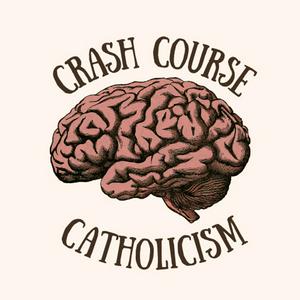
Catholicism can seem overwhelming, but it doesn't have to be.
Crash Course Catholicism breaks down the beliefs, traditions, and teachings of the Catholic Church in a way that's thoughtful, accessible, and engaging. The first 50 episodes of this podcast are a summary of the Catechism of the Catholic Church, while later episodes include deep dives into big questions about God, Scripture, Church history, the saints, morality, and the spiritual life. Our aim is to help you build a stronger understanding of the faith without requiring a theology degree.
Find out more: https://www.caitlinwest.com
Podcast websiteListen to Crash Course Catholicism, The Bible in a Year (with Fr. Mike Schmitz) and many other podcasts from around the world with the radio.net app
Get the free radio.net app
- Stations and podcasts to bookmark
- Stream via Wi-Fi or Bluetooth
- Supports Carplay & Android Auto
- Many other app features
Get the free radio.net app
- Stations and podcasts to bookmark
- Stream via Wi-Fi or Bluetooth
- Supports Carplay & Android Auto
- Many other app features
Crash Course Catholicism
Scan code,
download the app,
start listening.
download the app,
start listening.
 Ireland

