
Listen to this podcast in the app for free: Download for free in the App Store
radio.net
Sleep timer
Save favourites
210 episodes
Did Jesus Believe in Ghosts?
20/10/2026 | 46 mins.The Bible's world is crowded and unsystematic: ghosts, familiar spirits, demons that cause illness, and the dead who can be summoned. And at times, this world breaks through in ways modern readers don't always appreciate. When the disciples see Jesus walking on the water, their first thought is that he's a ghost. After the resurrection, Jesus has to reassure them he isn't one. King Saul has a medium call the prophet Samuel up from the dead, and it works.
So what happened to all those ghosts? Bart joins host Megan Lewis to explore the haunted world the Bible was written in, and how later Christians tidied it into a neater system of angels and demons, heaven and hell. Along the way: why demons were blamed for illness, why Jesus was accused of sorcery, and why believing in angels but not ghosts turns out to be a choice Christians made, not one the Bible made for them.Where Did Original Sin Come From?
13/10/2026 | 43 mins.Most Christians grow up believing that everyone is born a sinner, that when Adam and Eve ate the fruit, humanity inherited a broken nature and a guilt we can't escape. It's one of the most influential ideas in Western Christianity. But it isn't in Genesis, Jesus never taught it, and it didn't take its familiar form until four centuries after him.
Bart joins host Megan Lewis to trace where original sin actually came from: what the Garden of Eden story says and doesn't say, what Paul meant when he wrote that sin came into the world through one man, and how Augustine turned that line into a doctrine about every human being from the moment of conception. Along the way, why Eastern Orthodox Christians never fully accepted it, and what changes when you realize this belief has a history.How Apologists Use (and Misuse) Manuscripts
06/10/2026 | 56 mins.Do manuscripts prove the Bible never changed? Some Christian apologists have argued that the Great Isaiah scroll (1QIsaa) is proof of an unchanging Bible, that it's "Word for Word" identical to the later Masoretic Text. Some have argued that P52 – a small fragment of John's gospel – shows that eyewitnesses quickly wrote down gospels. In a debate with Bart a decade back, Daniel Wallace even referenced a first century Gospel of Mark, that turned out to be a stolen manuscript that was eventually dated much later. For some modern Christians and apologists, manuscripts are "proof" of something... that the Bible is unchanging or perhaps inerrant. But can that claim hold up?
In this episode, Bart unpacks what manuscripts do and don't prove, and the challenges they raise for people who want to argue for an unchanging Bible.Was Daniel Jesus' Favorite Book?
29/09/2026 | 41 mins.The Book of Daniel is set in the sixth century BCE, during the Babylonian exile. It describes visions of empires rising and falling — and for a long stretch, the sequence tracks real history with remarkable precision. Kingdom after kingdom, exactly as it happened.
Then, at a certain point, it stops being right.
That break is one of the most important pieces of evidence. Bart joins host Megan Lewis to explain what Daniel gets right, where it goes wrong, and why the exact point of failure tells us when the book was really written. And Bart will talk about how this book and its ideas may have shaped Jesus' thinking.The KJV is a Literary Masterpiece, and a Disaster Study Bible
22/09/2026 | 44 mins.The King James Bible is arguably the most influential book in the English language, and Bart thinks it's a literary masterpiece. He also thinks it's one of the worst Bibles you can study from.
In this episode of Misquoting Jesus, Bart and host Megan Lewis trace where the KJV came from, starting with William Tyndale, whose translation it largely reuses and who was burned at the stake for making it. They look at why its unicorns and cockatrices trip up modern readers, and why the words you think you understand, like "conversation," "strange," and "admiration," are more misleading than the ones you don't. They cover the theological choices its translators made, the late Greek manuscripts behind its New Testament, and a 1631 printing that told readers "thou shalt commit adultery." Bart also shares which modern translations he recommends instead.
In the listener Q&A: where the doctrine of original sin came from, whether early Christians evangelized door to door, and what Jesus meant about eunuchs in Matthew 19:12.
More Christianity podcasts


Trending Christianity podcasts



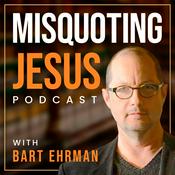
About Misquoting Jesus with Bart Ehrman
"Misquoting Jesus" is the only show where a six-time New York Times bestselling author and world-renowned Bible scholar uncovers the many fascinating, little known facts about the New Testament, the historical Jesus, and the rise of Christianity. The show features Dr. Bart Ehrman and host, Megan Lewis.
Podcast websiteListen to Misquoting Jesus with Bart Ehrman, Culture Wars Podcast and many other podcasts from around the world with the radio.net app
Get the free radio.net app
- Stations and podcasts to bookmark
- Stream via Wi-Fi or Bluetooth
- Supports Carplay & Android Auto
- Many other app features
Get the free radio.net app
- Stations and podcasts to bookmark
- Stream via Wi-Fi or Bluetooth
- Supports Carplay & Android Auto
- Many other app features

Misquoting Jesus with Bart Ehrman
Scan code,
download the app,
start listening.
download the app,
start listening.
 Ireland

