
Listen to this podcast in the app for free: Download for free in the App Store
radio.net
Sleep timer
Save favourites
194 episodes
Chad and James Hampton: Hunting for Purpose
22/10/2026 | 27 mins.On this episode of The Bandwich Tapes, I sit down with twin brothers Chad and James Hampton, founders of Huntin’ the Truth Ministries, pastors, outdoorsmen, authors, and hosts of Twin Factor. Their work brings together faith, hunting, mentorship, and a simple question that has become central to their ministry: What are you hunting for?
Chad and James grew up hunting with their father, beginning with bow hunting when they were seven years old. What started as a shared love of the outdoors eventually became the foundation for Huntin’ the Truth Ministries in 2004. We talk about how they began using hunting as a way to connect with people, share their faith, and mentor young people—including kids growing up without fathers and children with disabilities.
We also spend time discussing their new devotional, 100 Days of Strength for Hunters. Chad and James explain why they believe everyone is hunting for something, whether or not they ever step into the woods. The devotional encourages readers to slow down, spend time with God, and think intentionally about what they are pursuing and where that pursuit is leading them.
Our conversation also gets into the challenges facing young people in a world increasingly dominated by technology, social media, and constant distraction. Chad and James share why they return to the biblical story of Solomon as an example of the difference between pursuing things that appear fulfilling and pursuing a life grounded in purpose, faith, and relationships.
Finally, we talk about what it has meant to spend their lives working together as twins. They share how their different strengths complement one another, how they have supported each other through difficult seasons, and why living out the principles they teach matters more than simply talking about them. We also discuss Twin Factor, their work with Gold Star families, and their upcoming talk show, What Do You Hunt For with the Twins?
Key Takeaways
• Chad and James began hunting with their father at seven years old, long before they realized the outdoors would eventually become central to their ministry.
• Huntin’ the Truth Ministries began in 2004 with a vision of using hunting and the outdoors as a way to share their faith, build relationships, and mentor others.
• Their devotional, 100 Days of Strength for Hunters, is built around the idea that everyone is pursuing something and encourages readers to intentionally consider what they are “hunting” for in life.
• Mentoring young people, particularly those without strong father figures in their lives, has been an important part of Chad and James’ work from the beginning.
• Through Twin Factor, the brothers have used television as an extension of their ministry, including helping create hunting experiences for Gold Star children who lost fathers on active duty.
• Chad and James see their twin relationship as both a source of accountability and a partnership in which their different strengths allow them to accomplish more together.
• Difficult seasons in their own lives have challenged them to live out the same lessons about faith, perseverance, and endurance that they share with others.
Theme music: "Playcation" by Mark Mundy
About the Podcast
The Bandwich Tapes is a podcast about music, creativity, and the people behind the work, but the conversations often reach beyond music into the experiences, relationships, and ideas that shape our lives. I sit down with musicians, songwriters, artists, authors, and other guests for thoughtful conversations about their work, their stories, and what they have learned along the way.
Connect with the Show
contact@thebandwichtapes.comJames Woods: The Killer’s Wife – Inside the Songs (Part Two)
22/10/2026 | 55 mins.Episode Summary
On this episode of The Bandwich Tapes, I'm joined once again by actor, writer, and songwriter James Woods for the second installment of our three-part conversation about his new album, The Killer's Wife. After exploring James's transition into songwriting and the beginnings of this remarkable project in our first conversation, we return to take a closer look at the music itself, the stories behind the songs, and the creative partnership that brought the album to life.
James takes us inside his collaboration with songwriter and musician Bob Wayne and Grammy-winning producer Shooter Jennings. We discuss how James's lyrics become the foundation for Bob's compositions, how Shooter approaches the recording process, and why the three have developed such a strong creative relationship. James also shares stories from the sessions at Sunset Sound, the musicians who helped shape the record, and the importance of allowing a song to develop naturally rather than forcing it into a predetermined structure.
Much of our conversation focuses on the cinematic nature of The Killer's Wife. James explains how the album gradually developed into a larger narrative built around a fictional radio broadcast and tent revival, with themes of good and evil, faith, violence, redemption, and hope. We explore the origins of "I Am the Blazing Sun" and "Hearts of Men," two songs that eventually became the album's musical and thematic bookends, and how an unexpected creative breakthrough helped bring the entire concept together.
We also dig into the songwriting itself, including "Shadows of the Past," "Early Ripe, Early Rotten," "The Killer's Wife," and "Harm's Way." James shares how personal memories, literature, mythology, film, and even something as simple as a street sign can become the starting point for a song. He explains why a single word can transform a lyric, how he decides what to reveal to the listener, and why he's willing to let the music reshape the structure of his writing.
What I enjoyed most about this conversation was hearing James examine his own creative process, sometimes discovering connections and influences he hadn't consciously considered while writing. It's a fascinating look at an artist finding a new form of expression, and at a group of collaborators who trust one another enough to take creative risks.
This is part two of our three-part series with James Woods. We'll continue our exploration of The Killer's Wife in the next episode, going further into the songs, the production, and the stories behind the album.
Key Takeaways
A different kind of creative expression: James discusses how writing lyrics differs from acting and how songwriting has allowed him to explore personal memories, emotions, and experiences in ways he hadn't anticipated.
The partnership with Bob Wayne and Shooter Jennings: James explains how his lyrics inspire Bob's compositions, how Shooter brings his instincts as a producer to the recording process, and why trust and creative freedom are essential to their collaboration.
Building a cinematic concept album: The Killer's Wife evolved into a larger narrative framed by a fictional radio broadcast and tent revival, connecting individual songs through themes of good, evil, redemption, and hope.
The origins of "I Am the Blazing Sun" and "Hearts of Men": Written at different points in the creative process, these songs eventually became the album's opening and closing statements, giving the project its larger thematic structure.
Writing from experience and imagination: From the personal reflections of "Shadows of the Past" to the darker storytelling of "Early Ripe, Early Rotten," James explores how lived experiences, literary influences, and fictional narratives inform his lyrics.
The power of a single word: James explains how changing a lyric from "bodies" to "secrets" in "The Killer's Wife" transformed a literal description into something more poetic and evocative.
Authenticity over perfection: James discusses the importance of preserving the human element in recordings, embracing spontaneous performances, and allowing the musicians to bring their individual personalities to the music.
Music from the Episode
The Hearts of Men - James Woods
The Killer's Wife - James Woods
Shadows of the Past - James Woods
Harm's Way - James Woods
About the Podcast
The Bandwich Tapes is a music interview podcast hosted by musician Brad Williams. Each episode features conversations with musicians, songwriters, producers, and artists about their careers, creative processes, musical influences, and the experiences that shape their work. Through thoughtful, musician-to-musician conversations, the show explores not just the music people make, but how and why they make it.
Connect with the Show
Have a question, comment, or guest suggestion?
contact@thebandwichtapes.comOz Noy: Clarity, Groove, and Finding Your Own Sound
19/10/2026 | 37 mins.On this episode of The Bandwich Tapes, I sit down with guitarist Oz Noy for a conversation about the musical path he has built over three decades in New York, the players who have helped shape his music, and why clarity and groove remain at the center of his approach.
Oz talks about arriving in New York after already establishing himself as a working musician in Israel. Interestingly, becoming a solo artist was never really the plan. He simply wanted to play well, work with great musicians, and get gigs. His regular performances at the Bitter End gradually became a laboratory for developing his own music, eventually leading to recordings and a career as a bandleader.
We also get into Oz's fascination with great rhythm sections and the remarkable drummers he has worked with over the years, including Keith Carlock, Dave Weckl, Vinnie Colaiuta, Dennis Chambers, Anton Fig, and others. Oz's music has always been rooted in groove, and he talks about how moving to New York put him in the orbit of many of the musicians he had admired.
Oz also discusses his approach to practicing, improvisation, and teaching, along with his new instructional book on triad comping. For Oz, complexity isn't necessarily the goal. He is drawn to musical ideas that are clear and focused—whether that's an improvised line, a chord voicing, or an entire composition.
We finish by talking about his growing interest in the organ trio format, an upcoming organ trio album planned for 2027, and his loose, collaborative project with Joe Bonamassa, Will Lee, and Steve Ferrone. It's a conversation about developing a voice over time, finding the right musicians, and allowing musical ideas to evolve naturally.
Key Takeaways
• Oz never initially set out to become a solo artist. His career as a bandleader grew organically from playing his own gigs after moving to New York.
• His regular performances at the Bitter End became an important laboratory for developing his compositions, sound, and musical identity.
• Groove is central to Oz's music, which has led to long-running collaborations with drummers including Keith Carlock, Dave Weckl, Vinnie Colaiuta, Dennis Chambers, and Anton Fig.
• Oz believes musical ideas need time to develop. Concepts often have to "marinate" before they become a natural part of a musician's playing.
• His approach to triads and comping reflects a larger musical philosophy: clarity can often be more effective than density or unnecessary complexity.
• Hearing The Beatles helped ignite Oz's interest in electric guitar, while seeing the Pat Metheny Group's Still Life (Talking) tour in Israel became a life-changing musical experience.
• Oz's current interest in organ trio playing has opened up a different musical space, giving him another improvising voice in the band while changing the overall texture and feel of the music.
Music from the Episode
Get Down - Oz Noy
Solar - Oz Noy
All the Things You Are - Oz Noy
Zig Zag - Oz Noy
About the Podcast
The Bandwich Tapes is a podcast about the people who make music and the experiences that shape them. Hosted by musician Brad Williams, the show features conversations with artists, songwriters, producers, engineers, and other creative voices about their careers, influences, collaborations, creative process, and the craft behind the music.
Connect with the Show
Questions, comments, or guest suggestions?
contact@thebandwichtapes.comEthan Setiawan: Finding the Groove in Little Storms
15/10/2026 | 33 mins.On this episode of The Bandwich Tapes, I sit down with mandolinist, singer, and recording engineer Ethan Setiawan to talk about his new album, Little Storms, and the musical relationships that have shaped the band behind it. Ethan talks about meeting his bandmates during his years in Boston and why chemistry, listening, and simply getting along can be every bit as important as technical ability when putting a group together.
We also trace Ethan’s path on the mandolin, from learning bluegrass and old-time music as a young player to winning the National Mandolin Championship at seventeen. He reflects on the value of competitions as developmental milestones, the communal nature of bluegrass festivals, and the musicians who helped expand his idea of what the mandolin could do, including Mike Marshall and Jacob Jolliff.
Ethan takes me inside the making of Encyclopedia Mandolinica, his collection of mandolin duets and trios, and explains what recording with different players taught him about working efficiently in the studio. We also talk about his experience as an engineer and mixer, the importance of stepping away from a project to regain perspective, and the value of working with an engineer you trust.
With Little Storms, Ethan has also stepped more fully into the role of lead singer. We talk about recording the band live in a room together, the concentration required to sing and play mandolin simultaneously, and why he is particularly proud of the way his vocals and the ensemble came together on the record.
Along the way, we discuss Ethan’s years at Berklee, the changing realities of building a career as an independent musician, and the tension between music that develops slowly and a social media culture built around short-form content. For Ethan, the heart of it still comes back to playing live, listening closely, and making music with people he trusts.
Key Takeaways
• Ethan believes a successful band depends heavily on chemistry, listening, and the ability of musicians to adapt to one another—not simply individual technical ability.
• Bluegrass and old-time music were Ethan’s entry points into the mandolin, and after exploring jazz and other styles, he has increasingly returned to those roots.
• Winning the National Mandolin Championship at seventeen gave Ethan a valuable developmental benchmark, although he sees competition as very different from the collaborative spirit of making music.
• Mike Marshall has been a major influence on Ethan because of his ability to move naturally between bluegrass, jazz, Brazilian choro, and other musical traditions.
• Recording Encyclopedia Mandolinica taught Ethan how to enter a studio, focus quickly, and create strong performances within relatively short sessions.
• Ethan’s engineering experience has helped him make records more independently, while also teaching him the importance of leaving time between recording, editing, and mixing to regain perspective.
• On Little Storms, Ethan challenged himself to sing lead while playing mandolin live with the band, an experience that changed how he thinks about simplicity, concentration, and serving the music.
Music from the Episode
I Didn't Try Hard Enough - Ethan Setiawan
The Harbor Walk - Ethan Setiawan
Whiskey Boys - Ethan Setiawan
About the Podcast
The Bandwich Tapes is a music interview podcast hosted by Brad Williams featuring conversations with musicians, songwriters, producers, and other creative artists. Each episode explores the experiences behind the music—from influences and collaboration to technique, creativity, recording, touring, and the lifelong process of becoming a better musician.
Connect with the Show
contact@thebandwichtapes.comHeavy Diamond Ring: Let Love Be Enough
15/10/2026 | 38 mins.On this episode of The Bandwich Tapes, I sit down with Sarah Anderson and Paul DeHaven of Heavy Diamond Ring for a conversation about a musical partnership that has lasted more than two decades, the evolution of their approach to making records, and the band’s new EP, Let Love Be Enough.
Sarah and Paul first met when they were young musicians in Colorado and quickly began making music together. Their partnership eventually led to more than a decade in Paper Bird and, later, Heavy Diamond Ring. We talk about what allows a musical relationship to survive that long, why friendship and humor matter as much as musicianship, and how Heavy Diamond Ring developed into a band where listening to one another is more important than filling every available space.
That idea of space becomes a big part of our conversation. Paul talks about moving away from a more cerebral approach to playing and becoming increasingly interested in restraint, feel, and music that creates a place for the listener to inhabit. Sarah describes a similar evolution, from wanting to fill every space and make everything perfect to realizing that sometimes the most powerful thing a band can do is simply let a song breathe.
We also dig into the making of Let Love Be Enough, which began when the band took advantage of some extra time on tour in Minnesota and decided to experiment with recording away from their usual environment. That experience eventually brought them back to Minnesota to finish the EP, giving the band a chance to rethink some of its usual studio habits. Sarah talks about gaining confidence as a singer in a different recording environment, while Paul discusses the creative value of limitations and treating each record as a snapshot of who the band is at that particular moment.
Throughout the conversation, we keep returning to the idea of capturing something human. Sarah and Paul talk about imperfection, live performance, musical communication, and why a record doesn’t have to be polished into perfection to be right. We also discuss Sarah’s vocal influences, including Dolly Parton, Joni Mitchell, Fleetwood Mac, and Courtney Marie Andrews, the band’s connection to the sounds of the 1970s, and why Heavy Diamond Ring ultimately wants its records to sound and feel like people making music together.
Key Takeaways
• Sarah Anderson and Paul DeHaven have been making music together for more than two decades, beginning when they were young musicians in Colorado and continuing through Paper Bird and Heavy Diamond Ring.
• Friendship, communication, and humor have been essential to their musical partnership and to the chemistry of Heavy Diamond Ring.
• The band has gradually moved toward a more spacious approach to arranging, where restraint, listening, and knowing when not to play are as important as the notes themselves.
• Let Love Be Enough began during a tour stop in Minnesota, giving Heavy Diamond Ring an opportunity to experiment with recording away from its usual studio environment.
• Sarah found that working in a different studio and without the familiarity of recording with her brother helped build her confidence as a vocalist.
• The band increasingly views recording as capturing a moment rather than creating a definitive, perfect version of a song. Imperfection can preserve the humanity and communication of musicians playing together.
• Heavy Diamond Ring draws inspiration from the feel and sound of classic recordings while keeping the focus on songs, dynamics, collaboration, and the musical relationship between the players.
Music from the Episode
The One You Use - Heavy Diamond Ring
Problems Got Problems - Heavy Diamond Ring
Whatever You Need - Heavy Diamond Ring
About the Podcast
The Bandwich Tapes is a podcast about music, the people who make it, and the experiences that shape their creative lives. I sit down with musicians, songwriters, producers, and other artists for thoughtful conversations about craft, collaboration, careers, influences, and the stories behind the music.
Connect with the Show
contact@thebandwichtapes.com
More Music podcasts





Trending Music podcasts












About The Bandwich Tapes
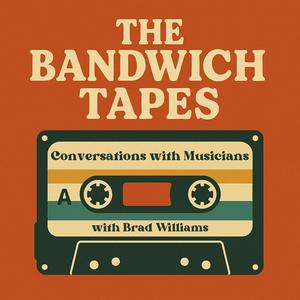
The Bandwich Tapes is a podcast where host Brad Williams sits down with musicians for thoughtful conversations about the craft of making music.
Each episode explores the experiences, influences, and creative decisions that shape an artist’s work. From improvisation and songwriting to collaboration, recording, and life on the road, the conversations go beyond biography to focus on how music actually gets made.
Guests include instrumentalists, composers, songwriters, and producers from across the musical landscape. The tone is relaxed, curious, and musician-to-musician—an opportunity to hear artists reflect on their process, their collaborators, and the musical moments that have stayed with them.
Whether you're a seasoned musician, a die-hard music fan, or simply someone who loves a good story, The Bandwich Tapes has something for everyone. So, come along for the ride as we explore the magic of music and the incredible journeys of the people who bring it to life.
Podcast websiteListen to The Bandwich Tapes, Word In Your Ear and many other podcasts from around the world with the radio.net app
Get the free radio.net app
- Stations and podcasts to bookmark
- Stream via Wi-Fi or Bluetooth
- Supports Carplay & Android Auto
- Many other app features
Get the free radio.net app
- Stations and podcasts to bookmark
- Stream via Wi-Fi or Bluetooth
- Supports Carplay & Android Auto
- Many other app features
The Bandwich Tapes
Scan code,
download the app,
start listening.
download the app,
start listening.
The Bandwich Tapes: Podcasts in Family
 Ireland