
Listen to this podcast in the app for free: Download for free in the App Store
radio.net
Sleep timer
Save favourites
134 episodes
Episode 130 - Bringing intelligence to the future of construction
22/10/2026 | 35 mins.In this episode, we explore how artificial intelligence is beginning to change the way buildings are designed, engineered, and permitted. We're joined by Maor Greenberg, co-founder and CEO of Spacial, a company developing AI-powered technology to automate engineering workflows and improve coordination across the building industry. We discuss how AI can help engineers move beyond traditional drawings and disconnected design software toward integrated building models that account for structural behavior, building codes, and other engineering disciplines.
We also explore the challenges of bringing AI into an industry where accuracy, safety, and professional responsibility are essential. From automating repetitive engineering tasks and identifying conflicts between building systems to understanding the role of licensed engineers in an increasingly automated design process, we discuss what this technology can realistically accomplish today and where it might take the profession in the future.
Guest Profile:
Maor Greenberg is the co-founder and CEO of Spacial, a technology company focused on AI-powered building design and engineering automation. With nearly two decades of experience in construction, architecture, and real estate development, Maor previously founded Greenberg Construction, Greenberg Design Gallery, and VRchitects. His experience delivering residential and commercial projects helped inspire Spacial's mission to simplify the process of turning architectural designs into coordinated, permit-ready construction documents.
Links & Resources:
Spacial Technology: spacial.io/tech
structurEd (our free PE/SE study tool): TheEngineeringPodcast.com/structurEd
Reach out to us:
TheEngineeringPodcast.com
Instagram
Linkedin
Disclaimer: HereEpisode 129 - Restarting the World's Tallest Building
14/10/2026 | 58 mins.In this episode, we go inside the engineering and restart of Jeddah Tower, the megaproject designed to become the world's tallest building. We explore the structural systems behind the tower, what it takes for an engineer to step into a project of this scale, and the challenges of continuing a design that began years earlier.
We also discuss what happens when construction on a megaproject stops for years and then starts again. From evaluating the partially completed structure and reviewing original design assumptions to considering changes in codes, technology, and construction practices, we explore the engineering required to get Jeddah Tower rising again—and what engineers can learn from one of the most ambitious structural projects in the world.
Guest Profile:
John Stark, EIT, M.Eng., is a structural engineer with Thornton Tomasetti in Chicago, where he works on complex tall-building design and construction. He earned his master's degree in structural engineering from MIT, with a focus on tall buildings, structural dynamics, and computational design. John is currently part of the structural engineering team working on Jeddah Tower, contributing to ongoing design updates and construction-phase engineering as the project continues toward becoming the world's first kilometer-tall building.
Links & Resources:
structurEd (our free PE/SE study tool): TheEngineeringPodcast.com/structurEd
Reach out to us:
TheEngineeringPodcast.com
Instagram
Linkedin
Disclaimer: HereEpisode 128 - Casting the Impossible: Rethinking Steel Connections
07/10/2026 | 1h 4 mins.In this episode, we explore how cast steel is changing what's possible in structural connection design. We discuss the origins of CAST CONNEX, why traditional fabrication methods can struggle with complex connection geometries, and how casting can provide new opportunities for structural performance, constructability, and architectural expression.
We also break down how cast steel connections are designed and manufactured, the differences between casting and forging, and where technologies like machining and 3D printing fit into the process. Finally, we go inside the engineering of the Sphere in Las Vegas to explore how cast steel helped solve some of the project's most complex structural connection challenges.
Guest Profile:
Carlos de Oliveira, M.A.Sc., P.Eng., is the co-founder and CEO of CAST CONNEX and a recognized expert in the design and use of steel castings in building construction. The company grew out of Carlos's graduate research at the University of Toronto, where he explored using cast steel to improve structural connections, particularly for seismic applications. Today, CAST CONNEX provides standardized and custom cast steel connections for complex structures around the world, including the Sphere in Las Vegas. Carlos has received numerous awards for engineering innovation and entrepreneurship throughout his career.
Michael Gray, Ph.D., P.Eng., is the co-founder and Executive Vice President of CAST CONNEX. He earned both his bachelor's degree and Ph.D. in structural engineering from the University of Toronto, where his doctoral research focused on cast steel yielding elements for high-ductility structural systems. Michael specializes in nonlinear finite element analysis, seismic design, steel behavior, and complex connection design, and has helped advance the use of cast steel components on major projects around the world, including the Sphere in Las Vegas.
Links & Resources:
structurEd (our free PE/SE study tool): TheEngineeringPodcast.com/structurEd
Reach out to us:
TheEngineeringPodcast.com
Instagram
Linkedin
Disclaimer: HereEpisode 127 - What If Wood Could Flow?
30/09/2026 | 41 mins.What if structural timber could be shaped to put material exactly where it's needed? In this episode, we sit down with the team from Strong by Form to explore Woodflow, a new approach to engineered timber that combines material efficiency, structural performance, and advanced manufacturing.
We break down how Woodflow is formed, how strand length and wood grade influence its behavior, and how it compares with established mass timber products. We also get into the engineering: strength and stiffness, weight, failure modes, durability, connections, field modifications, and the testing required to bring a new structural system to market. From current applications and code approval to manufacturing scale, embodied carbon, cost, and future research, this conversation looks at what it takes to move an emerging timber technology from the lab into real structures.
Guest Profile:
Jorge Christie is the co-founder and Chief Product Officer of Strong by Form, where he leads the development of Woodflow, a biomimetic engineered-wood technology that combines computational design, material optimization, and advanced manufacturing. An architect with advanced degrees in computational design and digital fabrication from the University of Stuttgart and ETH Zurich, Jorge's work focuses on translating the structural efficiency found in nature into high-performance timber products for construction and other industries.
Links & Resources:
structurEd (our free PE/SE study tool): TheEngineeringPodcast.com/structurEd
https://strongbyform.com/
https://strongbyform.com/woodflow-core
https://www.youtube.com/watch?v=casNqN2u
Reach out to us:
TheEngineeringPodcast.com
Instagram
Linkedin
Disclaimer: HereEpisode 126 - Your Design Works… But Can It Be Built?
23/09/2026 | 1h 6 mins.In this episode, we step outside the design office to explore what structural engineers often get wrong about construction. We discuss the disconnect between design intent and what actually happens in the field from constructability and tolerances to sequencing, temporary conditions, and coordination.
We also look at the details engineers tend to overcomplicate, the information contractors wish they had on structural drawings, and what makes an RFI response actually useful. Through real-world lessons from the field, we explore how understanding construction can help structural engineers design better, communicate more effectively, and ultimately deliver more successful projects.
Guest Profile:
Sergio Ortiz is a Senior Project Manager at Fransen Pittman Construction with extensive experience managing complex construction projects throughout Colorado and beyond. His portfolio includes schools, healthcare facilities, fire stations, commercial developments, historic renovations, and major additions to existing buildings. Sergio brings a field-focused perspective on constructability, coordination, sequencing, and the challenges that arise when structural designs move from drawings to reality.
Links & Resources:
structurEd (our free PE/SE study tool): TheEngineeringPodcast.com/structurEd
Reach out to us:
TheEngineeringPodcast.com
Instagram
Linkedin
Disclaimer: Here
More Courses podcasts







Trending Courses podcasts






About The Structural Engineering Podcast
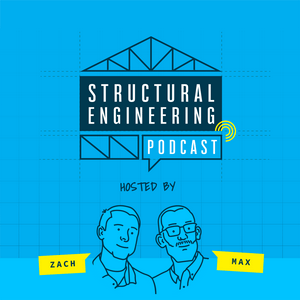
Hosted by Max and Zach, The Structural Engineering Podcast dives into the world of structural design, real-world engineering challenges, and the stories behind the structures that shape our world. Whether you're a practicing engineer, an aspiring student, or just curious about how buildings stand tall, tune in for expert insights, industry interviews, and relatable experiences from the field.
Podcast websiteListen to The Structural Engineering Podcast, The Learning Scientists Podcast and many other podcasts from around the world with the radio.net app
Get the free radio.net app
- Stations and podcasts to bookmark
- Stream via Wi-Fi or Bluetooth
- Supports Carplay & Android Auto
- Many other app features
Get the free radio.net app
- Stations and podcasts to bookmark
- Stream via Wi-Fi or Bluetooth
- Supports Carplay & Android Auto
- Many other app features
The Structural Engineering Podcast
Scan code,
download the app,
start listening.
download the app,
start listening.
The Structural Engineering Podcast: Podcasts in Family
 Ireland
