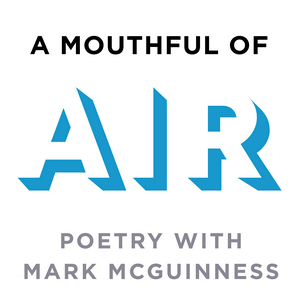
PodcastsArtsA Mouthful of Air: Poetry with Mark McGuinness

A Mouthful of Air: Poetry with Mark McGuinness

Mark McGuinness
A Mouthful of Air: Poetry with Mark McGuinness
Latest episode

87 episodes

  • A Mouthful of Air: Poetry with Mark McGuinness

    Dover Beach by Matthew Arnold

    22/12/2025 | 34 mins.

    Episode 87 Dover Beach by Matthew Arnold Mark McGuinness reads and discusses ‘Dover Beach’ by Matthew Arnold. https://media.blubrry.com/amouthfulofair/media.blubrry.com/amouthfulofair/content.blubrry.com/amouthfulofair/87_Dover_Beach_by_Matthew_Arnold.mp3 Poet Matthew Arnold Reading and commentary by Mark McGuinness Dover Beach By Matthew Arnold The sea is calm tonight.The tide is full, the moon lies fairUpon the straits; on the French coast the lightGleams and is gone; the cliffs of England stand,Glimmering and vast, out in the tranquil bay.Come to the window, sweet is the night-air!Only, from the long line of sprayWhere the sea meets the moon-blanched land,Listen! you hear the grating roarOf pebbles which the waves draw back, and fling,At their return, up the high strand,Begin, and cease, and then again begin,With tremulous cadence slow, and bringThe eternal note of sadness in. Sophocles long agoHeard it on the Aegean, and it broughtInto his mind the turbid ebb and flowOf human misery; weFind also in the sound a thought,Hearing it by this distant northern sea. The Sea of FaithWas once, too, at the full, and round earth’s shoreLay like the folds of a bright girdle furled.But now I only hearIts melancholy, long, withdrawing roar,Retreating, to the breathOf the night-wind, down the vast edges drearAnd naked shingles of the world. Ah, love, let us be trueTo one another! for the world, which seemsTo lie before us like a land of dreams,So various, so beautiful, so new,Hath really neither joy, nor love, nor light,Nor certitude, nor peace, nor help for pain;And we are here as on a darkling plainSwept with confused alarms of struggle and flight,Where ignorant armies clash by night. Podcast Transcript This is a magnificent and haunting poem by Matthew Arnold, an eminent Victorian poet. Written and published at the mid-point of the nineteenth century – it was probably written around 1851 and published in 1867 – it is not only a shining example of Victorian poetry at its best, but it also, and not coincidentally, embodies some of the central preoccupations of the Victorian age. The basic scenario is very simple: a man is looking out at the sea at night and thinking deep thoughts. It’s something that we’ve all done, isn’t it? The two tend to go hand-in-hand. When you’re looking out into the darkness, listening to the sound of the sea, it’s hard not to be thinking deep thoughts. If you’ve been a long time listener to this podcast, it may remind you of another poet who wrote about standing on the shore thinking deep thoughts, looking at the sea, Shakespeare, in his Sonnet 60: Like as the waves make towards the pebbled shore,So do our minutes hasten to their end; Arnold’s poem is not a sonnet but a poem in four verse paragraphs. They’re not stanzas, because they’re not regular, but if you look at the text on the website, you can clearly see it’s divided into four sections. The first part is a description of the sea, as seen from Dover Beach, which is on the shore of the narrowest part of the English channel, making it the closest part of England to France: The sea is calm tonight.The tide is full, the moon lies fairUpon the straits; – on the French coast the lightGleams and is gone; the cliffs of England stand,Glimmering and vast, out in the tranquil bay. And as you can hear, the poem has a pretty regular and conventional rhythm, based on iambic metre, ti TUM, with the second syllable taking the stress in every metrical unit. But what’s slightly unusual is that the lines have varying lengths. By the time we get to the third line: Upon the straits; – on the French coast the light There are five beats. There’s a bit of variation in the middle of the line, but it’s very recognisable as classic iambic pentameter, which has a baseline pattern going ti TUM, ti TUM, ti TUM, ti TUM, ti TUM. But before we get to the pentameter, we get two short lines: The sea is calm tonight.Only three beats; andThe tide is full, the moon lies fair – four beats. We also start to notice the rhymes: ‘tonight’ and ‘light’. And we have an absolutely delightful enjambment, where a phrase spills over the end of one line into the next one: On the French coast the light,Gleams and is gone. Isn’t that just fantastic? The light flashes out like a little surprise at the start of the line, just as it’s a little surprise for the speaker looking out to sea. OK, once he’s set the scene, he makes an invitation: Come to the window, sweet is the night-air! So if there’s a window, he must be in a room. There’s somebody in the room with him, and given that it’s night it could well be a bedroom. So this person could be a lover. It’s quite likely that this poem was written on Arnold’s honeymoon, which would obviously fit this scenario. But anyway, he’s inviting this person to come to the window and listen. And what does this person hear? Well, helpfully, the speaker tells us: Listen! you hear the grating roarOf pebbles which the waves draw back, and fling,At their return, up the high strand,Begin, and cease, and then again begin,With tremulous cadence slow, and bringThe eternal note of sadness in. Isn’t that just great? The iambic metre is continuing with some more variations, which we needn’t go into. And the rhyme is coming more and more to the fore. Just about every line in this section rhymes with another line, but it doesn’t have a regular pattern. Some of the rhymes are close together, some are further apart. There’s only one line in this paragraph that doesn’t rhyme, and that’s ‘Listen! You hear the grating roar’. If this kind of shifting rhyme pattern reminds you of something you’ve heard before, you may be thinking all the way back to Episode 34 where we looked at Coleridge’s use of floating rhymes in his magical poem ‘Kubla Khan’. And it’s pretty evident that Arnold is also casting a spell, in this case to mimic the rhythm of the waves coming in and going out, as they ‘Begin, and cease, and then again begin,’. And then the wonderful last line of the paragraph, as the waves ‘bring / The eternal note of sadness in’. You know, in the heart of the Victorian Age, when the Romantics were still within living memory, poets were still allowed to do that kind of thing. Try it nowadays of course, and the Poetry Police will be round to kick your front door in at 5am and arrest you. Anyway. The next paragraph is a bit of a jump cut: Sophocles long agoHeard it on the Aegean, and it broughtInto his mind the turbid ebb and flowOf human misery; So Arnold, a classical scholar, is letting us know he knows who Sophocles, the ancient Greek playwright was. And he’s establishing a continuity across time of people looking out at the sea and thinking these deep thoughts. At this point, Arnold explicitly links the sea and the thinking:                                     weFind also in the sound a thought,Hearing it by this distant northern sea. And the thought that we hear when we listen to the waves is what Arnold announces in the next verse paragraph, and he announces it with capital letters: The Sea of FaithWas once, too, at the full, and round earth’s shoreLay like the folds of a bright girdle furled. And for a modern reader, I think this is the point of greatest peril for Arnold, where he’s most at risk of losing us. We may be okay with ‘the eternal note of sadness’, but as soon as he starts giving us the Sea of Faith, we start to brace ourselves. Is this going to turn into a horrible religious allegory, like The Pilgrim’s Progress? I mean, it’s a short step from the Sea of Faith to the Slough of Despond and the City of Destruction. And it doesn’t help that Arnold uses the awkwardly rhyming phrase ‘a bright girdle furled’ – that’s not going to get past the Poetry Police, is it? But fear not; Arnold doesn’t go there. What comes next is, I think, the best bit of the poem. So he says the Sea of Faith ‘was once, too, at the full’, and then: But now I only hearIts melancholy, long, withdrawing roar,Retreating, to the breathOf the night-wind, down the vast edges drearAnd naked shingles of the world. Well, if you thought the eternal note of sadness was great, this tops it! It’s absolutely fantastic. That line, ‘Its melancholy, long, withdrawing roar,’ where the ‘it’ is faith, the Sea of Faith. And the significance of the line is underlined by the fact that the word ‘roar’ is a repetition – remember, that one line in the first section that didn’t rhyme? Listen! you hear the grating roar See what Arnold did there? He left that sound hovering at the back of the mind, without a rhyme, until it came back in this section, a subtle but unmistakeable link between the ‘grating roar’ of the actual sea at Dover Beach, and the ‘withdrawing roar’ of the Sea of Faith: Its melancholy, long, withdrawing roar, Isn’t that the most Victorian line ever? It encapsulates the despair that accompanied the crisis of faith in 19th century England. This crisis was triggered by the advance of modern science – including the discoveries of fossils, evidence of mass extinction of previous species, and the theory of evolution, with Darwin’s Origin of Species published in 1859, in between the writing and publication of ‘Dover Beach’. Richard Holmes, in his wonderful new biography of the young Tennyson, compares this growing awareness of the nature of life on Earth to the modern anxiety over climate change. For the Victorians, he writes, it created a ‘deep and existential terror’. One thing that makes this passage so effective is that Arnold has already cast the spell in the first verse paragraph, hypnotising us with the rhythm and rhyme, and linking it to the movement of the waves. In the second paragraph, he says, ‘we find also in the sound a thought’. And then in the third paragraph, he tells us the thought. And the thought that he attaches to this movement, which we are by now emotionally invested in, is a thought of such horror and profundity – certainly for his Victorian readers – that the retreat of the sea of faith really does feel devastating. It leaves us gazing down at the naked shingles of the world. The speaker is now imaginatively out of the bedroom and down on the beach. This is very relatable; we’ve all stood on the beach and watched the waves withdrawing beneath our feet and the shingle being left there. It’s an incredibly vivid evocation of a pretty abstract concept. Then, in the fourth and final verse paragraph, comes a bit of a surprise: Ah, love, let us be trueTo one another! Well, I for one was not expecting that! From existential despair to an appeal to his beloved. What a delightful, romantic (with a small ‘r’) response to the big-picture, existential catastrophe. And for me, it’s another little echo of Shakespeare’s Sonnet 60, which opens with a poet contemplating the sea and the passing of time and feeling the temptation to despair, yet also ends with an appeal to the consolation of love: And yet to times in hope my verse shall stand,blockquotePraising thy worth, despite his cruel hand. Turning back to Arnold. He says ‘let us be true / To one another’. And then he links their situation to the existential catastrophe, and says this is precisely why they should be true to each other: for the world, which seemsTo lie before us like a land of dreams,So various, so beautiful, so new,Hath really neither joy, nor love, nor light,Nor certitude, nor peace, nor help for pain; It sounds, on the face of it, a pretty unlikely justification for being true to one another in a romantic sense. But actually, this is a very modern stance towards romantic love. It’s like the gleam of light that just flashed across the Channel from France – the idea of you and me against an unfeeling world, of love as redemption, or at least consolation, in a meaningless universe. In a world with ‘neither joy, nor love, nor light,’ our love becomes all the more poignant and important. Of course, we could easily object that, regardless of religious faith, the world does have joy and love and light. His very declaration of love is evidence of this. But let’s face it, we don’t always come to poets for logical consistency, do we? And we don’t have to agree with Matthew Arnold to find this passage moving; most of us have felt like this at some time when we’ve looked at the world in what feels like the cold light of reality. He evokes it so vividly and dramatically that I, for one, am quite prepared to go with him on this. Then we get the final three lines of the poem:We are here as on a darkling plainSwept with confused alarms of struggle and flight,Where ignorant armies clash by night. I don’t know about you, but I find this a little jarring in the light of what we’ve just heard. We’ve had the magnificent description of the sea and its effect on human thought, extending that into the idea of faith receding into illusion, and settling on human love as some kind of consolation for the loss of faith. So why do we need to be transported to a windswept plain where armies are clashing and struggling? It turns out to be another classical reference, to the Greek historian Thucydides’ account of the night battle of Epipolae, where the two armies were running around in the dark and some of them ended up fighting their own side in the confusion. I mean, fine, he’s a classical scholar. And obviously, it’s deeply meaningful to him. But to me, this feels a little bit bolted on. A lot of people love that ending, but to me, it’s is not as good as some of the earlier bits, or at least it doesn’t quite feel all of a piece with the imagery of the sea. But overall, it is a magnificent poem, and this is a small quibble. Stepping back, I want to have another look at the poem’s form, specifically the meter, and even more specifically, the irregularity of the meter, which is quite unusual and actually quite innovative for its time. As I’ve said, it’s in iambic meter, but it’s not strictly iambic pentameter. You may recall I did a mini series on the podcast a while ago looking at the evolution of blank verse, unrhymed iambic pentameter, from Christopher Marlowe and Shakespeare’s dramatic verse, then Milton’s Paradise Lost and finally Wordsworth’s Tintern Abbey. ‘Dover Beach’ is rhymed, so it’s not blank verse, but most of the techniques Arnold uses here are familiar from those other poets, with variations on the basic rhythm, sometimes switching the beats around, and using enjambment and caesura (a break or pause in the middle of the line). But, and – this is quite a big but – not every line has five beats. The lines get longer and shorter in an irregular pattern, apparently according to Arnold’s instinct. And this is pretty unusual, certainly for 1851. It’s not unique, we could point to bits of Tennyson or Arthur Hugh Clough for metrical experiments in a similar vein, but it’s certainly not common practice. And I looked into this, to see what the critics have said about it. And it turns out the scholars are divided. In one camp, the critics say that what Arnold is doing is firmly in the iambic pentameter tradition – it’s just one more variation on the pattern. But in the other camp are people who say, ‘No, this is something new; this is freer verse,’ and it is anticipating free verse, the non-metrical poetry with no set line lengths that came to be the dominant verse form of the 20th century. Personally, I think you can look back to Wordsworth and see a continuity with his poetic practice. But you could equally look forward, to a link with T. S. Eliot’s innovations in ‘The Love Song of J. Alfred Prufrock’ and The Waste Land. Eliot is often described as an innovator in free verse, which is true up to a point, but a lot of his writing in that early period isn’t strictly free verse; it’s a kind of broken up metrical verse, where he often uses an iambic metre with long and short lines, which he varies with great intuitive skill – in a similar manner to Arnold’s ‘Dover Beach’. Interestingly, when ‘Dover Beach’ was first published, the reviews didn’t really talk about the metre, which is ammunition for the people who say, ‘Well, this is just a kind of iambic pentameter’. Personally, I think what we have here is something like the well-known Duck-Rabbit illusion, where you can look at the same drawing and either see a duck or a rabbit, depending how you look at it. So from one angle, ‘Dover Beach’ is clearly continuing the iambic pentameter tradition; from another angle, it anticipates the innovations of free verse. We can draw a line from the regular iambic pentameter of Wordsworth (writing at the turn of the 18th and 19th century) to the fractured iambic verse of Eliot at the start of the 20th century. ‘Dover Beach’ is pretty well halfway between them, historically and poetically. And I don’t think this is just a dry technical development. There is something going on here in terms of the poet’s sense of order and disorder, faith and doubt. Wordsworth, in the regular unfolding of his blank verse, conveys his basic trust in an ordered and meaningful universe. Matthew Arnold is writing very explicitly about the breakup of faith, and we can start to see it in the breakup of the ordered iambic pentameter. By the time we get to the existential despair of Eliot’s Waste Land, the meter is really falling apart, like the Waste Land Eliot describes. So overall, I think we can appreciate what a finely balanced poem Arnold has written. It’s hard to categorise. You read it the first time and think, ‘Oh, right, another conventional Victorian melancholy lament’. But just when we think he’s about to go overboard with the Sea of Faith, he surprises us and with that magnificent central passage. And just as he’s about to give in to despair, we get that glimmering spark of love lighting up, and we think, ‘Well, maybe this is a romantic poem after all’. And maybe Arnold might look at me over his spectacles and patiently explain that actually, this is why that final metaphor of the clashing armies is exactly right. Friend and foe are running in first one direction, then another, inadvertently killing the people on the wrong side. So the simile gives us that sense of being caught in the cross-currents of a larger sweep of history. With all of that hovering in our mind, let’s go over to the window once more and heed his call to listen to the sound of the Victorian sea at Dover Beach. Dover Beach By Matthew Arnold The sea is calm tonight.The tide is full, the moon lies fairUpon the straits; on the French coast the lightGleams and is gone; the cliffs of England stand,Glimmering and vast, out in the tranquil bay.Come to the window, sweet is the night-air!Only, from the long line of sprayWhere the sea meets the moon-blanched land,Listen! you hear the grating roarOf pebbles which the waves draw back, and fling,At their return, up the high strand,Begin, and cease, and then again begin,With tremulous cadence slow, and bringThe eternal note of sadness in. Sophocles long agoHeard it on the Aegean, and it broughtInto his mind the turbid ebb and flowOf human misery; weFind also in the sound a thought,Hearing it by this distant northern sea. The Sea of FaithWas once, too, at the full, and round earth’s shoreLay like the folds of a bright girdle furled.But now I only hearIts melancholy, long, withdrawing roar,Retreating, to the breathOf the night-wind, down the vast edges drearAnd naked shingles of the world. Ah, love, let us be trueTo one another! for the world, which seemsTo lie before us like a land of dreams,So various, so beautiful, so new,Hath really neither joy, nor love, nor light,Nor certitude, nor peace, nor help for pain;And we are here as on a darkling plainSwept with confused alarms of struggle and flight,Where ignorant armies clash by night. Matthew Arnold Matthew Arnold was a British poet, critic, and public intellectual who was born in 1822 and died in 1888. His father was Thomas Arnold, the famed headmaster of Rugby School. Arnold studied Classics at Oxford and first became known for lyrical, melancholic poems such as ‘Dover Beach’, ‘The Scholar-Gipsy’, and ‘Thyrsis’, that explore the loss of faith in the modern world. Appointed an inspector of schools, he travelled widely and developed strong views on culture, education, and society. His critical essays, especially Culture and Anarchy, shaped debates about the role of culture in public life. Arnold remains a central figure bridging Romanticism and early modern thought. A Mouthful of Air – the podcast This is a transcript of an episode of A Mouthful of Air – a poetry podcast hosted by Mark McGuinness. New episodes are released every other Tuesday. You can hear every episode of the podcast via Apple, Spotify, Google Podcasts or your favourite app. You can have a full transcript of every new episode sent to you via email. The music and soundscapes for the show are created by Javier Weyler. Sound production is by Breaking Waves and visual identity by Irene Hoffman. A Mouthful of Air is produced by The 21st Century Creative, with support from Arts Council England via a National Lottery Project Grant. Listen to the show You can listen and subscribe to A Mouthful of Air on all the main podcast platforms Related Episodes Dover Beach by Matthew Arnold Episode 87 Dover Beach by Matthew Arnold Mark McGuinness reads and discusses ‘Dover Beach’ by Matthew Arnold.Poet Matthew ArnoldReading and commentary by Mark McGuinnessDover Beach By Matthew Arnold The sea is calm tonight.The tide is full, the moon lies... Recalling Brigid by Orna Ross Orna Ross reads and discusses ‘Recalling Brigid’ from Poet Town. From The Rime of the Ancient Mariner by Samuel Taylor Coleridge Episode 85 From The Rime of the Ancient Mariner by Samuel Taylor Coleridge Mark McGuinness reads and discusses a passage from ‘The Rime of the Ancient Mariner’ by Samuel Taylor Coleridge.Poet Samuel Taylor ColeridgeReading and commentary by Mark McGuinnessFrom...

  • A Mouthful of Air: Poetry with Mark McGuinness

    Recalling Brigid by Orna Ross

    21/11/2025 | 34 mins.

  • A Mouthful of Air: Poetry with Mark McGuinness

    From The Rime of the Ancient Mariner by Samuel Taylor Coleridge

    31/10/2025 | 44 mins.

  • A Mouthful of Air: Poetry with Mark McGuinness

    Alchemy by Gregory Leadbetter

    27/9/2025 | 40 mins.

  • A Mouthful of Air: Poetry with Mark McGuinness

    Sir Walter Raleigh to His Son

    30/8/2025 | 31 mins.

More Arts podcasts

About A Mouthful of Air: Poetry with Mark McGuinness

Poems to take your breath away. Listen to contemporary poets reading their poems and talking about what went into them. You will also hear Mark McGuinness reading classic poems and sharing his thoughts on what makes them great.
Podcast website

Listen to A Mouthful of Air: Poetry with Mark McGuinness, The Moth and many other podcasts from around the world with the radio.net app
Get the free radio.net app

  • Stations and podcasts to bookmark
  • Stream via Wi-Fi or Bluetooth
  • Supports Carplay & Android Auto
  • Many other app features

A Mouthful of Air: Poetry with Mark McGuinness: Podcasts in Family

Social
v8.2.1 | © 2007-2025 radio.de GmbH
Generated: 12/31/2025 - 9:18:55 AM