

Listen to this podcast in the app for free: Download for free in the App Store
radio.net
Sleep timer
Save favourites
50 episodes

“I Love You, No Boolsheet”
02/09/2026 | 16 mins.When I was 24 years old, I joined the Navy.
It was during the Vietnam War, so part of the effort was to see that I wasn’t going to be on shore in a combat situation. I went to Officer Candidate School up in Newport, Rhode Island.
The very first part of the tour was in Charleston, South Carolina, which was hot as hell and miserable. But then we heard with great excitement that the destroyer tender I was on, the USS Everglades, was going to Naples and Malta.
A destroyer tender takes care of other destroyers. That’s why it’s called that. And so it means you’re mostly in port at the time. There was a wonderful opportunity to see Europe, and I jumped at it. I didn’t have much choice because that’s where we were going, but I was very excited about the fact that we were going to be going to these European ports.
In Naples, when I first went ashore, it was to Santa Lucia, which is a famous fleshpot. The smell of pizza, charred pizza, was in the air. And sex—for me, I mean, you could sense that there was sex there. I was in the closet. I hadn’t had sex with anybody.
So when we went ashore, some guy came up to me and said, “Hey, Joe, you want to buy flying cock and balls?”
I was afraid that he’d clocked me, that he knew that I would love a flying cock and balls. But it turned out to be this little icon, a little thing you wore around your neck that was a cock and balls and had wings.
The sailors loved them. My fellow sailors loved these things and bought them in great abundance. But I felt like having one around my neck would be like having a scarlet letter around my neck. It was not something I wanted to advertise.
There were also guys there at Santa Lucia advertising “exhibeesh,” which was a sexual show, basically, between a man and a woman, sometimes between a woman and a donkey.
I never went to see them. I can only imagine what that was like. But again, it was sex all around me, but nothing I could partake in.
I heard about them from my men when they returned to the ship late at night, and I could feel the Chianti breeze of their breath on my face as they told me about their exploits. Sometimes somebody would grab my knee for emphasis, and that sent me around the world, really.
During that time, I wrote a lot of letters home. I was a pretty well-behaved young man. Everybody in my family got letters, including my grandmother. My mother saved them all, and they’re now in my archives at the Bancroft Library in Berkeley.
There’s an excerpt I want to read to you about one night I went ashore. It reveals what I liked to tell my parents and what I liked to hide from my parents.
And the reason this is in all caps is that I had recently absconded with the communications typewriter, which types in all caps, so I don’t want you to think I’ve turned into Donald Trump.
Cliff has been gone for about five days. The last night we frequented one of the white hat bars for the sheer laughs of it. This particular one was called the Cactus Club (pronounced “Cockatoose Cloob” by the lovelies who hang around the joint, à la Long Branch, to drum up trade). Two of these adorables plopped their pasta-stuffed buttocks in our laps as soon as we sat down. Dialogue:
Lovely: Hey Joe, buy me drink.
Me: I am very poor. I no can buy drink.
Lovely: You reech. You offeece. Buy me drink.
Me: They are too expensive.
Lovely: Negats, Joe. Buy me drink.
Me: Try somebody else. I am very poor.
Lovely: Hey, Joe, I love you, no boolsheet!
That was sort of the theme of Naples: “I love you, no boolsheet.”
I am going to put in for Christmas leave now, so that I’ll have a stronger chance of getting off. I will get either Christmas or New Years off. That is, ten days or so in December or ten days in January. Since most of the officers live in Charleston and can go home every evening anyway, it seems only right and proper that I should get Christmas off. That remains to be seen I guess.
I devour all the news from home. I miss you all so much and I love you, no boolsheet.
Teddy
Sometimes on my day off I would take the ferry to Capri. I would go with my friend Jim, who was really in it for the girls. I just needed the company of somebody, and Jim was a good one.
Once, during a Revlon festival of all things, we were on Capri at the Hotel Quisisana, sitting there in the sunlight. And Jim made the observation, “Don’t look now, but that’s Faye f*****g Dunaway over there checking us out.”
And it was. The star of Bonnie and Clyde was there, looking very young and pretty. We also spotted George Hamilton and Penelope Tree that day.
Jim was very taken with the girls. And I was kind of distracted by the young men I saw in the square with silver-dollar nipples peeking through their mesh T-shirts. That’s where my mind went.
That was the first time I’d seen fishnet T-shirts. They hadn’t come to the States yet, as far as I know, and it was a novelty to see them. I went from there to fantasizing about these young men up in their rooms, stripping naked and getting on with it.
And I was not getting on with anybody. I felt it. I felt the absence of sex and love in my life. It was a hard time, really.
After Naples, we sailed into Malta. I’ll never forget that entrance into the city, into Valletta. Everything was sort of sandstone-colored and all of one piece. It looked like some sort of old lithograph. It was amazing.
Malta had all sorts of attractions for me that weren’t sexual, that were just the visual nature of that beautiful place.
I was assigned my first-ever cabin mate. I don’t know how it happened, but a Greek ensign was allowed to room with me. His name was Giorgos.
I got a lot of teasing in the wardroom from the other officers, who were saying, “Oh, you know about those Greeks, Armistead. You better watch out for them. Don’t drop the soap.”
Well, I had some hopes about that. But it was pretty obvious very early on that Giorgos was as straight as they come.
But he was also Greek, and he had an adventurous quality to him. When I told him how much I loved Zorba the Greek, the movie, he offered to teach me the sirtaki, the dance that was in Zorba the Greek. We’ve all seen that done.
And so I had the opportunity to stand with him, arms against each other’s shoulders, and do this dance. That was probably the closest I got to any tactile relationship with a man at that point.
There was a delicious freedom in this, of course, because it was all right, even manly, for men to dance with each other.
Alan Bates and Anthony Quinn did the dance in Zorba the Greek. And it was many years later that I discovered that Alan Bates himself was queer. So I was always getting in on the news late.
One night in Malta, Jim and I took a taxi to the far end of the island, where we saw in the headlights of the car these old ladies in what looked like mourning garb. It was a haunting scene.
It seemed very common for women to be in a perpetual state of mourning, just as I was in a perpetual state of longing.
My theme song was this haunting gypsy tune that seemed to be in every alleyway. For a long time I thought it was something local and unheard of. It sounded like something out of Malta.
It was only after I left there that I discovered it was “Those Were the Days,” sung by Mary Hopkin, and that it was a worldwide hit.
I approached the captain when I was put in charge of the cruise book, which is the equivalent of a high school yearbook, really, and told him that I wanted to name the cruise book Those Were the Days.
He was all for it because—well, I left out the part about “Was that lonely woman really me?” and emphasized the line “We’d fight and never lose,” which sounded sufficiently military to please the captain.
We dug up a copy of the book not long ago, and there it was.
The song was really an anthem for me at the time. There was this wistfulness, and the way in which it spoke to my own longing without really addressing it officially.
By the time we got back to Charleston, life settled into rotors on the deck and cheerleaders and water welcomes—the things that I had been doing before—and I felt really kind of empty.
I knew that something had to change in my life, and I knew what it was. I knew that I needed to lose my virginity.
I’d like to read you a letter that I wrote home at the time. It’s apropos of nothing, but I think it’s kind of funny. And it’s about the beginning of this.
About four days ago I shaved off a mustache of two months. It was a magnificent creature which curled up at the ends and was intended as a Christmas surprise for me family. It was light brown, with red overtones, and bore a disquieting resemblance to a dormant centipede.
I shaved it off because:
* It began to feel like a dormant centipede.
* Every night at the wardroom movie the boatswain would yell: “Move over Maupin, your mustache is in the way.”
* I developed a nervous habit of twisting it at the ends like a silent film villain, whenever a major crisis arose.
All of the ensigns on the ship have tried this little experiment, but there is only one mustache left now. He is being very stubborn about it, but I think he’ll give in any day now.
I have only one picture of myself wearing the contraption—one taken of me and Cliff by a street photographer at a sidewalk cafe—but that one was taken when it was only three weeks old.
I started to cut it off in one hunk and mail it to you so you could tie a blue ribbon around it or something like my baby locks, but after examining the residue I decided that the idea was somewhat macabre.
The next time I talk to you, I’m going to tell you about my second tour of duty, which was in Vietnam—on shore in Vietnam.
But thank you for coming along to hear about this, and I do appreciate it.
It’s nice spending time with you.
This is a public episode. If you'd like to discuss this with other subscribers or get access to bonus episodes, visit armisteadmaupin.substack.com/subscribeIn the Navy: Closeted, Confused and Full of Lust
11/08/2026 | 14 mins.Here’s a transcript of the video:
When I signed up for Officer Candidate School for the Navy in the late ’60s, it’s a good thing that my mother filled out the form and not me, because it asked if I had had any “homosexual tendencies”.
It was on the list of maladies that you needed to recognize before they let you in. So I didn’t have to lie about that, but I knew in my heart what was going on with me, who I was attracted to, all of that.
It was a big dark secret that I hadn’t acted on at that point, but I knew what I wanted to act on. And fortunately, the Navy provided more inspiration in that regard, if not actual action on my part.
I had been asked to appear on a television show, I think, to talk about the Navy. I don’t remember what. It was something in Charleston. It was my first time on TV, and I made every effort to make sure that I didn’t come off like a big sissy. I’m sure I did when I look back on it, but I put a little swagger in my step in order to pass. It’s hard to think about it now. It’s been a long time since I’ve wanted anybody to not know I was gay, but I didn’t at that point.
I wrote a number of letters home, which my mother saved religiously. And those letters are now in the Bancroft Library in Berkeley as part of my archives. I’m very pleased that it’s there, by the way.
I’d like to read you an excerpt from a letter that I wrote home to my family just a few days after I had reported on board the USS Everglades. I’d already made a joke about the ship being named after a swamp. The letter really captures what my mood was at that time.
Here we go.
Dear Mummie and Daddy,
The last three days have been a real jolt to my system. For a while I felt so depressed and inept and frightened that I was eleven years old and back at Camp Seagull again, wondering what humiliation my uncoordination had in store for me that day.
The captain, Tidd (it rhymes with Kidd ) nodded gravely when I told him of my lack of training in crypto and communications procedures and all I could see was Wyatt Taylor filling out a little green card reading…
Wyatt Taylor was the big guy at camp.
“Needs to improve ability to play various types of ball games.”
That’s very much true about me then and now. I have no interest in various types of ball games.
I was so awkward at camp, and I felt the same way really on board the Everglades. It was 600 men, and it was just a big factory. It was in the stinky heart of North Charleston. It was pretty miserable, actually. There were mosquitoes, and it was a very hard time for me because I felt like I was not where I belonged at all.
I was constantly getting lost. I couldn’t even find my own room sometimes. And it was embarrassing for an officer to ask an enlisted man if he knows the way to his room — especially if you call it a room. It was a cabin.
I was just really a fish out of water, and Charleston didn’t make it easier on me.
The ship itself was a destroyer tender that held 600 men. Its function was to sit in port and take care of other ships, other destroyers. That only got interesting when you went ashore, which is what we did eventually.
But on board the ship, the captain sort of embraced me. I think he knew I was a doofus and wanted to help out. And he let me write the ship’s newsletter, which I named The Tenderloin, as in Destroyer Tender: Choice Cuts on the Chopping Block.
I spent way too much time picking on the executive officer, who was very unpopular, a little martinet of a man. And I’m a little ashamed of that now when I think about it. I think he must have needed some friends, and he didn’t have any.
I was a communications officer, which meant that I was in charge of the signal flags and the radio and a lot of other things that I had no clue about whatsoever. I soon learned that enlisted men do all the work on one of these big ships, and officers have to pretend that they are, so that’s what I did.
I had something called a Cosmic Top Secret clearance, if you can believe that, which meant that I would go ashore once a week and pick up these rotors that had something to do with encryption on board the ship. And I would go ashore and I would bring those rotors in. I remember feeling really nervous that I was going to drop them into the bay. But you can see what my state of mind was. I was always living in fear.
Captain Tidd was a tall, affable — very affable — man with protruding ears and a pleasant smile that somehow or other, for me, conjured up Donald O’Connor in those Francis the Talking Mule movies. He was basically a decent chap, and I was really lucky to have him take me under his wing in the way that he did. Later on I would follow him to Vietnam.
He demanded professionalism. Even when he was chastising me, he did it in a nice way. I’ll never forget the day he approached me about the fact that I was sunbathing on the deck. And he said, “I don’t mind if you and the men sunbathe on the deck, but if they’re sunbathing on the port side, then I’d like you to be sunbathing on the starboard side.” And I think that was the first clue I had that he had some sense of what a threat I might be if they unleashed that monster.
There were a dozen men in my division, and I really liked most of them a great deal. Some were smarter than others. Some were cuter than others. One of them really stood out to me, a 19-year-old Billy Budd of a blond named Spikes. He was the cutest thing I’d ever seen. He was a signalman, which I considered the most romantic of all the Navy jobs.
My father learned of my birth when he was in the South Pacific through signal flags. I think it said, “Mother and son doing fine,” something like that. But Spikes, when he worked his flags, every muscle in his body seemed to participate in the procedure, and it was a lovely thing to watch. I still get chills thinking about it today.
One of the other officers on the ship told me that he thought that I was spending too much time with Spikes, showing favoritism. I believe that was the way he put it. And I couldn’t imagine what he would have seen in my behavior that would have made him think that, unless it was the time that Spikes was in the hospital having an appendectomy and I went to visit him, which is what naval officers are supposed to do with their enlisted men when they go into the hospital. And Spikes sort of pushed his trousers down — not his trousers, whatever he was wearing in the hospital — so I could see his “war wound,” as he called it.
He was a very sweet guy. I still remember him with affection. Nothing, of course, ever happened. I just dreamed of it.
As you can tell, I was quite smitten with him. But there was temptation everywhere on board the ship, not just Spikes. During the morning muster, some of the men very proudly wore their morning wood against their thirteen-button flies and made jokes about it. It’s when I realized that something that was very real and powerful for me was just a joke for other guys. They would grab each other’s asses and say, “I’m going to get me some of that,” completely in a joking mood, but it was still homoeroticism.
My writing in The Tenderloin caught the attention of Captain Tidd, who could tell that I had a taste for the vivid, and he put me in charge of the welcome-home committees for the ships coming into the harbor. This usually involved tugboats doing a water welcome, which was a huge ejaculation of water to celebrate the arrival of the ships returning home.
I worked with some cheerleaders in the Charleston area who participated in some of those welcome-home committees. And then I had the brainstorm of hiring a stripper to be standing on deck and welcoming — doing a little hoochie-cooch on the deck for the men — until the captain said, “Nice try, but this doesn’t happen in the Navy. Civilian women aren’t allowed on board a ship in the Navy.”
So we had to come up with another solution.
And finally, it happened when the captain said two words: “Get Lurch.”
Lurch was a machinist’s mate way down in the hole of the ship who was known for doing all sorts of wild stuff. I knew what he meant, and Lurch immediately volunteered for the job of being in drag, basically, to welcome these ships home.
It was an amazing thing to watch. He got into it completely, and I think the guys who were being welcomed home, the ships that were coming in, were more on board than they would have been if we’d had an actual female stripper.
Lurch ended up doing the bump and grind to the “Bump and Grind” number from Breakfast at Tiffany’s and ended up in a bright red cocktail dress, tearing it off and shaking his hairy ass at the troops as the ship pulled into the harbor. It was a memorable moment, to say the least.
Those first few months on board the ship were a mix of things for me. The terrible awkwardness I felt in my own body and the raging lust that I felt for my shipmates that I knew I had to keep under control. And I did. But it makes those memories so vivid in several different ways.
I want to talk to you more about that, and, as a matter of fact, to tell you about my time in Naples, which is coming up, I think.
But thank you for coming along today, and I’ll see you soon.
This is a public episode. If you'd like to discuss this with other subscribers or get access to bonus episodes, visit armisteadmaupin.substack.com/subscribeCatching Up
31/07/2026 | 5 mins.Here’s a transcript of the video:
Well, we owe you a bit of an apology, I think, because we haven’t been on here for a while. There are reasons for that, and I’ll explain some of them later, but we had a great time in France.
Zeke had a great time in France. We couldn’t take the Eurostar because they have this ridiculous rule about dogs not travelling on the Eurostar. So we took a ferry and had him with us every inch of the way, and he loved it. He loved the stimulation of it. We loved having him around. It was great.
It’s amazing when you have a dog and you can take them on adventures with you. It makes all the difference.
I know we caught up with you in that wonderful medieval village of Sarlat, maybe our favourite place on the whole trip. Then we went on to Nice and Marseille, but we filmed less and less at that point because it was just so friggin’ hot. It was pretty unbearable.
That’s really the reason we didn’t do more shooting, because it was just so f***ing hot. The last day we were in Paris, it was 102. I’ve never heard of such a thing in Paris, and it was unbearable.
Anybody who is a Republican who still believes that global warming is a fantasy should talk to us—or anybody who lives in Europe. England is having a heatwave like it’s never seen before.
So it was nice to be back, though. We stayed in the house. We kept the windows closed.
The other reason that we’ve taken so long to get anything done is that I had cataract surgery. I’d had it before I actually met Chris, 22 years ago. So it must have been 23 or 24 years ago that I had cataract surgery.
I was really impressed by what a minor operation it felt like and how well it improved my eyesight. It just gave me 20/20 vision suddenly. So I was expecting such a miracle this time.
It’s been pretty great, I have to say. This eye is incredible. I still need surgery done on this eye, but I went to the NHS and, as usual, had a wonderful experience.
They had to process a lot of people through there the day I was there, and a lot of them were having cataract surgery, I suppose. They were all sweet folks, and we kind of bonded in the waiting room.
Chris was a real champ about all of this because he’s been putting drops in my eyes—I don’t know, what is it, six or seven times a day?
Chris: Thirteen times a day.
Thirteen times a day. And that’s what must be done until you go back for the next appointment.
It has improved my eyesight considerably, even just operating with this eye. It’s amazing. Suddenly, I was seeing clarity that I hadn’t seen for a long time. So that’s a little miracle, and I’m happy for it.
And I’m happy we have the NHS. If I had this operation in the States, it would have cost me $13,000, something like that. And it’s free, of course, under the NHS. The attention they pay you is really very gratifying and thorough.
So things are looking up for me in that way. I can actually see things now. I’ve noticed details that I haven’t noticed in recent years because it kind of creeps up on you when you have a cataract. It becomes foggier in ways that you can’t really define, and it’s only when that’s lifted that you really feel the difference.
So I’m very grateful for that, and I’m so grateful for the NHS once again. I hope that I’m not grateful to them many times more, but they’re there to take care of you when you need it. And that’s made a difference in my life.
So anyway, it’s wonderful to be back. We really do enjoy making these videos. We get a lot of fun out of it.
And again, I apologise that it’s been so long, because we know that you’d like to keep up on a regular basis, and we’re going to try to do that for you.
Next time, we plan to do some stuff on my time in the Navy in Vietnam. We’ve had requests about that, oddly enough, so I’ve got a few stories to tell you about that, and I hope you enjoy them.
Anyway, thank you for coming along. Thank you for sticking with us. We’ll be back, and we’ll have plenty to say.
So, lots of love. Bye-bye.
correction: Armistead meant to say $3,000 for cataract surgery in the States (not $13,000).
This is a public episode. If you'd like to discuss this with other subscribers or get access to bonus episodes, visit armisteadmaupin.substack.com/subscribeRemembering David Hockney
17/06/2026 | 9 mins.Here’s a transcript of the video:
My dear old friend David Hockney—we just lost him, and we wanted to find a way to celebrate his life. It seemed that we were already in the perfect place for it: in the South of France, beside a swimming pool. It’s as if his ghost is here.
I knew David Hockney for many years because my friend Christopher Isherwood and his partner Don Bachardy introduced me to him. One of the first things they said was, “Oh, you’ve got to meet David.” Part of that was about our shared early queerness, but they also knew that I would like the man he was.
He was like a child in many ways. He had a wonderful childlike passion about the world, about art in general, and he loved to share it. Whenever we went over to his house, he had some new stunt, some new gimmick—most of which was lost on me.
It was there that I saw him experimenting with all sorts of technology: fax machines and other things I didn’t even understand. But he had this wonderful energy that made him want to share everything with the world.
It was also there that he took me on what he called the “Wagner Drive.” It took you through Santa Monica Canyon and out to the Pacific Coast Highway. The entire route was timed to the music of Wagner. Every twist and turn in the road was dictated by Wagner’s music. I was terrified most of the time. He would wheel around one corner and you’d end up—I don’t know where. It was utterly terrifying. But it was thrilling too, of course.
Another memorable occasion was going to his house for a Hogmanay celebration—the Scottish New Year. Vincent Price and his wife, Coral Browne, were there. They were dear friends of David’s.
Vincent once told David that Coral was out of town for the week and wondered if David had any recommendations for good pornography. David told him, “Catalina is the way to go,” and recommended a particular title he enjoyed called The Young and the Hung. I think I remember that one, actually. That became Vincent’s entertainment while his wife was away. Vincent was gay, by the way. Just listen to his old movies and you’ll hear that voice.
He was also one of the sweetest men I’d ever met—so kind. That evening at Hogmanay, I found myself standing next to him, and he reached out and held my hand because he was old and quite feeble and needed someone to steady him while the pipers were going by.
So I gladly held the hand of this horror-movie legend as the pipers passed. I don’t know why it spoke to me so deeply at the time, but there was something moving about holding the hand of this very spooky man while the year was changing. I was thrilled. I really enjoyed it.
David was an activist in the truest sense of the word. Some things really bugged him, and he spoke out about them. When he was in art school, I believe, he was openly gay and had a photograph of some famous pop star on the wall of his locker. And he continued living openly for the rest of his life.
I wasn’t very happy with his stance on smoking, which was that he was all for it. But it wasn’t my place to tell him otherwise. We posed once with a sign that said, “Thank you for pot smoking,” because that was one thing we could both agree on. We both loved weed.
David was his own man. He believed what he believed. Sometimes he could hold forth rather angrily about cigarette smoking restrictions, saying that his homosexuality was less of a violation in California than his cigarette smoking.
But anyway, I knew David for over four decades, and he was always such a kind person and so much fun. He shared everything with his friends. On one of my first visits to London years ago, he let us stay in his house in West London, where I could walk to Earl’s Court. He didn’t think twice about it. He simply told people we were coming, and that was that. There are many other examples of his generosity I could mention, but those are the ones that stick in my mind most strongly. I loved him as a human being.
I don’t want to claim him, because the world wants to claim him. But I was lucky to be in his orbit during part of his life, and it made a difference to me.
Among other things, David makes me think of my own mortality. The end may be fairly near for me—I hope not, but it probably will be. And it was wonderful to have the example of his kindness, his talent, and his urge for exploration.
David was one of those rare human beings who was always curious about life. He always wanted to know what the next adventure was going to be—whether technological, artistic, or otherwise. He was curious about what would happen next.
I wish I had all of that curiosity in my own nature. I don’t think I do. But I was happy to be in the presence of someone who was always stimulating me in that way, someone who knew how to ask questions and how to be fully part of the world.
So anyway, thank you for coming along.
I hope I’ll see you next time.
This is a public episode. If you'd like to discuss this with other subscribers or get access to bonus episodes, visit armisteadmaupin.substack.com/subscribeA Chat on the Road: How We Survived the South
15/06/2026 | 15 mins.First, an apology for being a little quiet lately here on Substack. We’re currently on a three-week road trip through the South of France with Zeke, soaking up beautiful villages, good food, and a slower pace of life.
Rather than our usual mini-documentary-style videos, we thought it might be nice to bring you along for some informal conversations from the road. In this first chat, we talk about growing up queer in conservative Southern families, finding community, surviving difficult times, and learning to forgive our parents.
I won’t be posting the full transcript this time. Because of the conversational nature of this video, with Armistead and me often finishing each other’s thoughts, I think it’s best experienced by watching rather than reading.
Love from France,Chris (and Armistead)
P.S. Our location in this video is Sarlat-la-Canéda, a beautifully preserved medieval town in France’s Dordogne region. We filmed this conversation in the shadow of a 14th-century church, with swallows circling overhead.
This is a public episode. If you'd like to discuss this with other subscribers or get access to bonus episodes, visit armisteadmaupin.substack.com/subscribe
More Documentary podcasts
 Careless | Tortoise InvestigatesDocumentary, Society & Culture, True Crime
 Black Box: The ChatbotsDocumentary, News, Society & Culture
 Unreliable Witness | StorycastDocumentary, News, Society & Culture, True Crime
 Freakonomics RadioDocumentary, Society & Culture
 Documentary on One PodcastDocumentary, Society & Culture
 I’m Not a Monster Presents… Where is Austin Tice?Documentary, Society & Culture, True Crime
 Heretics | Andrew GoldDocumentary, Society & Culture
 The Documentary PodcastDocumentary, Society & Culture
 CriminalDocumentary, Society & Culture, True Crime
Trending Documentary podcasts

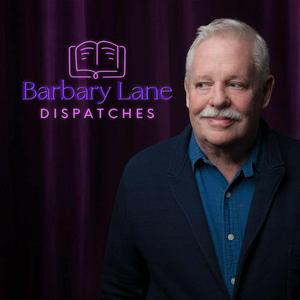
About Barbary Lane Dispatches Podcast
Pull up a chair on the porch of 28 Barbary Lane—tales, truth, and tea from Armistead Maupin. armisteadmaupin.substack.com
Podcast websiteListen to Barbary Lane Dispatches Podcast, Swingers and many other podcasts from around the world with the radio.net app
Get the free radio.net app
- Stations and podcasts to bookmark
- Stream via Wi-Fi or Bluetooth
- Supports Carplay & Android Auto
- Many other app features
Get the free radio.net app
- Stations and podcasts to bookmark
- Stream via Wi-Fi or Bluetooth
- Supports Carplay & Android Auto
- Many other app features

Barbary Lane Dispatches Podcast
Scan code,
download the app,
start listening.
download the app,
start listening.
 Ireland