

Listen to this podcast in the app for free: Download for free in the App Store
radio.net
Sleep timer
Save favourites
17 episodes
The Power of Pirate Agency: Navigating Uncertainty in the Modern Workplace with Sam Conniff
25/06/2026 | 50 mins.For the working majority, financial uncertainty is not an abstract concept—it is a daily reality. Yet research shows that 90% of senior leaders would choose a guaranteed bad outcome over an uncertain good one. Sam Conniff, creator of Uncertainty Experts and bestselling author of Be More Pirate, joins us to dismantle how fear dysregulates our brains and bodies, clouding rational financial choices. Conniff shares practical neurological lifehacks for reclaiming biological control and makes a powerful case for "professional rule-breaking"—shifting corporate culture from a dependency on permission to a culture driven by frontline agency and resilience.
Show Notes from our host, Emily Trant:
Have you ever had a moment where a tiny, insignificant mistake completely broke your ability to cope?
During the height of the pandemic, after my own startup had failed and my husband was made redundant, I found myself facing massive financial uncertainty with two young children and a mortgage. One afternoon, a broadband provider keyed in a promotional discount wrong on my account, accidentally upgrading me to a premium package instead. I completely lost it over a mistake that, objectively, wasn’t going to ruin us.
That is what acute financial stress does to the human brain. It's a psychobiological response that strips away your executive function, leaving you in a state of survival-driven fight-or-flight.
When I sat down with Sam Conniff, I met someone who deeply understands this intersection of emotion, biology, and structural adversity. Sam is a self-described pirate, an entrepreneur, and the mastermind behind Uncertainty Experts—the world’s most extensive behavioral study on how we respond to the unknown.
What I love about Sam's work is that it actively rejects the standard, sterile corporate models of risk management. Instead, he highlights the lived experiences of individuals who have historically navigated the deepest shadows of uncertainty: from refugees and gang-impacted youth to former inmates like Morgan Godin, who managed a high-security prison environment by structuring her days into rigorous, 15-minute intervals. Sam shows us how these extreme circumstances reveal real neurological tools for reclaiming agency.
This conversation completely reframed how I view systemic workplace challenges. It isn’t just about providing better financial tools; it’s about acknowledging the deep emotional weights the working majority carry every day. Sam makes a brilliant, rebellious case for "professional rule-breaking," showing that true resilience isn’t built on waiting for corporate permission—it’s built on having the courage to set a new precedent.
Thank you, Sam, for bringing your extraordinary insight, your rogue spirit, and your vulnerability to the show. You reminded me that while we cannot change the uncertainty of the world around us, we absolutely have the power to change how we navigate it together.
Buy Sam’s Book, Be More Pirate: https://www.amazon.com/Be-More-Pirate-Take-World-ebook/dp/B07DCDQK54/ref=books_amazonstores_desktop_mfs_aufs_ap_sc_dsk_1?_encoding=UTF8&pd_rd_w=5u0JY&content-id=amzn1.sym.9c9a049f-252a-49d9-a8c2-e300a1663200&pf_rd_p=9c9a049f-252a-49d9-a8c2-e300a1663200&pf_rd_r=143-4620680-4876941&pd_rd_wg=QZn07&pd_rd_r=06cd95e6-9bcd-4166-9e20-d9689856b610
Hosted on Acast. See acast.com/privacy for more information.The Motherhood Penalty with Joeli Brearley
16/03/2026 | 46 mins.54,000 women a year are pushed out of their jobs for getting pregnant. That's a woman every ten minutes. Joeli Brearley, founder of Pregnant Then Screwed, joins Emily to expose the motherhood penalty — the career and financial setback that makes the Invisible Worker a mother. From the marriage bar to the modern pay gap, they make the case for affordable childcare, shared parental leave reform, and men picking up a mop.
Episode Notes from our host, Emily Trant:
Joeli Brearley has helped over 300,0000 women, including me. I have even been a client of Pregnant Then Screwed, the charity that Joeli founded to support women who have experienced pregnancy and maternity discirmination at work.
Mothers are the Invisible Workers. They are the ones stitching together part-time jobs around caring responsibilities, quietly absorbing the financial hit of the motherhood penalty, and propping up the economy through unpaid labour that barely registers in GDP calculations. I knew I had to have Joeli on to unpack the history that brought us here and what we can do to change it.
Joeli is one of the most compelling advocates I have ever met. She is precise with data, unflinching in her honesty, and she made me laugh and want to cry in equal measure.
Thank you, Joeli, for everything you do for working mothers.
Here are some of the resources and research we discuss on the show:
Pregnant Then Screwed: The charity Joeli founded, offering free legal advice to women who experience pregnancy or maternity discrimination at work, and campaigning for systemic change. In the last 10 years, they've supported over 300,000 women. Find out more and access free support here: https://pregnantthenscrewed.com/
Equality and Human Rights Commission (EHRC): Source for the statistic that 54,000 women a year — one in nine pregnant women — are pushed out of their jobs. Read more here: https://www.equalityhumanrights.com/
Institute for Fiscal Studies (IFS): Research showing that by the time a woman's first child is 12 years old, her hourly pay rate is 33% behind a man's on average. Explore the research here: https://ifs.org.uk/
Joeli's book — Pregnant Then Screwed: A data-driven, deeply personal investigation into the forces that hold working mothers back. Essential reading. Buy it here: https://www.amazon.com/Pregnant-Then-Screwed-Motherhood-Penalty/dp/1471192679
Hosted on Acast. See acast.com/privacy for more information.The Frictionless Future of Finance with Nigel Morris
05/02/2026 | 31 mins.FinTech pioneer Nigel Morris (Capital One, QED Investors) joins the show to discuss the double-edged sword of frictionless digital payments and the challenge of low financial literacy. He explores how data-driven strategies democratized credit, the psychology behind modern debt, and the potential for "Agentic AI" to help the working majority make better long-term financial decisions.
Show notes from our host, Emily Trant:
It’s rare to meet a titan of finance who views the world through the lens of a psychologist, but that’s exactly what makes this man such a force in the world of FinTech. For decades, the credit card industry was a monolith that essentially ignored anyone who didn't fit a very specific profile. Then came Nigel Morris.
When I sat down with Nigel, I didn't just meet a venture capital powerhouse or the co-founder of a Fortune 500 company. I met a "rabid empiricist" with a psychology degree who saw, earlier than almost anyone else, that the mainstream financial system was failing the actual mainstream, the working majority. He and Richard Fairbank pioneered an "information-based strategy" that didn't just change how banks work; it fundamentally democratized access to credit for millions of Americans who had been turned away by traditional institutions.
Nigel, thank you for your decades of pushing boundaries, for your relentless optimism about how AI can finally bring "hedge fund economics" to the everyday person, and for helping us see the invisible gaps where FinTech can truly flourish.
Useful resources we discuss in the show:
QED Investors: Explore the venture capital platform Nigel co-founded, which focuses on disruptive fintech companies that are remaking the global financial system.
Learn more here: https://qedinvestors.com/
The Story of Capital One: For the full deep dive into how Nigel and Richard Fairbank revolutionized credit, check out The Capital One Story by Mary Curran-Hackett: https://www.amazon.com/Capital-One-Story-Institution-Leadership/dp/1400232791
ClearScore: The platform Nigel co-founded to democratize credit information by providing free access to credit scores and reports.
Check it out here: https://www.clearscore.com/
The Future of FinTech (BCG Report): Nigel discusses insights from the 3rd annual report with BCG on how challenger banks are serving the underserved.
Read the report here: https://www.bcg.com/publications/2024/global-fintech-prudence-profits-and-growth
Hosted on Acast. See acast.com/privacy for more information.The Unseen Cost of Bad Jobs (and Who Pays for It) with Zeynep Ton
22/01/2026 | 48 mins.The "Invisible Worker," who powers society, is often trapped in bad jobs lacking dignity and fair pay. MIT's Professor Zeynep Ton unveils her Good Jobs System, showing how operational choices—like cross-training and slack—create high productivity and dignity. She argues that making service jobs the next middle class jobs is an urgent necessity.
Notes from our host, Emily Trant:
Has a business book ever moved you to tears? I had to reach for the tissues more than once when I read Zeynep Ton’s book, The Case for Good Jobs. The human impact of her work is powerful. As a Professor of Practice at MIT Sloan and the President of the Good Jobs Institute, she has spent over two decades proving that treating workers well isn't just "nice"; it’s a competitive necessity. She has worked with the businesses you love to go to, like Sam’s Club, and helped make their workers love being there just as much as the customers.
Zeynep is everything you could hope for in a podcast guest. She is a powerhouse of operational expertise who speaks with incredible empathy and clarity about why our current labor system is failing so many. Thank you so much, Zeynep, for joining me to discuss how we can bring dignity and meaning to everyone's work.
Useful resources we discuss on the show:
The Good Jobs Institute: Explore their mission to convert 10 million "bad jobs" into good ones by 2027.
Learn more here: https://goodjobsinstitute.org/
The Case for Good Jobs: Zeynep’s latest book, which serves as both a rallying cry and a blueprint for organizational change.
Buy it here: https://www.amazon.com/Case-Good-Jobs-Companies-Everyones/dp/1647824176
The Economic Policy Institute (EPI): For data on wage standards and the 26 million workers earning less than $17 per hour.
Get more information here: https://www.epi.org/
Hosted on Acast. See acast.com/privacy for more information.Saving Ourselves from Ourselves: Behavioral Economics at Work with David Laibson
08/01/2026 | 24 mins.The median US worker retires with just $25,000 set aside for the rest of their lives. Harvard economist David Laibson argues our financial system favors the sophisticated, leaving the "Invisible Worker" in distress. He makes the case for forced savings and behavioral design solutions like automatic enrollment to overcome human procrastination and ensure financial security.
Show notes from our host, Emily Trant:
I first encountered David Laibson’s work years ago, long before I had the chance to meet him. His research on behavioral economics and automatic enrollment didn’t just sit in academic journals; it quite literally changed millions of people's retirement trajectories.
When I finally sat down with him at his beautiful home, the Lowell House at Harvard, I expected a lecture from one of the world’s most brilliant economists. What I got instead was a deeply empathetic conversation about the "gnawing feeling" of financial distress. David is the first to admit that even he isn't always "economically rational," and his humility in discussing the "triple whammy ice cream dessert" of life’s temptations is exactly why his work is so impactful.
David, thank you for your decades of work, for welcoming us into your home, and for helping us understand how to build systems that actually catch people before they fall.
Here is more information on the research and topics we discussed:
Influencing Retirement Savings Decisions: David’s work with Brigitte Madrian, James Choi, and John Beshears transformed how we think about "active choice."
Read here: https://www.nber.org/reporter/2024number3/influencing-retirement-savings-decisions-automatic-enrollment-and-related-tools?page=1&perPage=50
The UK Pensions Commission: Learn how the UK used David’s research to move private sector pension participation from 30% to over 80%.
Read here: https://www.pensionspolicyinstitute.org.uk/
Borrowing to Save?: A fascinating look at the impact of automatic enrollment on household debt.
Read here: https://laibson.scholars.harvard.edu/sites/g/files/omnuum5971/files/laibson/files/borrowing_to_save_20200812.pdf
The Semblance of Success: On the difficulty of nudging consumers to pay down credit card debt.
Read here: https://www.nber.org/papers/w31926
We also touched on some startling realities facing the "Invisible Worker" today:
The 401(k) "Leakage" Crisis: Research shows the median US worker reaches retirement with only $25,000 across all accounts, largely due to withdrawals during employer transitions.
The "0.5%" Rule: A look into why only a tiny fraction of the population acts with pure economic rationality, while the other 99.5% of us are driven by emotion and impulse.
Hosted on Acast. See acast.com/privacy for more information.
More Business podcasts
 A Bit of OptimismBusiness, Careers, Education, Self-Improvement
 The Diary Of A CEO with Steven BartlettBusiness, Education, Society & Culture
 Aspire with Emma GredeBusiness, Entrepreneurship, Society & Culture
 UnhedgedBusiness, Business News, Investing, News
 Prof G MarketsBusiness, Investing
 Inside Business with Ciaran HancockBusiness
 Money TalksBusiness
 The Other HandBusiness, News, Society & Culture
 Planet MoneyBusiness, News
 Working Hard with Grace BeverleyBusiness, Education, Health & Wellness, Marketing, Self-Improvement
Trending Business podcasts
 The Elite Recruiter PodcastBusiness, Careers, Education, Entrepreneurship, Investing, Management, Marketing, Self-Improvement, Tutorials
 All the Hacks: Money, Points & LifeBusiness, Education, Investing, Places & Travel, Self-Improvement, Society & Culture
 Reuters Morning BidBusiness, Business News, Investing, News
 The Gstaad Guy PodcastArts, Business, Design, Education, Entrepreneurship, Self-Improvement
 The Koerner Office - Business Ideas and Deep Dives with Chris KoernerBusiness, Entrepreneurship, Investing, Marketing
 IPI Planners PodcastBusiness, Management
 Figuring Out with Raj ShamaniBusiness, Education
 The Property PodcastBusiness, Business News, Education, Investing, News
 Inspiring Leadership with Jonathan Bowman-Perks MBEBusiness, Education, Management, Self-Improvement, Tutorials
 Business Book ClubArts, Books, Business, Education, Entrepreneurship, Self-Improvement
 James Sinclair's Business BroadcastBusiness, Entrepreneurship
 Business DailyBusiness
 Equity Mates Investing PodcastBusiness, Education, Investing, Tutorials
 Redefining EnergyBusiness
 Invest Like the Best with Patrick O'ShaughnessyBusiness, Investing, Technology
 The Lucy Gernon ShowBusiness, Careers, Education, Management, Self-Improvement, Society & Culture
 The Story of MoneyBusiness, Business News, History, News
 The Hidden Hustle PodcastBusiness
 The Startup Ideas PodcastBusiness, Entrepreneurship
 Financial AuditBusiness, Education, Investing, Self-Improvement
 Money For Couples with Ramit SethiBusiness, Investing, Relationships, Society & Culture
 The Martin Lewis PodcastBusiness
 The Entrepreneur ExperimentBusiness, Careers, Entrepreneurship
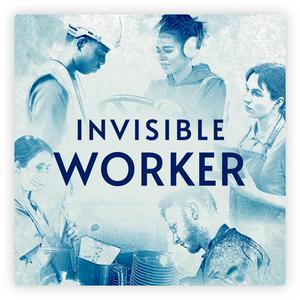
About Invisible Worker
Meet over half of the working world. They are the machine that powers our society - from making your coffee and emptying your bins, to caring for your relatives and delivering your parcels. You might see them as ‘frontline’ or ‘essential’ workers…or you might not see them at all. Invisible Worker explores the financial landscape of our most diligent workforce. By speaking to experts in mobility, inclusion, policy, research and more, we find out where the problems are, and how we can start to fix them. Hosted on Acast. See acast.com/privacy for more information.
Podcast websiteListen to Invisible Worker, A Bit of Optimism and many other podcasts from around the world with the radio.net app
Get the free radio.net app
- Stations and podcasts to bookmark
- Stream via Wi-Fi or Bluetooth
- Supports Carplay & Android Auto
- Many other app features
Get the free radio.net app
- Stations and podcasts to bookmark
- Stream via Wi-Fi or Bluetooth
- Supports Carplay & Android Auto
- Many other app features

Invisible Worker
Scan code,
download the app,
start listening.
download the app,
start listening.
 Ireland