

Listen to this podcast in the app for free: Download for free in the App Store
radio.net
Sleep timer
Save favourites
167 episodes
162: Building Tower Bridge
26/06/2026 | 30 mins.How Tower Bridge Was Built: The Untold Story of London's Most Famous Bridge
Discover the remarkable history behind Tower Bridge, one of London's most iconic landmarks. Learn how political battles, engineering innovation, and Victorian ambition transformed a transport crisis into one of the greatest bridge-building achievements of the nineteenth century.
00:00 Building Tower Bridge
01:00 Why London Needed a New Thames Crossing
03:00 The Engineering Challenge
05:00 Early Designs and Political Battles
06:00 Choosing the Bascule Design
06:30 Horace Jones and John Wolfe Barry
08:00 The Tower Bridge Act of 1885
10:00 Building the Foundations Beneath the Thames
12:00 The Six Divers of Tower Bridge
14:00 Constructing the Steel Superstructure
16:00 The Revolutionary Hydraulic System
18:00 Victorian Engineering and Safety Standards
20:00 Costs, Delays and Human Sacrifice
22:00 Legal Disputes During Construction
24:45 Why Victorian Critics Hated Tower Bridge
27:30 The Grand Opening of 1894
29:00 Tower Bridge's Lasting Legacy161: Life Below Stairs
12/06/2026 | 53 mins.Below Stairs London: Tracing Victorian Servant Life in Belgravia and MayfairHazel Baker guides listeners through surviving street-level traces of Victorian servant London—area steps and railings, coal-hole covers, bell systems, mews alleys, and service districts—showing how London’s architecture encoded a rigid “upstairs/downstairs” hierarchy and enforced servant invisibility. Using census figures, she explains domestic service as Britain’s largest employer of women, driven by coal soot, class display, and tax incentives against male servants, then outlines household ranks from butler and housekeeper to scullery maid and mews staff. She describes the physical toll of long days, the servant supply chain at Shepherd Market, mews history and later gentrification, and surviving examples including Hyde Park Gardens Mews, Belgravia Mews West’s Star Pub, Bathurst Mews stables, and 18 Stafford Terrace (Sambourne House). She critiques period dramas for softening labor and highlights servants’ documented sexual vulnerability and limited protections.00:00 161: Life Below Stairs00:12 Introduction01:55 The Scale of Servant London14:20 The Architecture of Invisibility17:02 Coal Holes & Bell Systems22:38 The Mews28:50 Shepherd Market33:23 A Day in the Life37:00 Downton Abbey vs. Reality40:04 Sexual Vulnerability & Structural Silence44:47 Why Did Servants Stay?46:32 18 Stafford Terrace48:54 The Dual City51:43 Outro & Related Episodes160: Soho Square’s Untold Stories: From Charles II to Mary Seacole
29/05/2026 | 29 mins.Host Hazel Baker and Westminster guide Philip Scott record in Soho Square, tracing its shift from Middlesex countryside and royal hunting ground—where “Soho!” was cried—to a late-1600s development originally called King Square for Charles II, whose weathered statue remains after being moved and later returned.
They highlight residents and landmarks, including Mary Seacole’s blue plaque and her Crimean War work after being refused by Florence Nightingale’s nurses: she built the British Hotel, treated soldiers and went to battlefields, later publishing her 1857 autobiography and receiving a benefit concert.
They discuss Seacole’s rediscovery from the 1980s and her statue near Parliament, the square’s 1925 mock-Tudor gardener’s hut and tunnel myth, Huguenot immigration and the French-language Protestant church, Theresa Cornelis and Casanova, and trivia about entertainer Danny La Rue, buried near Seacole. The episode ends promoting a Soho walking tour.159: Unveiling London's Victorian Vampire Legacy
22/05/2026 | 44 mins.London’s Dracula Connections: Victorian Vampires, Penny Dreadfuls & the Lyceum Theatre (World Dracula Day Special)On World Dracula Day (26 May), London History Podcast host Hazel Baker speaks with Lambeth tour guide and Gothic novelist David Turnbull about how a century of Gothic writing and London locations shaped Bram Stoker’s Dracula. They trace early vampire traits through Coleridge’s Christabel, Byron’s circle and the Villa Diodati summer, Polidori’s The Vampyre, and the influence of penny dreadfuls like Varney the Vampire and Lloyd’s publications, before moving to Fleet Street magazines and Sheridan Le Fanu’s Carmilla.
The conversation highlights Stoker’s Lyceum Theatre work under Henry Irving, the Beefsteak Room’s literary influences (including Burton and Vambéry), Stoker’s research at the British Museum and London Library, and Dracula’s London settings from Piccadilly and King’s Cross to Hampstead.
They discuss Dracula’s slow initial success, rivalry with The Beetle, and its 20th-century rise via Hamilton Deane and Bela Lugosi, ending with Turnbull’s Dracula-influenced novel The Hurdy Gurdy Man and related London tours.00:00 Introduction05:39 The Romantic Poets & Vampire Origins17:17 Penny Dreadfuls & Fleet Street31:57 Dracula's London Locations36:19 Dracula's Rise to Fame
See Show Notes158: Finsbury Circus: Marsh to Metropolitan Marvels
08/05/2026 | 28 mins.The script traces Finsbury Circus Gardens’ transformation from medieval marshland north of London’s wall—created as the Wallbrook’s flow was impeded—into today’s Grade II listed public garden and commercial centre. It recounts Roman burials, later use as a waste dump and tanning area, failed drainage and quarrying, and the successful draining in 1527.
The site became home to Bethlehem Royal Hospital (“Bedlam”) in 1675–76, designed by Robert Hooke, before its demolition in 1814–15 and redevelopment as an elegant oval residential circus planned by George Dance and executed by William Montague (1815–17). It covers the area’s religious institutions, a fatal 1825 construction accident, an unrealized radical monument to Rafael del Riego, its 19th-century medical quarter (including Moorfields Eye Hospital), later office redevelopment and key buildings like Lutyens’ Britannic House and Derwent Wood’s sculptures, public opening in 1900, and 2025 restoration after Crossrail works.
Podcast show notes: londonguidedwalks.co.uk/podcast
More History podcasts





Trending History podcasts
 Easy Money: The Charles Ponzi StoryDocumentary, History, Society & Culture, True Crime
 Oh What A Time...Comedy, Education, History
 Those Conspiracy GuysComedy, History, True Crime
 Revisionist History podcastHistory
 The Medieval Irish History PodcastHistory
 Our Ancestors Were MessyArts, Comedy, History
 TROJAN WAR: THE PODCASTHistory
 The History HourHistory, Personal Journals, Society & Culture
 ExpanseDocumentary, History, Society & Culture
 My Victorian NightmareHistory, True Crime
 A History of the World in 100 ObjectsHistory
 Trapped HistoryEducation, History, Society & Culture
 In Our Time: HistoryHistory
 Real NarcosDrama, Fiction, History, True Crime
 D-Day: The Tide TurnsHistory
 Trashy DivorcesComedy, History
 Historic Royal Palaces PodcastHistory
 The History of ByzantiumHistory
 Talking History with Patrick GeogheganHistory
 LoreHistory, True Crime
 Everything Everywhere Daily: History, Science, Geography & MoreEducation, History
 Conspiracy Theories, Cults, & CrimesHistory, True Crime
 School of WarArts, Books, Business, History
 History RageComedy, Comedy Interviews, Education, History, Society & Culture
 In Our Time: CultureHistory
About London History
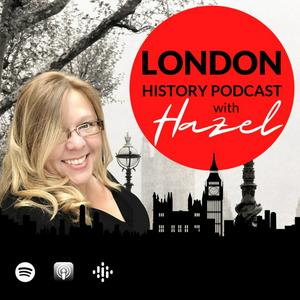
The London History Podcast uncovers the stories, people, and places that have shaped London over 2,000 years.
Hosted by historian & tour guide Hazel Baker, each 20–40 minute episode feels like an audio walking tour, covering everything from Roman Londinium and medieval guilds to Dickensian streets, Georgian scandals, and modern social change. Perfect for curious Londoners, visitors, students, and history lovers who want to go beyond the usual tourist highlights.
Podcast websiteListen to London History, Dan Snow's History Hit and many other podcasts from around the world with the radio.net app
Get the free radio.net app
- Stations and podcasts to bookmark
- Stream via Wi-Fi or Bluetooth
- Supports Carplay & Android Auto
- Many other app features
Get the free radio.net app
- Stations and podcasts to bookmark
- Stream via Wi-Fi or Bluetooth
- Supports Carplay & Android Auto
- Many other app features

London History
Scan code,
download the app,
start listening.
download the app,
start listening.
 Ireland