

Listen to this podcast in the app for free: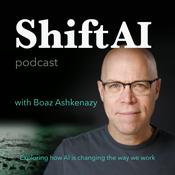 Download for free in the App Store
radio.net
Sleep timer
Save favourites
105 episodes
Teaching Discernment in the Age of AI and Higher Education with UW Vice Provost for AI Noah Smith
25/07/2026 | 25 mins.In this episode of Shift AI, Noah Smith, Vice Provost for AI at the University of Washington and Senior Director of NLP Research at the Allen Institute for AI, joins host Boaz Ashkenazy for a wide ranging conversation on how universities are preparing for a workplace increasingly run by AI agents.
Noah's path wound from a PhD at Johns Hopkins to a tenured professorship at Carnegie Mellon, until a call from UW pulled him west in 2015 to help build out its natural language processing faculty. A few years later he took on a second role leading a research team at the Allen Institute for AI, and this past November added a newly created role as UW's first Vice Provost for AI.
The conversation covers how faculty across UW are experimenting with AI in the classroom, from an interactive logic textbook in the philosophy department to new AI literacy courses, and digs into OLMo, the fully open language model project Noah leads at Ai2, unpacking why releasing the weights, code, and training data together, not just an API, matters for regulated industries, universities, and anyone who wants to retrain a model rather than just prompt it.
Noah lays out a scenario where 80 percent of entry level work gets done by autonomous agents and argues the skill universities need to double down on is not AI literacy so much as discernment, the ability to unwrap a problem and figure out what questions to ask.
This one is for university administrators, provosts, and faculty grappling with AI policy, as well as founders and engineers building on open source models, and anyone curious how a major research university is trying to get ahead of the agentic era instead of just reacting to it.
Chapters
[00:05] Welcome to Shift AI, live from UW's Foster School of Business
[03:44] Noah's path from Carnegie Mellon to UW's Vice Provost for AI
[06:08] Bagging groceries: Noah's first paid job
[08:11] Six months in: what surprised Noah most about the role
[09:22] How AI is reshaping teaching and pedagogy at UW
[11:33] Preparing students for a world where agents do 80 percent of the work
[14:08] Inside the Allen Institute for AI and the origins of OLMo
[15:52] What "fully open" really means for language models
[17:49] Specialized models versus general-purpose models for regulated industries
[19:47] AI governance, security, and UW's new governance committee
[24:35] The future of work in two words: human agency
Connect with Noah Smith
LinkedIn: https://www.linkedin.com/in/noah-smith-0322511a4/
Connect with Boaz Ashkenazy
LinkedIn: https://www.linkedin.com/in/boazashkenazy/
Email: info@shiftai.fmThe End of DevOps and the Rise of Autonomous Cloud with Hyphen AI CEO Jared Wray
16/07/2026 | 35 mins.In this episode of Shift AI, Jared Wray, CEO and co-founder of Hyphen, joins host Boaz Ashkenazy for a wide-ranging conversation on how AI is poised to eliminate the complexity of cloud infrastructure and the DevOps role entirely.
Jared shares his unconventional career journey from growing up in a small town in Idaho, where technology barely existed, to washing dishes at 15, teaching himself programming at the local ISP, and eventually founding five startups across cloud computing, energy tech, and developer infrastructure. From bootstrapping Tier 3 (acquired by CenturyLink) to co-founding Palmetto, now one of the largest energy lenders in the nation, Jared's path has been defined by a passion for solving infrastructure problems.
The conversation dives deep into why DevOps has become painfully complex, with developers needing to glue together seven to thirteen different services just to deploy a single application across providers like AWS, Google Cloud, and Cloudflare. Jared explains how Hyphen is using AI to abstract away this complexity by asking developers only for business rules like uptime requirements and performance needs, then letting the AI determine the right architecture, deploy it, and operate it autonomously.
Boaz and Jared explore why tools like Claude Code and other coding agents still cannot handle the full deployment lifecycle, what it would look like if AI agents replaced PagerDuty by calling you during an outage with a diagnosis and recommendation, and why the future of infrastructure is an autonomous cloud where humans are decision makers and agents handle everything else. The episode closes with a forward-looking discussion on agent-only companies, the death of cloud certifications, and why Jared believes DevOps was a good idea that we ran too long.
This episode is essential listening for CTOs, platform engineers, and startup founders who want to understand how AI is moving beyond writing code to fundamentally transforming how software is deployed, operated, and scaled.
Chapters
[00:00] From Pocatello to Five Startups: Jared's Career Journey
[02:49] Building Fonz, Co-founding Palmetto, and Finding Passion in Infrastructure
[06:05] Why AI Led Jared Back to Infrastructure with Hyphen
[07:05] First Job as a Dishwasher and Breaking Into Tech
[08:46] What Is DevOps and Why Does It Exist
[10:49] Why Cloud Infrastructure Has Become So Painfully Complex
[12:36] How AI Can Apply Best Practices Without Reinventing the Wheel
[14:35] The Hyphen Developer Experience: Business Rules Over Architecture
[17:14] Why Claude Code and Coding Agents Cannot Solve Infrastructure Yet
[20:26] The Full Context Problem: Operating Across Multiple Cloud Providers
[23:07] Autonomous Cloud: When Agents Talk to Agents
[24:17] Replacing PagerDuty: AI Agents That Call You During Outages
[28:47] March Madness, Live Streaming, and Why Five Minutes Feels Like a Lifetime
[30:59] Two Words for the Future of Work: Autonomous Cloud
[33:20] Agent-Only Companies and Why Humans Will Be CEOs
[35:12] DevOps Was a Good Idea We Ran Too Long
[35:41] What Is Next for Hyphen
Connect with Jared Wray
LinkedIn: https://www.linkedin.com/in/jaredwray/
Email: jw@hyphen.ai
Connect with Boaz Ashkenazy
LinkedIn: https://www.linkedin.com/in/boazashkenazy/
Email: info@shiftai.fmThe Case for Deterministic AI with Logical Intelligence CSO Patrick Hillmann
07/07/2026 | 38 mins.In this episode of Shift AI, Patrick Hillmann, Chief Strategy Officer at Logical Intelligence, joins host Boaz Ashkenazy for a conversation about why the next era of AI cannot be built on probability alone.
Patrick shares his unconventional path into AI, from crisis communications and cybersecurity work at Edelman and General Electric, to steering Binance through its most turbulent years and a major DOJ settlement. At Logical Intelligence, Patrick now works alongside Yann LeCun, a Fields Medalist, and engineers from Meta, Google, and Cruise to build deterministic, energy-based reasoning models.
Patrick explains why LLMs behave like a confident intern, fast and articulate, but wrong in ways you only catch if you already know the answer, and why critical systems like power grids, hospitals, and self-driving cars need a layer of certainty that probabilistic systems cannot provide. He and Boaz dig into Logical Intelligence's benchmark results, including a 98% score on the notoriously difficult Putnam math competition, and a public Sudoku test where their energy-based model, Kona, beat every major LLM combined while running on a fraction of the compute cost.
This episode is essential listening for CTOs, technical leaders, and anyone trying to understand what comes after the current generation of large language models.
Chapters
[00:00] Patrick's Improbable Path: From Grad School to the Front Lines of a Geopolitical Crisis
[02:43] From Binance to Chief Strategy Officer at Logical Intelligence
[02:54] The First Paid Job: Unloading UPS Trucks in 100 Degree Heat
[04:31] The UPS Lesson That Still Shapes How He Thinks About Work
[04:47] Why LLMs Are Confident Guessing Machines, Not Truth Machines
[07:14] The Team Behind Logical Intelligence: A Fields Medalist, Yann LeCun, and Math Olympiad Engineers
[08:55] Is Logical Intelligence Betting Against LLMs?
[10:32] The AI Sandwich: Where LLMs, Reasoning Layers, and World Models Fit
[12:36] The Putnam Benchmark and Why Formal Proofs Don't Get Partial Credit
[15:44] What Is an Energy-Based Model, Really?
[19:54] Eve Badia's 15-Year Path to the Energy-Based Reasoning Model
[22:04] Formal Verification and the Future of Secure Code Generation
[23:33] When Unverified Code Fails: The Molson Coors Ransomware Story
[25:39] Why AI Coding Tools Create Rat's Nests Engineers Can't Debug
[28:53] The Sudoku Test: 98% Accuracy for $4 vs $14,000 for the Leading LLMs
[31:13] ByteDance, China, and the Race for Formal Methods
[33:42] Two Words for the Future of AI: Chaotic Determinism
[37:12] Where to Follow Logical Intelligence and Founder Eve Badia
Connect with Patrick Hillmann
LinkedIn: https://www.linkedin.com/in/crisiscommunications
Connect with Boaz Ashkenazy
LinkedIn: https://www.linkedin.com/in/boazashkenazy/
Email: info@shiftai.fmAI, Security, and the Courage to Reinvent with Smartsheet CTO Cynthia Tee
26/06/2026 | 30 mins.In this episode of the Shift AI Podcast, Cynthia Tee, former CTO of Smartsheet, joins host Boaz Ashkenazy for a wide-ranging conversation on what it really takes to integrate AI at enterprise scale responsibly, securely, and in a way that earns lasting customer trust.
Cynthia shares her unconventional journey from growing up in Manila and working her first job at a library at age 12, to earning a computer science degree from MIT, building her career at Microsoft, running Ada Developers Academy, and ultimately leading engineering at Smartsheet through one of its most consequential chapters, including the company's transition from public to private and the rollout of its first generation of AI-powered features.
The conversation dives deep into how Smartsheet approached AI integration: using generative AI to simplify formula generation and data visualization, being deliberate about what information was and wasn't sent to LLMs, and communicating transparently with enterprise customers who needed to trust the system before they would adopt it. Cynthia explains why trust, governance, and data classification aren't afterthoughts, they're the foundation that makes AI deployment possible at scale.
Boaz and Cynthia explore the emerging role of MCP in connecting LLMs like Claude to applications like Smartsheet, translating user intent into real-world action across complex workflows. They also get into what SaaS executives often underestimate: that shipping AI features is the easy part, and evolving the rest of the organization, pricing, enablement, customer support, and role definitions is where companies get stuck.
The discussion turns to the next generation of workers and the genuine tension young people face between learning a craft and leaning on AI to accelerate it. Cynthia shares a perspective on hustle, curiosity, and what it looks like when someone who's never written a line of code builds an inventory system for vintage clothing because a tool like Claude made it possible.
This episode is essential listening for CTOs, engineering leaders, and product executives who want to understand what responsible AI deployment actually looks like inside a company operating at scale.Building the AI-First City with San Jose Chief Innovation Officer Stephen Caines
16/06/2026 | 40 mins.In this episode of the Shift AI Podcast, Stephen Caines, Chief Innovation Officer and Budget Director at the City of San Jose, joins host Boaz Ashkenazy for a wide-ranging conversation on how AI is reshaping city government, public services, and the workforce at one of America's most technologically ambitious cities.
Stephen shares his unconventional path from pre-med at Case Western to digital privacy law at the University of Miami, a Stanford fellowship researching surveillance AI ethics, and ultimately landing at San Jose's Mayor's Office where he now leads both innovation strategy and the city's budget. From there, the conversation dives into how San Jose is positioning itself as the AI-first city in the nation, leveraging proximity to Adobe, Cisco, Zoom, Nvidia, Apple, and Google to advance meaningful community-level change.
The discussion explores the city's AI for All initiative, a public-private partnership with Anthropic, Google, and OpenAI to provide free AI education to residents and city employees alike. Stephen walks through the city's dual-track upskilling program, its approach to employee training that is purposely non-mandatory, and how San Jose is balancing top-down innovation mandates with bottom-up experimentation.
Boaz and Stephen also dig into real-world deployments: object detection cameras on fleet vehicles that proactively identify potholes and road hazards before residents report them, AI translation tools expanding Spanish and Vietnamese participation in city council meetings, and the 311 customer service redesign aimed at reducing resident burden while improving satisfaction. Stephen is candid about the ROI question, how to distinguish pilots worth operationalizing from ones that generate noise without value and the long-term financial risks of AI infrastructure built on VC-subsidized pricing.
The episode closes with a discussion of the GovAI Coalition, a San Jose-founded network now spanning over 900 public agencies, and Stephen's two-word vision for the future of work: chronic adaptability.
Chapters
[00:00] From Pre-Med to Chief Innovation Officer: Stephen's Career Journey
[04:12] San Jose as the AI-First City: Population, Geography, and the Lean City Challenge
[07:49] Proximity as Advantage: Partnering with Anthropic, Google, OpenAI, and Nvidia
[08:23] AI for All: Free Community Education and In-Person Training Sessions
[11:10] Upskilling City Employees: Voluntary Training, Two Tracks, and Retention Strategy
[14:38] Balancing Top-Down and Bottom-Up Innovation
[16:14] The 311 Network and Customer Service Vision: A 360-Degree View of the Resident
[17:13] Object Detection on Fleet Vehicles: Proactive Pothole and Road Hazard Detection
[19:34] Surprising Community Feedback and the Case for Keeping Humans at the Front Door
[22:04] ROI in Government: How to Evaluate Pilots and Decide What Gets Operationalized
[24:24] The Hidden Costs of AI: Staffing Realignment, Drone Programs, and VC Subsidies
[26:14] Building Infrastructure You Own: The Road Safety Images Database
[27:24] The GovAI Coalition: 900 Public Agencies, Shared Contracts, and Peer Learning
[32:04] The Future of Work in Cities: Chronic Adaptability and the Individual Journey
Connect with Stephen Caines
LinkedIn: https://www.linkedin.com/in/stephen-caines/
City of San Jose Innovation Hub: https://www.sanjoseca.gov/your-government/departments-offices/information-technology/city-innovation/it-innovation-hub
Connect with the GovAI Coalition
Website: https://www.sanjoseca.gov/your-government/departments-offices/information-technology/ai-reviews-algorithm-register/govai-coalition
Connect with Boaz Ashkenazy
LinkedIn: https://www.linkedin.com/in/boazashkenazy/
Email: info@shiftai.fm
More Technology podcasts
 Tech Talk with Jess KellyTechnology
 The Big Tech ShowTechnology
 All-In with Chamath, Jason, Sacks & FriedbergBusiness, Entrepreneurship, Health & Wellness, Investing, Technology
 The a16z ShowBusiness, Entrepreneurship, Science, Technology
 Darknet DiariesTechnology
 The AI Daily Brief: Artificial Intelligence News and AnalysisTechnology
 Search EngineBusiness, Society & Culture, Technology
 AI Haven't A ClueTechnology
 But This Time It's DifferentTechnology
 AcquiredBusiness, Investing, Technology
Trending Technology podcasts
 EV News Daily - Technology and Business of EVsAutomotive, Business, Leisure, Technology
 This Machine KillsTechnology
 Ciao, Internet! con Matteo FloraTechnology
 Primary TechnologyNews, Tech News, Technology
 What Bitcoin DidBusiness, Investing, Technology
 ConnectedNews, Tech News, Technology
 Panic WorldNews, Society & Culture, Technology
 Mac Power UsersTechnology
 IA Sob Controle - Inteligência ArtificialTechnology
 Taylor Lorenz’s Power UserTechnology
 Darko.Audio podcastTechnology
 AppStoriesTechnology
 AI & ITechnology
 The Changelog: Software Development, Open SourceTechnology
 How I AITechnology
 Reply AllDocumentary, Society & Culture, Technology
About Shift AI
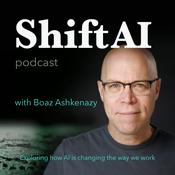
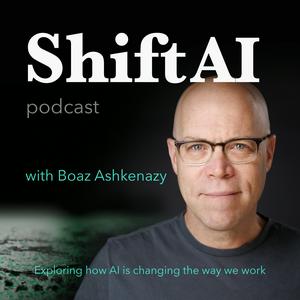
Shift AI explores how AI and ML is changing the way that we work in the digital age. The show's creator Boaz Ashkenazy interviews thought leaders who are redefining how businesses and employees will be impacted by emerging technology today and in the future | Visit shiftaipodcast.com
Podcast websiteListen to Shift AI, Tech Talk with Jess Kelly and many other podcasts from around the world with the radio.net app
Get the free radio.net app
- Stations and podcasts to bookmark
- Stream via Wi-Fi or Bluetooth
- Supports Carplay & Android Auto
- Many other app features
Get the free radio.net app
- Stations and podcasts to bookmark
- Stream via Wi-Fi or Bluetooth
- Supports Carplay & Android Auto
- Many other app features
Shift AI
Scan code,
download the app,
start listening.
download the app,
start listening.
 Ireland