
Listen to this podcast in the app for free: Download for free in the App Store
radio.net
Sleep timer
Save favourites
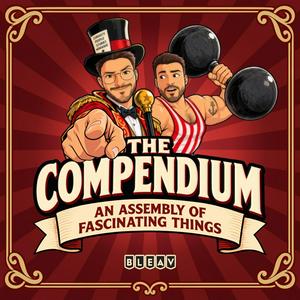
The Compendium: An Assembly of Fascinating Things
Strange True Stories with Kyle Risi & Adam Cox
Latest episode
152 episodes
Salem Witch Trials: The Dark History of America's Deadliest Witch Hunt
27/10/2026 | 1h 28 mins.In 1692, an enslaved woman named Tituba told a Salem courtroom that the Devil had come to her and bid her serve him. Her confession lit the fuse that would become known as the infamous Salem witch trials, the deadliest witch hunt in American history.
Within months, more than a third of Salem Village had been accused, imprisoned and were awaiting trial. Nineteen people were hanged. One man was pressed to death under stones for refusing to plead. And a four-year-old girl sat in custom-made shackles while her accusers watched.
But this is not really a story about witches. It is a story about mass hysteria, and how a Puritan community primed by centuries of European witch hunting, religious paranoia and moral surveillance convinced itself to kill its own neighbours on the strength of spectral evidence: testimony that someone's ghost attacked you in the night.
We trace the strange true story from Cotton Mather's witchcraft playbook to the witch cake, the Devil's book, the confessions that saved lives, and the moment the accusations reached the governor's wife and the whole thing collapsed. Plus the surprising link between Salem and our home town of Norwich.
Topics Included
what caused the Salem witch trials
Tituba's confession and why it changed everything
spectral evidence and why no alibi could save you
the witch cake ritual and the first three accused
the arrest of four-year-old Dorothy Good
Giles Corey's death by pressing and his final strategy
how the accusations reached the governor's wife and ended the trials
the 330-year fight to clear every victim's name
the Norwich connection to Bridget Bishop
Resources and Further Reading
Memorable Providences, Relating to Witchcrafts and Possessions - Cotton Mather, 1689,
Salem Witch Trials Memorial, Salem, Massachusetts - Memorial site opened 1992
Salem witch trials - Encyclopaedia Britannica
The last Salem witch has been exonerated - CNN
Host & Show Info
Hosts: Kyle Risi & Adam Cox
Editor: Giordanno Bottezini
Intro Music: Alice in dark Wonderland
Community & Calls to Action
Review & follow on: Spotify & Apple Podcasts
Instagram: @theCompendiumPodcast
Website: thecompendiumpodcast.com
Support us: Sign up to Patreon
Suggest a Topic: Freaky Register
Share this episode with a friend! If you enjoyed it, tag us on social media and let us know your favourite takeaway.
Hosted by Simplecast, an AdsWizz company. See pcm.adswizz.com for information about our collection and use of personal data for advertising.The Aberfan Disaster: The Day the Mountain Came Down
20/10/2026 | 1h 19 mins.On the last morning before half term, 240 children walked into Pantglas Junior School beneath a mountain of coal waste. Minutes after lessons began, Tip 7 collapsed above Aberfan, sending liquefied spoil through homes and classrooms and killing 116 children and 28 adults.
But the Aberfan disaster did not begin with the slide, and it did not end when the rescue stopped. The warning signs had been there: natural springs beneath the tip, earlier slips on the mountainside and concerns that failed to produce action. The tribunal later placed responsibility on the National Coal Board and concluded that the disaster could and should have been prevented.
Told through the experiences of survivors including Phil Thomas, Karen Thomas, Jeff Edwards and Gerald Tarr, this is a story of rescue, grief, institutional failure and the lives shaped by what happened on 21 October 1966. It also follows the fight to remove the remaining tips, the controversy surrounding the disaster fund and the long silence that made healing even harder.
Topics Included
The final morning at Pantglas Junior School
Why water beneath Tip 7 triggered the collapse
The warnings and earlier slides on Mynydd Merthyr
The children and teachers trapped inside the school
The rescue effort and its system of whistles and silence
The tribunal's findings against the National Coal Board
The compensation and disaster-fund controversies
The lasting trauma carried by survivors and families
Resources
The Aberfan Tribunal — Glamorgan Archives
Aberfan Disaster 1966 — National Library of Wales digital archive
The Aberfan Disaster, 1966 — British Geological Survey case study
Aberfan Disaster: Lessons Learned — Institution of Civil Engineers explainer
Aberfan: No End of a Lesson — History & Policy research paper
Aberfan Disaster Debate, 26 October 1967 — UK Parliament Hansard
Death of a Black Mountain: How the Aberfan Disaster Unfolded — HistoryExtra survivor history
The Psychological Effects of the Aberfan Disaster — 33-year follow-up study
Guidance to the Disused Tips Authority for Wales — Welsh Government consultation
This Year Marks the 60th Anniversary of the Aberfan Disaster — Merthyr Tydfil County Borough Council
Host & Show Info
Hosts: Kyle Risi & Adam Cox
Editor: Giordanno Bottezini
Intro Music: Alice in dark Wonderland
Community & Calls to Action
Review & follow on: Spotify & Apple Podcasts
Instagram: @theCompendiumPodcast
Website: thecompendiumpodcast.com
Support us: Sign up to Patreon
Suggest a Topic: Freaky Register
Share this episode with a friend! If you enjoyed it, tag us on social media and let us know your favourite takeaway.
Hosted by Simplecast, an AdsWizz company. See pcm.adswizz.com for information about our collection and use of personal data for advertising.Facebook's Social Reckoning: Whistleblowers Frances Haugen & Sarah Wynn-Williams
13/10/2026 | 1h 32 mins.A trillion-dollar company. Two women who worked inside it, years apart. And the exact same warnings, ignored twice.
This episode traces Frances Haugen, the Facebook product manager who walked out with a phone full of leaked documents and wiped six billion dollars off the company's share price in a single day, and Sarah Wynn-Williams, Facebook's former global policy chief, whose tell-all memoir Careless People landed her in emergency arbitration and a gag order so strict she's legally barred from discussing her own book.
We cover the Instagram research on teenage girls, the Myanmar crisis both women separately flagged, China, Cross-Check, the Capitol riot, and the 2026 courtroom reckoning that's cost Meta over seventeen billion dollars so far.
One whistleblower built a legal shield before she ever spoke. The other found out, too late, exactly how exposed she'd left herself. Coincidence, or exactly the pattern you'd expect from a company this size?
Topics Included
Frances Haugen's path from Google and Pinterest to Facebook's Civic Integrity team
The leaked internal research on Instagram's effect on teenage girls' body image
Cross-Check (XCheck) and the rules that didn't apply to Facebook's most powerful users
The Capitol riot, the Facebook Files, and Facebook's rebrand to Meta
Meta's 2026 courtroom reckoning: Section 230, the New Mexico and Los Angeles verdicts, and the $17.1 billion settlement
Sarah Wynn-Williams' six years as Facebook's global policy chief, and the Myanmar and China allegations in her book
The arbitration order and gag order that followed her memoir, Careless People
Arturo Bejar's testimony, and what happened to Meta's stock price after the settlement
Resources and Further Reading
Frances Haugen — Wikipedia
Frances Haugen's Written Testimony – the Senate Commerce Committee
Sarah Wynn-Williams — Wikipedia
Ex-Meta executive: — CNN
Sarah Wynn-Williams accuses Meta of colluding with China — TechCrunch
What the Wall Street Journal Got Wrong — Meta's official response
Host & Show Info
Hosts: Kyle Risi & Adam Cox
Editor: Giordanno Bottezini
Intro Music: Alice in dark Wonderland
Community & Calls to Action
Review & follow on: Spotify & Apple Podcasts
Instagram: @theCompendiumPodcast
Website: thecompendiumpodcast.com
Support us: Sign up to Patreon
Suggest a Topic: Freaky Register
Share this episode with a friend! If you enjoyed it, tag us on social media and let us know your favourite takeaway.
Hosted by Simplecast, an AdsWizz company. See pcm.adswizz.com for information about our collection and use of personal data for advertising.Unabomber Part 2: The Manifesto That Exposed Ted Kaczynski
26/09/2026 | 1h 11 mins.For 17 years, the Unabomber hid behind handmade bombs, false clues and the initials F.C. Then his need to explain himself gave the FBI the break it had been waiting for.
Part Two turns from the bombing campaign to Ted Kaczynski himself. We trace the gifted, isolated child who entered Harvard at 16, the controversial psychological study led by Henry Murray, the anti-technology ideas that hardened into violent ideology, and the contradictions of his off-grid life in a tiny Montana cabin.
When Industrial Society and Its Future was published, Ted’s brother David recognised something chilling in its language. What followed was a covert investigation, an arrest built around a Forest Service ruse, a cabin packed with evidence and a legal battle over whether any of it could be used. Even with the case closing around him, Kaczynski fought the defence designed to save his life because it threatened the one thing he still wanted the world to respect: his ideas.
Topics Included
Ted Kaczynski’s gifted but socially isolated childhood
Henry Murray’s controversial Harvard psychology study
The private crisis Kaczynski called a turning point in his life
Jacques Ellul and the roots of Kaczynski’s anti-technology ideology
The reality of living off-grid in the Montana cabin
The manifesto and the linguistic clues that exposed him
David Kaczynski’s decision to contact the FBI
The search warrant, mental-health dispute and guilty plea
Resources and Further Reading
Unabomber case history — FBI case archive and device timeline
The Unabomber Case 25 Years Later — FBI account of the linguistic investigation
Theodore Kaczynski Indicted in Sacramento — US Department of Justice indictment summary
Unabomber Cabin — FBI artefact history and cabin evidence
United States v. Kaczynski, 239 F.3d 1108 — Ninth Circuit opinion on the plea and self-representation dispute
The Ted Kaczynski Papers: FBI Files and Photographs — University of Michigan Library archive guide
Harvard and the Making of the Unabomber — Alston Chase’s archival investigation
Responses to Harvard and the Making of the Unabomber — participant and scholarly challenges to Chase’s interpretation
Ted Kaczynski dies in federal prison at 81 — Associated Press biography and case overview
Host & Show Info
Hosts: Kyle Risi & Adam Cox
Editor: Giordanno Bottezini
Intro Music: Alice in dark Wonderland
Community & Calls to Action
Review & follow on: Spotify & Apple Podcasts
Instagram: @theCompendiumPodcast
Website: thecompendiumpodcast.com
Support us: Sign up to Patreon
Suggest a Topic: Freaky Register
Share this episode with a friend! If you enjoyed it, tag us on social media and let us know your favourite takeaway.
Hosted by Simplecast, an AdsWizz company. See pcm.adswizz.com for information about our collection and use of personal data for advertising.Unabomber Part 1: The Biggest Manhunt in FBI History
26/09/2026 | 1h 7 mins.In 1978, a brown-paper parcel was found between two cars at a Chicago university. It looked ordinary. The professor named as the sender had never seen it before. Then it exploded.
That first device began a 17-year bombing campaign that moved from university campuses to an airliner, computer shops and private homes. Sixteen bombs would kill three people and injure 23, while investigators struggled with devices deliberately built from common materials and a bomber capable of disappearing for years.
What the FBI did have was strange: scrap-built components, pieces of wood, the initials F.C., a witness sketch and, eventually, a bomber who decided to start writing. Part One follows the creation of the UNABOM investigation, the long silences between attacks, the deadly return in the 1990s and the extraordinary decision to publish Industrial Society and Its Future.
Then, after thousands of bad tips, one lead arrived that pointed towards a name already inside the investigation: Ted Kaczynski.
Topics Included
The mysterious first package bomb found in Chicago in 1978
How the university and airline attacks gave the UNABOM case its name
The scrap-built bombs, pieces of wood and recurring F.C. signature
The escalation from serious injuries to the first fatalities
The 1987 eyewitness encounter and iconic hooded-man sketch
The Unabomber’s six-year disappearance and sudden return
Freedom Club and the demand to publish Industrial Society and Its Future
The manifesto publication and the tip that pointed towards Ted Kaczynski
Resources and Further Reading
Unabomber case history — FBI
Inside the FBI: The Unabomber Case — FBI podcast and transcript
The Unabomber Case 25 Years Later — FBI
Unabomber Bomb Shrapnel — FBI artifact
Unabomber Cabin — FBI artifact
The Profile of a Loner — The Washington Post
Unabomber's Elusive Trail — The Washington Post
To Unabomb Victims, A Deeper Mystery — The Washington Post
UNABOM Major Case 75 Task Force Report — digitised 1995 BATF, FBI and USPIS task-force report
Project Unabom — Apple Original podcast
Host & Show Info
Hosts: Kyle Risi & Adam Cox
Editor: Giordanno Bottezini
Intro Music: Alice in dark Wonderland
Community & Calls to Action
Review & follow on: Spotify & Apple Podcasts
Instagram: @theCompendiumPodcast
Website: thecompendiumpodcast.com
Support us: Sign up to Patreon
Suggest a Topic: Freaky Register
Share this episode with a friend! If you enjoyed it, tag us on social media and let us know your favourite takeaway.
Hosted by Simplecast, an AdsWizz company. See pcm.adswizz.com for information about our collection and use of personal data for advertising.
More Documentary podcasts


Trending Documentary podcasts


About The Compendium: An Assembly of Fascinating Things
Love strange true stories, true crime, dark history and real-life mysteries, but not ten-part series that turn listening into homework? The Compendium is a weekly documentary-style podcast that gives you one complete, thoroughly researched story from beginning to end in a single listen.
Each week, Kyle Risi takes co-host Adam Cox inside one remarkable real-life story that Adam has not heard before. As Adam asks the questions you are thinking, Kyle unpacks the context, the characters, the chaos, the terrible decisions and the tiny details that make you say, “Wait… how did this actually happen?”
From infamous crimes and forgotten history to cults, frauds, survival stories, celebrity scandals and remarkable people, the subject changes every week.
Podcast websiteListen to The Compendium: An Assembly of Fascinating Things, What It Was Like and many other podcasts from around the world with the radio.net app
Get the free radio.net app
- Stations and podcasts to bookmark
- Stream via Wi-Fi or Bluetooth
- Supports Carplay & Android Auto
- Many other app features
Get the free radio.net app
- Stations and podcasts to bookmark
- Stream via Wi-Fi or Bluetooth
- Supports Carplay & Android Auto
- Many other app features

The Compendium: An Assembly of Fascinating Things
Scan code,
download the app,
start listening.
download the app,
start listening.
 Ireland