

Listen to this podcast in the app for free: Download for free in the App Store
radio.net
Sleep timer
Save favourites
63 episodes
#62 | The Future of TV Advertising, Category Creation & AI with Amit Sharan
26/08/2026 | 36 mins.Overvoew
What does it take to build a category when customers do not yet know they need what you are selling?
In this episode of The Digital Diaries, Peter Woods speaks with Amit Sharan, SVP of Marketing at Tatari, about building brands, marketing teams and entirely new markets.
Amit shares lessons from helping build LiveRail into a leading video advertising platform before its acquisition by Facebook. He also reflects on his time at Meta, where he worked across advertising and products including Facebook Watch, Facebook Live and video monetisation.
The conversation explores why Amit prefers building over maintaining. He explains why clarity of positioning was so important at LiveRail and why marketing needs to do more than generate demand. It also needs to build the value and reputation of the company.
Amit explains what category creation really means. Sometimes customers are not actively searching for your solution. You first need to show them why the category matters before explaining why your company does it better.
Peter and Amit also explore the evolution of TV advertising. TV is becoming more measurable, targeted and accessible. Connected TV, retargeting and new advertising formats are bringing it closer to the performance marketing world.
They also discuss the growing role of AI in marketing. This includes how brands appear in LLMs, AI-powered media planning and AI-generated advertising. Amit shares why AI can reduce production costs, but also raises questions around consumer trust, synthetic talent and regulation.
Finally, Amit explains why he believes TV remains one of the most powerful brand-building channels available. Social media might amplify cultural moments, but many of those moments still begin on television.
Why Amit prefers building businesses from zero to one
Lessons from scaling LiveRail and working at Meta
Why clear positioning can create a competitive advantage
The difference between demand generation and category creation
Why digital-first brands eventually need new channels to grow
How connected TV is changing television advertising
The opportunity for TV retargeting in B2B marketing
How AI is changing search, media planning and advertising creative
Consumer trust and regulation around AI-generated talent
Why TV and social media can be stronger together
Why leaders should give people problems to solve, not just tasks to complete
Great marketing is not only about capturing existing demand. Sometimes you need to create the market first.
That means educating customers, establishing the category and building trust before someone is ready to buy.
For Amit, the same thinking applies to leadership. Give talented people a meaningful problem to solve and the space to work out how to solve it.#61 | Fixing Broken Meetings with Dr Rebecca Hinds
19/08/2026 | 38 mins.In this episode of The Digital Diaries, host Peter Woods speaks with Dr Rebecca Hinds, author of Your Best Meeting Ever, founder of the Work AI Institute at Glean, and former head of the Work Innovation Lab at Asana. They discuss why workplace meetings have become so dysfunctional and how applying product design principles can transform collaboration. Dr Hinds reveals actionable frameworks like the 4D CEO test, methods for managing calendar overload, and how artificial intelligence is reshaping modern work practices.
Treat Meetings like Products: Organisations should view meetings as critical internal products, using intentional design principles to optimise alignment and decision-making.
Meeting Doomsday: Conducting a calendar cleanse at the team level can reclaim substantial time, including up to 11 hours per person each month.
Combating Parkinson's Law: Work expands to fill allotted time; setting shorter meeting durations (such as 50 minutes) or wrapping up once goals are achieved prevents wasted effort.
Verb-Driven Agendas: Structuring agendas around actionable verbs ensures attendees understand the exact objective of each item.
Measuring True Costs: Beyond direct salary calculations, unoptimised schedules inflict heavy cognitive costs and fatigue across organisations
Navigating AI and "Bot Sitting": AI can streamline operations, but poor setup forces workers to spend up to 6.5 hours weekly supervising automated too
Key Takeaways
Treat Meetings like Products: Organisations should view meetings as critical internal products, using intentional design principles to optimise alignment and decision-making.
Meeting Doomsday: Conducting a calendar cleanse at the team level can reclaim substantial time, including up to 11 hours per person each month.
Combating Parkinson's Law: Work expands to fill allotted time; setting shorter meeting durations (such as 50 minutes) or wrapping up once goals are achieved prevents wasted effort.
Verb-Driven Agendas: Structuring agendas around actionable verbs ensures attendees understand the exact objective of each item.
Measuring True Costs: Beyond direct salary calculations, unoptimised schedules inflict heavy cognitive costs and fatigue across organisations.
Navigating AI and "Bot Sitting": AI can streamline operations, but poor setup forces workers to spend up to 6.5 hours weekly supervising automated tools.#60 | Why Authenticity Is the Future of Employer Branding, with Bryan Adams
13/08/2026 | 39 mins.This week Peter is joined by Bryan Adams — CEO and founder of Happy Dance, best-selling author, TEDx speaker (1.4M+ views), and one of the leading voices in employer branding and candidate experience. Over two decades, Bryan has helped nearly 200 global organisations — including Apple, Canva, Salesforce and Johnson & Johnson — rethink how they attract talent.
In this conversation, Bryan and Peter dig into why the best employer brands are built on honesty, not hype — and why "selling the truth" beats selling the perfect story every time.
The origin story — how a workshop moment that "gave Bryan goosebumps" set him on the path from marketing to employer branding, before the term even existed
Sell the truth, not the perfect story — why leading with the real challenges of a role (not just the perks) attracts the right candidates and repels the wrong ones
The imposter syndrome fix — how radical clarity about what a job actually demands removes the guesswork for new hires
Why career sites still fall short — page speed, legacy tech, and the risk-aversion of large organisations
AI and conversational candidate experience — how career sites are moving from static job boards to systems that "listen before they speak," cutting a 1,200-job firehose down to the 3 roles that actually fit
Good friction vs. bad friction — why re-typing your CV into an ATS is needless friction, and what good candidate experience removes
The three layers of story every organisation needs — reputation (what you're known for), expectation (the deal you're offering), and experience (the stories only your employees can tell)
Leadership advocacy — why employer brand only works when it's championed from the C-suite down, not run as an HR side project
Bryan's own story — nearly going out of business from a fear of public speaking, and the standup comedy course that changed everything
Five years out — Bryan's prediction that transparency, not perfection, will become the ultimate measure of emplyer brand
About Bryan Adams
Bryan is CEO and founder of Happy Dance, and author of Give and Get Employer Branding. His new book, Sell the Truth — a storytelling playbook for leaders who want to build cultures that win — is out 17 September in all good bookstores and on Amazon.
Learn more about Bryan's work at Happy Dance
Pre-order Sell the Truth, out 17 September#59 | einventing the Everyday: Building Smarter Products with Oscar Hedaya
10/08/2026 | 47 mins.Overivew
What does it take to reinvent a product that hasn't meaningfully changed in decades?
In this episode of The Digital Diaries, Peter Woods is joined by entrepreneur and product innovator Oscar Hedaya, founder of Space and creator of the Space Safe, a connected smart safe that combines modern technology with traditional physical security.
Oscar shares his journey from growing up with limited means to building multiple consumer product businesses, revealing how necessity sparked an entrepreneurial mindset that continues to shape his approach to innovation. Together, they explore what it really takes to bring hardware products to market, why customer feedback is the foundation of great product development, and how solving genuine problems is far more important than chasing the next big idea.
The conversation also dives into the unique challenges of hardware versus software, the future of connected security, and the realities of entrepreneurship that rarely make it into the headlines.
How adversity can become an entrepreneurial advantage
Why successful founders solve real problems—not imagined ones
The hidden complexity of building hardware products
What differentiates physical product innovation from software development
Why customer feedback should shape your roadmap
How connected technology is changing the future of home and hotel security
The financial realities every founder should understand before launching a business
Why AI is becoming an invaluable tool for aspiring entrepreneurs
Oscar's entrepreneurial journey and early businesses
Building companies with limited resources
Spotting opportunities through everyday frustrations
Designing and launching the Space Safe
Hardware development challenges and manufacturing lessons
Cybersecurity versus physical security
Smart home technology and connected devices
Customer-led product innovation
Startup funding, runway and financial planning
Using AI to validate business ideas
What success looks like after building multiple companies
Innovation starts with observation. Many of the best products don't invent something entirely new—they improve products people already use every day.
Hardware is unforgiving. Unlike software, physical products can't simply be patched after launch. Small design decisions can have expensive long-term consequences.
Build for genuine customer pain points. The strongest businesses solve problems customers are already experiencing and are willing to pay to eliminate.
Think lean from day one. Managing cash flow, understanding runway and validating demand are often more important than perfecting the product.
Listen to your customers. Some of Space's most valuable product features, including its innovative Panic PIN functionality, came directly from customer suggestions.
"The entrepreneur isn't the person who spots the problem, it's the person who builds the solution."
"Hardware is a nightmare. Software can be updated. Hardware has to be built right."
"Never ask your family and friends if your idea is good, they'll tell you what you want to hear."
"The day you open your business is the day you're open to selling your business."
"Innovation doesn't have to be complicated. Sometimes it's simply upgrading something people already use."
Oscar Hedaya is a serial entrepreneur and product developer with more than 15 years of experience bringing innovative consumer products to market. Having worked across manufacturing, retail and global distribution, he has launched products into major retailers including Walmart, Target, Costco and Best Buy.
Today, he's the founder of Space, creator of the Space Safe—a next-generation smart safe featuring touchscreen controls, built-in cameras, mobile notifications and advanced security features designed for both homes and hospitality environments.
Space Smart Safe
Amazon Web Services (AWS)
Tesla's touchscreen-first design philosophy
AI tools for market research and business planning
🌐 Space: https://thespacesafe.com#58 | Data Inspired: Why Better Decisions Start With Better Questions with Sebastian Wernicke
03/08/2026 | 36 mins.Overview
In this episode of The Digital Diaries, Peter Woods sits down with data scientist, consultant and author Sebastian Wernicke to explore why the biggest obstacle to digital transformation isn't technology—it's organisational courage.
Drawing on two decades of experience leading data science teams, advising Fortune 500 companies and working on national-scale innovation projects, Sebastian challenges the idea that becoming "data-driven" is enough. Instead, he argues that organisations should aspire to become data inspired—using data not just to optimise existing processes, but to unlock entirely new ways of thinking.
From luxury car manufacturers predicting bespoke customer demand before an order is placed, to the hidden politics behind boardroom decisions, this conversation dives into why successful transformation is fundamentally about people, trust and decision-making—not algorithms.
If you're leading digital transformation, building AI capabilities, or trying to create a culture where better decisions happen, this episode offers practical insights that go far beyond dashboards and analytics.
Why being data-driven isn't the same as being data inspired
The surprising luxury car case study that generated millions through predictive manufacturing
Why stakeholder alignment matters more than building the perfect algorithm
The biggest mistake data professionals make when presenting to executives
Why decisions are rarely made in the boardroom
How organisational politics shape successful transformation
Why culture cannot be "fixed" in a 12-week engagement
The hidden role of psychological safety in better decision-making
How companies like Amazon and Netflix intentionally design decision-making processes
Why many failed technology projects are actually failures of culture
The inspiration behind Sebastian's new book, Data Inspired
Technology is rarely the hardest part. The real challenge is aligning people across functions and building trust before implementation begins.
The best data projects create new possibilities. Rather than simply optimising existing processes, truly data-inspired organisations use data to rethink how business is done.
Boardroom meetings don't change minds. Successful decisions are usually made through conversations and stakeholder alignment long before executives gather around the table.
Culture cannot be mandated. Sustainable transformation requires leadership commitment, psychological safety and deliberate behavioural change over time.
Decision-making deserves intentional design. High-performing organisations don't leave important decisions to chance—they build repeatable processes that encourage challenge, curiosity and evidence-based thinking.
"The thing holding organisations back isn't their tooling—it's their nerve."
"The hard part wasn't building the algorithm. It was getting everybody into the same boat."
"The decision is never made in the decision meeting."
"Culture is not a project."
"Technology often becomes the lightning rod for cultural problems."
This episode is for:
Business and technology leaders
Data and AI professionals
Digital transformation teams
Strategy and innovation leaders
Consultants and change managers
Anyone interested in how organisations make better decisions
Sebastian Wernicke is a data scientist, consultant and author of Data Inspired. With over twenty years of experience helping organisations use data more effectively, he has worked across Fortune 500 companies, public sector initiatives and large-scale transformation programmes. His work focuses on helping organisations move beyond optimisation to create genuinely data-inspired cultures and decision-making.
Data Inspired by Sebastian Wernicke
Amy Edmondson's work on Psychological Safety
Amazon's six-page memo decision-making process
Netflix's approach to empowered decision-making
Adam Grant's endorsement of Data Inspired
Don't forget to subscribe, leave a review and share it with someone.
More Business podcasts

Trending Business podcasts









About The Digital Diaries
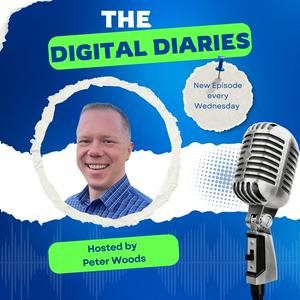
Hosted by Peter Woods
The Digital Diaries is a podcast about navigating modern work, creativity, and identity in a rapidly changing digital world.
Hosted by Peter Woods, the show features conversations with builders, creators, technologists, and leaders who are shaping — and questioning — how technology influences culture, careers, and human behaviour.
Each episode explores themes like creativity in the age of AI, leadership in the digital era, personal branding, entrepreneurship, and the tension between building and critiquing. This isn’t a hype-driven tech podcast. It’s a reflective space for people who want to
Podcast websiteListen to The Digital Diaries Hosted by Peter Woods, Inside Business with Ciaran Hancock and many other podcasts from around the world with the radio.net app
Get the free radio.net app
- Stations and podcasts to bookmark
- Stream via Wi-Fi or Bluetooth
- Supports Carplay & Android Auto
- Many other app features
Get the free radio.net app
- Stations and podcasts to bookmark
- Stream via Wi-Fi or Bluetooth
- Supports Carplay & Android Auto
- Many other app features

The Digital Diaries Hosted by Peter Woods
Scan code,
download the app,
start listening.
download the app,
start listening.
 Ireland