

Listen to this podcast in the app for free: Download for free in the App Store
radio.net
Sleep timer
Save favourites
Beyond Barbarossa: The Eastern Front of World War 2
Beyond Barbarossa: The Eastern Front of World War 2
Latest episode
116 episodes
S5 Ep108: Norway occupied: Concentration camps + resistance—Episode 108
05/10/2026 | 43 mins.The nazis thought they would find a brethren Nordic race in Norway. The people's resistance to their occupation brought about an even more brutal occupation.
Part 2 of the conversation with author J.L. Oakley
Hosted on Audioboom. See Beyond Barbarossa’s privacy policy for more information.S5 Ep107: World War 2 in Norway: A conversation with author J.L. Oakley—Episode 107
21/09/2026 | 37 mins.A conversation with J.L. Oakley, author of three historical novels set in Norway during the German occupation of 1940 to 1945
Like the Eastern Front, Norway’s experience during the Second World War is not well known in the English-speaking world. Author Janet Oakley is helping correct that.
Books mentioned
By J.L. Oakley:
The Jossing Affair
The Quisling Factor
The Brisling Code
Hitler's Northern Utopia by Dispina Stratigakos
Gold Run by Robert Pearson
Snow Treasure by Marie McSwigan
Hosted on Audioboom. See Beyond Barbarossa’s privacy policy for more information.S5: Special episode: The Cold War anniversary
07/09/2026 | 41 mins.In this special episode of the podcast on the Eastern Front of World War Two, we go beyond Beyond Barbarossa and beyond the end of the Second World War.
80 years ago to the day of this publication a handsome young man approached Canadian media and officials with proof that the Soviet Union was spying on its allies. The Cold War was on.
Former Soviet cypher clerk Igor Gouzenko, hooded to protect his identity, being interviewed by Associated Press reporter Saul Pett in Montreal in 1954.
The Gouzenkos’ apartment building on Somerset Street in central Ottawa. There is no plaque commemorating Igor Gouzenko. (Photo by Scott Bury, 2025.)
Igor Gouzenko in Canada, 1946.
Sources
Winston Churchill, “The Sinews of Peace,” speech given at Westminster College, Fulton, Missouri, U.S.A., 5 March 1946.
https://www.americanrhetoric.com/speeches/winstonchurchillsinewsofpeace.htm
J.L. Granatstein and David Stafford, Spy Wars: Espionage and Canada from Gouzenko to Glasnost. Toronto: Key Porter Books, 1990.
John Sawatsky, Gouzenko: The Untold Story. Toronto: Macmillan of Canada, 1984
Wikipedia, Gouzenko Affair. https://en.wikipedia.org/wiki/Gouzenko_Affair
Wondery Podcasts, “The Spy Who, Season 7: The Spy Who Started the Cold War” https://wondery.com/shows/the-spy-who/season/7/
Hosted on Audioboom. See Beyond Barbarossa’s privacy policy for more information.S5 Ep106: The USSR vs. Japan, 1945: A conversation with James Scott
24/08/2026 | 59 mins.Historian and author of Empire of Ashes: Truman, Hirohito and the Descent into Total War
James Scott’s latest book, Empire of Ashes, describes in detail the flights that brought nuclear bombs to Japan in August 1945. It also draws intimate portraits of the two leading antagonists on those days, U.S. President Harry Truman and Japanese Emperor Hirohito, from their earliest days through the personal transformations that ushered in a new era of warfare.
Hosted on Audioboom. See Beyond Barbarossa’s privacy policy for more information.S5 Ep2: Potsdam: The Big Three decide the new world order—Episode 105
10/08/2026 | 36 mins.In July and August, the leaders and delegations from the “Big Three” victors of the Second World War reshape the borders of Europe and set up a new world order.
Hosted on Audioboom. See Beyond Barbarossa’s privacy policy for more information.
More History podcasts
Trending History podcasts


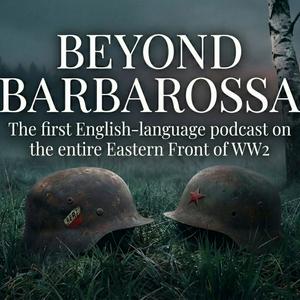
About Beyond Barbarossa: The Eastern Front of World War 2
You know about Stalingrad, the siege of Leningrad, maybe Kursk. But how well do you know the history of the ”Russian front” of the Second World War? Join this detailed description of the largest part of WW2 in Europe, the titanic clash between tyrants Hitler and Stalin. Hosted on Audioboom. See Privacy Policy (https://audioboom.com/about/privacy) for more information.
Podcast websiteListen to Beyond Barbarossa: The Eastern Front of World War 2, After Dark: Myths, Misdeeds & the Paranormal and many other podcasts from around the world with the radio.net app
Get the free radio.net app
- Stations and podcasts to bookmark
- Stream via Wi-Fi or Bluetooth
- Supports Carplay & Android Auto
- Many other app features
Get the free radio.net app
- Stations and podcasts to bookmark
- Stream via Wi-Fi or Bluetooth
- Supports Carplay & Android Auto
- Many other app features

Beyond Barbarossa: The Eastern Front of World War 2
Scan code,
download the app,
start listening.
download the app,
start listening.
 Ireland