

Listen to this podcast in the app for free: Download for free in the App Store
radio.net
Sleep timer
Save favourites
36 episodes
Michael Collins - Part 1
05/10/2026 | 41 mins.On the 22nd of August 1922, Michael Collins, the Commander in Chief of the National Army was shot dead. He was just 31.
Almost immediately the myth making around Michael Collins began, starting with the last words he’s alleged to have uttered.
But what is the real legacy of Michael Collins? He was a man who operated as a politician but was capable of ruthless violence.
On this week’s What Were We Like, we talk about Michael Collins, a man that has captured the imagination of the Irish public, film makers, artists and politicians like no other figure in modern Irish history.
See omnystudio.com/listener for privacy information.Stardust – From national tragedy to national scandal
28/09/2026 | 49 mins.In the early hours of February 14th 1981, a fire ripped through the Stardust Nightclub in Artane in Dublin.
48 people, aged between 16 and 27, die in the tragedy. It is one of the worst fires, in terms of loss of life and significant injury, in the State’s history.
In 1982 a Tribunal controversially found that the fire was "probably caused deliberately" despite no evidence.
For 43 years, the families fought for justice for the 48 people who died and to get answers how their love ones died. This is the story of Stardust.
See omnystudio.com/listener for privacy information.Sean O’Casey – The Irish Rebel playwright
21/09/2026 | 42 mins.He was one of Ireland’s greatest and most controversial playwrights. Sean O’Casey’s remarkable life began in the slums of Dublin and took him to the biggest stages in the world, including the Abbey Theatre.
His work caused riots in Dublin and caused protests around the world, from Texas to Berlin to London. O’Casey made enemies of the Church and the Censors, forcing him to choose self-imposed exile in England.
Through his plays, O’Casey asked fundamental questions about violence and challenged the founding myths of the new Irish state. They were questions a new Ireland wasn’t ready for.
See omnystudio.com/listener for privacy information.The Ballyseedy Massacre (Part 2)
14/09/2026 | 32 mins.After committing one of the worst atrocities in the Irish Civil War, the State attempts to cover up its role in the massacre.
As “Terror Month” in Kerry continues, further atrocities are carried out with more prisoners blown up by landmines.
However, the man who gave the order at Ballyseedy, Paddy O'Daly, remains unrepentant, stating: “No one asked me to take my kid gloves to Kerry and I didn’t take them.”
Diarmaid and Catriona discuss the fall out from Ballyseedy, how the truth finally emerges, and why the Dáil record still contains the cover-up.
See omnystudio.com/listener for privacy information.The Ballyseedy Massacre (Part 1)
07/09/2026 | 30 mins.On the 7th of March 1923, nine anti-Treaty prisoners were taken to a field in Kerry, tied to a landmine and blown up. It was one of the most shocking events of the Irish Civil War and became known as the Ballyseedy Massacre. The State immediately tried to cover it up but incredibly, one man survived and his witness account revealed just how brutal the civil war had become. Diarmaid and Catriona recount the whole affair, and also the wider conflict in Kerry at the time, which is often referred to as "Terror Month".
See omnystudio.com/listener for privacy information.
More History podcasts
 Empire: World HistoryHistory
 Irish History PodcastHistory
 The Rest Is ClassifiedHistory
 Short History Of...History
 American ScandalDocumentary, History, Society & Culture
 Dan Snow's History HitHistory
 British ScandalDocumentary, History, Society & Culture
 In Our TimeHistory
 The Rest Is HistoryHistory
 After Dark: Myths, Misdeeds & the ParanormalHistory, Society & Culture, True Crime
Trending History podcasts
 Roma AeternaHistory
 The Irish History BoysEducation, History, News
 PreOccupation: A Not-So-Brief History of PalestineDocumentary, Government, History, Islam, Religion & Spirituality, Society & Culture
 History For Sleep with the Drowsy HistorianHistory
 Cool People Who Did Cool StuffHistory, Society & Culture
 Wiser WorldEducation, History, Places & Travel, Society & Culture
 Revolutionary IrelandEducation, History
 The History of WWII PodcastEducation, History, Society & Culture
 WW2: Both Sides of The WireHistory
 ABC RewindDocumentary, History, Society & Culture
 ThroughlineDocumentary, History, Society & Culture
 The History of IrelandHistory
 Ancient to RecentHistory
 Tarihte Acaib ve GaraibEducation, History, Society & Culture
 Conflicted: A History PodcastEducation, History, Society & Culture
 BattlegroundHistory
 The Story of MoneyBusiness, Business News, Education, History, News, Society & Culture
 History of the Germans from the Middle Ages to ReunificationEducation, History, Language Learning, Society & Culture
 BlindspotDocumentary, History, Society & Culture
 History HubCourses, Education, History
 Ask Haviv AnythingHistory
 History's Greatest Conspiracy TheoriesHistory
 the memory palaceHistory
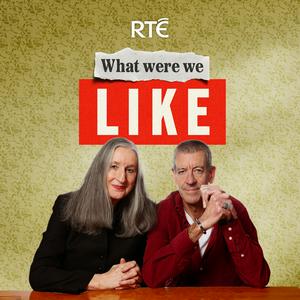
About What Were We Like
Diarmaid Ferriter and Catriona Crowe bring us on a journey through the hidden histories, humanity and humour of our past.
Podcast websiteListen to What Were We Like, Empire: World History and many other podcasts from around the world with the radio.net app
Get the free radio.net app
- Stations and podcasts to bookmark
- Stream via Wi-Fi or Bluetooth
- Supports Carplay & Android Auto
- Many other app features
Get the free radio.net app
- Stations and podcasts to bookmark
- Stream via Wi-Fi or Bluetooth
- Supports Carplay & Android Auto
- Many other app features

What Were We Like
Scan code,
download the app,
start listening.
download the app,
start listening.
What Were We Like: Podcasts in Family
 Ireland