

Listen to this podcast in the app for free: Download for free in the App Store
radio.net
Sleep timer
Save favourites
24 episodes

Episode 24: Understanding Environmental Toxins with Professor Alistair Boxall
02/07/2026 | 40 mins.Episode Overview
IProfessor Alastair Boxall, an environmental scientist who has monitored chemical pollution across more than 230 rivers in over 100 countries, helps us separate genuine risk from needless worry when it comes to environmental toxins. Prof. Boxall explains why detecting a chemical is not the same as it being dangerous, what really slips through our drinking water treatment, and why some of the biggest threats — like antimicrobial resistance and pet flea treatments — receive far less attention than they should. Rather than fuelling fear, this interview offers a calm, evidence-based framework for understanding what matters and the practical steps that genuinely reduce your exposure. It's a refreshing antidote to the alarming headlines, grounded in decades of real-world monitoring.
Key 'Environmental Toxins' Insights:
Detection Isn't Danger: Modern instruments can detect hundreds or thousands of chemicals in a single water sample, but only a tiny fraction occur at levels capable of causing harm. Increasingly sensitive testing scares people without necessarily revealing real risk.
Tap Water Often Beats Bottled: UK drinking water treatment is genuinely good, removing most river contaminants. Bottled water carries its own problems — plastic additives that leach in, and far higher microplastic levels than tap water.
The Three Biggest Concerns: Of all the contaminants Prof. Boxall studies, PFAS ("forever chemicals"), antibiotics driving antimicrobial resistance, and aquatic insecticides worry him most — not the microplastics that dominate headlines.
Antimicrobial Resistance Is a Silent Pandemic: Antibiotics detected almost everywhere in the global environment may be selecting for resistant bacteria that re-enter human populations. AMR was linked to an estimated 1.2 million deaths globally in 2019.
Pet Flea Treatments Are an Overlooked Threat: With 22 million cats and dogs in the UK now routinely treated monthly, highly toxic insecticides like imidacloprid are entering rivers and harming the invertebrates that keep waterways healthy. Environmental risk isn't even assessed in their approval.
Microplastics Are Over-Hyped: While not harmless, much of the alarming microplastics-and-health coverage rests on weak science. Robust research is still needed before we know whether they truly pose a risk to human health.
Lead Piping Still Matters in Older Homes: Houses built before the 1970s may still have lead pipes. Running the tap each morning to clear water that sat overnight significantly reduces chronic exposure.
Want the complete framework?
Get The Vital 3 Method guide free — the evidence-based system for sustainable health after 40.
Download the Free Guide
Expert 'Environmental Toxins' Takeaways
Reframe scary headlines by remembering that detecting a chemical says nothing about whether it's present at a harmful level
Reconsider bottled water — it offers no proven safety advantage over UK tap water and carries more microplastics
If you live in a pre-1970s home, run the tap each morning before drinking to flush water that has been sitting in potentially lead-containing pipes
Research any water filter before buying — different filters remove different things (lead, PFAS, hardness), so match the filter to your actual concern
Wash or peel fruit and vegetables, since chemical residues concentrate in the peel rather than the flesh
Avoid swimming in rivers for a few days after heavy rainfall, when storm overflows discharge sewage and bacteria; check live overflow maps where available
Choose locally sourced, varied food and reduce reliance on factory-farmed products to lower both your exposure and the wider environmental chemical burden
Think before applying pet flea treatments routinely — consider whether monthly preventive dosing is necessary, as these chemicals migrate into the environment after use
Walk or cycle instead of driving where you can, reducing traffic-related air pollution that contributes to the UK's "pollute-ome"
About Our Guest
Professor Alastair Boxall is a Professor of Environmental Science specialising in the occurrence, fate, and effects of chemical contaminants in the natural environment. His research has included global monitoring of pharmaceutical pollution across more than 230 rivers in 104 countries, alongside pioneering work on PFAS, antimicrobial resistance, and the emerging environmental risks of pet flea treatments. His work informs how scientists and regulators understand the real-world risks posed by environmental toxins.
Visit Professor Boxall's Academic Profile
Watch the 'Environmental Toxins' Interview
'Environmental Toxins' Resources
Key Research Discussed:
Pharmaceutical Pollution of the World's Rivers (PNAS, 2022) — Prof. Boxall's global study of 258 rivers across 104 countries, showing the worst pollution in low- and middle-income regions.
https://www.pnas.org/doi/10.1073/pnas.2113947119
Trifluoroacetic Acid (TFA) in UK Surface Waters (University of York / Fidra, 2025) — Found TFA at 98% of sites tested, with Glasgow's River Kelvin the second-highest level ever recorded globally.
https://www.york.ac.uk/news-and-events/news/2025/research/forever-chemicals-river/
Relevant Organisations:
Environment Agency — Monitors the ecological and chemical status of England's rivers.
https://www.gov.uk/government/organisations/environment-agency
Drinking Water Inspectorate — Regulates UK drinking water quality; consumer advice on tap water, filters, and lead.
https://www.dwi.gov.uk/
Food Standards Agency — Monitors food for chemical contaminants against safe levels.
https://www.food.gov.uk/
National Storm Overflow Hub (Water UK) — Live map of storm overflow discharges; check before river swimming after rain.
https://www.streamwaterdata.co.uk/pages/the-national-storm-overflow-hub
It's not about willpower
A doctor's guide to healthy living and making it stick
What's inside
Why healthy living matters for you and your loved ones
The actions that make a difference - not 100 biohacks that don't!
My exact program that helped me lose 14kg in weight, reverse my metabolic age, and feel in the best shape of my life
Tips on using AI to supercharge your lifestyle changes
First Name
Please enter your name.
Email Address
Please enter a valid email address.
Send me the Free PDF!
Please check your email for further instructions. Check your junk mail if you cannot find the email in the next few minutes.
Something went wrong. Please check your entries and try again.
I will not share your details with any third party
Additional Interviews
Are you interested in other expert interviews on health, wellness and longevity topics? Click on the links below to discover more.
Sleep
The most under-rated life pillar of all!
Sleep Content
Exercise
The foundation of lasting health
Exercise Content
Nutrition
The fuel that shapes your wellbeing
Nutrition Content
The post Episode 24: Understanding Environmental Toxins with Professor Alistair Boxall first appeared on Stress-Free Longevity.Episode 23: Understanding Microplastics with Professor Richard Thompson
31/03/2026 | 55 mins.Episode Overview
Professor Richard Thompson — the marine biologist who coined the term "microplastics" — reveals what three decades of research have uncovered about these microscopic particles now found in our food, water, and air. Prof. Thompson explains how microplastics move from the environment into our bodies, why the chemicals associated with them pose a growing threat to human health, and what practical steps we can all take to reduce our exposure.
Key 'Microplastics' Insights:
The Scientist Who Named the Problem: Prof. Thompson published the first paper using the term "microplastics" in Science in 2004. There are now over 7,000 scientific publications on the topic.
Microplastics Are Literally Everywhere: Microscopic plastic particles have been found on every continent, 4,000 metres deep in the ocean, and in Arctic ice cores — often in greater quantities in remote locations than near major cities.
Your Kitchen Air Is a Bigger Source Than Your Fish Supper: The quantity of microplastics in your kitchen air during meal preparation exceeds the amount present in the fish itself. Household dust is a major source of human exposure.
16,000 Chemicals, 4,000 Potentially Harmful: Over 16,000 chemicals are associated with plastic production, more than 4,000 of which are known to be potentially harmful — yet very few are regulated.
The Health Costs May Equal the Entire Plastic Market: Research suggests that global health costs from plasticizer chemicals alone could match the entire annual value of the plastics industry.
Today's Plastic Items Are Tomorrow's Microplastics: Even if all pollution stopped today, microplastic levels would continue rising for decades as existing large items fragment into smaller pieces.
Want the complete framework?
Get The Vital 3 Method guide free — the evidence-based system for sustainable health after 40.
Download the Free Guide
Expert 'Microplastics' Takeaways
Reduce single-use plastic where possible — carry a refillable bag, water bottle, and coffee cup
Drink tap water instead of bottled water where it's safe to do so
Refuse unnecessary plastic packaging in shops, restaurants, and bars — consumer resistance sends a powerful market signal
Check which plastics your local authority actually accepts for recycling, as this varies significantly between areas
Wash synthetic clothes less frequently — half of all fibre emissions come from everyday wear rather than laundering
Maintain car tyres properly, as each set releases roughly 4–5kg of microplastic dust into the environment before replacement
Recognise that individual changes alone cannot solve this — the biggest impact comes from better product design, stronger policy, and industry accountability
About Our Guest
Professor Richard Thompson OBE is a marine biologist at the University of Plymouth who coined the term "microplastics" in his landmark 2004 paper in Science. He is co-coordinator of the Scientists' Coalition for an Effective Plastics Treaty, a network of 400 scientists bringing independent evidence to global policy negotiations.
Visit Professor Thompson's Academic Profile
Watch the 'Gut-Brain Connection' Interview
'Microplastics' Resources
Key Research Discussed:
Thompson et al. 2004, "Lost at Sea: Where Is All the Plastic?" (Science) — The landmark paper coining the term "microplastics": https://www.science.org/doi/10.1126/science.1094559
Thompson et al. 2024, "Twenty Years of Microplastic Pollution Research — What Have We Learned?" (Science) — The 20-year review paper: https://www.science.org/doi/10.1126/science.adl2746
Relevant Organisations:
Scientists' Coalition for an Effective Plastics Treaty: https://ikhapp.org/scientistscoalition/
Marine Conservation Society: https://www.mcsuk.org/
It's not about willpower
A doctor's guide to healthy living and making it stick
What's inside
Why healthy living matters for you and your loved ones
The actions that make a difference - not 100 biohacks that don't!
My exact program that helped me lose 14kg in weight, reverse my metabolic age, and feel in the best shape of my life
Tips on using AI to supercharge your lifestyle changes
First Name
Please enter your name.
Email Address
Please enter a valid email address.
Send me the Free PDF!
Please check your email for further instructions. Check your junk mail if you cannot find the email in the next few minutes.
Something went wrong. Please check your entries and try again.
I will not share your details with any third party
Additional Interviews
Are you interested in other expert interviews on health, wellness and longevity topics? Click on the links below to discover more.
Sleep
The most under-rated life pillar of all!
Sleep Content
Exercise
The foundation of lasting health
Exercise Content
Nutrition
The fuel that shapes your wellbeing
Nutrition Content
The post Episode 23: Understanding Microplastics with Professor Richard Thompson first appeared on Stress-Free Longevity.Episode 22: Understanding the Gut-Brain Connection with Professor John Cryan
17/03/2026 | 42 mins.Episode Overview
Professor John Cryan — Vice President for Research at University College Cork and a pioneer of microbiome-gut-brain science — reveals how trillions of gut microbes directly influence your mood, stress resilience, and long-term brain health. From coining the term "psychobiotic" to leading research linking gut bacteria to social behaviour and neurodegenerative disease, Prof. Cryan explains what the gut brain connection means for anyone looking to support their mental health and healthy aging through what they eat.
Key 'Gut-Brain Connection' Insights:
Your Gut Has Its Own Brain: The enteric nervous system contains more nerve cells than your spinal cord. This "second brain" sends signals directly to your brain via the vagus nerve, influencing how you feel moment to moment.
Three Pathways Link Gut to Brain: Gut bacteria communicate with the brain through metabolites that cross the blood-brain barrier, immune cells that signal to the brain, and hormones including GLP-1.
Your Microbiome Follows a Daily Rhythm: UCC research revealed that the gut microbiome shifts across the day with circadian rhythms. When the microbiome was depleted, normal daily stress regulation collapsed entirely — suggesting when you eat may matter as much as what.
Stress Reshapes Your Gut — And Vice Versa: Chronic stress alters gut bacteria composition, and those altered bacteria amplify the stress response. Feeding stressed students a diet rich in fibre and fermented foods dampened their stress response.
Parkinson's May Begin in the Gut: In many cases, gut symptoms like constipation appear years before brain symptoms. Pathological changes may travel from the gut to the brain via the vagus nerve, opening new avenues for early detection.
Social Behaviour Depends on Gut Microbes: Mice without gut microbes lose interest in social interaction entirely. When Prof. Cryan's team transplanted microbes from social anxiety patients into healthy mice, those mice developed elements of social anxiety — a causal link.
Most Commercial Probiotics Are Untested: The majority of probiotic products have never been tested for clinical benefit, and some don't survive stomach acid. Always ask whether the specific strain has published evidence behind it.
Want the complete framework?
Get The Vital 3 Method guide free — the evidence-based system for sustainable health after 40.
Download the Free Guide
Expert 'Gut-Brain Connection' Takeaways
Prioritise dietary fibre — it feeds beneficial gut bacteria that produce short-chain fatty acids critical for gut lining health and brain signalling
Increase colour and diversity in your diet — polyphenols in berries, green tea, dark chocolate, and onions are broken down by microbes into brain-beneficial chemicals
Add fermented foods daily — kefir, kombucha, sauerkraut, and fermented vegetables introduce beneficial bacteria affordably
Reduce ultra-processed food, artificial sweeteners, and emulsifiers — all shown to negatively impact microbiome diversity
Scrutinise probiotic supplements — demand published evidence for the specific strain, not general marketing claims
Support breastfeeding and minimise unnecessary antibiotics in early life — the microbiome largely settles by age two to four, and early disturbances can have lasting effects
Protect your sleep and circadian rhythms — sleep disturbances and jet lag harm your microbiome and disrupt its role in daily stress regulation
Consider getting a dog — emerging research links pet ownership to improved microbiome diversity and better mental health, with recent studies suggesting the benefit is mediated through the microbiome
About Our Guest
Professor John Cryan is Vice President for Research and Innovation at University College Cork and a Principal Investigator at APC Microbiome Ireland. A stress neurobiologist who co-coined the term "psychobiotic" and co-authored The Psychobiotic Revolution, his pioneering research on the gut brain connection has shaped our understanding of how gut bacteria influence mood, stress, social behaviour, and brain health across the lifespan.
Visit Professor Cryan's Academic Profile
Watch the 'Gut-Brain Connection' Interview
'Gut-Brain Connection' Resources
Key Research Discussed:
Psychobiotic Diet and Stress Study — Berding, Cryan, Dinan et al. (2022), Molecular Psychiatry. Four-week psychobiotic diet (high fibre + fermented foods) reduced perceived stress in healthy adults
Microbiota Is Essential for Social Development in the Mouse — Desbonnet, Clarke, Shanahan, Dinan & Cryan (2014), Molecular Psychiatry. First study showing germ-free mice display social deficits
Social Interaction and the Amygdala in Microbiome-Deficient Mice — Stilling, Moloney et al. (2018), eLife. Molecular basis for how the microbiome is crucial for normal social behaviour
Gut Microbiota Composition Correlates with Diet and Health in the Elderly — Claesson, Jeffery, O'Toole et al. (2012), Nature. Landmark ELDERMET study of 178 elderly subjects linking dietary diversity to microbiome diversity and health
MAEVE Polyphenol Trial — Ongoing study with University of Ulster and UCLA on berry polyphenols in people at risk for Alzheimer's
Relevant Resources
APC Microbiome Ireland — The UCC research centre leading gut brain connection research
The NiMe Diet: Scientific Principles and Recipes — Free online cookbook by Anissa Armet and Prof. Jens Walter (UCC) based on ancestral dietary patterns
Books Mentioned:
The Psychobiotic Revolution by Scott C. Anderson, John F. Cryan and Ted Dinan (National Geographic Press, 2017)
Amazon UK
Amazon USA
It's not about willpower
A doctor's guide to healthy living and making it stick
What's inside
Why healthy living matters for you and your loved ones
The actions that make a difference - not 100 biohacks that don't!
My exact program that helped me lose 14kg in weight, reverse my metabolic age, and feel in the best shape of my life
Tips on using AI to supercharge your lifestyle changes
First Name
Please enter your name.
Email Address
Please enter a valid email address.
Send me the Free PDF!
Please check your email for further instructions. Check your junk mail if you cannot find the email in the next few minutes.
Something went wrong. Please check your entries and try again.
I will not share your details with any third party
Additional Interviews
Are you interested in other expert interviews on health, wellness and longevity topics? Click on the links below to discover more.
Sleep
The most under-rated life pillar of all!
Sleep Content
Exercise
The foundation of lasting health
Exercise Content
Nutrition
The fuel that shapes your wellbeing
Nutrition Content
The post Episode 22: Understanding the Gut-Brain Connection with Professor John Cryan first appeared on Stress-Free Longevity.Episode 21: Understanding Protein and Muscle with Professor Luc Van Loon
02/02/2026 | 42 mins.Episode Overview
In this evidence-rich conversation, Professor Luc Van Loon, one of the world's leading researchers on protein and muscle metabolism at Maastricht University, cuts through the noise to reveal what the science actually shows. With over three decades of research spanning elite athletes to intensive care patients—and approximately 40 million euros of research investment—Prof. Van Loon explains the relationship between protein and muscle, why the protein aisle in supermarkets is mostly marketing, and the surprisingly simple factors that affect how well we absorb what we eat. This interview separates genuine nutritional science from social media hype and provides practical guidance on protein and muscle health at any age.
Key 'Protein and Muscle' Insights:
Your Muscles Completely Renew Every Few Months: Muscle proteins turn over at 1-2% per day, meaning your entire muscle mass is broken down and rebuilt roughly every 50-100 days. This constant refurbishment is why protein and muscle health are so closely linked—and why muscle loss becomes apparent so quickly during illness or immobility.
The WHO Minimum Isn't the Optimum: The WHO guideline of 0.83g protein per kilogram body weight per day represents the minimum to maintain nitrogen balance, not optimal intake. Most healthy, active people naturally consume 1-1.2g/kg, while athletes easily reach 1.5g/kg simply by eating more food.
20-25 Grams Per Meal Is the Sweet Spot: This amount of protein stimulates muscle protein synthesis for four to six hours. That's equivalent to half a litre of milk, two to three eggs, 70-100g of meat or fish, or a coffee cup full of nuts.
Plant Proteins Work—You Just Need More: While plant-based proteins have lower digestibility and may lack certain amino acids, eating a diverse range of plant foods compensates for these limitations. As Prof. Van Loon puts it: "Similar to cheap beer, you can compensate for lesser quality by greater quantity."
Sitting Upright and Chewing Well Aren't Just Manners: Research shows body position and chewing have measurable effects on protein digestion—comparable in magnitude to the differences between whey and casein proteins. Studies hanging participants upside down revealed dramatically impaired gastric emptying.
Hospital Patients Are Severely Underproteinised: People recovering from elective surgery consume only 0.5g protein per kilogram body weight daily—roughly one third of the 1.2-1.5g/kg recommended for recovery. Most food provided simply isn't eaten.
Age-Related Muscle Loss Is Largely Preventable: The demographic decline in muscle mass as we age isn't inevitable biology—it's the accumulated impact of successive periods of illness and immobility where people lose more muscle than they regain during recovery.
Want the complete framework?
Get The Vital 3 Method guide free — the evidence-based system for sustainable health after 40.
Download the Free Guide
Expert 'Protein and Muscle' Takeaways
Include 20-25 grams of protein at each main meal, paying particular attention to breakfast where most people fall short
Sit upright while eating and chew your food thoroughly—these simple habits meaningfully improve protein digestion and absorption
Consume some protein after evening exercise sessions, whether as a snack or a later meal, to support overnight muscle recovery
Combine different plant-based protein sources if eating predominantly plant-based, rather than relying on any single source, to ensure complete amino acid coverage
Focus on your overall diet before considering supplements—most people using protein powders don't actually know how much protein they're already consuming from food
If using GLP-1 agonist medications for weight loss, prioritise protein-dense foods since reduced eating makes nutrient quality even more critical
Recognise that most "high protein" products in supermarkets were already high in protein before the label was added—it's often education rather than fortification
Maintain physical activity during periods of illness or recovery, as the combination of exercise and protein creates a synergistic effect on muscle building that neither achieves alone
About Our Guest
Professor Luc Van Loon leads the protein and muscle metabolism research group at Maastricht University in the Netherlands. With over 30 years of research spanning elite athletes to intensive care patients, his work has fundamentally shaped our understanding of protein and muscle, including protein timing, digestion, and absorption.
Visit Prof. Luv van Loon's Academic Profile
Watch the 'Protein and Muscle' Interview
'Protein and Muscle' Resources
Key Research Discussed:
WHO/EFSA Protein Guidelines — The recommendation of 0.83g protein per kilogram body weight per day for nitrogen balance: https://www.efsa.europa.eu/en/press/news/120209
Body Position and Protein Digestion — The "inversion table" study showing posture affects gastric emptying and amino acid availability: https://pubmed.ncbi.nlm.nih.gov/27089362/
Upright vs Lying Position Study — Follow-up research on sitting upright versus lying down during meals: https://pubmed.ncbi.nlm.nih.gov/28212491/
Pre-Sleep Protein Ingestion — Research on protein before sleep and overnight muscle protein synthesis: https://pubmed.ncbi.nlm.nih.gov/22330017/
Pre-Sleep Protein Review — Comprehensive update on pre-sleep protein and exercise adaptation: https://www.frontiersin.org/journals/nutrition/articles/10.3389/fnut.2019.00017/full
Relevant Organisations:
M3 Research Group, Maastricht University — Prof. Van Loon's research laboratory: https://www.researchgate.net/lab/M3-Research-Group-Luc-J-C-van-Loon
It's not about willpower
A doctor's guide to healthy living and making it stick
What's inside
Why healthy living matters for you and your loved ones
The actions that make a difference - not 100 biohacks that don't!
My exact program that helped me lose 14kg in weight, reverse my metabolic age, and feel in the best shape of my life
Tips on using AI to supercharge your lifestyle changes
First Name
Please enter your name.
Email Address
Please enter a valid email address.
Send me the Free PDF!
Please check your email for further instructions. Check your junk mail if you cannot find the email in the next few minutes.
Something went wrong. Please check your entries and try again.
I will not share your details with any third party
Additional Interviews
Are you interested in other expert interviews on health, wellness and longevity topics? Click on the links below to discover more.
Sleep
The most under-rated life pillar of all!
Sleep Content
Exercise
The foundation of lasting health
Exercise Content
Nutrition
The fuel that shapes your wellbeing
Nutrition Content
The post Episode 21: Understanding Protein and Muscle with Professor Luc Van Loon first appeared on Stress-Free Longevity.Episode 20: Understanding Ultra Processed Foods with Dr Euridice Martinez-Steele
06/01/2026 | 47 mins.Episode Overview
In this eye-opening conversation, Dr Euridice Martinez-Steele, who has spent 12 years researching ultra processed foods at NUPENS (University of Sao Paulo), explains how these industrial food formulations are driving chronic disease worldwide. Drawing on evidence from almost 10 million participants and the gold-standard randomised controlled trials, Dr Martinez-Steele reveals how ultra processed foods increase our eating rate, disrupt our gut microbiome, and expose us to additives with unknown long-term effects. This interview challenges the assumption that approved food additives are necessarily safe and provides practical guidance for navigating the modern food environment.
Key 'Ultra Processed Foods' Insights:
They're Formulations, Not Food: Ultra processed foods are industrial formulations of food-derived substances (oils, fats, sugars, starches) containing little or no whole food. They combine molecules in proportions never found in nature, with synthetic additives our bodies may not know how to metabolise.
Linked to 32 Health Conditions: A 2024 umbrella review evaluating almost 10 million participants found evidence that ultra processed food consumption is associated with mortality, obesity, type 2 diabetes, cardiovascular disease, certain cancers, depression, dementia, and gastrointestinal disease.
RCTs Prove Overconsumption: Two randomised controlled trials demonstrated that participants eating ultra processed diets consumed significantly more calories per minute and gained more weight over just two weeks—providing causal evidence beyond observational studies.
Soft Texture Drives Fast Eating: The deconstructed food matrix of ultra processed foods makes them soft, meaning they're eaten faster with more calories consumed per mouthful. You don't feel full until long after you've finished, driving overconsumption.
Additives Have Unknown Effects: Over 10,000 additives are approved in the US alone, yet their long-term effects, cumulative daily intake effects, and interactions between multiple additives remain largely unknown. Most safety testing uses short-term studies in mice.
Your Gut Microbiome Suffers: The lack of fibre in ultra processed foods starves beneficial gut bacteria, forcing them to consume the protective mucus lining instead. This erodes the gut barrier, potentially allowing harmful bacteria to leak into the bloodstream.
Children Face Greatest Risk: Children consume more additives relative to their body size, begin exposure at an early age, and face a lifetime of cumulative effects. Pregnant women's consumption may also affect fetal development.
Want the complete framework?
Get The Vital 3 Method guide free — the evidence-based system for sustainable health after 40.
Download the Free Guide
Expert 'Ultra Processed Foods' Takeaways
Avoid buying ultra processed foods in the first place—if they're not in your home, you won't consume them in moments of convenience
Skip the ultra processed food aisles in supermarkets entirely and shop at local markets where fresh fruits and vegetables are more prominent
Read ingredient lists on packaged foods—a long list of unfamiliar ingredients indicates ultra processed food, and fewer additives is always better
Fill your plate with whole foods first, as these are satiating and naturally reduce your consumption of ultra processed alternatives
Eat slowly to give your body time to register satiety signals, countering the fast eating rate that ultra processed foods encourage
Avoid eating alone, as solitary eating tends to involve more ready-to-eat ultra processed foods consumed mindlessly
Learn to cook and involve the whole family—regaining cooking skills is one of the most effective ways to reduce ultra processed food dependence
Teach children to read ingredient lists as a form of food education, helping them navigate the ultra processed food environment for life
About Our Guest
Dr Euridice Martinez-Steele is a researcher at NUPENS (Centre for Epidemiological Research in Nutrition and Health) at the University of Sao Paulo, Brazil, where she has studied ultra processed foods for over 12 years. She works closely with the team that developed the NOVA food classification system and her research has helped inform dietary guidelines in Brazil and other countries now recommending reduced ultra processed food consumption.
Visit Dr Euricice Martinez-Steele's Academic Profile
Watch the 'Ultra Processed Foods' Interview
'Ultra Processed Foods' Resources
Key Research Discussed:
The 2024 Umbrella Review — Comprehensive analysis of almost 10 million participants linking ultra processed food consumption to 32 health outcomes
The NOVA Classification System — Developed by Professor Carlos Monteiro at the University of Sao Paulo, categorising foods by extent and purpose of industrial processing
Randomised Controlled Trial on UPFs — The seminal paper by Kevin Hall et al, on UPF and calorie consumption
Relevant Organisations:
NUPENS (Centre for Epidemiological Research in Nutrition and Health) — University of Sao Paulo research centre leading global UPF research
Brazilian Dietary Guidelines — First national guidelines to recommend avoiding ultra processed foods
Policy Initiatives Mentioned:
Chile's Marketing Regulations — Comprehensive ban on marketing foods with nutrient warning labels to children under 14
Colombia's UPF Tax (2023) — First law in Latin America taxing ultra processed foods with warning labels
Brazil's School Lunch Policy — Requires 75% of school lunch funds be spent on unprocessed foods
It's not about willpower
A doctor's guide to healthy living and making it stick
What's inside
Why healthy living matters for you and your loved ones
The actions that make a difference - not 100 biohacks that don't!
My exact program that helped me lose 14kg in weight, reverse my metabolic age, and feel in the best shape of my life
Tips on using AI to supercharge your lifestyle changes
First Name
Please enter your name.
Email Address
Please enter a valid email address.
Send me the Free PDF!
Please check your email for further instructions. Check your junk mail if you cannot find the email in the next few minutes.
Something went wrong. Please check your entries and try again.
I will not share your details with any third party
Additional Interviews
Are you interested in other expert interviews on health, wellness and longevity topics? Click on the links below to discover more.
Sleep
The most under-rated life pillar of all!
Sleep Content
Exercise
The foundation of lasting health
Exercise Content
Nutrition
The fuel that shapes your wellbeing
Nutrition Content
The post Episode 20: Understanding Ultra Processed Foods with Dr Euridice Martinez-Steele first appeared on Stress-Free Longevity.
More Education podcasts
 Coffee Break ItalianCourses, Education, Language Learning
 The Comeback with Brenda DennehyEducation, Health & Wellness, Mental Health, Self-Improvement
 Finding Freedom with Peter CroneEducation, Health & Wellness, Mental Health, Religion & Spirituality, Self-Improvement, Spirituality
 The Florence Given ShowEducation, Health & Wellness, Mental Health, Philosophy, Self-Improvement, Society & Culture
 IT IS WHAT IT IS!Education, Self-Improvement
 Good Life ProjectBusiness, Education, Health & Wellness, Self-Improvement, Tutorials
 No More Booze - The PodcastEducation, Self-Improvement
 Coffee Break SpanishCourses, Education, Language Learning
 Begin Again with Davina McCallEducation, Health & Wellness, Mental Health, Self-Improvement, Society & Culture
 The Mel Robbins PodcastEducation, Health & Wellness, Mental Health, Relationships, Self-Improvement, Society & Culture
Trending Education podcasts
 Conversations with TylerEducation, Society & Culture
 The Jordan Harbinger ShowBusiness, Education, Science
 Coffee Break Italian AdvancedCourses, Education, Language Learning
 Struggle CareEducation, Self-Improvement
 Talking Rubbish - The Recycling PodcastDocumentary, Education, Nature, Science, Society & Culture, Tutorials
 The Middletown Centre for Autism PodcastEducation, Health & Wellness
 ALIGNED | The Path to PurposeAlternative Health, Education, Health & Wellness, Religion & Spirituality, Self-Improvement, Spirituality
 Английский язык по плейлистам. Английский язык с нуля. Полный курсEducation, Language Learning
 How to PhD - your academic survival guideEducation, Science, Tutorials
 Dear GabbyEducation, Health & Wellness, Mental Health, Religion & Spirituality, Self-Improvement, Spirituality
 InnerFrenchEducation, Language Learning
- No More Booze - The PodcastEducation, Self-Improvement
 Change is PossibleEducation, Self-Improvement
 This Naked Mind PodcastEducation, Self-Improvement
- Good Life ProjectBusiness, Education, Health & Wellness, Self-Improvement, Tutorials
- The Florence Given ShowEducation, Health & Wellness, Mental Health, Philosophy, Self-Improvement, Society & Culture
 Learn Indonesian | IndonesianPod101.comEducation, Language Learning, Places & Travel, Society & Culture
 PUBLISHING ACADEMIC RESEARCH | Complete Your Scholarship, Thesis, or Dissertation and Maintain Your Mental HealthEducation, Tutorials
- Coffee Break ItalianCourses, Education, Language Learning
 The BossticksBusiness, Education
 Listening Time: English PracticeEducation, Language Learning
 How to Be a Better HumanEducation, Self-Improvement
 The Art of DeclutteringEducation, Home & Garden, Kids & Family, Leisure, Parenting
 A Normal Meets A NerdEducation, History, Science
 The Daily StoicBusiness, Education, Self-Improvement, Society & Culture
About Stress-Free Longevity
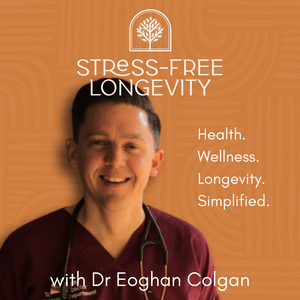
Feeling overwhelmed by conflicting health advice? Join Dr. Eoghan Colgan and leading scientists as they cut through the noise to uncover what really works. We explore the science behind life’s essential pillars, finding simpler paths to wellness. No rigid rules – just clear, evidence-based insights you can trust. For curious minds seeking better ways to live well.
Podcast websiteListen to Stress-Free Longevity, Coffee Break Italian and many other podcasts from around the world with the radio.net app
Get the free radio.net app
- Stations and podcasts to bookmark
- Stream via Wi-Fi or Bluetooth
- Supports Carplay & Android Auto
- Many other app features
Get the free radio.net app
- Stations and podcasts to bookmark
- Stream via Wi-Fi or Bluetooth
- Supports Carplay & Android Auto
- Many other app features

Stress-Free Longevity
Scan code,
download the app,
start listening.
download the app,
start listening.
 Ireland