
Listen to this podcast in the app for free: Download for free in the App Store
radio.net
Sleep timer
Save favourites
110 episodes
ROBOTICS PROFESSOR: "AI Is Becoming Self-Aware! Here’s the Biggest Danger!"
22/10/2026 | 1h 21 mins.Is “AI will destroy humanity” a real risk, or a story we tell ourselves because we haven’t done the hard engineering?
This episode is brought to you by AgelessRx, where aging becomes a puzzle that can be solved. The mission is to help you live longer and healthier by adding more life to your years through science-backed solutions and personalized care. Learn more at agelessrx.com/beyond-tomorrow.
This conversation opens with a simple question to roboticist Hod Lipson, the mind behind Emo: does he feel like a villain? His answer is honest. He’s both excited and terrified, like someone being told an alien race is about to arrive and being asked whether to welcome them. From there, the discussion turns to why robot faces are so hard to build, and why he thinks the moment a robot genuinely smiles back at you will change how we connect with machines.
Then it gets into the harder questions. Hod is firm that AI won’t wipe out humanity, and he’s challenged more than once on superintelligence, on who benefits from the fear, and on whether nested sandboxes and “AI cops” can really keep us safe. The conversation also explores what it means for a robot to be self-aware, robots that repair and even “eat” each other, why he worries about kids and students whose best friend is an AI, and how any of us finds meaning when machines can do almost everything. It closes with the best advice he’s ever been given.
About Hod Lipson
Hod Lipson is a roboticist and AI researcher who leads work on Emo, a robot focused on realistic facial expression and lip movement. His research spans robot self-awareness, self-repairing and self-reproducing robots, and AI in agriculture.
⏱ Timestamps
00:00 Intro
00:08 Do You Feel Like a Villain? The AI Disaster Question
00:59 Robot Faces Are Next
03:49 Why Do We Need a Robot Face?
05:58 Robots That Look More Human-Like
07:50 Are You Scared?
08:42 “We Earned It” as a Human Race
10:40 The Benefits of Developing AI
15:07 Could AI Go Against Us?
17:42 Regulation, Liability and the FDA Analogy
20:00 Meet Emo
23:56 How Will We Interact With Robots in 2030?
27:00 Can a Humanoid Say No to You?
29:24 Do We Lose Skills to Technology?
32:24 Hod’s P(doom) Number: Zero
34:54 AI Is Limited to a Small Part of Our Life
37:42 Can You Switch Off All Robots?
40:44 Is the Doomer Movement Marketing?
43:40 Using AI to Make AI Safer
46:23 Why AI Can’t Kill Us All
50:07 China Leads in Robotics
52:12 Can Robots Develop Awareness?
58:12 The ChatGPT Moment for Robotics
59:28 A Robot Best Friend for a Child?
01:00:26 Would You Let a Robot Babysit?
01:01:53 Self-Awareness in Robots
01:03:42 The Weirdest Things People Will Do With Robots
01:05:10 Building and Maintaining Robots: Robot Metabolism
01:08:41 Exciting Possibilities With Physical Robots
01:10:22 Humans Are Evolving Too
01:13:04 The Pyramid of Needs: Finding Meaning
01:17:35 The Best Piece of Advice
01:18:58 If Tomorrow Was Your Last Day
Connect with Hod:
LinkedIn: https://www.linkedin.com/in/hod-lipson-4018189
Website: https://www.hodlipson.com/
YouTube: https://www.youtube.com/c/HodLipson1
Books: https://www.amazon.com/stores/author/B008VGBM8E/allbooks
Connect with Julian
Instagram: https://www.instagram.com/thebeyondtomorrowpodcast/ / https://www.instagram.com/juliankissa/
LinkedIn: https://uk.linkedin.com/in/julian-issa
X: https://x.com/juliankissa
Website: www.beyondtomorrowpodcast.com
Email: bookings@beyondtomorrowpodcast.com
Watch the full episode on YouTube, or catch it on Spotify and Apple Podcasts. For more conversations from the edge of what's possible, sign up for updates here.BT Clip: Exercise Scientist on Weight Loss Drugs (Mike Israetel)
20/10/2026 | 8 mins.Do we really know enough about GLP-1 drugs?
Mike Israetel breaks down the risks and trade-offs, from anhedonia and calorie-deprived diets to cognitive distortion and the myth of a “zero-harm” default.
Watch the full episode here: https://open.spotify.com/episode/4iHXkGzLvxSU87rzOHNvlq?si=361782122faa4ea94 Longevity Legends Debate Each Other About Human Flourishing
15/10/2026 | 1h 3 mins.What if the fastest way to a longer life isn't a miracle drug, but a wartime mentality against aging?
This episode is brought to you by AgelessRx, where aging becomes a puzzle that can be solved. The mission is to help you live longer and healthier by adding more life to your years through science-backed solutions and personalized care. Learn more at agelessrx.com/beyond-tomorrow.
Curious about quantum energy wellness? Check out Leela Quantum Tech. Check out https://leelaq.com/
On this episode of Beyond Tomorrow, four heavyweights of the longevity field take a rapid-fire statement format and turn it into a real debate. Aubrey de Grey, Alex Zhavoronkov (Insilico Medicine), George Church (Harvard Medical School), Michael Ringel (Life Biosciences) argue over whether hype helps or hurts the field, and when longevity escape velocity, the point where damage is repaired faster than it accumulates, might actually arrive. Aubrey puts it at a 50/50 chance within 12 to 15 years. Alex says 20 to 50 years and doubts drugs alone can get there. Michael pushes back on the idea of infinite lifespans entirely, while George suggests we may already be gaining years without the evidence to prove it.
From there the panel digs into the FDA's new interest in aging, why the TAME metformin trial never opened the floodgates, and whether AI will really shrink clinical timelines. George cites a gene therapy that reached a patient in seven months, while Alex, running many programs, argues that biology still moves at the speed of traffic. The back half covers biohacking and early adopters, the gap between everyday "longevity" and longevity biotechnology, the science of epigenetic reprogramming, what could happen by the XPRIZE Healthspan deadline in 2030, and what each panelist thinks the "ChatGPT moment" for longevity will look like.
About the Panelists
Aubrey de Grey has spent his entire career in the nonprofit sector, coined the term longevity escape velocity, and has been signed up with Alcor for cryonic preservation since 2002.
Alex Zhavoronkov is the founder and CEO of Insilico Medicine, a public biotech company with a large pipeline of drug programs that uses AI to compress early discovery work.
George Church is a Harvard Medical School geneticist and an optimist on gene therapy and exponential technologies, who argues that regulators embrace new technology and that trial parallelism could dramatically cut development time.
Michael Ringel left a career at BCG to join Life Biosciences as chief operating officer, where he works on epigenetic restoration as a path to treating age-related disease and, ultimately, aging itself.
⏱ Timestamps
00:00 Intro
00:20 Is Hype Necessary for Longevity?
02:49 When Hype Goes Too Far
04:14 When Can Longevity Escape Velocity Happen?
09:52 The FDA and Aging as a Focus Area
19:49 Will AI Transform Longevity Research?
24:04 Can AI Shorten Clinical Trials?
26:57 AI Optimists vs. Skeptics
28:38 Alex on Being the Field’s Biggest Skeptic
32:00 Do Critics Need a Drug in the Clinic?
35:24 When Criticism Does Harm
36:45 Is Biohacking Hurting Longevity’s Credibility?
46:57 What Could Be Possible by 2030?
50:49 Optimism vs. Skepticism: Final Thoughts
54:01 Cryonics
54:36 The Longevity “ChatGPT Moment”
Connect with Aubrey:
X: https://x.com/aubreydegrey
LinkedIn: https://www.linkedin.com/in/aubrey-de-grey-24260b
Connect with Alex:
X: https://x.com/biogerontology
LinkedIn: https://www.linkedin.com/in/zhavoronkov
Connect with George:
LinkedIn: https://www.linkedin.com/in/george-church-2b86301
Website: https://colossal.com/george-church/
Connect with Michael:
LinkedIn: https://www.linkedin.com/in/michael-ringel-b272a2
Instagram: https://www.instagram.com/msringel/
Connect with Julian
Instagram: @thebeyondtomorrowpodcast / @juliankissa
LinkedIn: julian-issa
X: @juliankissa
Website: www.beyondtomorrowpodcast.com
Email: bookings@beyondtomorrowpodcast.comBT Clip: Can We Escape The Simulation? (Roman Yampolskiy)
13/10/2026 | 10 mins.Are we living in a simulation?
Dr. Roman Yampolskiy explains how scientists run experiments inside simulations, why boxing AI may not hold, and what it would mean if AI breaks out of its safe environment, or if humanity escapes its own.
Watch the full episode here: https://open.spotify.com/episode/2R7oKzVSOWTR5079TYrZsg?si=7fd6c78a016a4b67MIT Professor & AI Doomer Admits He Was WRONG (Ramesh Raskar)
08/10/2026 | 1h 6 mins.What happens when millions of people hand their lives to AI agents, and nobody has built the rules of the road?
This episode is brought to you by AgelessRx, where aging becomes a puzzle that can be solved. The mission is to help you live longer and healthier by adding more life to your years through science-backed solutions and personalized care. Learn more at agelessrx.com/beyond-tomorrow.
MIT Media Lab professor Ramesh Raskar argues the real danger isn't the AI engine, it's agents with no governance. His case: decentralize AI so billions of people run their own agents, and build the licences, inspections and audit trails agents need, instead of trusting a few labs to make the engine safe. His P(doom) has fallen from 90% to under 10%.
The conversation covers what an AI agent actually is, personal agents like Dot, Muse, Instinct and CC, the DRIVE framework for gradually trusting an agent, why there's no such thing as "zero-shot AGI," the OpenAI and Hugging Face incident, prompt injection, and the shift from an attention economy to an intention economy. One question runs through it all: can we get the benefits of AI agents without handing control to a handful of companies, or to the agents themselves? Ramesh's answer: don't just build better engines, build the roads, the rules and the governance.
Key Takeaways
An agent is an LLM in a loop with tools: the LLM is the engine, the agent is the car, the internet is the road.
Build trust with DRIVE (Discover, Request, Instruct, Venture, Execute), and start with reversible tasks, no credit cards.
Decentralized agents shrink the blast radius, which is why Ramesh's P(doom) has dropped sharply.
Cost is the bottleneck: running an agent per user costs far more than serving a social media user, so expect revenue-share deals.
Prompt injection is the top risk because LLMs can't separate commands from content. Agents need licences, inspection stickers and audit trails.
About Ramesh Raskar
Ramesh Raskar is a professor at the MIT Media Lab, where he works on decentralized AI and the Internet of Agents. His research focuses on how personal AI agents can be built so power stays distributed instead of concentrated in a few companies.
⏱ Timestamps
00:00 Intro
00:00 Why AI Is Moving So Fast: The Intelligence Economy
01:27 What Is an AI Agent, Really?
04:00 Ramesh's P(Doom) Update
05:46 Is Decentralized AI Safer Than Centralized AI?
09:54 How to Use Personal AI Agents (Dot, Muse, Instinct)
13:35 Will AI Agents Become the New Super App?
17:44 The Agentic Web Explained
20:14 Can Personal Superintelligence Exist?
25:17 A Model That Learns How to Learn Everything
29:19 AI Literacy: What to Do If You're Not Using AI
31:16 From OpenClaw to Muse
36:25 It's Not About Bigger Models, It's About Better Agents
37:51 Road Safety Rules for AI Agents
42:58 What a Safe Agentic World Looks Like
44:23 Surfing the Web With AI Agents
48:44 Voice, Screens or Taps? The Future of Agent Interfaces
50:05 Where Will AI Agents Be in One Year?
53:00 The Best Advice on Agent Autonomy
55:12 The Best Things AI Agents Can Do Today
57:12 Prompt Injection: The Command vs Content Problem
01:03:35 If Tomorrow was Your Last Day...
Resources & Mentions
Muse (Meta): https://muse.ai
Dots (OpenAI): https://siliconangle.com/2026/09/29/openai-launches-dots-always-on-ai-agents-in-chatgpt-with-their-own-cloud-computers/
OpenClaw: https://openclaw.ai
Hermes Agent (Nous Research): https://hermes-agent.nousresearch.com/docs/
Connect with Ramesh:
LinkedIn: https://www.linkedin.com/in/raskar
MIT Media Lab: https://www.media.mit.edu/people/raskar/overview/
Connect with Julian
Instagram: @thebeyondtomorrowpodcast / @juliankissa
LinkedIn: julian-issa
X: @juliankissa
Website: www.beyondtomorrowpodcast.com
Email: bookings@beyondtomorrowpodcast.com
Watch the full episode on YouTube, or catch it on Spotify and Apple Podcasts. For more conversations from the edge of what's possible, sign up for updates here.
More Life Sciences podcasts




Trending Life Sciences podcasts



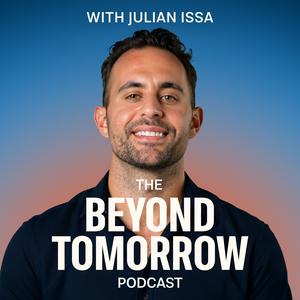
About The Beyond Tomorrow Podcast with Julian Issa
The future feels exciting but a little scary. We're here to help guide you through it.
How?
1. Building stronger, more abundant mindsets.
2. Shining a spotlight on the technologies of tomorrow.
3. Identifying the latest longevity & health protocols.
Health, longevity, human potential and AI.
It's great to have you here.
Julian
Podcast websiteListen to The Beyond Tomorrow Podcast with Julian Issa, The BioCentury Show and many other podcasts from around the world with the radio.net app
Get the free radio.net app
- Stations and podcasts to bookmark
- Stream via Wi-Fi or Bluetooth
- Supports Carplay & Android Auto
- Many other app features
Get the free radio.net app
- Stations and podcasts to bookmark
- Stream via Wi-Fi or Bluetooth
- Supports Carplay & Android Auto
- Many other app features

The Beyond Tomorrow Podcast with Julian Issa
Scan code,
download the app,
start listening.
download the app,
start listening.
 Ireland