
Listen to this podcast in the app for free: Download for free in the App Store
radio.net
Sleep timer
Save favourites
1500 episodes
How A Sociopath Builds A Moral Code Without Guilt | Dr. Patric Gagne
26/10/2026 | 6 mins.What if guilt was never the thing keeping you good?
Check out the full episode: https://greatness.lnk.to/1995DM
Dr. Patric Gagne, a diagnosed sociopath, told Lewis she lives without shame or guilt. What keeps her in line is an internal code built on logic, and the amount of harm she chooses to do is zero.
She once stole from a cruel woman and handed the item to a stranger on the street. It felt so good that she saw the slippery slope right away.
Patric traces that urge to a deep sense of unfairness, one that started in kindergarten when she learned Santa was a lie. She argues that if guilt is the only thing stopping you, you have no real control.
You will start asking why you actually do the right thing, and whether your reasons would still hold if the guilt went quiet.
Sign up for the Greatness newsletter: http://www.greatness.com/newsletter
Hosted by Simplecast, an AdsWizz company. See pcm.adswizz.com for information about our collection and use of personal data for advertising.How To Train Your Brain and Learn Faster Starting Today | Jim Kwik
25/10/2026 | 11 mins.The story that you are a slow learner might be the only thing holding your brain back.
Check out the full episode: https://lewishowes.com/podcast/jim-kwik/
Jim Kwik, who has spent two decades teaching people how to learn and remember, told Lewis about the head injury that left him feeling broken as a kid. It took him two extra years to learn to read, and by college he was ready to quit.
Then he pushed so hard he passed out in the library and woke up in the hospital two days later, down to 117 pounds.
A nurse handed him tea in an Einstein mug: the same level of thinking that created the problem won’t solve the problem. Jim stopped asking why he was slow and started asking how to learn faster. Within 60 days, it felt like a light switch went on.
Ask yourself which story about your own mind you have been calling a fact.
Sign up for the Greatness newsletter!
Hosted by Simplecast, an AdsWizz company. See pcm.adswizz.com for information about our collection and use of personal data for advertising.If Fear Keeps You Safe But Stuck, Open Your Sail | Scott Barry Kaufman
24/10/2026 | 7 mins.You don't have to wait until your fear is gone to start moving toward the life you want.
Check out the full episode: https://greatness.lnk.to/1116DM
Scott Barry Kaufman, the psychologist behind the sailboat model of human needs, told Lewis that Maslow never drew a pyramid at all. Scott sees your needs as one vessel: the boat keeps you afloat, and the sail is what moves you.
When you're short on safety, you start screaming for it, and that gap quickly drains your connection and self-esteem too. Scott calls it the insecurity cycle.
Patching the holes only gets you from negative 50 to zero. Growth starts when you open the sail, even nervous, the way Scott was driving six miles in a suit for the first time in a year.
Pick one place where you've been waiting to feel safe, and choose exploration there anyway.
Sign up for the Greatness newsletter: http://www.greatness.com/newsletter
Hosted by Simplecast, an AdsWizz company. See pcm.adswizz.com for information about our collection and use of personal data for advertising.Turn Your Anxiety Into a Signal That Finally Sets You Free | Dr. John Delony
23/10/2026 | 6 mins.Your anxiety might be the one part of you that is working perfectly.
Check out the full episode: https://greatness.lnk.to/1994DM
Dr. John Delony, a mental health expert, told Lewis that anxiety is a smoke alarm in your house. It can't tell you which room is burning. It just knows there is smoke.
If you carry six figures in student loans and a mortgage, your body would be failing you if it let you sleep all night. Waking at 2:30 in the morning means it is doing its job.
Numbing it with another drink or another Netflix night is, in John's words, duct-taping a pillow over the alarm. Sometimes the real fix is sitting down with your spouse and saying, “We have to rebuild this thing or it's over.”
The next time the alarm wakes you, put down the fight and ask what in your life feels unsafe.
Sign up for the Greatness newsletter: http://www.greatness.com/newsletter
Hosted by Simplecast, an AdsWizz company. See pcm.adswizz.com for information about our collection and use of personal data for advertising.How To Destroy Scarcity With Gratitude in 10 Minutes a Day | Tony Robbins
22/10/2026 | 7 mins.The richest person you know might have almost nothing, as long as they wake up full of gratitude for it.
Check out the full episode: https://greatness.lnk.to/1218DM
Tony Robbins, the life and business strategist, told Lewis that billionaire investor Sir John Templeton once gave him the secret to wealth in one word: gratitude. A billion dollars lived pissed off and frustrated is still a pissed off, frustrated life.
Tony was broke and working 18 hour days when he pulled over on a California freeway near midnight. He wrote in his journal, “the secret to living is giving.” Then he cried.
He saw he had only been asking what he wasn't getting. Scarcity left him that night, and the boy whose family had no Thanksgiving meal has since fed 42 million people.
Try his morning habit tomorrow: three and a half minutes naming what you are grateful for, starting with something as small as the wind on your face.
Sign up for the Greatness newsletter!
Hosted by Simplecast, an AdsWizz company. See pcm.adswizz.com for information about our collection and use of personal data for advertising.
More Education podcasts






Trending Education podcasts



















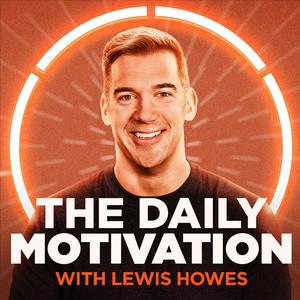
About The Daily Motivation
The stories you tell yourself on a daily basis determines the person you will become.The good, the bad, the negative, the positive, the uplifting, the draining – they’re all part of the equation. But YOU are the author of your life story – so, what story are you writing?
Top Podcaster & Best-selling Author Lewis Howes brings you the The Daily Motivation Show, where you’ll hear from industry-leading experts, you’ll learn proven principles, and you’ll discover life-changing ideas that will help you get motivated and STAY motivated.
Podcast websiteListen to The Daily Motivation, Change is Possible and many other podcasts from around the world with the radio.net app
Get the free radio.net app
- Stations and podcasts to bookmark
- Stream via Wi-Fi or Bluetooth
- Supports Carplay & Android Auto
- Many other app features
Get the free radio.net app
- Stations and podcasts to bookmark
- Stream via Wi-Fi or Bluetooth
- Supports Carplay & Android Auto
- Many other app features

The Daily Motivation
Scan code,
download the app,
start listening.
download the app,
start listening.
The Daily Motivation: Podcasts in Family
 Ireland
