
Listen to this podcast in the app for free: Download for free in the App Store
radio.net
Sleep timer
Save favourites
558 episodes
Atlassian Chief AI Officer: Building Products for Agents and Humans
16/09/2026 | 54 mins.Check out Gartner Symposium: https://cxo.news/KGg8XY
===
Tamar Yehoshua is Chief Product and AI Officer at Atlassian, where AI agents are now direct users of the software her team builds. She led product at Google Search and Slack before joining Atlassian, and in this conversation she explains how the company designs products for both people and agents: the teamwork graph that gives an agent the organizational context it arrives without, who stays accountable when a chain of agents goes wrong, how Atlassian measures AI spending with its CFO, and why she never believed agents would kill SaaS.
YOU'LL DISCOVER
✅ Why an AI agent arrives like someone joining your organization with no background whatsoever, and how the teamwork graph (over 200 billion entities) supplies the missing context
✅ The result of Atlassian's A/B tests: 44% higher quality and 48% lower token usage when coding agents use the teamwork graph, versus MCP alone
✅ How Mercedes-Benz built a Rovo agent that cut manual bug triage work for engineers by 85%
✅ The 10x question Atlassian asks before automating a process, instead of settling for a 10 to 20% incremental gain
✅ How Atlassian measures AI value with the CFO: PRs deployed per engineer, features developed, and whether a growing token budget delivers more value
✅ Why vibe-coded replacements for enterprise SaaS "just don't last" at large companies: support, security, and enterprise readiness
✅ The accountability principle for agent chains: the human who builds the first agent stays responsible, with agents increasingly acting as guardrails for other agents
✅ Why Atlassian's AI gateway routes each job to the right model on quality, latency, and cost instead of locking into one model
⏱️ TIMESTAMPS
0:00 Introduction
0:26 Building products for humans and agents
5:50 The teamwork graph and agent context
13:33 Human oversight and agent guardrails
18:26 Moving fast versus getting it right
21:56 Efficiency first, then new capabilities
26:25 Tokens, vibe coding, and SaaS survival
33:00 Agent accountability and the software lifecycle
38:53 Simpler interfaces and visualizing agent work
41:49 How AI reshapes leadership and hierarchy
48:07 Reimagining processes and the Forge ecosystem
50:44 Advice for CIOs and managing AI costs
CXOTalk streams live with audience questions. Join us live and ask the guests your own questions: https://www.cxotalk.com/subscribe
Subscribe to CXOTalk for weekly conversations with leading business and technology leaders.
Get the CXOTalk newsletter: https://newsletter.cxotalk.com
Show notes, transcript, and summary: https://www.cxotalk.com/episode/atlassian-chief-ai-officer-building-products-for-agents-and-humans
Episode 930 | Recorded August 28, 2026
#CXOTalk #AIAgents #Atlassian #EnterpriseAI #ArtificialIntelligence #AgenticAI #ChiefAIOfficer #ProductManagement #DigitalTransformation #SaaSHow Snap Built a Production System Where Agents Write 90% of Code
01/09/2026 | 54 mins.Check out Gartner Symposium: https://cxo.news/KGg8XY
========
More than 90% of the code at Snap is now written by AI agents, and a code review agent checks most of it within ten minutes. Saral Jain, SVP, Head of Engineering and CIO at Snap Inc., built the system that makes that safe for nearly a billion monthly users. He explains the golden path of 14 managed agents, the guardrails that account for more than half of the investment, and why accountability still rests with a named human for every change that ships.
YOU'LL DISCOVER
✅ Why Snap funds 14 blessed agents on a golden path instead of letting every team build its own
✅ How Casper turns a Slack conversation into a sandboxed pull request that CodePal reviews before a human sees it
✅ Why more than half of Snap's agent investment goes into evals, code review and rollback rather than into building
✅ The risk-tiering test that separates an internal dashboard from a privacy-sensitive change
✅ Why Saral says the risk is not AI-generated code, it is unowned code
✅ How Snap measures value on outputs, with commits up 75% year over year and severe outages down 57%
✅ Why context beats model 100 out of 100 times, and what context actually means inside a 15-year-old codebase
✅ Four pieces of advice for CIOs, ending with why adoption has to start at the top
⏱️ TIMESTAMPS
0:00 Agents write the code, engineers own it
7:17 Agents as teammates with defined personas
12:52 Systems for agents, features for humans
16:09 How Snap governs thousands of agents
22:39 Invest in guardrails before building agents
29:46 Output metrics and the coordination tax
33:08 Context you can give, judgment you cannot
38:14 The risk is unowned code
44:58 Working with unpredictable AI systems
47:13 Agents beyond engineering, and human skills
50:24 Token spend and model routing
52:35 Advice for leaders and the risks ahead
Subscribe for weekly conversations with leading business and technology leaders.
Get the CXOTalk newsletter: https://newsletter.cxotalk.com
Show notes, transcript, and summary: https://www.cxotalk.com/episode/snap-agentic-ai-software-development-at-scale
Episode 929 | Recorded August 21, 2026
#CXOTalk #AgenticAI #SoftwareDevelopment #EngineeringLeadership #AICodeReview #Snap #CIO #AIGovernance #DeveloperProductivity #snapchatEnterprise AI Biggest Opportunities: A Top VC's Take
10/08/2026 | 55 mins.Enterprise AI has moved past experimentation and now has to prove its return. Ed Sim, Founder and General Partner of boldstart ventures, ranked the No. 1 seed investor in the Business Insider Seed 100 two years running, sees hundreds of AI startup pitches a year, and writes the first check into companies enterprises buy from years later. He wrote the first check into Snyk and backed Protect AI, which Palo Alto Networks acquired for more than $700 million.
In this conversation, he lays out the three waves of enterprise AI adoption, why rising token costs are pushing companies toward open-weight models and their own hardware, how agent identity and access create a new attack surface, and what separates AI vendors that survive a shakeout from the ones that do not.
YOU'LL DISCOVER
✅ The three waves of enterprise AI: get AI running, get agents running, and the wave happening now, where ROI and tokenomics decide what survives
✅ Why Ed expects dozens of models inside a single enterprise, and the choice he frames as renting intelligence versus owning it
✅ How one portfolio company packaged eight GPUs, CPUs, and a model router into an appliance, routing roughly 10% of queries to the frontier labs and claiming 70% savings per year
✅ Why agents should be granted access at runtime that expires when the task ends, so a breach's blast radius stays contained to one narrow authorization
✅ Cost per outcome as the yardstick: the human doing the task, the AI doing the task, and the human assisted by AI, applied first to discrete work like coding and customer support
✅ A 57-step insurance claims process where the AI was correct 98% of the time and the humans 85%, a gap only visible because every step was recorded
✅ The real difference between open source and open weight models, and why most of Ed's startups now build on open weight models under the hood
✅ Why he argues offense is the new defense, and what the Black Hat sandbox escape means for CISOs planning autonomous defense
⏱️ TIMESTAMPS
0:00 Introduction
0:36 Three waves and the ROI test
3:06 Many models and where startups win
10:32 Who owns access, context, and evaluations
17:21 It's the people, not the architecture
20:04 Measure the outcome, then cut the cost
28:14 Buying talent and changing culture
33:05 Systems of record versus headless agents
36:31 Venture money pivots to robotics and chips
40:11 Open weights and owning your intelligence
44:44 Autonomous attacks need autonomous defense
51:32 Judging vendors and earning enterprise trust
👉 Subscribe for weekly conversations with leading business and technology leaders.
📩 Get the CXOTalk newsletter: https://newsletter.cxotalk.com
📝 Show notes, transcript, and summary: https://www.cxotalk.com/episode/top-vc-perspective-where-enterprise-ai-is-headed
Episode 928 | Recorded August 7, 2026
#CXOTalk #EnterpriseAI #AIAgents #AgenticAI #VentureCapital #AISecurity #OpenWeightModels #AIROI #CIO #CISOWhy Your Enterprise AI Pilot Won't Scale (with Nate B. Jones)
06/08/2026 | 54 mins.Most enterprise AI pilots stall or fail before production, and the blocker is rarely the model.
Nate B. Jones, an AI analyst and advisor who works with Fortune 500 companies and global banks, tells Michael Krigsman that naming an effort a pilot invites small budgets and safe goals.
He explains how to pick a first project that matters to the business, why adoption is roughly 80 percent a people problem, and how to budget AI by cost per completed task rather than cost per token. Recorded live on CXOTalk with questions from the audience throughout.
YOU'LL DISCOVER
✅ Why calling the work a pilot produces smaller budgets, safer goals, and weaker learning
✅ The two starting points Jones gives leaders: get hands-on with the tools yourself, then pick a project where success creates real business leverage
✅ Why adoption follows a bell curve, and what actually moves the middle of the distribution
✅ Why data flow, not the model, is the technical issue that stops initiatives most often
✅ The harness (context, memory, reusable procedures, review gates) treated as company intellectual property
✅ How to compare open weights against frontier models on cost per completed action, including token efficiency between models
✅ Why cost per task keeps falling even as frontier work stays expensive, and how to budget against that
✅ The case for one named owner per agent, and what Jones tells CIOs about shadow AI and cyber defense
⏱️ TIMESTAMPS
0:00 Introduction
0:24 Why pilots fail and where to start
3:30 Adoption is mostly a people problem
8:51 Data, outcomes, and undocumented knowledge
14:19 Learning from pilots and proving value
17:57 The harness and AI fluency
23:59 Why a culture of experimentation wins
28:03 Open weights, costs, and team fluency
33:25 When new model releases matter
38:15 Job fear, AI costs, and accountability
46:41 Agent owners, evals, and production gates
51:03 Advice for CIOs and when to stop
Subscribe for weekly conversations with the business and technology leaders shaping enterprise AI strategy: https://newsletter.cxotalk.com
Show notes, transcript, and summary: https://www.cxotalk.com/episode/why-ai-pilots-stall-how-to-make-enterprise-ai-work
Episode 927 | Recorded Friday, July 31, 2026
#CXOTalk #EnterpriseAI #AIStrategy #AIAdoption #DigitalTransformation #CIO #AIAgents #Tokenomics #AIGovernanceAI Agents in Banking: UBS Former Chief Information Officer
21/07/2026 | 54 mins.Are AI agents ready for banking and financial services? Former UBS Group CIO Oliver Bussmann explains the risks to trust and reputation in banking.
This session examines the current adoption landscape of AI agents within the financial sector. With roughly 50% of financial institutions now integrating these tools into their workflows, understanding the operational implications is critical for industry leaders and tech professionals alike.
Bussmann breaks down why financial AI requires a balanced approach. You will learn how firms are navigating the tension between rapid innovation and the need to maintain client trust as they deploy AI agents at scale.
Whether you are managing banking technology or assessing the impact of financial AI, this overview provides context on the real-world challenges facing major institutions today. The discussion highlights the specific reputational hazards that arise when automating sensitive financial processes.
YOU'LL DISCOVER
✅ How copilot use is shifting toward autopilot across back office, IT, and marketing functions
✅ What has to be in place before an agent gets write access to a core ledger: testing, traceability, audit logs, and rollback
✅ Why Bussmann expects audit agents to move into the second and third lines of defense, with PwC and Deloitte already bringing their own
✅ How the risk classification of a use case drives the level of cross-model validation, human verification, and cross-checks
✅ Trust is the asset a bank cannot lose, and Bussmann is waiting for an industry incident driven by hallucination
✅ Why junior software engineer job advertisements are down about 40%, and why you cannot stop hiring juniors you will need as seniors in three to five years
✅ Coding is not the bottleneck; the organizational change required for process redesign is the real constraint
✅ Bussmann is optimistic that agents will run across bank functions within a year, with gains of one, two, or three times in certain use cases against the copilot era's 10 to 30%
⏱️ TIMESTAMPS
0:00 Introduction
0:22 The technology works, the controls lag
6:22 Guardrails first, then measure the gains
9:38 How regulation shapes what agents may do
17:15 Machine learning and high-risk decisions
20:14 Trust is what a bank cannot lose
25:19 Agents are reshaping technology careers
34:26 Risk classification sets the autonomy line
39:29 Customer agents need verified digital identity
45:12 Proving control to regulators and boards
48:23 AI native banks still need people
51:41 Agents in production within a year
Subscribe for weekly conversations with leading business and technology leaders.
Get the CXOTalk newsletter: https://newsletter.cxotalk.com
Show notes, transcript, and summary: https://www.cxotalk.com/episode/agentic-ai-in-financial-services-former-ubs-and-sap-group-cio
Episode 925 | Recorded July 17, 2026
#CXOTalk #AgenticAI #AIinBanking #FinancialServices #AIGovernance #EnterpriseAI #AIAgents #RiskManagement
More Technology podcasts







Trending Technology podcasts




















About CXOTalk
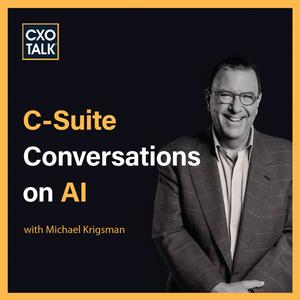
C-Suite Conversations on AI and Strategy. Join industry analyst Michael Krigsman for unfiltered discussions with the leaders shaping the future of business. From AI implementation to digital transformation, hear directly from CIOs, CTOs, CEOs, and more from the world's largest companies. No scripts. No PR fluff. Just real questions from our live audience and honest answers from the C-Suite.
Want to participate?
Get invited to the next live show: https://www.cxotalk.com/subscribe
Podcast websiteListen to CXOTalk, Cheeky Pint and many other podcasts from around the world with the radio.net app
Get the free radio.net app
- Stations and podcasts to bookmark
- Stream via Wi-Fi or Bluetooth
- Supports Carplay & Android Auto
- Many other app features
Get the free radio.net app
- Stations and podcasts to bookmark
- Stream via Wi-Fi or Bluetooth
- Supports Carplay & Android Auto
- Many other app features

CXOTalk
Scan code,
download the app,
start listening.
download the app,
start listening.
 Ireland
