

Listen to this podcast in the app for free: Download for free in the App Store
radio.net
Sleep timer
Save favourites
167 episodes
E155 – THE END OF THE BILLABLE HOUR? Larry Fenelon on AI, legal jobs and reinventing the law firm
16/10/2026 | 45 mins.THE BILLABLE HOUR IS UNDER ATTACK. AND AI COULD CHANGE THE LEGAL PROFESSION FOREVER.
What happens when one of Ireland's most innovative solicitors decides to throw out the traditional rulebook?
Larry Fenelon SC, founder of Fenecas Law and previously of Leman Solicitors, joins Peter Leonard BL and Mark Tottenham BL on Episode 155 of The Fifth Court.
He's built a litigation-only firm that doesn't record billable hours, embraces artificial intelligence and believes the Irish legal profession needs to move much faster.
And his numbers are extraordinary.
Five hours of document preparation reduced to five minutes.
Ten employees doing work he believes might otherwise require 20–22 people.
Fixed-fee arrangements instead of the traditional six-minute billing clock.
Larry also reveals:
Why increasing his previous law firm from 25 to 55 people didn't necessarily increase profits.
How Leman Solicitors became part of international law firm Ogier.
Why AI is forcing lawyers to rethink how they charge clients.
Why paper-based court processes are increasingly unsustainable.
Why Ireland could become a major international arbitration centre, competing with London, Paris, Vienna and Stockholm.
Why he believes Ireland's legal professionals can compete with the best in the world.
There's also a remarkable personal story, from working in his family's meat business and studying at the University of Limerick to building, merging and then starting a law firm all over again.
Plus: the Decisis Law Reports case review
Peter and Mark examine three important decisions:
T.O. v HSE — a child's access to weight-loss medication and a challenge to the HSE's refusal to fund treatment.
L.M. v N.O.M. — children wrongfully retained in Ireland following a holiday visit, and their return to South Africa under the Hague Convention.
The People v C.U. — admissions made by a 17-year-old during Garda questioning and whether those admissions were admissible in evidence.
The Decisis case-law review is proudly sponsored by Charltons Solicitors and Collaborative Practitioners, George's Street, Dún Laoghaire, specialists in family law, civil litigation, property, wills and probate.
Presented by Peter Leonard BL and Mark Tottenham BL.
The Fifth Court. No Ordinary Courtroom.
Follow and subscribe wherever you get your podcasts.
Hosted on Acast. See acast.com/privacy for more information.E109 The Fifth Court - retired High Court judge, Bernard Barton RIP
11/08/2026 | 45 mins.As the multitude of tributes have shown Bernard was not only a highly respected Judge and member of the Law Library, but was an absolute gentleman, known for his kindness, warmth, and great sense of fun. This we experienced in abundance when he joined us as a guest on the The Fifth Court podcast.
In what was one of our most popular episodes, Bernard’s charm and infectious enthusiasm for law and life shone through.
Accordingly , we are re-releasing this episode in tribute to this wonderful man.
Mark Tottenham Peter Leonard
Hosted on Acast. See acast.com/privacy for more information.E154 The Fifth Court: John Freeman BL — Central Bank Power, Personal Accountability and Fair Procedures
23/07/2026 | 37 mins.Peter Leonard BL and Mark Tottenham BL are joined by John Freeman BL, author of The Central Bank Acts: A Commentary.
John explains the modern role of the Central Bank of Ireland and how financial regulation has changed since the banking crisis. The discussion examines the increased focus on individual accountability within financial institutions, including how responsibility is assigned to particular executives and decision-makers.
They also consider:
The Central Bank’s investigative and enforcement powers
Personal responsibility for regulatory failures
Fines, suspensions and exclusion from the financial services industry
The effect of the Zalewski judgment on regulatory hearings
Fair procedures when the regulator investigates and adjudicates
Appeals to the Irish Financial Services Appeals Tribunal and the High Court
The independence of the Central Bank
The relationship between the Central Bank of Ireland and the European Central Bank
Why the Central Bank Acts have become so difficult to navigate
John also discusses the work involved in writing a major legal commentary, the growing use of Irish within the legal profession and his interest in French revolutionary legal history.
Before the interview, Peter and Mark review three recent decisions from Decisis.ie:
An unlawful repossession of a family home resulting in an award of €20,000 in damages
Planning permission quashed because inadequate provision had been made for children’s play facilities
A constitutional challenge concerning temporary release and a mandatory minimum sentence for serious drug offences
The Decisis.ie case-law section is sponsored by Charltons Solicitors and Collaborative Practitioners of George’s Street, Dún Laoghaire, specialists in family law, civil litigation, property, wills and probate.
Presented by Peter Leonard BL and Mark Tottenham BL.
Hosted on Acast. See acast.com/privacy for more information.E153 The Fifth Court - Who Really Built Ireland's Legal System? Daire Hogan on Judges Who Shaped Irish History
14/07/2026 | 46 mins.For more than a century, Ireland's judges shaped the country's politics, business, land ownership and legal system.
But who were they?
On Episode 153 of The Fifth Court, Peter Leonard BL and Mark Tottenham BL are joined by legal historian Daire Hogan, former McCann FitzGerald partner, former President of the Irish Legal History Society and author of the remarkable new book The Judges of Ireland 1866–1921.
It's a fascinating conversation about Victorian Ireland, judicial power, Westminster politics, the Four Courts, Home Rule, the birth of the modern legal system and some extraordinary judicial personalities whose influence is still felt today.
Along the way they discuss:
• why 1877 completely changed Irish courts
• the astonishing political influence behind judicial appointments
• why some judges nearly sailed on the Titanic
• how Irish judges were viewed in London
• the origins of today's High Court and Court of Appeal
• what legal history tells us about modern Ireland
Before Daire Hogan joins Peter and Mark, Mark reviews three important recent decisions from Decisis, kindly brought to listeners with the support of Charlton Solicitors & Collaborative Practitioners, specialists in family law, civil litigation, property, wills and probate.
The featured cases include:
Adoption without parental consent
Security for costs
Legal professional privilege and shareholder rights
Hosted on Acast. See acast.com/privacy for more information.E152 The Fifth Court - Jimmy Wales, Wikipedia founder, on trust, AI and why the internet still needs rules
01/07/2026 | 55 mins.Episode 152 of The Fifth Court features a very special guest: Jimmy Wales, founder of Wikipedia
Interviewed by Mark Tottenham BL at Dalkey Book Festival.
This is not just a tech-founder interview. It is a fascinating conversation about law, trust, neutrality, rules, evidence, platform responsibility, AI hallucinations, volunteer communities, public knowledge and why Wikipedia has survived while much of the internet has become angrier, noisier and less trusted.
Jimmy explains why Wikipedia’s neutral point of view matters, why “assume good faith” is more practical than naïve, how Wikipedia deals with vandalism, why AI can invent very convincing false sources, why WikiNews did not work, and why Wikipedia avoided the advertising model that turned so much of the web into clickbait.
Jimmy's cultural recommendation, a book by the late author Ray Bradbury, 'Something Wicked this Way Comes'.
Before the interview, Peter Leonard BL and Mark Tottenham BL discuss three recent cases from the Decisis Casebook, sponsored by Charltons Solicitors & Collaborative Practitioners: the Supreme Court on “no foal, no fee” and conditional fee arrangements; a drink-driving blood-specimen chain-of-custody case; and a murder conviction quashed because of an unbalanced judicial charge to the jury.
00:00 – Intro: Episode 152
01:47 – Decisis Casebook sponsor: Charltons Solicitors & Collaborative Practitioners
02:00 – “No foal, no fee” and conditional fee arrangements
03:29 – Drink-driving conviction and blood-specimen chain of custody
04:34 – Murder conviction quashed over judicial charge to jury
06:03 – Jimmy Wales interview begins
06:43 – Why Wikipedia was hard to compete with
07:58 – Neutral point of view and controversial topics
09:49 – How Wikipedia’s rules developed
11:40 – Volunteer communities and optimism about people
15:12 – Why a wiki works for an encyclopedia, but maybe not for poetry
17:03 – Why Wikipedia is vandal-proof
18:30 – Jimmy Wales: “Queen Elizabeth II, not Henry VIII”
20:07 – Arbitration committees and Wikipedia governance
21:24 – Wikipedia in 150–300 languages
23:31 – What workplaces can learn from volunteers
29:06 – Audrey Tang, Taiwan and digital consensus
32:10 – “Assume good faith”
34:25 – ChatGPT, fake ISBNs and made-up legal cases
37:17 – Law enforcement and good faith
39:03 – Why WikiNews did not really work
44:12 – Constitutional change and institutional deadlock
49:37 – Platforms, publishers and free speech
50:25 – Why Wikipedia did not become an ad machine
53:04 – Jimmy Wales’ book recommendation: Something Wicked This Way Comes
54:33 – Outro
Hosted on Acast. See acast.com/privacy for more information.
More Business podcasts







Trending Business podcasts




















About The Fifth Court
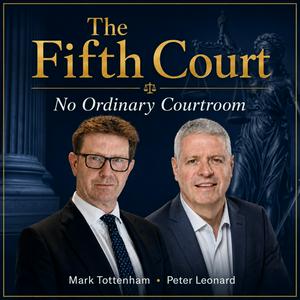
This is no ordinary courtroom, this is Ireland's legal podcast, presented by the multi-award winning team of Peter Leonard BL and Mark Tottenham BL Hosted on Acast. See acast.com/privacy for more information.
Podcast websiteListen to The Fifth Court, The Quinn Files and many other podcasts from around the world with the radio.net app
Get the free radio.net app
- Stations and podcasts to bookmark
- Stream via Wi-Fi or Bluetooth
- Supports Carplay & Android Auto
- Many other app features
Get the free radio.net app
- Stations and podcasts to bookmark
- Stream via Wi-Fi or Bluetooth
- Supports Carplay & Android Auto
- Many other app features

The Fifth Court
Scan code,
download the app,
start listening.
download the app,
start listening.
The Fifth Court: Podcasts in Family
 Ireland