
Listen to this podcast in the app for free: Download for free in the App Store
radio.net
Sleep timer
Save favourites
140 episodes
134: How to Land a $300k PM Role in 2026 with Mukhtar Kadiri
13/10/2026 | 50 mins.What if the reason your project management job search is stalling has nothing to do with your skills? On average, about 300 people apply to a single opening, and the odds of being the one who gets the offer are slim. In that market, strong project leadership isn't enough. Landing a six-figure project management role takes the same things that make projects succeed: clear decision making, a targeted strategy, and the ability to read how an organization really works.
In this episode of Project Management Happy Hour, Kate and Kim talk with Mukhtar Kadiri, PMP, a project management career coach and recruiter with more than 15 years on both sides of the hiring table. Mukhtar helps project managers land roles in the $100,000 to $300,000 range and shares his insights with a LinkedIn community of more than 70,000 project professionals. His hard-won business lesson sets the tone. Early in his consulting career, he was called into an office and given a verbal beating by a stakeholder who sat nowhere near the top of the org chart. She turned out to be one of the most powerful people on the project. Once he won her over, she became his biggest champion, a mentor, and a lifelong friend, and he has looked past the official org chart ever since. As Kim puts it: "There's the one on paper and there's the one that really gets things done."
From there, the conversation turns to bias in hiring and then to the heart of the episode: the first two steps of Mukhtar's job search framework, clarity and positioning.
Grab a drink and join us.
Quotes from the Episode
"The purpose of the resume is to sell you to the gatekeeper so that you can get through the door, right?" — Mukhtar Kadiri
"And it's not that you as a project manager aren't good enough. It's that job hunting is a different skill than doing the job and getting another certificate that proves you know how to do the job is not going to help you get a job." — Kate Anderson
"And not just what is the problem they're trying to solve, but how are you the best person to try to solve this?" — Kim Essendrup
"So don't wait for the perfect match because sometimes people don't exactly know what they want or they're not good at documenting it." — Kim Essendrup
"Because I know the fear is that I don't want to miss out on opportunities, but when you actually do target and when you focus, you actually get more opportunity because your branding, so to speak, is more potent." — Mukhtar Kadiri
Practical Takeaways
The shadow org chart. Influence often sits with people who have no formal authority, so map the real power structure, not only the official hierarchy.
The five-step job search framework. The steps are clarity, positioning, the hidden job market, interviewing, and negotiation.
The 75% match rule. Job descriptions are wish lists, so target roles where you meet roughly 75% or more of the criteria. Below that is a poor use of time; near 100% can read as overqualified.
Pain-point mapping. Distill a role into its top 3–5 pain points, map one skill to each, and back each skill with quantified evidence.
The four-person outreach strategy. Email the recruiter, the hiring manager, a peer, and a leader. Follow up twice, since most responses arrive after the second follow-up.
Closing Reflection
The episode closes with Mukhtar's toast to finding what you want in your career, whether that's a new job, the next level, or peace and sanity in your current role. It's a reminder that a job search is a project in its own right, and it deserves the same strategy you'd bring to any other.
🔗 Links & Resources Mentioned
Mukhtar Kadiri on Substack: https://substack.com/@mukhtarkay
Mukhtar Kadiri on LinkedIn: https://www.linkedin.com/in/m-kadiri/
Email-finding tools mentioned:
Lusha
Hunter
Apollo.io
LinkedIn Sales Navigator
PM Happy Hour Membership: pmhappyhour.com/membership
PM Happy Hour Facebook Page133: The Introvert's guide to Communication for Project Managers
15/09/2026 | 33 mins.Why "over-communicating" isn't about saying more — it's about knowing exactly what your stakeholders need to hear, and when.
What happens when a project manager goes silent? According to this episode of Project Management Happy Hour, nothing good. Left in an information vacuum, stakeholders don't assume the best — they assume the worst. That single insight sits at the center of a conversation about project leadership, stakeholder communication, and the quiet skill that separates good project managers from great ones: knowing exactly what to say, to whom, and when. If you've ever been accused of "running dark" on a project, or been told to simply "communicate more" without any idea what that actually means, this episode is for you.
Kate and Kim open up about their own early missteps as project managers — Kim recalling a boss who relentlessly demanded he "over communicate" without explaining what that looked like in practice, and Kate admitting that while she never struggled to talk to her own team, she took years to learn how to communicate effectively up and out to executives and sponsors. Their honest, back-and-forth storytelling style — equal parts practical and funny — turns what could be a dry topic into a genuinely useful conversation about project delivery and leadership communication.
Grab a drink and join us.
Quotes from the Episode
"The human brain is not nice. It takes lots of therapy and or meditation to tell yourself nice stories... if you're in an information vacuum, because our brain wants to protect us from bad things happening." — Kate Anderson
"Data is meaningless without context and contrast." — Tim Creasy (as quoted by Kim)
"It's not that it's meaningless. It's that it's vulnerable to misinterpretation without context and contrast." — Kate
Practical Takeaways
The information vacuum effect — In the absence of updates, stakeholders default to negative assumptions rather than neutral or positive ones.
Communication baseline calibration — New project managers often start with a communication baseline that is far lower than stakeholders actually need.
Bottom-line-up-front (BLUF) messaging — Lead with the specific action or decision needed, then follow with supporting context.
Self-service reporting channels — Creating an always-available update source (chat channel, dashboard, bulletin) reduces stakeholder anxiety and unplanned interruptions.
Narrative ownership in project leadership — Framing project updates as a story you control, rather than a list of data points, shapes how stakeholders perceive project health.
Closing Reflection
The episode's real throughline is ownership: the best project managers don't just report facts, they own the narrative of their work. As Kate puts it, data without context and contrast is vulnerable to misinterpretation — and if you don't tell the story of your project, someone else's imagination will tell it for you.
🔗 Links & Resources Mentioned
PM Happy Hour Membership: pmhappyhour.com/membership
PM Happy Hour Facebook Page
Get the Audience Persona Worksheet at: pmhappyhour.com/resources
PMHH Episode 091: The Perfect Status Report
PMHH Epsiode 131: Listen to Don't Be the PM Everybody Hates with Rachel Losser
Got your communication conundrum? 📧 Email us at social@pmhappyhour.com — you might just hear it (and the answer) on a future episode.132: Why Your Most Supportive Stakeholder is Ruining your Project, with Dawn Mahan
25/08/2026 | 51 mins.Projects rarely fail from a lack of templates — they fail because of people. Author Dawn Mahan reveals the animal avatars that help you spot the cheerleader, the finicky fan, and the saboteur before one of them bites you in the ankle.
Why do projects really fail? Not, as guest Dawn Mahan argues, from a shortage of templates or Gantt charts — but from the people around them. In this episode, Kim and Kate dig into the human side of project delivery: the stakeholders who love your project, the ones who quietly want it dead, and the "style under stress" that surfaces when the pressure cooker of Projectland heats up. If you've ever been blindsided by a saboteur or tripped up by an over-eager cheerleader, this conversation on stakeholder management, risk, and project leadership is for you.
Kim and Kate welcome Dawn Mahan, author of the bestselling Meet the Players in Project Land and co-editor of Project Land Goes to the Movies: 22 Blockbuster Strategies for Project Success. Dawn's premise is refreshingly human: projects rarely fail because the paperwork is wrong — they fail because the people involved aren't set up for success. Using animal avatars to make stakeholder behavior easier, and safer, to talk about, she gives project managers and leaders a practical vocabulary for the messy, political, feelings-driven reality of getting work done inside real organizations.
Grab a drink and join us.
Quotes from the Episode
"If you're skipping through the meadow of project land toward your goal, one might just jump up and bite you in the ankle when you least expect it…" — Dawn Mahan
"You've got a style under stress." — Kate Anderson
"Instead of being a cheerleader, she accidentally became a saboteur." — Dawn Mahan
"I believe PMs are in the pain prevention business." — Dawn Mahan
"Any of us can sabotage our own lives, relationships, projects, even." — Dawn Mahan
Practical Takeaways
The three stakeholder archetypes — the cheerleader (happy dog), the finicky fan (flamingo), and the saboteur (snake), and how each one engages with or endangers a project.
"Style under stress" — how both stakeholder and team behavior shifts under pressure, and why leaders should plan for those reactions in advance.
Stakeholder analysis as a scheduled activity — running it privately with the sponsor, casting a wide net, documenting decisions, and coding the stakeholder register discreetly.
The "Feel" question — asking "How do you feel about this?" instead of "What do you think?" to surface fear and identify project risk early.
Managing cheerleaders with soundbites — the Stakeholder Gabby lesson on why enthusiastic champions can accidentally become saboteurs, and how to channel their energy constructively.
Closing Reflection
Perhaps the most human insight of the episode is Dawn's reminder that any of us can sabotage our own projects. Sabotage isn't always evil; more often it's fear, miscommunication, or a stakeholder who simply doesn't understand how Projectland works. The leadership question worth sitting with: who on your project is operating from fear right now — and what could you do to change that?
🔗 Links & Resources Mentioned
PM Happy Hour Membership: pmhappyhour.com/membership
PM Happy Hour Facebook Page131: Don't be the PM everyone hates, with Rachel Losser
12/08/2026 | 50 mins.Your worst project management habit might also be your superpower — the trick is knowing which one you're wielding, and when.
What actually separates a great project manager from the one everyone dreads seeing on their calendar? It's rarely a certification or a prettier Gantt chart — it's behavior. This episode of Project Management Happy Hour digs into project leadership, accountability, team dynamics, and the everyday habits that quietly undermine project delivery. The uncomfortable truth running through the whole conversation: our worst project management habits are usually just our genuine strengths turned all the way up, with no dial to turn them back down.
Kate and Kim are joined by Rachel Losser, founder and managing partner of Losser Consulting Solutions, a delivery-focused firm known for its get-stuff-done philosophy. Together they walk through five "bad PM personas" — the versions of ourselves that colleagues quietly avoid — and, crucially, the more skilled counterpart each one can grow into. Rachel sets the tone early with a bit of grace: we're talking about these "with love and reverence," because everybody starts somewhere and most of us have been every one of them at some point.
The practical throughline is nuance. Every strength becomes a liability when it's your only mode. Great PMs read the moment: when to slow down and build consensus, and when to say "we're going this way." They tell hard truths early, manage handoffs rather than just dates, and treat relationships and communication as the real currency of the job. As Kate puts it, the only way out of a struggling project is through it — not around the color of the status.
Which persona are you under stress? That self-awareness, the hosts suggest, is where better project leadership actually begins.
Grab a drink and join us.
Quotes from the Episode
"The PM has to be the brutal truth-sayer. Because if the PM doesn't say it, who's going to say it?" — Kim Essendrup
"The only way out is through." — Kate Anderson
"We had to live it to be able to write it." — Rachel Losser
"You have no idea what people are motivated by until you implement something like that." — Rachel Losser
Practical Takeaways
Every PM strength has a shadow. Each of the five personas is a positive skill (documenting, reporting, follow-through, decisiveness, convening) overused into a liability.
Report status honestly, then own the path back to green. Transparent "highlighter green" reporting builds credibility; greenwashing destroys it.
Accountability beats date-moving. A Task Master probes why a deadline slipped and what will change, instead of silently updating the due date.
Directive leadership works only in moderation. The Hammer is effective in a crisis precisely because they aren't operating at full intensity all the time.
Every meeting needs a goal and buy-in. Confirming the objective at the top of a call is how you avoid becoming the Meeting Vampire.
Closing Reflection
Rachel's toast says it best: this is often a thankless job of late nights and "adult babysitting." But the difference between a PM everyone avoids and one everyone wants on their project usually isn't talent — it's the self-awareness to know which persona you default to under stress, and the discipline to reach for its better half instead. Which of the five is your worst habit — and what would its superpower version look like?
🔗 Links & Resources Mentioned
PM Happy Hour Membership: pmhappyhour.com/membership
PM Happy Hour Facebook Page
Losser Consulting Solutions — Rachel Losser's firm
Big Project Energy with Rachel Losser
Rachel Losser on LinkedIn
Losser Consulting Solutions on LinkedIn
Rachel Losser on Instagram: @losserconsultingsolutions
Rachel Losser on TikTok: @losserconsultingsolutions130: Rigged bids, fake deadlines, and going 181x over budget
29/07/2026 | 38 mins.A $6.9 million estimate. A $1.25 billion catastrophe. How fake deadlines, a rigged bid, and a steering committee allergic to bad news turned a routine payroll migration into one of the biggest project disasters in Australian history.
What happens when project leadership treats risk management as optional, decision making gets diffused across committees, and a hard deadline turns out to be completely negotiable? You get one of the most instructive project failure case studies in project management history — and in this episode, Kim and Kate pour it out one painful lesson at a time.
The subject is Queensland Health, the public healthcare provider for the Australian state of Queensland, employing roughly 85,000 people across about 300 sites. In 2005, their legacy payroll vendor gave them three years' notice: support ends June 30, 2008. Sounds like plenty of runway — until the organization waited two of those three years to act. By the time a consultant named Terry Burns (remember that name) ran the procurement and IBM signed a contract in December 2007, the original $6.9 million estimate had ballooned to a $98 million contract with just six months to deliver a system covering more than 24,000 unique payroll combinations.
Why does this matter for project managers and leaders? Because almost nothing that went wrong here is exotic. Late project intake. Governance where a transition team, a steering committee, and an IT department all had partial authority but no single decision-making structure. Two weeks — total — for requirements gathering on a nine-figure program. A "lift and shift" strategy that preserved every broken process and demanded 2,500 custom software configurations to replicate them. As Kim and Kate walk through it, the episode becomes a masterclass in how ordinary project management failures compound into organizational catastrophe.
The discussion highlights are equal parts horrifying and hilarious. There's the program's actual internal slogan, taken straight from the project materials: "Plan A or Die" — no continuity plan, no risk mitigation, no fallback. There's the June 2008 deadline that came and went with a simple change request and some extended support from the legacy vendor, prompting Kate's sharp observation that the date was fake and not fake at once: end-of-life risk is real even when the cliff turns out to be movable. There's the UAT phase in June 2009 that surfaced 2,422 severe defects — after which the steering committee simply reclassified high-severity defects as lower severity so the dashboards would show enough green to proceed. Watermelon project, indeed. And when frontline payroll staff kept failing the system in testing, leadership's answer was to remove the requirement for business sign-off entirely.
The go-live in March 2010 delivered the reckoning: 35,000 payroll anomalies, roughly $400 million in accidental overpayments, zero-dollar paychecks for healthcare workers, and government debt collectors hounding nurses for money they never asked to receive. Queensland ultimately hired a thousand staff to manually prop up the new system — a 40 percent increase in labor over the old one — with a projected five-year cost to taxpayers of $1.25 billion. The commission of inquiry that followed, led by the Right Honourable Richard Noel Chesterman, revealed the final twist: Terry Burns, a former IBMer, had leaked a competitor's bid specs to IBM and browbeaten the selection panel into rescoring until IBM won. And when the state sued? A release buried in the fine print of a change order had signed away its right to litigate.
Grab a drink and join us.
Quotes from the Episode
"Everyone's in charge, so no one's in charge." — Kate
"If you've got a deadline, question the deadline." — Kim
"I've heard the term watermelon project where they're green on the outside and red on the inside." — Kim
"And you are paying that company that you're hiring to learn." — Kate
"But ultimately, if your project options are plan A or die. Maybe sometimes the best option is die." — Kim
Practical Takeaways
Governance and decision rights — When multiple bodies share authority without a single decision-making structure, accountability evaporates ("everyone's in charge, so no one's in charge").
Deadline validation — Interrogate whether a project deadline is a true constraint or a negotiable date, and what options (like extended vendor support) exist beyond it.
The watermelon project pattern — Recognizing status distortion, including reclassifying defect severity and removing sign-off requirements to force green dashboards.
Parallel run as cutover risk mitigation — Why replacing a legacy business-critical system requires side-by-side operation and validation before go-live.
Procurement integrity and vendor selection — The risks of conflicts of interest in vendor selection, of choosing a vendor with no prior experience delivering the solution, and of unreviewed contract fine print.
Closing Reflection
Nobody ever really "accepts" a risk on paper. When risks are realized, someone always pays—taxpayers, frontline workers, or the organization itself. Sometimes the bravest act of project leadership is admitting that Plan A deserves to die.
🔗 Links & Resources Mentioned
PM Happy Hour Membership: pmhappyhour.com/membership
PM Happy Hour Facebook Page
More Business podcasts








Trending Business podcasts
























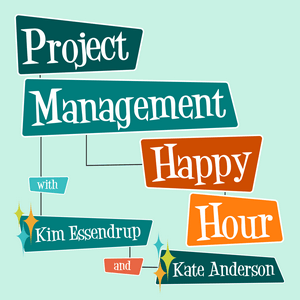
About Project Management Happy Hour
PM Happy Hour is the place for frank and honest discussion about real world issues in project management. We do it in a way that's not too dry, though it may get a bit salty from time to time.
Each episode, your hosts Kim Essendrup and Kate Anderson cover a problem faced in project management today, and share practical advice, real-life examples and the occasional project horror story.
Not only that, but every podcast is also an online class! Our host is a PMI Registered Education Provider, who has structured each podcast as an easy-to-listen-to lesson. To get credit, go to our web site at PMHappyHour.com, purchase your class, take the test (based on the content from our podcast) and you get your PDU certificate instantly!
Podcast websiteListen to Project Management Happy Hour, Better With Money and many other podcasts from around the world with the radio.net app
Get the free radio.net app
- Stations and podcasts to bookmark
- Stream via Wi-Fi or Bluetooth
- Supports Carplay & Android Auto
- Many other app features
Get the free radio.net app
- Stations and podcasts to bookmark
- Stream via Wi-Fi or Bluetooth
- Supports Carplay & Android Auto
- Many other app features

Project Management Happy Hour
Scan code,
download the app,
start listening.
download the app,
start listening.
 Ireland
