PodcastsHistoryPsychology of the Strange

Psychology of the Strange

Tara Perreault
Psychology of the Strange
Latest episode

41 episodes

  • Psychology of the Strange

    Of Mushrooms and Little People

    26/05/2026 | 27 mins.
    In this episode, I enter one of the strangest corners of mycology, folklore, and consciousness research I've encountered: Lanmaoa asiatica, a mushroom with no identified psychoactive compound that nonetheless causes ninety-six percent of people who eat it undercooked to hallucinate the same thing. Small humanoid figures, marching through their real-world environment. Climbing furniture. Slipping under doors. Exactly two centimeters tall.

    And then I pull back to ask why, across every inhabited continent, human cultures with no contact and no shared history have been building folklore about small beings living just beyond the threshold of ordinary perception for thousands of years.

    In this episode:

    Lanmaoa asiatica, the "Lilliputian mushroom" of Yunnan province and what researcher Colin Domnauer found when he followed it to the Philippines

    The 3rd-century Daoist text that described this mushroom seventeen hundred years before modern science confirmed it

    Fairy rings, the Aos Sí, and why the folklore was structurally accurate all along

    The fly agaric (Amanita muscaria), the Koryak shamans of Siberia, and the surprisingly dark origin story of Santa Claus

    Lilliputian hallucinations as a clinical phenomenon and why their cross-cultural consistency is the strange part

    Aldous Huxley's reducing valve, the default mode network, and what modern neuroscience says about how psychedelics change what we're able to perceive

    Theoretical physics, extra dimensions, and the oldest question in shamanic tradition: what if ordinary perception is the filter, not the truth?
  • Psychology of the Strange

    Analog Horror Manufacturing Dread

    19/05/2026 | 27 mins.
    Analog horror, psychology of fear, and the neuroscience of dread. In this episode of Psychology of the Strange, I'm breaking down what the analog horror genre is actually doing to your brain and why it works so precisely on modern audiences.

    Analog horror is a subgenre of found footage horror that emerged on YouTube in the mid-to-late 2010s. It uses the visual grammar of VHS tapes, emergency broadcast systems, public access television, and educational films to manufacture a specific kind of psychological dread. One that bypasses rational thought entirely and lands somewhere older and harder to name. I'm looking at the neuroscience behind why corrupted signals trigger threat detection, how the uncanny valley extends beyond faces and bodies into institutional formats, and what liminal space does to a nervous system that can't locate the threat.

    I'm also asking why this genre has exploded right now, at a moment when the government has confirmed UAP phenomena it spent decades denying, the Epstein files are still unfolding, and AI-generated video has made provenance verification a skill most people don't have. The comment sections of analog horror videos are full of people asking "is this real?" and that question is more complicated than it used to be.

    Series covered include Local 58, The Mandela Catalogue, and Gemini Home Entertainment.

    Psychology of the Strange is hosted by Tara Perreault, doctoral researcher at the University of South Florida, and is part of the Dark Cast Network.

    New episodes every Tuesday

    If you enjoy the show, you can support it here: buymeacoffee.com/psychstrangepod

    Find me on Instagram and TikTok at @psychstrangepod.

    Check out the substack that goes along with the episode When You Can't Tell If It's Real Anymore: Analog Horror and the Collapse of the Signal
  • Psychology of the Strange

    The Fashion Sense of Ghosts & Woman in White Lore

    12/05/2026 | 25 mins.
    Every ghost sighting follows the same dress code, the long dress, pale, timeless, and tragic. Almost nobody is reporting the apparition in low rise flare jeans and butterfly clips. It is a window into how the human brain constructs, maintains, and inherits its fear of the dead.

    In this episode, I trace the Woman in White across cultures, like La Llorona, the White Lady of Balete Drive, the Bean Nighe, Resurrection Mary, to ask why the most universal ghost story in the world belongs to a figure deliberately unanchored in time. From there we get into the cognitive psychology of ghost sightings: schema theory, the brain as a prediction machine, and how a seventh century pope's decision to weaponize ghost stories as theology quietly wrote the template your brain still reaches for in the dark. We close with Schopenhauer's afterglow of consciousness, Ryle's category mistake, and the question of whether the cultural script around ghosts is genuinely self-sealing, and what that means for the girl from 2007 who is probably still in purgatory.

    Pray for her. Maybe she'll be haunting you soon too.

    Topics covered: ghost lore, Woman in White folklore, La Llorona, Resurrection Mary, Bean Nighe, schema theory, cognitive psychology of perception, Pope Gregory I, Victorian death culture, Schopenhauer, Gilbert Ryle, Cartesian dualism, purgatory

    If you enjoy the show, you can support it here: buymeacoffee.com/psychstrangepod

    For More on Fashion Sense of Ghosts like why do they wear clothes at all check out the substack: https://open.substack.com/pub/psychstrangepod/p/why-do-ghosts-wear-clothes?r=4ajm1n&utm_campaign=post-expanded-share&utm_medium=post%20viewer

    Psychology of the Strange is part of the Dark Cast Network. Find me on Instagram and TikTok at @psychstrangepod.
  • Psychology of the Strange

    Voodoo Dolls, Marie Laveau, and the Psychology of Magical Thinking

    05/05/2026 | 28 mins.
    The voodoo doll you picture (small cloth figure, colorful pins) has almost nothing to do with Voodoo. That image is a Western invention, laundered through Hollywood until the real story got lost entirely. In this episode, I'm tracing where the object actually comes from, why versions of it appear across cultures with no contact with each other, and what the psychology underneath it tells us about the human need for control.

    From the wax effigies used in a plot against Pharaoh Ramesses III in 1100 BCE, to the Kongo Nkondi figures misread by Western colonizers, to the European poppet tradition, the logic is always the same: embed intention into an object, connect it to a person, and trust that the distance between you just collapsed.

    Then there's Marie Laveau. Born in New Orleans in 1801 as a free woman of color, she built one of the most documented and least fully understood power bases in American history, a hairdresser with an intelligence network, a devout Catholic who built altars in death row cells, a Voodoo queen whose practice centered on exactly this kind of object-based magic. Her gris-gris bags operated on identical principles to every effigy and poppet we've been talking about. Personal objects. Embedded intention. The belief that a physical item can carry something across the distance between you and the person you're trying to reach.

    Whether it works in the causal sense is almost beside the point. Rotter's locus of control, Rozin and Nemeroff's laws of sympathetic magic, and the confirmation bias that closes the loop, the psychology here suggests the doll does work. Just not the way the instruction card says it does.

    And if that makes you think of vision boards and manifestation culture, you're already seeing the connection I want to talk about.

    Want to go deeper? I wrote a companion piece for this episode exploring the peer-reviewed research behind the voodoo doll  including why the object has become a validated instrument in psychology labs, and why it might actually be a more effective way to process anger than hitting a pillow. Read it on Substack. The Scientific Use of Voodoo Dolls

    Grad school doesn't fund itself, and neither does late-night research into the rugarou, demonic mirrors, and the psychology of cults. If an episode got under your skin, sent you down your own rabbit hole, or made you text someone "you need to hear this", buying me a coffee keeps the strange alive.
    https://buymeacoffee.com/psychstrangepod

    Psychology of the Strange is part of the Dark Cast Network. Find me on Instagram and TikTok at @psychstrangepod.
  • Psychology of the Strange

    The Psychology of the Final Girl in Horror Movies

    28/04/2026 | 33 mins.
    Why do we cheer when the final girl fights back in horror movies? From Laurie Strode in Halloween to Sidney Prescott in Scream to Sienna Shaw in Terrifier 2, slasher films give us vulnerable protagonists who survive brutal violence, and we love watching them become ruthless. This episode explores the psychological mechanism behind the final girl trope and why vulnerability licenses extreme violence.

    Drawing on recent horror research on the imbalance between a weak protagonist and powerful antagonist triggers something deeper than fear. It changes how your brain judges violence. Through film analysis of classic and contemporary horror movies including A Nightmare on Elm Street and Terrifier 2, I examine how moral typecasting theory explains why we grant final girls permission to do things we'd condemn in any other context.

    What separates horror from action? Why does Alien feel terrifying while Predator feels like an action movie, even with nearly identical threats? The answer lies in protagonist vulnerability and how your brain categorizes victims versus aggressors. I also explore how this same psychological pattern shows up in true crime cases, self-defense trials, and real-world moral judgments about violence.

    If you've ever wondered why slasher movie violence feels justified when the final girl does it, this episode reveals the cognitive mechanisms at work. Vulnerability decides who gets to fight back.


    Grad school doesn't fund itself, and neither does late-night research into the rugarou, demonic mirrors, and the psychology of cults. If an episode got under your skin, sent you down your own rabbit hole, or made you text someone "you need to hear this", buying me a coffee keeps the strange alive.

    https://buymeacoffee.com/psychstrangepod

    Psychology of the Strange is part of the Dark Cast Network. Find me on Instagram and TikTok at @psychstrangepod.

    Papers referenced in this episode

    Edgard Dubourg & Coltan Scrivner. (2026). Vulnerability and the computational logic of fear: insights from the horror genre. Evolution & Human Behavior, 47, 106813.
    https://www.sciencedirect.com/science/article/abs/pii/S109051382500162X

    Gray, K., & Wegner, D. M. (2009). Moral typecasting: Divergent perceptions of moral agents and moral patients. Journal of Personality and Social Psychology, 96(3), 505–520. https://doi.org/10.1037/a0013748
More History podcasts
About Psychology of the Strange
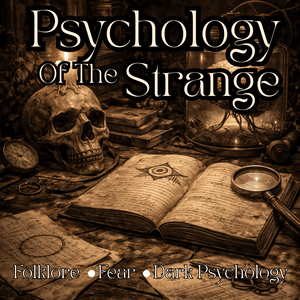
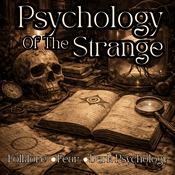
Folklore. Fear. Dark Psychology. Psychology of the Strange is a narrative psychology podcast that explores the eerie, the uncanny, and the deeply human. Every episode begins with an original atmospheric story rooted in dark folklore, superstition, or real events and then shifts into a psychological analysis that unpacks why these tales grip the human mind. From winter-born omens and skeletal visitors to fearlessness, moral ambiguity, and the monsters we create to explain uncertainty, this show lives in the spaces where folklore and psychology overlap. If you like stories that linger… and explanations that cut deeper… you’re in the right place. ABOUT THE HOST Hosted by Tara Perreault, a doctoral student in psychology at the University of South Florida. Her research focuses on the darker edges of human nature: fearlessness, Dark Triad traits, moral ambiguity, recreational fear, and the meanings people draw from the strange and the supernatural. Tara blends academic insight with myth, atmosphere, and psychological storytelling. Her approach is part folklore study, part dark psychology, part narrative experiment. She has presented research at multiple conferences, published empirical work, and spent years studying how people make sense of fear — in haunted houses, on screen, and in the stories we pass down through generations. Psychology of the Strange is her creative extension of that work: a place where the uncanny becomes meaningful, and where every monster is really a metaphor for something we haven’t faced yet.

Podcast website

Listen to Psychology of the Strange, The Rest Is Classified and many other podcasts from around the world with the radio.net app

Get the free radio.net app

  • Stations and podcasts to bookmark
  • Stream via Wi-Fi or Bluetooth
  • Supports Carplay & Android Auto
  • Many other app features