
Listen to this podcast in the app for free: Download for free in the App Store
radio.net
Sleep timer
Save favourites
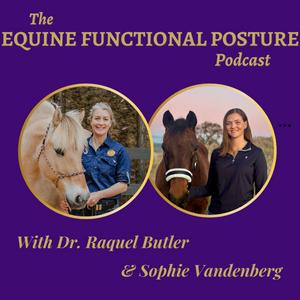
The Equine Functional Posture Podcast
Dr. Raquel Butler & Sophie Vandenberg
Latest episode
109 episodes
Episode 108: The Missing Piece: Equine Posture Transformations
18/10/2026 | 57 mins.Understanding Your Horse: The Value of Functional Posture Education
What if you could recognise the smaller signs that your horse is struggling, understand why, and feel confident knowing what to do next?
In this episode Dr Raquel Butler and Sophie Vandenberg explore how understanding the relationships between posture, movement, balance and behaviour can change the way we care for our horses - and share a few incredible transformations when these principles are applied to everyday horse management.
Through real experiences from Equine Functional Posture course participants, we discuss:
Recognising subtle changes in posture, movement and behaviour.
Examples of horses (of all ages!) showing improvements in balance, limb control, posture and willingness to engage.
How physical stability and discomfort may influence behaviour and training.
Why individual assessment matters more than simply following a collection of exercises.
Developing the skills to make informed decisions about training, rehabilitation and professional care.
The Equine Functional Course is now open for Enrolment - Closes 2nd Nov 2026
https://www.integratedvettherapeutics.com/efpEpisode 107 - The Neurological Examination
11/10/2026 | 32 mins.Episode 107 - The Neurological Examination
A horse can pass a lameness assessment and still show signs that warrant a neurological examination.
In this episode, Dr. Raquel Butler and Sophie Vandenberg explain how an equine neurological examination differs from a musculoskeletal assessment. They explore the tests veterinarians use to assess sensation, coordination, balance, limb awareness and nervous-system function, alongside signs that may indicate the need for further investigation.
We discuss:
Why a neurological examination is different from a lameness or musculoskeletal assessment
How cranial nerves, skin sensitivity and limb placement are assessed
What stability tests can reveal while the horse is standing and moving
Why head elevation, tight circles, slopes and obstacles challenge coordination
Signs to observe including stumbling, falling, unusual limb placement and unpredictable behaviour
Why results must be considered together and rider and practitioner safety must come first
To learn more about Dr Raquel Butler visit:
Facebook: Integrated Veterinary Therapeutics
Website: https://www.integratedvettherapeutics.com.au
To learn more about Sophie Vandenberg:
Facebook: Equine Posturelate - Sophie Vandenberg
Have any questions or topics you'd love us to cover?
Email us at: equinefunctionalposture@gmail.comEpisode 106 - Pre-purchase Exams - Are They Worth It?
04/10/2026 | 41 mins.Episode 107 - Pre-Purchase Exams: Are They Worth It?
A pre-purchase examination can reduce risk and provide valuable information, but it cannot guarantee a horse's future soundness or suitability.
In this episode, Dr. Raquel Butler and Sophie Vandenberg explore what equine pre-purchase examinations can and cannot tell us. They discuss the standard stages of a veterinary examination, choosing radiographs and optional diagnostics, understanding fitness for purpose, and combining veterinary findings with observation, history and informed decision-making.
We discuss:
Why the horse's intended purpose should guide the examination
What is included in a standard two-stage or five-stage vet check
How to choose radiographs and understand the importance of different views
Confidentiality, risk assessment, optional diagnostics and independent veterinary opinions
What a standard examination may not reveal about soft tissue, posture and neurological function
Why history, repeated viewings, educated observation and trusting your concerns still matter
To learn more about Dr Raquel Butler visit:
Facebook: Integrated Veterinary Therapeutics
Website: https://www.integratedvettherapeutics.com.au
To learn more about Sophie Vandenberg:
Facebook: Equine Posturelate - Sophie Vandenberg
Have any questions or topics you'd love us to cover?
Email us at: equinefunctionalposture@gmail.comEpisode 105 - Post Colic Surgery Rehabilitation
27/09/2026 | 42 mins.Episode 105 - Post Colic Surgery Rehabilitation
Returning to performance after colic surgery does not necessarily mean that a horse's core function has fully recovered.
In this episode, Dr. Raquel Butler and Sophie Vandenberg discuss rehabilitation following colic surgery, including how abdominal surgery can affect core strength, posture, breathing and movement. They outline a staged approach that begins with wound management and gut health, then progresses through stability, functional activation, strength and a carefully assessed return to riding.
We discuss:
Why return to performance is not a complete measure of recovery
How scar tissue and internal adhesions may influence comfort and function
Early priorities including wound management, circulation, gut health, hoof balance and breathing
How feeding posture can support balance and gentle abdominal activity
The difference between true core activation and abdominal bracing as exercises progress
What to assess before returning a horse to riding or normal paddock activity
To learn more about Dr Raquel Butler visit:
Facebook: Integrated Veterinary Therapeutics
Website: https://www.integratedvettherapeutics.com.au
To learn more about Sophie Vandenberg:
Facebook: Equine Posturelate - Sophie Vandenberg
Have any questions or topics you'd love us to cover?
Email us at: equinefunctionalposture@gmail.comEpisode 104 - Equine Functional Posture Clinic: Insights and Breakthroughs
20/09/2026 | 53 mins.Sometimes the most powerful change comes from doing less, waiting longer and observing more carefully.
This episode is a reflective discussion about a recent two-day equine posture clinic hosted by Dr Raquel involving five very different horses. Differing levels of balance, stability, communication and mental engagement shaped each horse's response, and we explain why the same exercise may need to look completely different for each individual horse.
We discuss:
Why doing less and allowing time to process can create meaningful change
How balance and stability can influence focus, behaviour and willingness
Why the handler's body position, softness and intention affect the horse's movement
How exercises, poles, aids and rewards can be adapted to the individual horse
What five contrasting horses revealed about lameness, forelimb instability, posture, bracing and mental disengagement
Why stopping, refusing or looking away can be considered valuable communication rather than disobedience
To learn more about Dr Raquel Butler visit:
Facebook: Integrated Veterinary Therapeutics
Website: https://www.integratedvettherapeutics.com.au
To learn more about Sophie Vandenberg:
Facebook: Equine Functional Therapy
Have any questions or topics you'd love us to cover?
Email us at: equinefunctionalposture@gmail.com
More Education podcasts



Trending Education podcasts










About The Equine Functional Posture Podcast
This podcast is created by Dr. Raquel Butler from Integrated Veterinary Therapeutics and Sophie Vandenberg from Equine Posturelate. Dr. Raquel is a Biomechanical Medicine Veterinarian and Educator. Sophie is an Equine Science graduate and has studied Equine Osteopathy. This podcast is your ultimate source for insights into the influences of functional posture on biomechanics, health and overall well-being of horses . Tune in each week as we discuss practical tips, delve into expert interviews and explore the latest research in the impact of static and dynamic posture on your horse journey.
To Learn more about Dr Raquel visit:
Facebook: https://www.facebook.com/IntegratedVetherapeutics
Website: https://integratedvettherapeutics.mykajabi.com/about
To learn more about Sophie Vandenberg:
Facebook: https://www.facebook.com/profile.php?id=100091267906532
Join our community of proactive horse people exploring the world of equine functional posture - our next course begins November 2024!! To view the course visit:
https://integratedvettherapeutics.mykajabi.com/store
Have any questions? Email us at:
equinefunctionalposture@gmail.com
Podcast websiteListen to The Equine Functional Posture Podcast, The Mel Robbins Podcast and many other podcasts from around the world with the radio.net app
Get the free radio.net app
- Stations and podcasts to bookmark
- Stream via Wi-Fi or Bluetooth
- Supports Carplay & Android Auto
- Many other app features
Get the free radio.net app
- Stations and podcasts to bookmark
- Stream via Wi-Fi or Bluetooth
- Supports Carplay & Android Auto
- Many other app features

The Equine Functional Posture Podcast
Scan code,
download the app,
start listening.
download the app,
start listening.
 Ireland
