
Listen to this podcast in the app for free: Download for free in the App Store
radio.net
Sleep timer
Save favourites
123 episodes
The Metrics Brothers Hiatus
03/06/2026 | 12 mins.After 122 episodes covering SaaS metrics, GTM analytics, and the evolving world of AI-native software, Dave "CAC" Kellogg and Ray "Growth" Rike announce that The Metrics Brothers podcast is going on hiatus.
In this abbreviated special episode, Ray and Dave reflect on what made the show work, what made it hard, and why now is the right time to take a pause. They share their top-performing episodes across 122 weeks, including the all-time most-listened episode on NRR, a breakout episode on pipeline generation, and the Intercom AI transformation episode that set a record for first-week downloads.
They also explain the primary driver behind the break: AI changed the subject matter faster than their accumulated operator experience could keep up. What started as two veterans trading war stories about metrics they had lived with for decades became something that required more prep, more research, and more time to do with the quality they demanded. Both hosts decided they would rather spend more time inside AI from an operator's perspective to gain real-life AI experience, then return with better stories to tell.
Ray shares his plans to accelerate the AI to ROI podcast and newsletter, expand AI benchmarking initiatives with partners including Scale Ventures, and build out advisory services for companies trying to measure and justify AI business impact. Dave will be putting more time into Kellblog, deepening his work with the Balderton Capital portfolio and his advisory clients.
The Metrics Brothers consistently ranked in the Top 25-50 on Apple Podcasts in the Business Management category. All 122 episodes remain available in the archive.
Listeners with feedback or ideas for what comes next can reach the Metrics Brothers at metricsbros@benchmarkit.ai.
See Privacy Policy at https://art19.com/privacy and California Privacy Notice at https://art19.com/privacy#do-not-sell-my-info.The Agentic Work Unit (AWU)
27/05/2026 | 27 mins.Salesforce made waves in February 2026 by introducing the Agentic Work Unit, or AWU, as a new way to measure and potentially price AI agent activity. The Metrics Brothers, Ray "Growth" Rike and Dave "CAC" Kellogg dig into whether the AWU is a legitimate step toward outcome-based pricing, a vendor-specific adoption metric, or just another awkward intermediate measure in the long, messy history of software pricing models.
Episode Highlights:
Tokens are not business metrics. Ray and Dave open by drawing a clear line: tokens measure text processing and compute consumption, not business outcomes. Nobody walks into a board meeting announcing they processed 14 billion word fragments, and enterprise buyers should not be priced on that basis.
What Salesforce is actually trying to do with the AWU. Defined as "one discrete task accomplished by an AI agent," the AWU is Salesforce's attempt to bridge the gap between low-level compute metrics and business outcomes. The hosts debate whether it is a pricing metric in waiting, an AI adoption signal, or simply the best available approximation of work performed by agents.
A short history of bad pricing units. From CPU counts to MIPS to kilocharacters to gigabytes, Ray and Dave trace the long, humbling history of software vendors searching for a pricing metric that maps to value. The Soviet chandelier analogy makes an appearance, courtesy of Appian CEO Matt Calkins.
Activity versus outcome: the core tension. Ray argues the AWU is directionally right but fundamentally an activity metric, not a true economic outcome. Dave is more skeptical that outcome-based pricing can scale broadly, pointing out that customers say they want value-based pricing until a vendor actually tries to take a cut of the upside.
Vertical AI applications have the clearest path. Both hosts agree that verticals with well-defined, countable outputs, such as cases resolved in customer support or claims processed in insurance, are best positioned to price on outcomes and may not need the AWU at all.
The AWU needs a new name, and probably a new definition. Ray and Dave close with the observation that just as NRR took nearly a decade to emerge as a standard SaaS metric, meaningful AI metrics will take time to mature. The AWU, as currently defined, is a Salesforce-specific construct and unlikely to become an industry standard.
If you are a B2B SaaS or AI-Native software operating executive, this conversation on one of the first agentic AI metrics to measure work activity is a great listen.
See Privacy Policy at https://art19.com/privacy and California Privacy Notice at https://art19.com/privacy#do-not-sell-my-info.Private Credit and the Medallia Incident
13/05/2026 | 29 mins.What happens when a $6.4 billion PE buyout becomes a cautionary tale for every SaaS operator, investor, and board member? In this episode, Dave "CAC" Kellogg and Ray "Growth" Rike break down Private Credit: what it is, how it works, and why it is showing up everywhere from venture rounds to leveraged buyouts. Then they walk through the Medallia deal step by step to show exactly how the model breaks.
What we covered:
Private credit 101: from venture debt to leveraged buyouts
Private credit is non-bank lending done by funds instead of banks, with a repayment-first mindset rather than a returns mindset. Capital deployment hit nearly $600 billion in 2024, up 78% from 2023, with 22 to 25% of that concentration in SaaS companies. Ray and Dave explain the difference between venture debt (lending to startups post-round) and direct lending (providing the "L" in LBO transactions), and why these structures have moved from niche to standard in software finance.
How debt is priced and why it costs what it costs
Private credit loans are floating-rate instruments priced at SOFR plus 500 to 800 basis points. In the zero-rate era that meant 6 to 9% all-in. Today it means 10 to 13%. Dave explains warrants as the "sweetener" (typically 5 to 15% of the loan amount, translating to under 2% equity ownership) and why the real economic driver is repayment, not upside. Ray frames the contrast with VC math: a lender who loses principal on one deal has no portfolio-level offset.
The terms that matter: PIK, bullets, and covenants
Pay-in-kind interest defers cash pain today by adding to the principal balance tomorrow. A $100M loan PIK-ing at 10% annually becomes $121M in two years and $133M in three. Bullet loans put the entire principal due at maturity, which for most companies means refinancing or a sale event. Dave's strongest language is reserved for covenants, which he calls the "third rail": liquidity, EBITDA, ARR growth, and coverage ratio thresholds that give lenders the right to call the loan if tripped. He argues these belong on page one of every board dashboard, every time.
The Medallia case study: when all the assumptions move against you
Thoma Bravo acquired Medallia in 2021 for $6.4 billion at 9x revenue, with roughly $1.8 billion of debt backed by Blackstone, Apollo, and KKR. The deal was underwritten on continued growth and margin expansion toward 25% free cash flow. Instead, growth slowed, base rates rose more than 400 basis points, PIK interest compounded the balance from $1.8B to $2.2B, and EBITDA of $200M fell below annual interest expense of $300M. Interest coverage dropped below 1x. Thoma Bravo's $5 billion equity investment went to zero. Lenders took the keys via debt-for-equity conversion.
Why these structures can look stable and then break fast
The Medallia deal was not unusual at entry. The problem was that PIK, rising rates, and slowing growth are individually manageable and jointly lethal. By March 2026, Blackstone was marking its first-lien Medallia debt at 60 cents on the dollar. Ray notes that between 2015 and 2025, more than 1,900 software companies were acquired by PE in deals worth over $440 billion, and 20 to 25% of all private credit went to SaaS. The exposure across the sector is large.
The lesson Rory O'Driscoll would underline
Dave closes with a line from Rory O'Driscoll: as soon as something becomes a formula, the play is probably over. Private credit for SaaS worked reliably for nearly a decade. The combination of higher rates, compressed multiples, and closed IPO and M&A windows revealed that the formula was underwriting a world that no longer existed. Senior debt gets paid first. When the debt is impaired, the equity is gone. The math does not negotiate.
See Privacy Policy at https://art19.com/privacy and California Privacy Notice at https://art19.com/privacy#do-not-sell-my-info.The Redpoint 2026 State of the Market Report
07/05/2026 | 29 mins.Dave "CAC" Kellogg and Ray "Growth" Rike dig into the Redpoint Ventures 2026 Software and AI Market Update - a 69-page report built on proprietary CIO survey data from 141 respondents, plus public market data from Qatalyst, Pitchbook, Goldman Sachs, RBC, and McKinsey. Big report with even bigger implications. Ray and Dave unpack the data that matter most for B2B SaaS and AI-native software operators.
WHAT WE COVER IN THIS EPISODE
The AI Build-Out Is Real and It's Not the Dot-Com Bubble
Hyperscaler CapEx is projected to hit $765B in 2026, up nearly 50% year over year. More than 90% of new data center capacity is already pre-committed. Compare that to the dot-com era when fiber utilization was under 3%. The other critical difference: today's infrastructure spend is funded primarily by free cash flow, not debt. The more important signal is demand. AI has reached 1 billion monthly active users in four years. The internet took far longer to reach 70 million. The demand is real. The risk of speculative overbuild is also real.
The Agent Maturity Curve and Why Most of the Value Is Still Ahead
Page 7 of the report maps the four phases of agent maturity by runtime: co-pilots (seconds), task agents (minutes), workflow agents (hours), autonomous agents (days). Co-pilots represent roughly $500B in software spend. Task agents, where coding tools live today, push that to $1.2T. Workflow agents expand the TAM to $2.8T. Autonomous agents take it to $6.1T. Coding has been the beachhead use case for good reasons: structured training data, instant verification, self-improving feedback loops. The real enterprise revenue opportunity is still in phases three and four.
What the CIO Survey Actually Says
This is the buried lead of the report. 54% of CIOs are actively consolidating vendors. 45% of AI budgets are coming from existing software budgets, not net-new spend. 58% say AI feature additions are the top driver of incremental software spend. 54% prefer to stay with incumbent vendors if they deliver on AI. Only 13% have a strong preference for AI-native software. The 33% who are neutral are the swing vote. Incumbents are winning the preference battle but losing the execution battle — the CIO feedback on Agentforce, Copilot, and ServiceNow AI in the survey is not flattering.
Terminal Value Is the Real SaaS Valuation Story
The public SaaS median NTM revenue multiple sits at 4.1x (Meritech says 3.1x), the lowest since the global financial crisis. In a SaaS DCF, 85 to 95% of enterprise value comes from terminal value, not the five-year forecast. The implied long-term growth rate embedded in current SaaS valuations has collapsed from 4.7% to 1.1%. Short-term beats like ServiceNow's recent quarter do almost nothing to move the stock because the market's concern is not next year. It's year ten and beyond. That is a terminal value story, not a growth story.
ARR Per Employee - The Benchmark Evolves
Cursor and Anthropic hit $100M ARR in roughly two years. Slack took three. Salesforce and Adobe took four to five. ServiceNow took seven to eight. AI-native companies have made $1M revenue per FTE the new floor. The P&L transformation model in slide 39 projects R&D costs down 15 to 20%, sales costs down 15 to 20%, COGS increasing due to inference spend but offset by reductions in customer support and customer success. Net result: potential EBITDA expansion of 100 to 250% on the same revenue base over three to five years.
Private Markets Are in an AI Love Fest
AI-native deals represent nearly 100% of new VC activity in Q1 2026. Deal concentration is accelerating: the top 20 deals captured 44% of total funding in 2025, up from 31% in 2024 and 7% in 2022. At the model layer, dollars and valuations are concentrated while deal volume belongs to the application layer (61% of deals). The model competition is effectively over. The only question is rank order. The application layer is where the volume plays out, and AI-native vendors are winning that battle.
Redpoint 2026 Software and AI Market Update: https://www.redpoint.com/reports/2026-market-update
ABOUT THE METRICS BROTHERS Ray Rike is the Founder and CEO of Benchmarkit, the leading B2B SaaS and AI-native software benchmarking company. Dave Kellogg is an EIR at Balderton Capital, independent consultant, and author of Kellblog. Together they bring a CFO-meets-GTM lens to the metrics and benchmarks that drive efficient revenue growth and enterprise value.
See Privacy Policy at https://art19.com/privacy and California Privacy Notice at https://art19.com/privacy#do-not-sell-my-info.The Intercom AI Transformation
29/04/2026 | 23 mins.Dave "CAC" Kellogg and Ray "Growth" Rike tell the full story of how Intercom, a $400M ARR company that stalled at 4% growth, executed one of the most dramatic AI-first transformations in B2B SaaS. From writing off tens of millions in ARR to building a proprietary vertical AI model, this episode breaks down what it actually took to reinvent a mature SaaS business from the ground up.
Topics Covered
From 4% to 26% Growth: The Numbers Behind the Turnaround. Intercom hit rock bottom with five straight quarters of declining net new ARR before founder Eoghan McCabe returned and went all in on AI following the ChatGPT launch in November 2022. Ray and Dave walk through the growth trajectory and what made the timing of the reset both urgent and actionable.
The "Burn the Ships" Organizational Decision. Intercom rotated roughly 80% of its R&D team onto the new AI product, deliberately wrote off 50 to 60 million in ARR, and created small startup-like teams of 10 to 15 people with directly responsible individuals leading each workstream. Ray and Dave discuss why half-measures fail and how a stuck business actually has an advantage: very little to lose.
Board Dynamics and Why Committees Kill Bold Moves. Dave shares a candid take on how PE boards versus VC boards respond differently to dramatic pivots, and why the committee nature of multi-partner VC boards tends to drive toward measured, middle-ground responses that often produce no real outcome.
AI Economics: Gross Margins, Inference Costs, and Building Your Own Model. The shift from SaaS to AI-native changes the cost structure fundamentally. Ray puts current gross margin ranges in context (40 to 55% for pure AI-native, 55 to 70% for blended), explains why inference spend is actually rising despite lower per-token costs, and discusses why Intercom built its own vertical customer agent model for both performance and COGS optimization.
Outcome-Based Pricing and the 99-Cent Resolution. Customer support is one of the clearest use cases for outcome-based pricing because the natural unit is obvious: a resolved ticket. Ray and Dave break down how Intercom priced Fin at 99 cents per resolution, validated the model against an 81% internal resolution rate, and watched NRR climb from 112% to 146% as adoption scaled across 8,000 customers.
Never Waste a Good Crisis. Dave frames the broader lesson for SaaS CEOs: two paths exist now, dramatic AI reinvention or a Rule of 60/70 efficiency play. The Intercom story illustrates what the reinvention path actually demands. Ray adds that many SaaS companies sitting at 10% growth and 25% EBITDA are already in a slow-moving crisis and just haven't admitted it yet.
If you lead a B2B SaaS company navigating the shift to AI, this episode is the most concrete case study available on what full commitment actually looks like in practice. Ray and Dave go beyond the headlines to examine the organizational design, board dynamics, cost structure, pricing model, and retention metrics behind Intercom's transformation. Whether you are considering an AI-first pivot or trying to understand why incremental approaches tend to stall, this episode gives you the analytical framework and the real numbers to think it through.
See Privacy Policy at https://art19.com/privacy and California Privacy Notice at https://art19.com/privacy#do-not-sell-my-info.
More Business podcasts







Trending Business podcasts























About The Metrics Brothers
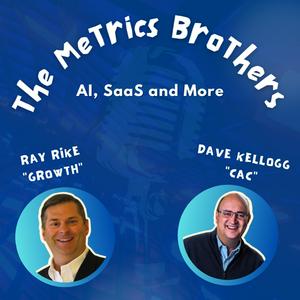
The Metrics Brothers is hosted by Dave "CAC" Kellogg and Ray "Growth" Rike. The Metrics Brothers provides unique insights, strategies, tactics, and metrics that are relevant to AI-Native software and SaaS companies.Each 25-30 minute episode will cover a topic critical to leading a B2B software company, and chock-full of practical advice that can be introduced and applied in most Native-AI, Agentic AI, and B2B software and SaaS companies.
Podcast websiteListen to The Metrics Brothers, The Other Hand and many other podcasts from around the world with the radio.net app
Get the free radio.net app
- Stations and podcasts to bookmark
- Stream via Wi-Fi or Bluetooth
- Supports Carplay & Android Auto
- Many other app features
Get the free radio.net app
- Stations and podcasts to bookmark
- Stream via Wi-Fi or Bluetooth
- Supports Carplay & Android Auto
- Many other app features

The Metrics Brothers
Scan code,
download the app,
start listening.
download the app,
start listening.
 Ireland
