

Listen to this podcast in the app for free: Download for free in the App Store
radio.net
Sleep timer
Save favourites
60 episodes
Writing for an Audience of One | Ep. 58
11/08/2026 | 23 mins.Who exactly are you writing for when you’re writing an academic article, chapter, or book? What if the fastest way to make your writing clearer, more confident, and more compelling is to stop imagining an “audience” and start imagining a single person?
Hey co-authors! One of the most common problems in academic writing is trying to write for everyone. But, when your audience is abstract or generalized, writing can quickly become anxious, overly cautious, and unfocused. In this episode, we’ll explore why writing for an audience of one can actually make your academic writing clearer, more confident, more generous, and ultimately more publishable. In this episode, we’ll explore:
Why abstract audiences create anxiety and how the advice “write for the field” can leave writers guessing about what an imaginary audience actually wants.
How generalized audiences dilute your voice by flattening tone, disrupting pacing, and encouraging you to write defensively rather than generously.
How to identify— whether that person is a struggling student, a colleague who needs clarity, a practitioner who could use your findings, or a younger version of yourself.
How to identify and write to your audience of one by imagining their questions, confusion, curiosity, and needs as you develop your project.
Why writing for one can actually help you reach many because writing with a clear reader in mind produces manuscripts that feel intentional, confident, and purposeful.
Academic publishing doesn’t have to feel like performing for a faceless crowd of reviewers and scholars. When you write for one real human being who needs your insight, your writing becomes clearer, kinder, and more focused and those qualities are exactly what can help your work connect with a much larger audience.
Want to Connect?
Email: publishingacademicresearch@gmail.com
LinkedIn: www.linkedin.com/in/c-kyle-rudick-59a040a7
Schedule a Free, 30-Minute Consultation: https://calendly.com/publishingacademicresearch/30minBreaking out of ADHD Writing Traps | Ep. 57
04/08/2026 | 27 mins.Have you ever followed all the "correct" writing advice and still struggled to make progress? What if the problem isn't your writing ability, but the writing process you've been told to use?
Hey co-authors! Most writing advice assumes that writers can sustain attention, manage time consistently, and move through projects in a predictable, linear fashion. For people with ADHD, that's often not how the brain works. In this episode, we explore why conventional writing advice often fails ADHD writers, what ADHD research tells us about attention and motivation, and how designing a writing process around your brain can unlock greater creativity and consistency. In this episode, you'll discover:
How nonlinear attention shapes the writing process, including why focus naturally spikes, shifts, and redirects instead of remaining steady throughout a writing session.
The evolutionary perspective from Thom Hartman's Hunter in a Farmer's World and how traits that once benefited hunters can clash with modern academic writing expectations.
Practical strategies for reducing cognitive friction, creating "dopamine anchors" through music, movement, and novelty.
How to build a writing system that complements your cognitive style, replacing unrealistic expectations with strategies that capitalize on the creativity, originality, and associative thinking that many ADHD writers naturally possess.
Whether you're starting a book or simply trying to finish the next page, this episode will help you rethink what productive writing looks like. Working with ADHD allows your imagination, insight, and originality to become your greatest strengths.
Want to Connect?
Email: publishingacademicresearch@gmail.com
LinkedIn: www.linkedin.com/in/c-kyle-rudick-59a040a7
Schedule a Free, 30-Minute Consultation: https://calendly.com/publishingacademicresearch/30minBeing a Good Research Co-Author | Ep. 56
28/07/2026 | 27 mins.Have you ever wondered what your name really means when it appears beside someone else's on a manuscript? Is coauthorship simply dividing the work, or is it something much deeper than shared writing?
Hey co-authors! Too often, scholars assume everyone shares the same definition of what it means to be a coauthor, only to discover conflicting expectations, uneven workloads, ethical dilemmas, and frustration along the way. We explore what true coauthorship looks like, why misunderstandings emerge so easily, and how thoughtful communication, ethical practices, and shared accountability can transform collaboration into one of the most rewarding parts of academic life. In this episode, you'll discover:
How poor communication undermines collaborations before the writing even begins and the conversations every coauthor should have at the start of a project.
The ethical problems in co-authorship every scholar should recognize and why these practices damage both scholarship and professional trust.
Practical strategies for defining roles early, establishing expectations, setting deadlines, and creating accountability throughout the writing process.
How to think about coauthorship as shared scholarly identity, where every name on the manuscript represents shared responsibility, shared ownership, and shared care for the finished work.
This episode offers a practical framework for building healthier, more ethical, and more productive research partnerships.
Want to Connect?
Email: publishingacademicresearch@gmail.com
LinkedIn: www.linkedin.com/in/c-kyle-rudick-59a040a7
Schedule a Free, 30-Minute Consultation: https://calendly.com/publishingacademicresearch/30minWriting Research when You Don't Want To | Ep. 55
21/07/2026 | 24 mins.Why is it so hard to start writing when you know exactly what needs to be done? What if your lack of progress is a perfectly normal human response to difficult cognitive and emotional work?
Hey co-authors! In this episode, we explore the psychology behind writing resistance and uncover why reluctance is not a sign that you're a bad writer, but a predictable part of the creative process. You'll learn why writing often feels emotionally taxing, how cognitive load contributes to avoidance, and practical strategies that can help you regain momentum even when motivation is nowhere to be found. In this episode, we'll discuss:
Why writing resistance is universal and why even accomplished writers experience periods of avoidance.
The hidden psychology of reluctance, including cognitive load, emotional exposure, and decision fatigue that make writing feel harder than it actually is.
The most common causes of writing avoidance, from losing interest in a project and feeling overwhelmed to identity pressure, vulnerability, and environmental distractions.
Simple strategies to overcome resistance, including reframing writing from an obligation into an opportunity, resetting your environment, preparing your body before your mind, and embracing "minimum viable progress."
Writing isn't always fueled by inspiration. Sometimes it's built through small decisions, gentle persistence, and the willingness to begin before you feel ready. Discover how to write even when you don't want to and why those reluctant writing sessions often become the ones that matter most.
Want to Connect?
Email: publishingacademicresearch@gmail.com
LinkedIn: www.linkedin.com/in/c-kyle-rudick-59a040a7
Schedule a Free, 30-Minute Consultation: https://calendly.com/publishingacademicresearch/30minApplying for Tenure and/or Promotion with Confidence | Ep. 54
14/07/2026 | 30 mins.How do you apply for tenure and/or promotion with confidence when so much of the process feels uncertain? What if the biggest obstacle to a successful application isn't your record, but the story you're telling yourself about it?
Hey co-authors! In this episode, we explore one of the most significant milestones in an academic career: applying for tenure and/or promotion. The process is a deeply personal moment where years of work, identity, and professional aspirations converge. Yet many faculty approach the process with anxiety, self-doubt, and a nagging sense that they may not be "enough." We'll examine why the process feels so overwhelming, why confidence often erodes during the process, and practical strategies for approaching your dossier with clarity, preparation, and self-trust.
In this episode, you'll learn:
How scholars routinely undervalue their own teaching, service, and research contributions.
How the emotional stakes of tenure can turn a professional dossier into a referendum on personal worth.
The importance of building a clear and coherent professional narrative that explains who you are, what you contribute, and where your work is headed.
How to map your accomplishments directly onto your institution's tenure criteria to create structure and clarity.
How to reframe your application as an opportunity to communicate your value rather than prove your worth.
By the end of this episode, you'll understand that applying for tenure and/or promotion with confidence is not about presenting a perfect record or becoming an extraordinary scholar overnight. It's about clearly demonstrating the sustained contributions you've already made and trusting the professional story you've spent years building.
Want to Connect?
Email: publishingacademicresearch@gmail.com
LinkedIn: www.linkedin.com/in/c-kyle-rudick-59a040a7
Schedule a Free, 30-Minute Consultation: https://calendly.com/publishingacademicresearch/30min
More Education podcasts
 The Comeback with Brenda DennehyEducation, Health & Wellness, Mental Health, Self-Improvement
 Business Alchemy with Jackie MinskyEducation
 Coffee Break FrenchCourses, Education, Language Learning
 Tom's TalksEducation, Health & Wellness, Mental Health, Self-Improvement
 Living Your LegacyBusiness, Education, Entrepreneurship, Film Interviews, Self-Improvement, TV & Film
 80,000 Hours PodcastEducation, Technology
 Begin Again with Davina McCallEducation, Health & Wellness, Mental Health, Self-Improvement, Society & Culture
 The Mel Robbins PodcastEducation, Health & Wellness, Mental Health, Relationships, Self-Improvement, Society & Culture
 6 Minute EnglishEducation, Language Learning
 The Jefferson Fisher PodcastEducation, Relationships, Self-Improvement, Society & Culture
Trending Education podcasts
 Change is PossibleEducation, Self-Improvement
 The Manifest MovementBusiness, Education, Religion & Spirituality, Self-Improvement, Spirituality
 The Jordan B. Peterson PodcastEducation, Science, Society & Culture
 Pulling The Thread with Elise LoehnenEducation, Religion & Spirituality, Self-Improvement
 Victim To Victory PodcastEducation, Personal Journals, Relationships, Self-Improvement, Society & Culture
 French Mornings with ElisaEducation, Language Learning
 French for BeginnersComedy, Education, Language Learning
 Dreaming Spanish Podcast – Chats in Beginner SpanishEducation, Language Learning
 The Alcohol-Free Advantage with Andy RamageEducation, Health & Wellness, Self-Improvement
 Little Talk in Slow FrenchCourses, Education, Language Learning
 Nuacht MhallEducation, Language Learning
 English Learning PodcastEducation, Language Learning
 Platypus Economics with Justin WolfersBusiness, Courses, Education, Science, Social Sciences
 The Calm & Happy HomeEducation, Religion & Spirituality, Self-Improvement, Spirituality, Tutorials
- Tom's TalksEducation, Health & Wellness, Mental Health, Self-Improvement
 ALIGNED | The Path to PurposeAlternative Health, Education, Health & Wellness, Religion & Spirituality, Self-Improvement, Spirituality
 Easy German: Learn German with native speakers | Deutsch lernen mit MuttersprachlernCourses, Education, Language Learning
 Английский язык по плейлистам. Английский язык с нуля. Полный курсEducation, Language Learning
- Coffee Break FrenchCourses, Education, Language Learning
 The BossticksBusiness, Education
 How to PhD - your academic survival guideEducation, Science, Tutorials
 Luke's ENGLISH Podcast - Learn British English with Luke ThompsonComedy, Education, Language Learning
 Therapists Talk TherapyEducation, Health & Wellness, Mental Health
 Blood WorkEducation, History, News, Politics
 Coffee Break ItalianCourses, Education, Language Learning
 Learn Indonesian | IndonesianPod101.comEducation, Language Learning, Places & Travel, Society & Culture
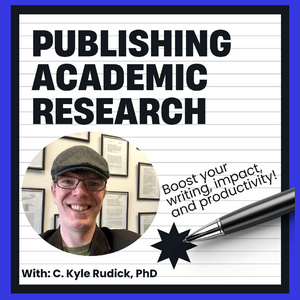
About PUBLISHING ACADEMIC RESEARCH | Complete Your Scholarship, Thesis, or Dissertation and Maintain Your Mental Health
**********Top 5% Globally Ranked Podcast**********
Whether you're a graduate student staring down a thesis/dissertation, a junior scholar building your research agenda, or a seasoned academic ready to level up, this podcast is here to help you write smarter, publish more, and thrive in the process.
I’m Dr. Kyle Rudick, full professor at the University of Northern Iowa. I’ve published dozens of articles, chapters, books, and essays, and edited for some of the top outlets in my field. Along the way, I’ve learned a lot (sometimes the hard way), and now I’m here to help you navigate the publishing world with more clarity, confidence, and joy.
Each episode is packed with practical strategies to:
Build a sustainable and impactful research program
Finish your thesis or dissertation
Boost writing productivity and make the most of your time
Get published and increase your scholarly visibility
Navigate job searches, tenure and promotion, and grant success
And most importantly, stay sane, healthy, and motivated along the way
If you're ready to quiet the inner critic, write with purpose, and finally get your work out into the world, then you’re in the right place.
Let’s get your research published! And, keep Reviewer Two from ruining your day!
Want to Connect?
Email: publishingacademicresearch@gmail.com
LinkedIn: www.linkedin.com/in/c-kyle-rudick-59a040a7
Schedule a Free 30-minute Consultation: https://calendly.com/publishingacademicresearch/30min
Podcast websiteListen to PUBLISHING ACADEMIC RESEARCH | Complete Your Scholarship, Thesis, or Dissertation and Maintain Your Mental Health, The Comeback with Brenda Dennehy and many other podcasts from around the world with the radio.net app
Get the free radio.net app
- Stations and podcasts to bookmark
- Stream via Wi-Fi or Bluetooth
- Supports Carplay & Android Auto
- Many other app features
Get the free radio.net app
- Stations and podcasts to bookmark
- Stream via Wi-Fi or Bluetooth
- Supports Carplay & Android Auto
- Many other app features

PUBLISHING ACADEMIC RESEARCH | Complete Your Scholarship, Thesis, or Dissertation and Maintain Your Mental Health
Scan code,
download the app,
start listening.
download the app,
start listening.
 Ireland