
Listen to this podcast in the app for free: Download for free in the App Store
radio.net
Sleep timer
Save favourites
629 episodes

What Is Your REAL Case Acceptance Rate? | 5MF
23/10/2026 | 8 mins.We talk constantly about increasing case acceptance because it’s one of the fastest ways to grow an orthodontic practice without spending more money to bring additional patients through the door. But before you can improve that number, you need to answer a surprisingly difficult question: What exactly counts as case acceptance?
In this Five Minute Friday, I break down the different ways practices can calculate case acceptance and the situations that can make the number confusing. What happens when someone is ready for orthodontics but needs periodontal treatment first? What about someone who starts six months later, a patient who isn’t financially ready, or a child who simply isn’t ready for treatment yet? Depending on how you define the metric, those patients can completely change your numbers.
💬 Quotes
“Whatever it is you choose, just do that all the time.”
— Dr. Glenn Krieger
“You want to revolutionize your practice overnight. Pay fastidious detail to your case acceptance.”
— Dr. Glenn Krieger
🎯 Key Takeaways
Intro: What does “case acceptance” actually mean? (00:32)
Why practices need a clear definition of case acceptance (00:42)
When does a patient who needs periodontal treatment count? (01:05)
What happens when a patient starts months later? (02:04)
The different ways practices calculate case acceptance (02:36)
Why consistency matters more than the specific formula you choose (03:10)
The macro-tracking analogy: Measure the same way every time (03:20)
Why long-term trends matter more than individual months (03:56)
Be honest about what your case acceptance numbers are telling you (04:24)
Why I believe 85–90% case acceptance is achievable (04:40)
Why orthodontic case acceptance should be relatively straightforward (04:58)
My personal definition of case acceptance (06:11)
Who I consider “ready to start” when calculating the metric (06:24)
A simple example of calculating case acceptance (06:37)
Why increasing case acceptance can grow your practice without more new patients (07:06)
The potential impact of a 15% improvement in case acceptance (07:35)
Final takeaway: Track it correctly, consistently, and closely (08:02)
🟦 Additional Resources
Before you worry about improving your case acceptance, make sure you actually know what your number is.
Define what counts. Track it the same way every single time. Look at your trends over months and years instead of celebrating or panicking over one month. Then ask yourself where you can improve.
Personally, I look at the number of patients who started treatment out of the number who were truly ready to start. If ten patients were ready and eight started, that’s an 80% case acceptance rate. Simple.
And once you know your real number, start working to move it.
If you want to go much deeper into the systems, psychology, and doctor-TC process behind increasing case acceptance, join me at Close More Cases, April 2–3, 2027.
👉 Close More Cases Meeting:
https://closemorecases2027.com/home
👉 Airway Meeting:
https://web.orthopreneurs.com/arizonasleepandairway2026
👉 For more information about Orthopreneurs, visit:
https://orthopreneurs.com/
👉 Become an OrthoPreneur and join the free Facebook group:
https://www.facebook.com/groups/Orthodontics Has Changed. Has Your Practice? w/Brian Wright
20/10/2026 | 54 mins.In this episode, I sit down with Brian Wright, founder and CEO of New Patient Group and WrightChat, to talk about what orthodontists need to change if they want to thrive in today’s market. Brian breaks down his “Five to Thrive” framework—leadership, culture, sales, hospitality, and marketing—and explains why the practices that continue investing in these areas are the ones creating separation while everyone else is blaming outside forces.
We dig into everything from missed new-patient calls and rising no-show rates to price shoppers, team training, consumer behavior, and why the old orthodontic playbook simply doesn’t work the way it used to. Brian and I also share practical strategies for changing the way your team handles new-patient calls and consultations, including one of my favorite approaches for dealing with patients who say price is their number-one concern.
The bigger message is simple: you can’t control the economy, demographics, competition, or what other practices are doing. But you can control how well you lead, how your team communicates, how effectively you create value, and whether you’re willing to invest in getting better. If your practice—or your life—isn’t where you want it to be, waiting for conditions to improve isn’t the answer.
💬Quotes
“Nobody’s asking you to like it. You just need to embrace it.”
— Brian Wright
“Sales is a dirty word in healthcare, but it shouldn’t be because all it means is educating ethically to place more value on what you do.”
— Brian Wright
🎯 Key Takeaways
Intro + Meet Brian Wright (00:00)
The Five to Thrive Framework (01:34)
How Many New Patients Are You Missing? (03:01)
Your Receptionist Is Part of the Sales Process (07:00)
Orthodontics Is Changing (10:06)
Why the Old Playbook No Longer Works (15:00)
The “New Normal” in Orthodontics (17:52)
Invest When Everyone Else Pulls Back (21:20)
Focus on What You Can Control (25:12)
Cost vs. Investment (33:20)
How I Handle Price Shoppers (39:01)
Can Leadership Be Trained? (45:33)
Make More, Work Less (47:50)
🟦 Additional Resources
If your practice isn’t performing the way you want it to, don’t wait for the market to fix it for you. Pick one opportunity from this episode—your phones, new-patient experience, treatment coordinator process, leadership, hospitality, or sales—and start improving it now.
👉 To learn more about Brian Wright and New Patient Group, visit NewPatientGroup.com
👉 The Brian Wright Show:
https://www.youtube.com/c/NewPatientGroupHouston
And most importantly, ask yourself: Is your practice—and your life—the way you actually want it to be? If the answer is no, the only person who can begin changing it is you.
👉 Airway Meeting:
https://web.orthopreneurs.com/arizonasleepandairway2026
👉 For more information about Orthopreneurs, visit:
https://orthopreneurs.com/
👉 Become an OrthoPreneur and join the free Facebook group:
https://www.facebook.com/groups/OrthoPreneursWant to Make More Money? Increase Your Case Acceptance | 5MF
16/10/2026 | 13 mins.We spend so much time thinking about marketing, advertising, referrals, and getting more people into the top of our sales funnel. Those things absolutely matter. But if those patients are already walking into your office and your case acceptance isn’t where it should be, you may be overlooking one of the biggest opportunities sitting right in front of you.
In this Five Minute Friday, I break down three basic ways to increase profitability: bring more people into your funnel, improve case acceptance, and reduce overhead. The problem with overhead is that there’s a limit to how much you can realistically cut. But improving case acceptance allows you to generate more production from patients you’ve already spent the time and money to acquire.
💬 Quotes
“Increase your case acceptance. That’s the key. Increase your case acceptance.”
— Dr. Glenn Krieger
“If the case acceptance didn’t go up, you are leaving money on the table.”
— Dr. Glenn Krieger
🎯 Key Takeaways
Intro: The sales funnel, closing, and getting more starts (00:25)
How to make more money without increasing new-patient volume (01:02)
Three ways to improve profitability in your practice (01:40)
Why improving case acceptance can be more powerful than cutting overhead (02:37)
Why you can’t simply cut your way to profitability (03:48)
How your sales funnel should nurture patients before the TC room (04:36)
Why you need to know where the consultation is headed before it begins (05:04)
The simple math behind case acceptance (05:24)
Why you need to accurately track your true case acceptance rate (06:06)
How a 10% improvement can translate into significant additional production (06:41)
Why most practices may overestimate their case acceptance (07:17)
The metrics you should be auditing over the course of a year (07:50)
The opportunity when fewer patients are coming through the door (08:10)
The change you can start making without spending more on marketing (09:26)
Why the doctor/TC process needs a repeatable system (09:44)
The step-by-step science behind improving the close (10:17)
What the Close More Cases meeting will cover (10:57)
Final takeaway: Keep marketing — but put more effort into closing (12:54)
🟦 Additional Resources
Keep marketing. Keep advertising. Keep looking at your overhead. But don’t spend all your energy getting more people through the front door while ignoring what happens once they’re already inside.
Know your numbers. Audit your case acceptance. Train your TC. Understand the doctor-TC relationship. And build a repeatable system for moving patients through the consultation process.
If you want to dive much deeper into the psychology of buying, the words that matter, and the systems I use to improve case acceptance, join me and Victor Antonio at Close More Cases 2027.
👉 Close More Cases Meeting:
https://closemorecases2027.com/home
👉 Airway Meeting:
https://web.orthopreneurs.com/arizonasleepandairway2026
👉 For more information about Orthopreneurs, visit:
https://orthopreneurs.com/
👉 Become an OrthoPreneur and join the free Facebook group:
https://www.facebook.com/groups/MARPE vs. FME: What Really Matters? w/Girl Jaw
13/10/2026 | 1h 25 mins.I've seen firsthand how quickly patients become convinced they need MARPE or another expansion procedure without fully understanding what's actually causing their breathing problems. In this episode, I join Girljaw from Get Expanded to discuss one of the most important principles in orthodontics: diagnosis must always come before treatment. We explore the growing interest in adult palatal expansion, the misconceptions surrounding airway treatment, and why even the most advanced technology won't necessarily solve a problem that hasn't been properly identified.
I also share my personal journey into airway-focused orthodontics, including the patient experience that completely changed my perspective on expansion. We dive into CBCT imaging, sleep studies, custom bone-borne expanders, FME, and why an interdisciplinary team is essential when treating complex cases. Whether you're already offering expansion or considering incorporating airway-focused care into your practice, this conversation will help you approach treatment planning with greater confidence, make more informed clinical decisions, and ultimately deliver better care for your patients.
💬Quotes
"A MARPE is a device. That's not a treatment, right? You need some sort of expansion of your maxilla."
— Dr. Glenn Krieger
"We're not getting a second piece of lumber to work on here, folks. We want to do this once. We want to do it right."
— Dr. Glenn Krieger
🎯 Key Takeaways
Introduction and the importance of diagnosis-first treatment (00:00)
Why patients are increasingly requesting MARPE without understanding their diagnosis (03:42)
Multiple treatment options, but one correct diagnosis (06:52)
My first experience with bone-borne expansion and Dr. Won Moon's MSE (08:18)
The patient who changed my perspective on airway treatment (14:01)
Why CBCT is valuable and what it cannot diagnose (19:21)
The most important diagnostic tool: listening to your patients (24:19)
Understanding skeletal discrepancies and dental compensation (29:44)
Why expansion should be customized to each patient's anatomy (37:11)
Building an interdisciplinary airway treatment team (42:47)
Why getting the diagnosis right matters more than choosing a specific appliance (51:40)
Custom bone-borne expanders vs. FME: understanding the differences (59:40)
Nasal obstruction, sleep studies, and treatment considerations (1:06:00)
The importance of prevention and patient advocacy (1:24:40)
🟦 Additional Resources
If you're treating patients with airway concerns or considering adding expansion to your practice, I encourage you to listen to this conversation before making your next treatment decision.
Great orthodontics starts with great diagnosis. Take the time to understand what's really happening, surround yourself with knowledgeable specialists, and never stop learning.
👉 Girl Jaw:
https://www.youtube.com/@GirlJaw
👉 Get Expanded:
https://www.youtube.com/channel/UCXV6P5r8vbNICm8cvgasDwA
👉 Airway Meeting:
https://web.orthopreneurs.com/arizonasleepandairway2026
👉 For more information about Orthopreneurs, visit:
https://orthopreneurs.com/
👉 Become an OrthoPreneur and join the free Facebook group:
https://www.facebook.com/groups/OrthoPreneursThe 5 Biggest Mistakes I’ve Made in My Career | 5MF
09/10/2026 | 10 mins.What if some of the best decisions you’ll ever make in your career come from learning which mistakes not to repeat?
After more than three decades in practice, I’ve made plenty of decisions that worked out — and plenty that taught me expensive lessons. In this Five Minute Friday, I’m breaking down five of the biggest mistakes I’ve made throughout my career so you can hopefully avoid learning some of these lessons the hard way.
💬 Quotes
“Life is about making three great financial moves and avoiding that one disastrous one.”
— Dr. Glenn Krieger, sharing advice from Michael Cohen
“If you’re chasing money, that’s the wrong reason to do something.”
— Dr. Glenn Krieger
🎯 Key Takeaways
Intro: The five biggest mistakes I’ve made in my career (00:32)
A mentor’s lesson: Make great financial moves and avoid the disastrous one (01:18)
Mistake #1: Taking unnecessary investment risks when you’re young (02:11)
Why capital preservation matters early in your career (02:40)
Mistake #2: Bringing an associate into your practice too soon (03:08)
Why adding an associate can change a practice you already love (03:25)
Mistake #3: Choosing the wrong reasons to enter a partnership (04:54)
Why strong relationships matter when partnerships get difficult (05:25)
Mistake #4: Expanding into additional locations for the wrong reasons (06:04)
The hidden responsibilities that come with opening another practice (06:32)
Why organizational support changes the satellite-office equation (07:17)
Mistake #5: Not specializing sooner (07:36)
Why becoming an expert in orthodontics ultimately appealed to me (08:17)
Why I still wouldn’t erase my years in restorative dentistry (09:20)
Final takeaway: Learn from my mistakes without having to repeat them (09:44)
🟦 Additional Resources
today. But that doesn’t mean you have to make every mistake I made to learn the same lessons.
Protect your capital. Think carefully before bringing in an associate. Choose partners for reasons that will survive the difficult times. Don’t expand simply because you think another location means more money. And above all, think seriously about what kind of career and life you actually want to build.
If you see me at an upcoming meeting, come say hi, pick my brain, and let’s talk. And if you’re interested in our upcoming Airway & Sleep meeting, visit opairway.com for more information.
👉 Close More Cases Meeting:
https://closemorecases2027.com/home
👉 Airway Meeting:
https://web.orthopreneurs.com/arizonasleepandairway2026
👉 For more information about Orthopreneurs, visit:
https://orthopreneurs.com/
👉 Become an OrthoPreneur and join the free Facebook group:
https://www.facebook.com/groups/OrthoPreneurs
More Business podcasts










Trending Business podcasts


























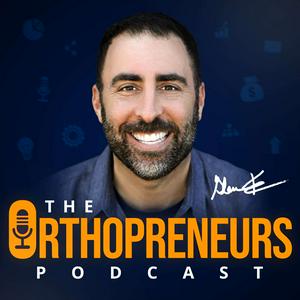
About The Orthopreneurs Podcast with Dr. Glenn Krieger
What does it mean to become an Orthopreneur? Hi there! My name is Dr. Glenn Krieger and I believe that in today’s competitive world, the orthodontic and dental communities should be collaborative. And I've created Orthopreneurs so that we can move towards that goal together. Orthodontists are smart people. You’ve accomplished a lot to get where you are, but chances are you never got a formal education in how to run the most effective and lowest stress practice possible. Don’t sweat it! Because we’ve got your back... Being an Orthopreneur means that you’re a part of a community. A community that brings peers together to become the best clinicians and the best business owners they can be. Becoming an Orthopreneurs means you never ever need to practice alone. Join the FREE Facebook group by simply applying:https://www.facebook.com/groups/OrthoPreneurs
Podcast websiteListen to The Orthopreneurs Podcast with Dr. Glenn Krieger, The Diary Of A CEO with Steven Bartlett and many other podcasts from around the world with the radio.net app
Get the free radio.net app
- Stations and podcasts to bookmark
- Stream via Wi-Fi or Bluetooth
- Supports Carplay & Android Auto
- Many other app features
Get the free radio.net app
- Stations and podcasts to bookmark
- Stream via Wi-Fi or Bluetooth
- Supports Carplay & Android Auto
- Many other app features
The Orthopreneurs Podcast with Dr. Glenn Krieger
Scan code,
download the app,
start listening.
download the app,
start listening.
 Ireland