
Listen to this podcast in the app for free: Download for free in the App Store
radio.net
Sleep timer
Save favourites
1604 episodes
1605: From Art Director to Tech CEO: The Power of Solving Your Own Problem w/ Rayne Chapman
28/10/2026 | 32 mins.Rayne Chapman, a creative director turned tech founder, joins the show to share how she transformed a personal frustration—the lack of a good way to save online inspiration—into a thriving business called Neat. This episode is a masterclass in building a product with deep intentionality, driven by genuine user needs rather than just adding features for the sake of it. For any entrepreneur or wantrepreneur, this conversation is packed with insights on how to leverage your unique background, use customer feedback to build a better product, and embrace the often-scary but magical process of building a company from the ground up.
💡 What You'll Take Away For YOUR Business
🚀 How to turn your own professional frustration into a scalable business idea.
🗣️ Simple, effective strategies for gathering user feedback that actually shapes your product roadmap (hint: it's not just NPS scores).
🤖 Why AI is a powerful augmentation tool for creativity and productivity, not a replacement for human vision.
🧠 The power of cross-industry inspiration (like a bullet train inspired by a bird) to solve complex business problems.
🎨 How to build a brand that empowers your users' unique vision instead of imposing your own aesthetic.
🧘♀️ Why embracing the "process" over instant gratification is the key to building a sustainable and impactful business.
📝 About Rayne Chapman
Rayne Chapman is the Founder and CEO of Neat, an innovative platform for saving and organizing creative inspiration. With a rich background as an agency art director and creative director at places like Meta, she experienced firsthand the problem of wrangling inspiration from endless online sources. Rayne brings a unique, creative-first perspective to the world of tech entrepreneurship, focusing on building tools that are intentional, user-centric, and designed to enhance human creativity.
🎯 Rayne’s BEST Piece of Advice for Wantrepreneurs and Entrepreneurs
Don't underestimate the power of the process; the magic is in the day-to-day journey of building, not just in reaching the destination.
📢 Memorable Quotes
“Building something that actually helps people and is really intentional, I think, is kind of that human superpower we want to hold on to.” – Rayne Chapman
“I actually think the magic is in the process... the inspiration is where you start, but like the happy accident or the things or the challenges along the way are what that's going to make that end product feel really unique and ownable to you.” – Rayne Chapman
“You can find inspiration that's completely unrelated to something that you're doing and it can help you solve a problem.” – Rayne Chapman
💡 Actionable Takeaways
✅ Start your own inspiration board today. Use a tool like Neat to save ideas from different sources—websites, images, links—and see what new connections you can make.
✅ Actively seek user feedback. Instead of a generic survey, send a personal email or text to a few key users and ask, "What's one thing that would make this more useful for you?"
✅ Look for inspiration outside your industry. Spend 30 minutes this week exploring a topic completely unrelated to your business (like nature, architecture, or sports) and see what ideas it sparks.
✅ Experiment with an AI tool to augment a task you dislike. Use something like Gamma AI for presentations or another tool to help with note-taking, and see how it can free up your time for more creative work.
🔗 Links & Resources
Website: https://neatinspo.com
Connect with Rayne on LinkedIn
Follow Neat Inspo on LinkedIn1604: This AI Assistant Knows Your Team Better Than You Do w/ Masumi Nakamura
27/10/2026 | 30 mins.In a world buzzing with AI advancements, Masumi Nakamura is focused on the one thing technology often overlooks: the people. After 25 years as a top engineering leader at giants like Cisco and PayPal, Masumi realized the biggest challenges weren't in the code, but in the complex human dynamics of a team. In this episode, he introduces askMyu, his private AI assistant designed to navigate the "people side" of work. This isn't about replacing jobs; it's about enhancing our most human skills. For any wantrepreneur or entrepreneur building a team, this episode is a masterclass in leveraging AI to foster better communication, navigate career growth, and solve the interpersonal issues that truly define a company's success, all while prioritizing individual privacy.
💡 What You'll Take Away For YOUR Business
Why the most critical business challenges are often human-related, not technical, and how AI can help bridge the gap.
How to build a company culture where technology enhances human skills like decision-making and relationship-building, rather than replacing them.
The crucial role of privacy and end-to-end encryption when integrating AI tools into your team's workflow to build trust.
How an AI assistant can gather context from emails, calendars, and messages to help you prepare for meetings and understand team dynamics.
A forward-thinking perspective on how AI will increase the importance of human interaction and systemic thinking in the workplace.
Actionable insights on how to guide your team through the AI revolution by focusing on addition and augmentation, not fear and subtraction.
📝 About Masumi Nakamura
Masumi Nakamura is the co-founder and CEO of askMyu, a private AI assistant for the people side of work. With a storied 25-year career as an engineer and engineering leader, Masumi has been at the forefront of innovation at companies like Cisco, PayPal, and Mercari US, where he served as VP of Engineering. He discovered that across every team, the engineering was the easy part; the human element was the real challenge. This insight, combined with his experience mentoring founders at Techstars, led him to build a tool that helps professionals navigate their careers and relationships at work.
🎯 Masumi’s BEST Piece of Advice for Wantrepreneurs and Entrepreneurs
"No matter what, it's about the people. If you fundamentally think about what a company is, at the end of the day, it's a grouping of people and resources to get some goal done... The more you understand your relationships, the more you build on it, the better you will be."
📢 Memorable Quotes
“The engineering, the building, that's the easy stuff. It was the people side that often is the issue.” – Masumi Nakamura
“You end up having to pay a lot more attention to what's not said as well as what is said.” – Masumi Nakamura
“The bigger troubling thing that's actually happening is the amount of load is increasing on the person... what humans need to do elevates up. You need to have a better sense of system thinking. You're going to have to interact with more people, actually.” – Masumi Nakamura
💡 Actionable Takeaways
✅ Audit your own "people problems." Identify where communication breakdowns or relationship friction are holding your business back.
✅ When evaluating AI tools, make privacy your top priority. Ensure any new technology protects individual data and builds trust within your team.
✅ Shift your focus from automating tasks to augmenting human capabilities. Use AI to free up time for strategic thinking, creativity, and relationship-building.
✅ Encourage your team to develop elevated skills like systems thinking, complex decision-making, and interpersonal communication—these are the skills that will be amplified, not replaced, by AI.
🔗 Links & Resources
Website: https://www.askmyu.com
Connect with Masumi on LinkedIn
Follow askMyu on LinkedIn1603: Are You in the Weeds? How to Think Strategically + One Level Higher w/ Mark McSweeney
26/10/2026 | 34 mins.Mark McSweeney, a 30-year veteran of the association and nonprofit world, shares powerful insights on governance, strategy, and leadership that apply to any business. He reveals the universal patterns of success he's observed across countless organizations and breaks down why even the most unique businesses face similar challenges. This episode is a masterclass in strategic thinking, teaching you how to get out of the "weeds," facilitate better conversations, and ask the kind of questions that lead to breakthrough solutions. Tune in to learn how to shift from a tactical operator to a visionary leader in your own venture.
💡 What You'll Take Away For YOUR Business
🚀 Why "nonprofit is a tax status, not a business strategy" and how to apply this mindset to your own company's growth.
🧠 The critical difference between governance and management, and how to adopt a "nose in, fingers out" approach to leadership.
❓ A powerful framework for asking "one level higher" to ensure you're solving the right problems, not just the most immediate ones.
🤝 The art of facilitation and how to lead your team, clients, and partners to better solutions by asking questions instead of giving answers.
📈 How to intentionally carve out time for strategic thinking and escape the "weedy" operational mindset that holds so many entrepreneurs back.
💡 The surprising power of associations and why joining one could be the secret to your professional and business growth.
🎯 How the E-Myth principle of "technician vs. owner" applies to every stage of the entrepreneurial journey.
📝 About Mark McSweeney
Mark McSweeney is a governance strategist, facilitator, and the founder of Envisioned Future. With over 30 years of experience in the association and nonprofit sectors, including serving as an association CEO at just 27, he brings a unique perspective on leadership. Mark specializes in helping boards and leadership teams think strategically, navigate change, and make better decisions about their future. His genius lies in asking the questions that help leaders get out of their own way and see their challenges from a higher, more impactful vantage point.
🎯 Mark’s BEST Piece of Advice for Wantrepreneurs and Entrepreneurs
Before you rush into finding a better answer, make sure you're asking a better question. His advice is to "always ask one level higher" to shift your perspective from immediate problem-solving to true strategic thinking.
📢 Memorable Quotes
“Nonprofit is a tax status, not a business strategy.” – Mark McSweeney
“Sometimes the very things that made us successful can also get in the way of where we need to go next.” – Mark McSweeney
“Before you rush into a better answer, make sure you're asking a better question.” – Mark McSweeney
💡 Actionable Takeaways
✅ Schedule dedicated "strategic thinking" time each week. Get out of your usual environment to force your brain out of its operational rut.
✅ The next time your team faces a problem, stop them and ask, "What's the bigger question behind the question we're trying to answer?"
✅ Practice a "nose in, fingers out" leadership style. Understand what's happening in your business without micromanaging the day-to-day operations.
✅ Research and identify a professional association in your industry. Explore joining to tap into a community of peers for networking and growth.
✅ Re-evaluate your business model with the mindset that you are a business first, regardless of your mission or tax status.
🔗 Links & Resources
Website: https://envisionedfuture.co
Connect with Mark on LinkedIn
Follow Envisioned Future LLC on LinkedIn1602: You'll get PUNISHED as the FINISHER... (AI took this episode over!)
26/10/2026 | 21 mins.Every entrepreneur loves the superhero story: the founder who swoops in at midnight to fix the crashed server, write the perfect sales copy, and hold the whole business together. But what if that superhero is actually trapped in a cage built from their own competence? In this special Solo Sunday, Brian is unplugged and spending time with his family, so two AI hosts take over the feed. Nobody on Brian’s team prompted or directed them. They chose to turn the microphone around and dissect Brian’s own book, OPERATE: Escape the Finisher’s Trap and Build a Business That Runs Without You. They cover the stories behind it, including a Christmas Eve drive through a snowstorm to fix a client’s email server, a roast beef shop owner asking “what’s next?”, and a dorm room TV playing Google Analytics 24/7. They also break down all seven pillars of the OPERATE Framework, which helps you stop being the bottleneck and build a business that runs beautifully without you.
✨ Why This Matters for You
The OPERATE Framework is a game-changer for entrepreneurs because:
It names the “operator ceiling,” the point where your own ability to get things done is what stops your business from growing.
It moves you from finisher to architect, so you design the systems others use to finish the work.
It ends the feast-or-famine cycle by making visibility a constant current instead of a light switch.
It shows how automation can protect the human touch instead of replacing it.
It gives you practical tools for handing over real decisions to your team, including decision thresholds and the 4 D’s.
📝 Key Takeaways
Be the Architect, Not the Finisher. A founder is like a rocket’s booster stage: essential to get off the ground, but dead weight if it never detaches. Your highest value is designing the systems, not finishing every task.
Become a Lighthouse, Not a Lifeboat. Good work doesn’t market itself. Brian’s Outreach Equation is Message × Medium × Motion, and motion is what keeps your message going out while you sleep or deliver client work.
Pipelines Are Relationship Journeys. Capture, nurture, convert. Automation doesn’t replace empathy. It makes sure empathy happens consistently, which is how Brian earned a “your timing is spooky” reply from a prospect.
Delivery Runs on Clarity, Cadence, and Capacity. Hustle hides broken systems. Retention then runs on Experience, Engagement, and Evolution, and continuity offers give clients a systematized bridge to their next level.
Leverage Beats Efficiency. Efficiency gets today’s tasks done. Leverage changes what you’re capable of for the next decade. Brian’s AI teammates, Micaela and Andrew, handle the mechanical work so the humans can do the meaningful work.
Respect the Empathy Line. Never automate hiring decisions, creative reviews, apologies, or gratitude. Automation handles the movement of data, not the meaning of the relationship.
Track All Three Layers of Telemetry. Operational (the daily pulse), performance (the scoreboard), and personal (your energy, sleep, and team morale). Don’t track vanity metrics.
Mistakes Are Tuition. Use Brian’s enablement trifecta of Empowerment, Education, and Environment, and follow the 4 D’s: Document → Delegate → Develop → Disappear (then distribute decisions). Set decision thresholds, like the Ritz-Carlton’s $2,000 rule, scaled to your business.
🚀 Put It Into Action
This week, don’t try to build all seven pillars at once. Pick one friction point and build one system:
Block off one hour in your calendar.
Name the single biggest bottleneck in your business. Is it a leaky pipeline, feast-or-famine outreach, or a team that waits on you for every decision?
Write down every step you take to handle that bottleneck manually.
Turn that document into a system. Automate the data movement, delegate the execution, or set a decision threshold (e.g., “If it costs under $200 to fix, you have the authority to decide”).
Then ask yourself the episode’s closing question: when your business no longer needs you to be the hero, what will you do with your life?
🔗 Stay Connected
Subscribe to the show so you never miss an episode
Grab your copy of OPERATE: Escape the Finisher’s Trap and Build a Business That Runs Without You
Connect with Brian on Instagram @imetbrian
Share this episode with a fellow entrepreneur who’s stuck being the hero of their own business1601: Just when you think it FLOPPED, here's how it can work out... (COLLAB EPISODE!)
23/10/2026 | 25 mins.In this special Collab Week episode of Wantrepreneur to Entrepreneur, 8 founders come together to answer one deceptively powerful question:
Think back to a flop or failure you’ve had in your business. How did it end up feeding something that worked?
This episode covers ad campaigns that flopped, teams scaled too fast, AI projects that got ahead of the technology, a contractor who never delivered, an expo full of the wrong audience, a deal lost on the two-yard line, and a lot more. Together, the answers show that the failure itself rarely matters most. What matters is what you do with it next.
For any wantrepreneur or entrepreneur still stinging from something that didn’t work, or wondering whether you’re “failing too much,” this episode is a reminder that every founder you admire has a story like yours. You’ll hear how each one turned a setback into better data, sharper focus, new skills, and a stronger business.
✨ What You’ll Take Away
In this episode, you’ll learn:
How scaling your team before you understand your operations can almost sink your business
Why setting expectations up front matters most when you’re selling AI
How a failed contractor relationship can push you to build skills you never planned to learn
Why asking the right questions saves you time and money
What “the deal dies in maybes” means for founders still building their sales muscle
Why saying no to the wrong opportunities makes room for the right ones
🎙️ Meet the Collab Week Contributors
Sara Reece — Workmind
Sara Reece is the CEO and Co-Founder of Workmind, where she helps organizations use practical, operations-first automation to remove friction and grow without increasing headcount at the same pace. Over the last seven years, she has designed and implemented automation for nonprofits, small businesses, franchise systems, and Fortune 500 enterprises, drawing on a career that spans journalism, television broadcasting, environmental research, and technology. Sara is the author of The Practical Path to Operational Automation and speaks regularly on practical automation, AI, leadership, and sustainable growth.
Connect with Sara:
Website: https://workmind.cloud/
Jaimz Hodge — Cart Catalyst
Jaimz Hodge is the owner of Cart Catalyst, a Missoula, Montana agency that helps Shopify brands convert more customers by removing the hidden friction in their buying experience. From the first ad click to checkout, Jaimz and his team improve both the website and the Google Ads behind it so ecommerce businesses can scale to the next level.
Connect with Jaimz:
Website: https://www.cartcatalyst.com/
Julie Silvestri — Inside Out Box
Julie Silvestri is the founder and CEO of Inside Out Box, which builds custom software and AI tools, starting with how a company’s data is designed and organized. After studying theoretical math at Harvard, Julie spent more than a decade at startups in finance and edtech, where she managed cross-national software development teams. For more than four years, Inside Out Box has served a broad range of mid-sized companies.
Connect with Julie:
Website: https://www.insideoutbox.com/
Jane Alexander — Emma Advisor
Jane Alexander is the founder and CEO of Emma Advisor, an AI platform that helps families get from high school to college with more clarity, strategy, and confidence. Homeschooled in rural Idaho, Jane went from community college to a private university and later did graduate work at Harvard, then spent more than a decade advising leaders at over 200 colleges and universities. She built Emma Advisor on the belief that opportunity shouldn’t depend on connections or expensive consultants.
Connect with Jane:
Website: https://emmaadvisor.ai/
Felix Vicknair — United Business Works
Felix Vicknair is an executive business advisor and the founder of United Business Works, based in Chattanooga, Tennessee. He provides cost optimization services that help small businesses, nonprofits, and healthcare practices reduce expenses and run leaner, both locally and across the US.
Connect with Felix:
Website: https://unitedbusinessworks.com/
Kacy Webster — Profit Quiver
Kacy Webster is a Business Transformation Strategist, Certified AI Consultant, and the founder of Profit Quiver, based in Minburn, Iowa. With more than 30 years of executive leadership in higher education, workforce development, and enterprise transformation, she helps colleges, nonprofits, and organizations adopt AI in ways their people can trust. Her framework, the 12 Domains of Human-First AI Adoption, gives leaders a structured path to transformation that starts with culture, alignment, and readiness rather than the technology itself.
Connect with Kacy:
Website: https://www.profitquiver.com/
Drew Mehta — ThinkFraction
Drew Mehta is the founder of ThinkFraction, which helps owner-operated businesses build practical AI into their everyday workflows to grow revenue, lower costs, and improve quality. After more than 20 years in corporate, much of it in product management, Drew now combines advisory, implementation, and education to fix the leaks in his clients’ back-end operations, and he’s open about learning the entrepreneurial journey as he goes.
Connect with Drew:
Website: https://thinkfraction.xyz/
Heather Waisanen — Coastal Maverick
Heather Waisanen is the founder of Coastal Maverick, a woman-owned boutique out-of-home advertising agency in Jacksonville, Florida that helps brands nationwide with strategy, media planning, buying, negotiation, and campaign execution. After being laid off from her role as a senior media planner, she launched the agency, drawing on more than a decade of experience across the client, agency, and media owner sides of the industry. Now in her fourth year in business, Heather was named a JAX Chamber Small Business Leader of the Year and is a member of the inaugural 2026 Visionaries 200 class.
Connect with Heather:
Website: https://www.coastalmaverick.com/
More Business podcasts









Trending Business podcasts




















About Wantrepreneur to Entrepreneur | Start and Grow Your Own Business
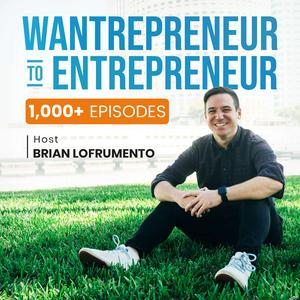
Brian Lofrumento reveals everything you need to go from wantrepreneur – or someone who WANTS to own their own business – to a money-making, action-taking entrepreneur. Discover exactly how to start a business and build a raving audience of fans and customers who want to buy your stuff, and learn exactly how to best serve your customers and clients by building a customer-centric line of products and services. Brian has built multiple six-figure businesses, including a six-figure SEO agency at the age of 24, and now helps thousands of entrepreneurs from around the world grow, automate, and scale their businesses by implementing high-converting marketing strategies and systems into their businesses. Visit the show online and get a free copy of the book, Wantrepreneur to Entrepreneur, at TheWantrepreneurShow.com. Our show is made possible by the financial, time, and knowledge contributions of our amazing guests. Together with the Wantrepreneur to Entrepreneur host and team, our guests believe in the power of entrepreneurs lifting up other entrepreneurs, and their contributions make it possible for us to reach wantrepreneurs and entrepreneurs all over the world ad-free.
Podcast websiteListen to Wantrepreneur to Entrepreneur | Start and Grow Your Own Business, Money Talks and many other podcasts from around the world with the radio.net app
Get the free radio.net app
- Stations and podcasts to bookmark
- Stream via Wi-Fi or Bluetooth
- Supports Carplay & Android Auto
- Many other app features
Get the free radio.net app
- Stations and podcasts to bookmark
- Stream via Wi-Fi or Bluetooth
- Supports Carplay & Android Auto
- Many other app features

Wantrepreneur to Entrepreneur | Start and Grow Your Own Business
Scan code,
download the app,
start listening.
download the app,
start listening.
 Ireland

