

Listen to this podcast in the app for free: Download for free in the App Store
radio.net
Sleep timer
Save favourites
354 episodes
ChatGPT Makes a Silent Character Speak
25/08/2026 | 8 mins.ChatGPT makes a silent character speak, while AI in literature education shows why Emile Bernard’s Madeleine in the Bois d'Amour defeats pattern matching.
In this episode:
AI in literature education should focus on critical thinking AI, enabling students to directly confront the limitations of tools like ChatGPT in literary analysis.
ChatGPT made specific errors when analyzing Carson McCullers' *The Heart is a Lonely Hunter*, including changing a bus to a train and giving dialogue to the silent character, John Singer.
Southern Gothic AI analysis reveals that AI struggles with the nuanced contradictions and 'grotesque' elements in authors like Flannery O'Connor, highlighting AI limitations in humanities.
Effective teaching AI literary analysis involves students annotating AI responses for textual support and then revising them, fostering a 'productive struggle' that deepens understanding.
Rather than simply dismissing AI for lack of 'feelings,' educators should guide students to critique AI interpretations based on textual evidence, coherence, and insight.
Chapters:
00:00 — Cold open & welcome
00:30 — Exploring AI in literature education with ChatGPT
00:52 — ChatGPT’s errors in *The Heart is a Lonely Hunter*
01:15 — Why Southern Gothic AI analysis challenges pattern matching
01:52 — Critiquing AI interpretations: beyond 'no feelings'
02:30 — ChatGPT ignores John Singer’s silence
03:00 — Practical teaching AI literary analysis: annotation and revision
03:45 — Rethinking assessment: product, process, and live understanding
04:15 — Professional development for critical thinking AI
04:45 — AI in literature education makes close reading essential
How can teachers use AI in literature education without students misusing it?
Teachers can foster critical thinking AI by allowing students to directly identify AI limitations in literary analysis, such as ChatGPT's errors when analyzing *The Heart is a Lonely Hunter*.
What are the specific AI limitations in humanities subjects, especially literature?
AI's linguistic fluency can create the appearance of understanding without genuine insight, missing nuanced textual details, contradictions, and character specificities, as seen in Southern Gothic AI analysis.
How can teachers develop critical thinking skills using AI tools for literary analysis?
Teachers can have students annotate AI-generated literary analyses, identifying supported claims, areas needing more evidence, and overlooked details, then requiring them to rewrite sections with their own defended interpretations.
Featuring: Dan Fitzpatrick, Emile Bernard, Madeleine in the Bois d'Amour, Carson McCullers, The Heart is a Lonely Hunter, Flannery O'Connor, Spiros Antonapoulos, John Singer, ChatGPT.
Read the original source
Follow AI in Education with Dan Fitzpatrick for more on AI in education.Five Tests for Classroom Technology
24/08/2026 | 8 mins.Screen time is a poor proxy for learning. AI in education policy should judge thinking, access, ethics and student data.
In this episode:
The United States Department of Education outlines five core principles for AI in education policy: technology must be educator-led, ethical, accessible, transparent, and protective of student data.
Evaluating education technology guidelines means shifting focus from mere screen time in schools to the quality of student thinking and the learning outcomes produced.
Responsible AI education emphasizes rigorous edtech procurement, requiring independent evaluations and a focus on evidence of impact, not just vendor popularity or brand recognition.
Accessibility features like text-to-speech and captioning are critical equity components of effective edtech procurement, ensuring all students can access grade-level content.
Effective AI in education policy balances evidence, professional judgment, and local context to ensure technology genuinely enhances learning rather than becoming an expensive, unproven addition.
Chapters:
00:00 — Cold open & welcome
00:25 — United States Department of Education's 5 principles for AI in education policy
01:00 — Why screen time in schools is a poor metric for learning
01:50 — Balancing duration with educational value in education technology guidelines
02:35 — The critical difference between passive consumption and active thinking with an AI chatbot
03:15 — Raising standards for edtech procurement: evidence and independent evaluation
04:15 — Leadership responsibility in implementing new education technology guidelines
05:05 — Equity and accessibility as a foundation for responsible AI education
06:00 — Balancing evidence, professional judgment, and local context in AI in education policy
What are the United States Department of Education's five principles for AI in education policy?
The five principles are that technology should be educator-led, ethical, accessible, transparent, and protective of student data.
How should schools evaluate education technology guidelines beyond just screen time in schools?
Schools should focus on the quality of student thinking, the learning outcomes produced, and the cognitive tasks students are engaging in, rather than simply measuring screen exposure.
What evidence should districts look for during edtech procurement to ensure responsible AI education?
Districts should seek independent evaluations, randomized controlled trials, and evidence that considers the specific conditions under which the technology proved effective, not just brand popularity or basic usage numbers.
Featuring: Dan Fitzpatrick, United States Department of Education, Elementary and Secondary Education Act, Every Student Succeeds Act, Apple Podcasts, Spotify, Google, AI chatbot, Linda McMahon.
Follow AI in Education with Dan Fitzpatrick for more on AI in education.Google Gemini, ChatGPT Face Nine Rulebooks
21/08/2026 | 8 mins.Nine neighbouring districts set different rules for the same technology, showing why AI policy school districts adopt must be clearer.
In this episode:
Nine Central Florida school districts demonstrate varied AI policy school districts are adopting, from outright prohibition to specific allowances for tools like Google Gemini and ChatGPT.
Student AI use policy must clearly define 'permission' to avoid six teachers setting six different boundaries for the same student, ensuring consistent instructional guidance.
Orange County Public Schools and Brevard Public Schools correctly avoid relying on AI detection software as definitive proof of cheating, requiring supporting evidence like writing samples or student conversations.
Effective AI guidelines for teachers should integrate AI tools for education into learning design, emphasizing human judgment and student cognitive engagement over simple machine production.
Districts like Flagler Schools offering enterprise access to AI tools for education can provide stronger privacy controls, but policy language needs technical precision to avoid vague terminology.
Chapters:
00:00 — Cold open & welcome
00:30 — AI policy in Central Florida schools: Nine districts, different rules
01:00 — Foundational AI guidelines for teachers
01:30 — Variations in student AI use policy
02:45 — Why AI detection software isn't definitive proof of cheating
03:45 — Procurement and governance of AI tools for education
04:30 — The problem of access and equitable provision
05:15 — Beyond training: measuring impact and designing professional development
06:15 — Characteristics of good AI policy in school districts
How can teachers use AI marking safely?
Teachers should use AI tools for education with permission, protect sensitive student data, disclose AI involvement, check outputs for errors or bias, and rely on human judgment, especially for grading and high-stakes decisions.
What are common challenges for AI policy in school districts?
Challenges include varied student AI use policies across classrooms, over-reliance on AI detection software for cheating, and the need for technically precise language in procurement to ensure privacy and security with tools like Google Gemini and ChatGPT.
How can schools ensure equitable access to AI tools for education?
Schools must design AI provision to be accessible for all students, addressing needs related to homes, disabilities, and languages, rather than treating accessibility as an afterthought to purchasing decisions.
Featuring: Dan Fitzpatrick, Maria Salamanca, Orange County School Board, Brevard Public Schools, Katye Campbell, Flagler Schools, Don Foley, Google Gemini, ChatGPT.
Read the original source
Follow AI in Education with Dan Fitzpatrick for more on AI in education.AI access approved two days pre-term
20/08/2026 | 8 mins.A school AI policy reversed an AI ban two days before term, leaving teachers to define supervised student AI use.
In this episode:
The Shawnee Mission School Board's last-minute reversal of an AI ban, two days before term, created immediate uncertainty for educators defining student AI use.
Effective district AI guidelines must clarify 'teacher-guided access' for students, distinguishing between productive struggle and outsourcing thinking to AI tools.
The PICRAT framework is a useful tool for teachers to consider student engagement with AI, but it doesn't replace the need for clear school AI policy and operational guidance.
Assessment strategies for teaching with AI should prioritize student process, explanation, and live performance over relying on AI detection software to gauge understanding.
A credible school AI policy requires genuine community workgroups, cross-departmental collaboration, and funding for professional development to support consistent student AI use.
Chapters:
00:00 — Cold open & welcome
00:15 — Shawnee Mission School Board reverses AI ban two days pre-term
00:45 — Challenges of 'teacher-guided access' for student AI use
01:15 — Defining acceptable student AI use vs. cheating
01:45 — PICRAT framework for teaching with AI
02:15 — Superintendent Schumacher's call for balance in AI in schools
02:45 — Parent concerns and AI policy governance
03:15 — Community workgroup and measures of AI success
03:45 — Rethinking assessment in the age of AI
04:15 — Funding the reality of school AI policy
What are the immediate challenges when a school AI policy changes right before term starts?
When a school AI policy changes last-minute, teachers face significant challenges in interpreting new rules, preparing for classroom scenarios, and communicating effectively with families due to a lack of time and consistent district AI guidelines.
How can schools define 'teacher-guided access' for student AI use effectively?
Schools can define 'teacher-guided access' by clarifying what counts as direct supervision, specifying approved tools and contexts (e.g., brainstorming vs. drafting), and distinguishing between AI reducing friction and removing productive struggle for students.
How can educators adapt assessment when students are using AI?
Educators can adapt assessment by focusing on the student's process, live performance, and ability to explain decisions or defend sources, rather than relying solely on the final product or unreliable AI detection software.
Featuring: Dan Fitzpatrick, Shawnee Mission School Board, PICRAT, Dr. Mike Schumacher, Center for Academic Achievement, KCTV.
Read the original source
Follow AI in Education with Dan Fitzpatrick for more on AI in education.73 Percent Demand AI Assessment Redesign
19/08/2026 | 8 mins.73 percent of faculty faced AI integrity cases, making AI assessment redesign safer than relying on unreliable detectors.
In this episode:
A striking 73 percent of faculty have already faced academic integrity issues related to AI, according to a national survey highlighted by Inside Higher Ed.
Major AI detectors such as OpenAI, Writer, Copyleaks, GPTZero, and CrossPlag are widely unreliable, prone to false positives, and disproportionately flag non-native English writers, making AI detectors in education a risky strategy.
Instead of an endless 'cat-and-mouse' game with detection, a better approach is AI assessment redesign, focusing on 'AI-resilient' assignments that make it harder to outsource critical thinking.
The 'Three Ps model' (product, process, and performance) offers a practical framework for teaching with AI, enabling educators to gather richer evidence by observing how students interact with and transform AI output.
Successful academic integrity AI strategies require systemic support, not just individual teacher efforts, prioritizing curriculum reform over the purchase of unreliable AI detection software.
Chapters:
00:00 — Cold open & welcome
00:30 — 73% of faculty face AI academic integrity cases
00:55 — The unreliability of AI detectors in education
01:30 — Why the 'cat-and-mouse' game with AI detection fails
01:55 — Moving to AI-resilient assignments and AI assessment redesign
02:25 — Context matters: Scaling AI-proofing assignments for large classes
03:00 — The Three Ps model: product, process, and performance in teaching with AI
03:45 — Systemic support for AI assessment redesign, not just individual effort
04:30 — Balancing 'protected' and 'supported' AI use moments
05:00 — Rethinking academic integrity AI: revealing minds, not catching machines
What percentage of faculty are dealing with AI academic integrity issues?
A national survey cited by Inside Higher Ed indicates that 73 percent of faculty have personally dealt with academic integrity issues involving AI.
Are AI detectors in education reliable for identifying AI-generated text?
No, studies show AI detectors from companies like OpenAI, Writer, Copyleaks, GPTZero, and CrossPlag are deeply unreliable, producing inconsistent results and falsely flagging human writing, especially from non-native English speakers.
How can teachers implement AI assessment redesign to make assignments more 'AI-resilient'?
Educators can implement AI assessment redesign by making tasks require visible processes, real-world application, and live performance, such as photographing local features for a geography project or challenging AI claims, embodying the 'Three Ps model' of product, process, and performance.
Featuring: Dan Fitzpatrick, Inside Higher Ed, Brown University, Alcorn State University, OpenAI, Writer, Copyleaks, GPTZero, CrossPlag.
Read the original source
Follow AI in Education with Dan Fitzpatrick for more on AI in education.
More Education podcasts
 Finding Freedom with Peter CroneEducation, Health & Wellness, Mental Health, Religion & Spirituality, Self-Improvement, Spirituality
 Begin Again with Davina McCallEducation, Health & Wellness, Mental Health, Self-Improvement, Society & Culture
 The Daily StoicBusiness, Education, Self-Improvement, Society & Culture
 The Comeback with Brenda DennehyEducation, Health & Wellness, Mental Health, Self-Improvement
 How to Be a Better HumanEducation, Self-Improvement
 Gaeilge WeeklyEducation, Language Learning
 6 Minute EnglishEducation, Language Learning
 IT IS WHAT IT IS!Education, Self-Improvement
 Good Life ProjectBusiness, Education, Health & Wellness, Self-Improvement, Tutorials
 Coffee Break SpanishCourses, Education, Language Learning
Trending Education podcasts
 The Tamsen ShowEducation, Health & Wellness, Self-Improvement, Society & Culture
 Japanese podcast for beginners (Nihongo con Teppei)Education, Language Learning
 Law of Attraction Changed My LifeEducation, Kids & Family, Parenting, Religion & Spirituality, Self-Improvement, Spirituality
 Know ThyselfEducation, Self-Improvement
 The Jordan Harbinger ShowBusiness, Education, Science
 The Middletown Centre for Autism PodcastEducation, Health & Wellness
 Zero to Finals Medical Revision PodcastEducation, Health & Wellness, Life Sciences, Medicine, Science
 French Mornings with ElisaEducation, Language Learning
 BEING HER with Margarita NazarenkoEducation, Health & Wellness, Relationships, Sexuality, Society & Culture
 ALIGNED | The Path to PurposeAlternative Health, Education, Health & Wellness, Religion & Spirituality, Self-Improvement, Spirituality
 Английский язык по плейлистам. Английский язык с нуля. Полный курсEducation, Language Learning
 How to PhD - your academic survival guideEducation, Science, Tutorials
 Listening Time: English PracticeEducation, Language Learning
- Gaeilge WeeklyEducation, Language Learning
 Clutterbug - Real-Life Hacks and Tips to Declutter, Organize and Clean your Home FastEducation, Home & Garden, Kids & Family, Leisure, Self-Improvement
 Luke's ENGLISH Podcast - Learn British English with Luke ThompsonComedy, Education, Language Learning
- The Daily StoicBusiness, Education, Self-Improvement, Society & Culture
 Learn Indonesian | IndonesianPod101.comEducation, Language Learning, Places & Travel, Society & Culture
 PUBLISHING ACADEMIC RESEARCH | Complete Your Scholarship, Thesis, or Dissertation and Maintain Your Mental HealthEducation, Tutorials
 The Jordan B. Peterson PodcastEducation, Science, Society & Culture
- How to Be a Better HumanEducation, Self-Improvement
 Motivation Daily by MotiversityEducation, Health & Wellness, Self-Improvement
 80,000 Hours PodcastEducation, Technology
 The Art of DeclutteringEducation, Home & Garden, Kids & Family, Leisure, Parenting
 EconTalkCourses, Education, Philosophy, Science, Social Sciences, Society & Culture
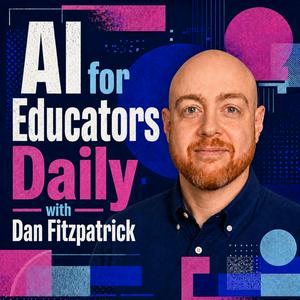
About AI for Educators Daily with Dan Fitzpatrick
Hey, I'm Dan, The AI Educator.
I know that we both care deeply about the state of education, amid the uncertainty of rapidly advancing AI. I work with leading schools and governments worldwide to help them strategise and build capability, and I have recently been recognised as a top voice on AI. While most teachers are aware of the influence of AI on education and student learning, many are unsure how to respond in practice.
My mission is to amplify credible expert insight and give educators the clarity, confidence, and tools they need to teach effectively and prepare students.
Podcast websiteListen to AI for Educators Daily with Dan Fitzpatrick, Finding Freedom with Peter Crone and many other podcasts from around the world with the radio.net app
Get the free radio.net app
- Stations and podcasts to bookmark
- Stream via Wi-Fi or Bluetooth
- Supports Carplay & Android Auto
- Many other app features
Get the free radio.net app
- Stations and podcasts to bookmark
- Stream via Wi-Fi or Bluetooth
- Supports Carplay & Android Auto
- Many other app features
AI for Educators Daily with Dan Fitzpatrick
Scan code,
download the app,
start listening.
download the app,
start listening.
 Ireland