

Listen to this podcast in the app for free: Download for free in the App Store
radio.net
Sleep timer
Save favourites
79 episodes
The Terrifying Secrets of the 4th Dimension
14/10/2026 | 36 mins.What if reality has a dimension you can’t see?
Up, down, left, right. These directions define how you experience the world. But what if there’s more to reality than the three dimensions you know? From the mind-bending geometry of a four-dimensional universe to Einstein’s spacetime and the role of the fourth dimension in gravity and GPS, explore the mysteries that challenge everything you think you know about reality.
How would you perceive a world beyond three dimensions? And what if the fourth dimension is already shaping your everyday life?
These are the secrets of the 4th Dimension.
CHAPTERS
00:00 The Terrifying Secrets of the 4th Dimension
00:41 Unraveling What You Think You Know
05:58 What Even Is a Dimension?
08:52 Flatland
15:50 Geometric 4th Dimension
20:53 What Would It Mean to See in 4D?
22:39 Einstein’s 4th Dimension
26:59 The Train and Lightning Experiment
29:28 Gravity and Spacetime
33:28 GPS in 4D
34:51 What Is 4D?You are the Universe Experiencing Itself | Spinoza's God
07/10/2026 | 46 mins.Every atom in your body was forged in the heart of a star. The calcium in your bones, the iron in your blood, the oxygen in your lungs, all of it was born in cosmic furnaces billions of years ago, long before the Earth even existed. Every atom inside you traveled across the universe for unimaginable stretches of time. And then, for one brief moment in cosmic history, the universe arranged itself into something capable of looking up at the stars in awe. The universe became… you. This is the philosophy of Baruch Spinoza. The idea that you, me, every living thing, are not separate from the universe, but expressions of it. That consciousness itself is the cosmos becoming aware of its own existence. And that there is no God watching over the universe, but the universe itself is God. 00:00 Spinoza and the Stardust Inside Us01:37 The God of Einstein 09:15 Deus Sive Natura18:02 God is Dead23:50 The Illusion of Free Will32:32 Sub Specie Aeternitatis36:32 The intellectual love of God.42:17 You are the Universe experiencing itself Aperture explores the ideas shaping how we think — philosophy, psychology, and the hidden forces behind human behavior. New perspectives, every week.Where Your Consciousness Goes When You Sleep
30/09/2026 | 45 mins.Every night, you close your eyes and lose contact with the world. The room disappears, your identity fades, and for several hours, you enter one of the greatest mysteries in human existence: sleep and dreams.
From ancient portals to modern psychology, humanity has always felt that dreams reveal something hidden beneath the surface. In this episode of Aperture, we explore the science, history, and profound mystery behind what happens when we fall asleep.
00:00 Quantum Echoes01:48 The Echo11:31 The Perturbation21:39 The Dreamer30:42 The Simulation39:00 The Signal
Stream Aperture on Spotify for weekly deep dives into the human mind, philosophy, and the mysteries of our universe.The Greatest Lie You've Been Told About Modern Society
05/04/2026 | 21 mins.You were taught to share before you understood ownership.
To sit still before you understood why. To raise your hand before you understood who gave anyone the right to decide when you could speak.
Nobody called it conditioning. They called it growing up.
By the time you reached school, the architecture was already in place. Not the architecture of buildings. The architecture of what questions are allowed. What success looks like. What a good life is supposed to contain, and in what order.
Work. Optimize. Defer. Retire. Reflect.
Most people reach the end and realize they spent their lives inside a structure they never agreed to. They just never saw it clearly enough to refuse.
The lie isn't that society is bad. The lie is that it's neutral. That the shape of your days arrived by accident, rather than by design.
Freedom doesn't look like what they told you it would look like. It never did.
🎧 In this episode, we trace the architecture of the life you were handed — from infancy to retirement — and ask what it would mean to actually choose your own.
🖤 Share this with someone who has started to feel the edges of the frame.
#Society #Freedom #Philosophy #CriticalThinking #Aperture #SciencePodcast #HumanNature #Consciousness #BigIdeas #ModernLife #Conformity #Identity #MeaningArtemis II: The Moon Was Never Enough
02/04/2026 | 10 mins.Four humans left Earth for the Moon. The first in 53 years.
We named the program after Apollo's twin sister. Not the god of reason or science. The god of wild places. Of everything that lies just beyond the edge of what we know.
That choice wasn't accidental.
Apollo took us there and brought us back. Artemis is asking a different question. Not can we go. But what happens to us when we decide to stay.
Every civilization that has ever looked up has built a mythology around what they saw. We are the first to go there. And we still don't fully understand why we need to.
Maybe that's the most human thing about it.
🎧 This episode is about what it really means to reach beyond Earth — and what we're actually looking for when we do.
🖤 Share this with someone who still has their eyes on the sky.
#Artemis #ArtemisII #Moon #NASA #Space #Aperture #SciencePodcast #Philosophy #HumanNature #SpaceExploration #BigIdeas
Stay connected with Aperture:
Website: https://aperture.gg/
YouTube: https://www.youtube.com/@ApertureScience
Instagram: https://www.instagram.com/theapertureyt/
Twitter: https://twitter.com/TheApertureYT
Merch: https://aperture.gg/merch
More Education podcasts







Trending Education podcasts























About Aperture
Become a Paid Subscriber: https://bit.ly/ApertureSpotify
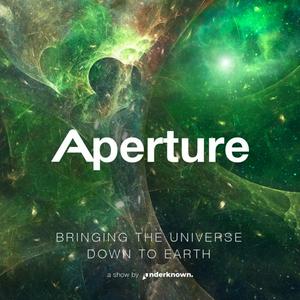
Most people never ask the questions that actually matter. Not because they aren't curious. Because nobody told them it was allowed. Aperture explores philosophy, psychology, science, and the forces quietly shaping human civilization. Consciousness, reality, society, the future of humanity. We go wherever the ideas lead and don't stop when it gets uncomfortable. New episode every Tuesday.
Podcast websiteListen to Aperture, IMO with Michelle Obama and Craig Robinson and many other podcasts from around the world with the radio.net app
Get the free radio.net app
- Stations and podcasts to bookmark
- Stream via Wi-Fi or Bluetooth
- Supports Carplay & Android Auto
- Many other app features
Get the free radio.net app
- Stations and podcasts to bookmark
- Stream via Wi-Fi or Bluetooth
- Supports Carplay & Android Auto
- Many other app features

Aperture
Scan code,
download the app,
start listening.
download the app,
start listening.
Aperture: Podcasts in Family
 Ireland