

Listen to this podcast in the app for free: Download for free in the App Store
radio.net
Sleep timer
Save favourites
234 episodes
Addressing the Mental Health Crisis in Schools: Challenges, Solutions, and the Road Ahead
15/09/2026 | 34 mins.…With Amy Sayer
Amy Sayer is a mental health and neurodiversity consultant and former secondary school senior leader. This episode discusses the growing mental health crisis among young people, highlighting challenges in accessing CAMHS support, with only 36% of referrals receiving help. Amy emphasises schools' critical role in supporting student wellbeing, advocating for both a meaningful mental health curriculum and a positive whole-school culture. Amy also addresses staff wellbeing, inclusivity for neurodivergent students, and funding gaps. The conversation centres on her book, How to Build a Meaningful Mental Health Curriculum: A Practical Guide for Schools, offering practical support for educators.
Amy's Book - How to Build a Meaningful Mental Health Curriculum: A Practical Guide for Schools: https://www.sagepub.com/shop/buy-a-book/how-to-build-a-meaningful-mental-health-curriculum-1-292569
Amy's Website: https://amy-sayer.com/
Hub of Hope: https://hubofhope.co.uk/
Episode with Reinhard Pekrun: https://changingstatesofmind.libsyn.com/exploring-the-complex-role-of-emotions-in-student-motivation-performance-and-well-being
Episode in bullet points:
Amy Sayer's background in education and mental health leadership.
Overview of her book, "How to Build a Meaningful Mental Health Curriculum: A Practical Guide for Schools."
Current state of young people's mental health and challenges in accessing services like CAMHS.
Societal factors contributing to mental health issues among youth, including poverty and social media.
The role of schools and teachers in supporting mental health, especially when external services are limited.
Importance of staff mental health and creating a supportive school environment.
Strategies for developing a positive mental health culture in schools.
The need for an inclusive mental health curriculum that addresses diverse student needs.
Systemic barriers to delivering effective mental health support in educational settings.
The significance of funding for mental health training and resources in schools.Exploring the Complex Role of Emotions in Student Motivation, Performance, and Well-Being
09/09/2026 | 43 mins.…with Professor Reinhard Pekrun
In this episode, Professor Reinhard Pekrun discusses the critical role emotions play in academic settings. Drawing on his Control-Value Theory, he explains how emotions influence students' learning, motivation, and well-being. Pekrun challenges the oversimplified view that positive emotions always help and negative ones always hinder learning, emphasising context and intensity as key factors. He also highlights teachers' emotional impact on students and outlines six instructional strategies to foster positive emotional experiences. The episode concludes with practical insights for educators on supporting students' emotional health while maintaining their own enthusiasm and avoiding burnout.
Links:
Reinhard Pekrun: https://www.essex.ac.uk/people/PEKRU37203/Reinhard-Pekrun
Book: Emotion in Education. by Paul Schutz (Editor), Reinhard Pekrun (Editor), Gary D. Phye (Series Editor): https://www.amazon.co.uk/Emotion-Education-Educational-Psychology/dp/0123725453
Emotions in Learning, Unesco: https://unesdoc.unesco.org/ark:/48223/pf0000227679
Episode in Bullet points:
The role of emotions in education and their impact on learning and academic performance.
The relationship between students' emotional states and their motivation, self-regulation, and engagement.
The categorization of emotions into positive and negative, and their effects on learning outcomes.
The significance of context, intensity, and task demands in understanding emotional impacts on students.
The historical focus of educational research on cognitive processes, with a recent shift towards recognizing the importance of emotions.What Is Test Anxiety and How Can We Help Students Overcome It?
01/09/2026 | 42 mins....with Professor David Putwain
In this episode, Professor David Putwain, from Liverpool John Moores University, shares his expertise and insights into test anxiety. Drawing on over 23 years of research, David explains the distinction between stress and anxiety, debunks the myth that moderate anxiety improves performance, and estimates that up to 20% of secondary students are significantly affected. He discusses how the UK's high-stakes exam culture amplifies pressure and outlines practical, evidence-based strategies to support students, including breathing techniques and cognitive-behavioural approaches. David also highlights available resources for teachers, parents, and students.
Links mentioned:
David's Book: Understanding and Helping to Overcome Exam Anxiety: What Is It, Why Is It Important and Where Does It Come From? https://www.amazon.co.uk/Understanding-Helping-Overcome-Exam-Anxiety/dp/103271638X
BPS Toolkit: https://cms.bps.org.uk/sites/default/files/2025-04/Teachers%20Toolkit%20-%20Effective%20Coping%20With%20Exam%20Pressure.pdf
Ofqual Guidance: Coping with exam pressure - a guide for students: https://www.gov.uk/government/publications/coping-with-exam-pressure-a-guide-for-students/coping-with-exam-pressure-a-guide-for-students
Lucinda's Book Overcoming exam anxiety and stress: https://www.hachette.co.uk/titles/lucinda-powell/overcoming-exam-anxiety-and-stress/9781408783450/
Episode in Bullet points:
Definition and prevalence of test anxiety among students.
Differences between stress and anxiety, particularly in the context of exams.
The impact of the education system on exam anxiety, including high-stakes testing.
Recognition of test anxiety by teachers and the cultural shift towards discussing mental health.
The distinction between moderate stress and harmful anxiety in academic performance.
Cognitive-behavioral strategies for managing exam anxiety.
The role of sports psychology in understanding stress and anxiety.
Practical interventions for students experiencing high levels of anxiety.
Resources available for teachers, parents, and students to address exam anxiety.
The need for systemic changes in education to reduce pressure and support student well-being.Why school exams don't prepare you for University (and that's Okay!)
28/08/2026 | 38 mins....with Dr Jonathan Firth
In this episode Jonathon Firth, a Principal Teaching Fellow at the University of Strathclyde and former secondary psychology teacher, discusses the major academic transition students face when moving from secondary school to higher education. Jonathon shares critical insights into why top-performing school students often experience an academic "shock" at university, the shift from exam-focused criteria to self-directed, original analysis, and the unique disadvantages faced by first-generation students lacking "cultural capital" .
The conversation explores practical, research-backed strategies for developing essential study habits, including effective note-taking, active reading, and structured writing reflection . Jonathon also addresses modern learning hurdles—such as digital distractions, declining reading habits, and the rise of AI—while advocating for cross-curricular creativity and sustained metacognition . Rather than treating study skills as a one-time orientation activity, Jonathon emphasises embedding metacognitive awareness continuously throughout a student's schooling to foster independent, future-ready learners .
Links to Jonathan's Books and to sign up for his newsletter can found here: https://jonathanfirth.co.uk/
Jonathan's previous interview on metacognition can be found here: https://changingstatesofmind.libsyn.com/learning-to-learn
Please do sign up for the Psychology in the Classroom newsletter here: https://changingstatesofmind.com/contact-me
Key Takeaways:
Bridging the Assessment Gap: Secondary education often rewards compliance and specific exam marking criteria, whereas university success hinges on holistic grading, original thesis generation, and self-directed research .
Moving Beyond Verbatim Notes & Skimming: Effective note-taking requires deep cognitive processing and concept extraction rather than transcription . Active reading and scheduled reviews combat the natural "forgetting curve" .
Building Knowledge & Cultural Capital: True creativity and critical thinking are not isolated, transferable skills; they rely on deep foundational knowledge, interdisciplinary connections, and broad reading .
Metacognition as a Continuous Habit: Understanding how learning works—recognizing forgetting, self-evaluating strategies, and managing cognitive load—should be built iteratively into teaching across all key stages .
The Episode in Bullet points:
Transition challenges from secondary school to university for students.
Differences in academic expectations and assessment styles between secondary education and higher education.
The importance of developing independent study skills for university success.
The role of cultural capital and broad general knowledge in academic performance.
Strategies to prepare students for university learning, including effective note-taking and reading skills.
The disconnect between school-focused exam preparation and university-level learning requirements.
The impact of first-generation university students lacking familial guidance on academic skills.
The significance of fostering curiosity and interconnected understanding across subjects in schools.
The challenges students face due to varying levels of general knowledge upon entering university.
The need for metacognitive strategies to help students manage feelings of being overwhelmed in a new academic environment.
Effective study skills and strategies for student success
Importance of note-taking techniques and their impact on learning
Challenges of digital distractions in educational settings
Transition from structured school environments to independent university learning
Strategies for improving reading comprehension and engagement
The role of creativity in education across various subjects
The significance of metacognition in self-regulated learning
Declining reading habits and their effects on academic performance
The influence of AI on student learning and skill development
Integrating metacognitive and creative strategies into existing teaching practicesThe Power of Professional Dialogue: Turning Lesson Observations into Meaningful Conversations for Growth
16/06/2026 | 38 mins....with Angela Myers
In this episode, Angela, an educator with 60 years of experience spanning primary, secondary, further and community education shares her thoughts on classroom observations. Having held roles from classroom teacher through to Deputy Principal at Solihull College, Angela brings a remarkable depth of knowledge to one of the most talked-about — and often dreaded — aspects of teaching: the lesson observation. Whether you're a classroom teacher who feels a knot in your stomach every time someone walks through your door with a clipboard, a middle leader tasked with observing your colleagues for the first time, or a senior leader trying to build a culture where professional learning is genuinely valued, this episode has something for you.
What we cover:
The history of lesson observations: Angela takes us back to the introduction of the first national inspection framework in 1992, explaining how grading and observation became intertwined from the very beginning — and why that legacy still shapes how many teachers feel about being observed today.
From quality assurance to coaching: We explore how the purpose of lesson observations has shifted dramatically over the decades, moving away from a model of judgement and towards one rooted in professional dialogue, reflection and genuine improvement.
What to look for when observing a lesson: Angela shares the five key areas she identified through visits to over 100 colleges, offering practical guidance for anyone stepping into an observation role for the first time. This includes why talking to students during a lesson can be one of the most revealing things an observer can do. **Observing lessons for your own development** Not all observations are about giving feedback. Angela discusses how to approach watching a colleague's lesson when your aim is to improve your own practice — including a fascinating example of the "narrative approach" as an alternative to traditional lesson objectives.
How to give effective feedback: From the outstanding lesson where you're not sure what to say, to the lesson where learning has broken down entirely, Angela offers a clear framework for feedback that prioritises partnership, teacher agency and sustainable change.
Professional dialogue explained: Angela unpacks the model of professional dialogue she helped develop — drawing on learning conversations and the work of Chris Argyris — and walks us through a detailed, real-world example of how it works in practice.
Building a culture where observations are welcomed: Perhaps most importantly, Angela makes a compelling case for what schools and colleges look like when observation becomes an organic, ongoing part of the way everyone talks about learning — rather than an annual event to be endured.
More Education podcasts
 Begin Again with Davina McCallEducation, Health & Wellness, Mental Health, Self-Improvement, Society & Culture
 Nuacht MhallEducation, Language Learning
 6 Minute EnglishEducation, Language Learning
 Good Life ProjectBusiness, Education, Health & Wellness, Self-Improvement, Tutorials
 The Comeback with Brenda DennehyEducation, Health & Wellness, Mental Health, Self-Improvement
 The Jefferson Fisher PodcastEducation, Relationships, Self-Improvement, Society & Culture
 The Rich Roll PodcastEducation, Health & Wellness, Self-Improvement, Society & Culture
 Motivation Daily by MotiversityEducation, Health & Wellness, Self-Improvement
 The Mel Robbins PodcastEducation, Health & Wellness, Mental Health, Relationships, Self-Improvement, Society & Culture
 The Ella EraEducation, Self-Improvement, Society & Culture
Trending Education podcasts
 Change is PossibleEducation, Self-Improvement
 Easy Spanish: Learn Spanish with everyday conversations | Conversaciones del día a día para aprender españolCourses, Education, Language Learning, Places & Travel, Society & Culture
 All Ears English PodcastBusiness, Education, Language Learning
 The Jordan B. Peterson PodcastEducation, Science, Society & Culture
 Английский язык по плейлистам. Английский язык с нуля. Полный курсEducation, Language Learning
 Do you really know?Education, News
 German Stories - Learn German with StoriesComedy Fiction, Courses, Education, Fiction, Language Learning, True Crime
 The ShiftEducation, Religion & Spirituality, Self-Improvement
 Learn Spanish: Fluency in Real Life with HandyspanishEducation
 Platypus Economics with Justin WolfersBusiness, Courses, Education, Science, Social Sciences
 Zero to Finals Medical Revision PodcastEducation, Health & Wellness, Life Sciences, Medicine, Science
 ALIGNED | The Path to PurposeAlternative Health, Education, Health & Wellness, Religion & Spirituality, Self-Improvement, Spirituality
 Coffee Break Italian AdvancedCourses, Education, Language Learning
- The Rich Roll PodcastEducation, Health & Wellness, Self-Improvement, Society & Culture
 Dear GabbyEducation, Health & Wellness, Mental Health, Religion & Spirituality, Self-Improvement, Spirituality
 Easy German: Learn German with native speakers | Deutsch lernen mit MuttersprachlernCourses, Education, Language Learning
 This Naked Mind PodcastEducation, Self-Improvement
 Law of Attraction Changed My LifeEducation, Kids & Family, Parenting, Religion & Spirituality, Self-Improvement, Spirituality
 Flow PodcastEducation, Self-Improvement
 How to Be a Better HumanEducation, Self-Improvement
 Coffee Break FrenchCourses, Education, Language Learning
- Nuacht MhallEducation, Language Learning
- The Jefferson Fisher PodcastEducation, Relationships, Self-Improvement, Society & Culture
About Psychology in the Classroom
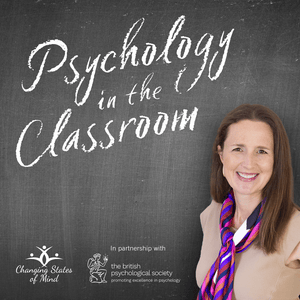
Psychology in the Classroom: bridging the gap between educational science and daily teaching practice. Hosted by Lucinda Powell, the show provides expert insights in education by translating complex educational psychology into actionable, science for educators.
Through high-level education expert interviews, listeners gain access to the latest findings in the science of learning, including evidence-based revision strategies and methods for creating an effective classroom environment. If you are looking for psychological education tools to improve student outcomes, this podcast delivers a mix of theory deep-dives and educational myth busting.
Podcast websiteListen to Psychology in the Classroom, Begin Again with Davina McCall and many other podcasts from around the world with the radio.net app
Get the free radio.net app
- Stations and podcasts to bookmark
- Stream via Wi-Fi or Bluetooth
- Supports Carplay & Android Auto
- Many other app features
Get the free radio.net app
- Stations and podcasts to bookmark
- Stream via Wi-Fi or Bluetooth
- Supports Carplay & Android Auto
- Many other app features

Psychology in the Classroom
Scan code,
download the app,
start listening.
download the app,
start listening.
 Ireland