

Listen to this podcast in the app for free: Download for free in the App Store
radio.net
Sleep timer
Save favourites
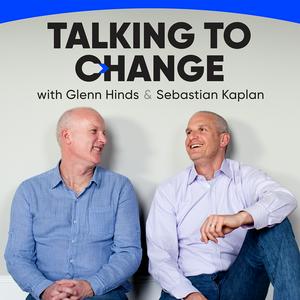
Talking To Change - A Motivational Interviewing Podcast
Glenn Hinds & Sebastian Kaplan
Latest episode
98 episodes
Ep 98 – Motivational Interviewing for Community Healthcare in Japan
12/10/2026 | 1h 2 mins.How can Motivational Interviewing work in a busy community clinic? In this episode of Talking to Change, Dr Takeshi Shimada joins Glenn and Sebastian to explore brief healthcare consultations, the value of slowing down and the influence of Japanese culture on MI practice.
Takeshi is a physician specialising in diabetes care with more than two decades of clinical experience. He directs a community clinic in Osaka, Japan, where he sees around 80 patients a day, sometimes more than 90. He is particularly interested in how MI can be used meaningfully within brief medical encounters, rather than requiring a separate intervention.
Takeshi is a member of the Motivational Interviewing Network of Trainers (MINT) and serves on the Board of the Japanese Association of Motivational Interviewing (JAMI). At the 2024 MINT Training for New Trainers (TNT) in Christchurch, New Zealand, he served as a Lead Trainer for the Japanese language group. He currently serves as a member of the MINT Endorsed TNT Committee, supporting the planning and organisation of MINT Endorsed Training for New Trainers internationally.
In addition to his clinical work, Takeshi is deeply interested in how MI is understood and practiced across different languages and cultures in East Asia. Building on his experience in Japan, he hopes to work with colleagues across East Asia to explore and develop culturally responsive approaches to MI training and reliable MI coding across languages, while remaining grounded in the spirit of MI.
In this episode
Glenn and Sebastian explore how Motivational Interviewing can become part of everyday healthcare conversations, even when practitioners have limited time. Drawing on Takeshi’s experiences in Japan, the discussion considers the value of slowing down, resisting the urge to provide immediate solutions, and creating space for patients to explore their own motivations.
The conversation also explores compassion in healthcare, the influence of Japanese cultural values on MI practice, and how reflections, affirmations and silence can support understanding. Takeshi shares his hopes for greater collaboration and culturally responsive MI training across East Asia.
Episode index
0:00 – Opening and episode introduction
6:12 – Takeshi’s early experiences with MI
14:15 – How slowing down can save time
22:15 – Rethinking solutions
25:40 – Three communication styles
28:00 – Compassion in community healthcare
37:25 – The development of MI in Japan and its relationship with Japanese culture
41:00 – Harmony, silence and checking understanding through reflections
49:00 – Affirmations, humility and modesty in Japanese culture
59:00 – Collaborations across East Asia
1:02:36 – End of recording
Guest contact
Email: sodc2013@gmail.com
Continue with Talking to Change
Podcast: podcast@glennhinds.com
Glenn: glenn@glennhinds.com
Sebastian: sebkaplan34@gmail.com
Follow Talking to Change on Bluesky
@talkingtochange.bsky.social
@glennhinds.bsky.social
@sgkfromnc.bsky.social
Listen: Browse the full Talking to Change podcast listening archive.
Support the podcast
Learn: Explore Talking to Change episodes and learning resources on glennhinds.com.
The post Ep 98 – Motivational Interviewing for Community Healthcare in Japan appeared first on Glenn Hinds Motivation & Coaching Consultants.Ep 97 – Motivational Interviewing with Families
06/09/2026 | 1h 4 mins.In Episode 97 of Talking to Change: A Motivational Interviewing Podcast, Glenn Hinds and Sebastian Kaplan welcome Douglas C. Smith, Ph.D., LCSW, to discuss Motivational Interviewing with families. The conversation explores what changes when MI moves beyond a single client and a single target behaviour, including working with change talk across family members, balancing autonomy and practitioner direction, and avoiding what Doug describes as the “superfluous engagement trap”.
About Professor Douglas C. Smith
Douglas C. Smith, Ph.D., LCSW, is Professor of Social Work at the University of Illinois at Urbana-Champaign and Director of the Center for Prevention Research and Development (CPRD). He received his Ph.D. in Social Work in 2006 from the University of Iowa and has over twenty years of experience in substance use disorder prevention and treatment as a clinician, clinical supervisor and researcher.
His research focuses on improving treatments for adolescents and young adults experiencing substance use disorders. He is the author of two books, including Emerging Adults and Substance Use Disorder Treatment (Oxford Press) and Motivational Interviewing with Families (Guilford Press).
Go deeper with the MI Practice Companion
This episode also has a Talking to Change: MI Practice Companion, developed to help practitioners explore and apply the learning from the conversation. Explore Motivational Interviewing with Families, Adolescents and Substance Use: Practice Lessons from Professor Doug Smith.
Episode Index
0:00 – Glenn and Sebastian introduce the episode and key themes
3:58 – Doug Smith’s route into Motivational Interviewing
8:39 – Moving from individual practice to work with adolescents and families
13:18 – Family engagement, blame, empathy and what MI contributes
20:47 – Motivational Interviewing with Families: why Doug wrote the book
30:40 – Change talk across family relationships
33:48 – Individual, family and multi-level target behaviours
43:45 – Bringing structure and focus into family conversations
46:02 – Practitioner direction, autonomy and the “superfluous engagement trap”
1:00:22 – Current research and where MI with families might go next
1:04:30 – End of episode
Links and episode resources
Email: smithdc@illinois.edu
Book: Motivational Interviewing with Families by Douglas C. Smith
15% listener discount: Guilford Press is offering listeners to this episode 15% off Douglas C. Smith’s Motivational Interviewing with Families. Use promotional code AU2E when ordering. The special offer is valid in the U.S. and Canada only.
Continue with Talking to Change
Podcast: podcast@glennhinds.com
Glenn: glenn@glennhinds.com
Sebastian: sebkaplan34@gmail.com
Follow Talking to Change on Bluesky
@talkingtochange.bsky.social
@glennhinds.bsky.social
@sgkfromnc.bsky.social
Listen: Browse the full Talking to Change podcast listening archive.
Support the podcast
Learn: Explore Talking to Change episodes and learning resources on glennhinds.com.
The post Ep 97 – Motivational Interviewing with Families appeared first on Glenn Hinds Motivation & Coaching Consultants.Ep 96 – Enhancing MI Skills for Mental Health Providers
28/07/2026 | 1h 8 mins.Talking to Change: MI Practice Companion
In this episode of Talking to Change, Glenn Hinds and Sebastian Kaplan welcome Kristin Dempsey and Ali Hall to explore how mental health practitioners can strengthen their Motivational Interviewing skills through experiential learning, deliberate practice and feedback. Drawing on their book Advancing Motivational Interviewing: An Experiential Skills Guide for Mental Health Providers, the conversation considers an important question for anyone developing MI: how do we move from understanding Motivational Interviewing to using it skilfully in real conversations?
This Practice Companion draws out the practical learning from the conversation. It explores the assessment trap, using MI when time is limited, responding to wider systemic influences, and creating meaningful opportunities for deliberate practice. It also connects these ideas with related resources in the Motivational Interviewing Knowledge Centre for practitioners who want to develop their skills further.
Listen to the full conversation
This Practice Companion highlights selected ideas and practice implications from the episode. Listen to the full conversation with Kristin Dempsey and Ali Hall for the complete discussion, examples and reflections. Listen to Episode 96: Enhancing MI Skills for Mental Health Providers
Kristin Dempsey is a psychotherapist, trainer, and counselor educator in the San Francisco Bay Area. She has over 30 years’ experience working with individuals, youth, and families with challenging behavioral issues that impact their lives such as substance use disorders, co-occurring mental health and substance use disorders, trauma symptoms, and unresolved grief. Kristin believes that each individual has unlimited ability to change and grow, and she enjoys exploring the complexities of complex challenges and how to approach them with compassion and curiosity. Kristin has taught many classes in the counselor education curriculum, and she is currently focused on practitioner skill development, substance use disorder treatment, and effective practices in community mental health. Kristin is a member of the Motivational Interviewing Network of Trainers (MINT), and she currently teaches MI to behavioral health and other allied human services professionals. She is an adjunct professor at the Wright Institute’s Counseling Psychology Program and lecturing faculty at San Francisco State University. Kristin is the author of The Harm Reduction Workbook for Addiction (New Harbinger, 2024), co-author of Advancing Motivational Interviewing: An Experiential Skills Guide for Mental Health Professionals (PESI, April 2026), and a writer for The Mental Health and Substance Use Recovery Workbook (New Harbinger, May 2027).
Ali Hall is a member of the Motivational Interviewing Network of Trainers (MINT), a MINT Certified Trainer, and an independent consultant and trainer.
Ali has designed and facilitated thousands of MI workshops for a wide variety of providers, including those who serve within criminal justice systems, behavioral health, substance use recovery, mental health, health care, children/family services and wraparound, and has served multiple Training for New Trainers events. Ali regularly provides skill development coaching for interdisciplinary provider teams. Ali is the co-developer of the Motivational Interviewing Competency Assessment (MICA), a coding and coaching tool for MI skill improvement, co-author of the book Motivational Interviewing for Mental Health Clinicians: A Toolkit for Skill Development (2021), developer of the Cultivating Hope activity deck (2025) and co-author of Advancing Motivational Interviewing: An Experiential Skills Guide for Mental Health Providers (2026).
From knowing MI to practising MI
One of the central themes in this conversation is the difference between knowing about Motivational Interviewing and being able to use it skilfully in practice. Reading about MI, attending training and understanding its principles all matter, but they do not automatically translate into fluent practice.
Developing MI proficiency requires opportunities to practise specific skills, notice what happens in the interaction, receive useful feedback and try again. Dempsey and Hall’s emphasis on experiential learning therefore connects closely with deliberate practice: identifying an aspect of our MI practice that we want to improve and working on it purposefully rather than simply accumulating more experience.
This matters because experience alone does not guarantee improvement. Deliberate practice involves identifying a specific aspect of performance, practising with intention, using feedback to understand what is happening, and repeating the process. For MI practitioners, that might mean focusing on the depth of reflections, recognising opportunities to evoke change talk, reducing questions that inadvertently direct the conversation, or reviewing recorded practice with a coach or coding tool.
Explore further: Deliberate Practice in Motivational Interviewing
The assessment trap: when gathering information gets in the way
Mental health practitioners often need to gather substantial amounts of information. Assessment, risk, diagnosis, safeguarding and organisational requirements can all create pressure to ask questions. The difficulty arises when the conversation becomes a sequence of practitioner-led questions and client answers.
In Motivational Interviewing, this is sometimes described as the assessment trap. The problem is not assessment itself. It is what can happen to the quality of the conversation when information gathering takes precedence over engagement, listening and understanding what matters to the person.
A useful practice question is: Am I asking this question because I genuinely need the information now, or because asking questions has become the way I am organising the conversation?
MI does not require practitioners to abandon necessary assessment. Instead, we can pay attention to how we conduct it. Reflections, summaries and open questions can help an assessment feel more like a collaborative conversation and less like an interview conducted on the person.
One practical response is to become more intentional about the balance between questions and reflections. When someone gives us information, we do not always need another question. A reflection can communicate understanding, invite the person to elaborate and allow them greater influence over where the conversation goes.
Open questions remain valuable, particularly when they invite exploration rather than simply gather facts. Used alongside reflective listening, they can help practitioners meet assessment requirements while maintaining partnership and curiosity.
Explore further: Reflective Listening in Motivational Interviewing | Open Questions in Motivational Interviewing
Can you use Motivational Interviewing when time is limited?
A common concern for practitioners is whether there is enough time to use Motivational Interviewing. In busy mental health, healthcare and support settings, conversations may be brief and practitioners can feel pressure to move quickly towards assessment, advice or action.
MI does not necessarily require a long conversation. What matters is the quality and direction of the interaction. Even within a brief encounter, a practitioner can communicate partnership, listen carefully for what matters to the person, reflect rather than immediately advise, and create opportunities for the person to voice their own reasons for change.
The question therefore shifts from “Do I have time to do MI?” to “How can I bring an MI-consistent way of being and communicating into the time that I have?”
This does not mean squeezing every MI process or skill into a short conversation. Sometimes the most useful outcome may simply be stronger engagement, a clearer focus, or helping someone articulate something important about change.
The four processes are not a checklist
The four processes of Motivational Interviewing, Engaging, Focusing, Evoking and Planning, provide a helpful way of understanding how conversations about change develop. They are not four stages that practitioners must complete in order during every encounter.
In a brief conversation, much of the useful work may involve Engaging and Focusing. At another time, a clear focus may already exist and a few carefully chosen reflections or questions can create space for Evoking. Planning becomes relevant when the person is ready to consider what they might do next.
Skilled MI therefore involves responding to where the person is in the conversation rather than trying to move them through a predetermined sequence.
Explore further: Engaging | Focusing | Evoking | Planning
MI does not happen in a vacuum
Another important theme in the conversation is the influence of the systems in which practitioners work. Mental health professionals may practise within services shaped by assessment procedures, documentation requirements, risk management, targets, limited appointment times and expectations about what a practitioner should accomplish.
These pressures can influence how we communicate. When practitioners feel responsible for producing a particular outcome, it becomes easier to move towards directing, persuading, correcting or solving. In MI, this is closely related to the Fixing Reflex, our understandable tendency to want to put things right for another person.
Developing MI skill therefore involves more than learning conversational techniques. It also involves noticing the pressures acting on us as practitioners. A useful question is: What is happening in me, or around me, that is making it harder to remain curious about this person’s perspective?
This does not remove professional responsibilities. Rather, it helps us distinguish between what the situation genuinely requires of us and the additional pressure we may place on ourselves to make another person change.
Explore further: The Fixing Reflex in Motivational Interviewing
What might this sound like in practice?
Consider a practitioner working with someone who has been struggling with their mental health and has stopped taking prescribed medication.
Practitioner-led response:
“You know the medication was prescribed for a reason. What made you stop taking it? Have you spoken to your doctor? You really need to make an appointment.”
A more MI-consistent response:
“You’ve made a decision to stop taking it, and I imagine there are some important reasons behind that.”
The second response does not mean that the practitioner agrees with the decision or ignores potential risk. It creates an opportunity to understand the person’s perspective before deciding what information, assessment or action may be necessary.
The person might respond by describing side effects, doubts about whether the medication helps, concerns about dependency, difficulties remembering it, or something entirely different. Once we understand what matters to them, the conversation can become much more focused.
This illustrates a recurring theme in MI: understanding before influencing. When we resist the urge to immediately correct or solve, we often learn something that helps us have a more useful conversation about change.
Practice takeaways from this episode
For practitioners developing their Motivational Interviewing skills, several practical lessons stand out from this conversation:
Prioritise understanding before influencing. Slow down the impulse to correct, reassure or solve. A fuller understanding of the person’s perspective often reveals a more useful direction for the conversation.
Pay attention to how your responses shape the conversation. MI is not simply a collection of techniques. The way we listen and respond can strengthen exploration, autonomy and change talk, or unintentionally pull the conversation towards resistance and sustain talk.
Use reflections with purpose. Reflections can do more than demonstrate listening. Skilful reflections can help a person hear their own motivations, meanings and possibilities more clearly.
Keep autonomy visible. People are more likely to engage honestly when they experience the conversation as collaborative rather than as an attempt to persuade them.
Treat MI proficiency as something that develops through practice. Training provides an important foundation, but continued feedback, coaching and deliberate practice help practitioners translate MI knowledge into consistent conversational skill.
Questions for your own practice
As you reflect on your own work, consider a recent conversation in which you were trying to help someone think about change. Rather than asking only whether you ‘used MI’, it can be more useful to examine what was happening moment by moment.
Where did you feel an urge to advise, correct, reassure or solve?
Were there moments when another reflection might have been more useful than another question?
How well did you understand what mattered to the person before trying to influence the conversation?
Which of the four MI processes best describes where the conversation actually needed to be?
If you could practise one small part of that conversation again, what would you choose to do differently?
These questions can turn everyday practice into an opportunity for deliberate learning. The aim is not to produce a perfect MI conversation. It is to notice your practice closely enough to identify the next skill worth developing.
Audio moments for practice and reflection
Short extracts from the full conversation can also be used as prompts for learning, supervision or deliberate practice. Three moments are particularly worth returning to:
Experiential learning and deliberate practice. A short extract in which Kristin Dempsey or Ali Hall discusses how practitioners move beyond knowing MI towards developing skill through practice and feedback.
The assessment trap and time pressure. A section exploring what happens when assessment requirements, limited time or practitioner agendas begin to dominate the conversation.
Developing MI within real systems. An extract that captures the tension between practising MI consistently and working within organisational expectations, clinical responsibilities and wider systemic pressures.
These clips can later be embedded here and used independently on social media to invite listeners into the full episode and this Practice Companion.
Further learning in the Motivational Interviewing Knowledge Centre
If this episode has prompted you to look more closely at your own MI practice, the following Knowledge Centre resources develop several of the themes explored by Kristin Dempsey and Ali Hall:
Deliberate Practice in Motivational Interviewing – developing skill through purposeful practice, feedback and repetition.
Reflective Listening in Motivational Interviewing – using reflections to deepen understanding and support exploration.
Open Questions in Motivational Interviewing – asking questions that invite exploration rather than simply gathering information.
The Fixing Reflex in Motivational Interviewing – recognising the understandable urge to correct, persuade or solve for another person.
Engaging, Focusing, Evoking and Planning – explore each of the four overlapping processes that help practitioners understand the direction of an MI conversation.
Talking to Change: MI Practice Companion is designed to sit alongside the original podcast conversation. The episode provides the voices, discussion and context; the Practice Companion helps translate that conversation into reflection, deliberate practice and further learning.
Use the episode for deliberate practice
Listening to an MI conversation can become more useful when you listen with a specific practice question in mind. Rather than trying to remember everything from the episode, choose one aspect of your own practice to notice and develop.
You might listen for how the speakers describe moving beyond knowledge towards skill, how they respond to the pressures of assessment and limited time, or how feedback and repeated practice contribute to greater proficiency. Then choose one small behaviour to practise in your next conversation.
A simple deliberate-practice cycle is: choose one skill, practise it, notice what happens, seek feedback where possible, and try again. Over time, this turns podcast learning into observable changes in practice rather than information that is simply understood.
Episode guide
Use these timestamps to return to particular parts of the full conversation:
0:00 – Opening and episode introduction
7:12 – Kristin and Ali’s introductions and early MI stories
13:20 – The early process of writing their book
27:00 – “What’s the problem?” and the assessment trap
38:10 – Macro MI and addressing systemic issues when practising MI
53:30 – Web-based interventions, brief encounters and “I only have 5 minutes”
1:02:30 – Kristin on writing and relearning music; Ali on swimming and writing a new children’s book
1:08:43 – End of recording
Guest links and episode resources
Kristin Dempsey
Kristin Dempsey’s website
Advancing Motivational Interviewing book page
Kristin Dempsey on LinkedIn
Kristin Dempsey on Facebook
Kristin Dempsey on Substack
Kristin Dempsey on Instagram
Email Kristin Dempsey
Ali Hall
Ali Hall Training
Ali Hall’s MINT profile
Ali Hall on LinkedIn
Ali Hall’s Macro MI Substack post
Watch the promotional video for Ali Hall and Kristin Dempsey’s book, Advancing Motivational Interviewing: An Experiential Skills Guide for Mental Health Providers.
Try a sample activity from Advancing Motivational Interviewing: An Experiential Skills Guide for Mental Health Providers.
Continue with Talking to Change
Podcast: podcast@glennhinds.com
Glenn: glenn@glennhinds.com
Sebastian: sebkaplan34@gmail.com
Follow Talking to Change on Bluesky
@talkingtochange.bsky.social
@glennhinds.bsky.social
@sgkfromnc.bsky.social
Listen: Browse the full Talking to Change podcast listening archive.
Support the podcast
Learn: Explore Talking to Change episodes and learning resources on glennhinds.com.
The post Ep 96 – Enhancing MI Skills for Mental Health Providers appeared first on Glenn Hinds Motivation & Coaching Consultants.Ep 95 – Advancing MI Practice Through Coding and Coaching
19/06/2026 | 1h 27 mins.Glenn and Sebastian welcomed back Katie Hartlieb, PhD, RDN, to discuss advancing MI practice through coding and coaching. The conversation explores how structured feedback can support deliberate practice in Motivational Interviewing, how MITI and MI fidelity can help practitioners understand their developing skills, and the role of coaching and mentoring in strengthening MI practice over time. Dr. Hartlieb is a professor and program director of the Master of Science in Functional Nutrition at Parker University, in Dallas, Texas, for professionals seeking to create holistic, science-based health partnerships for optimal patient wellness. She has been an active member of MINT for over 15 years and was named a Pediatric Obesity Subject Matter Expert by the Commission on Dietetics Registration. Her research interests include improving health behavior change conversations and family empowerment to achieve healthy lifestyles.
Dr. Hartlieb specializes in MI coding, coaching, and strengthening the MI standardized patient experience internationally, collaborating with organizations like the Wisconsin Human Service MI Implementation Team and the Japanese Association for Motivational Interviewing (JAMI). She resides with her family in Northern Michigan, USA, where nature time and eating the rainbow are daily pursuits and serves on the Board of Directors for the Grain Train Community Food Cooperative.
In this episode
0:00 – Opening and episode introduction
7:38 – Role play
27:14 – Katie’s journey into MI and using coding to enhance practice
33:10 – Coding and coaching using the MI Treatment Integrity Code (MITI)
38:40 – Coaching session between Katie and Seb
1:06:00 – Coaching session debrief
1:25:50 – Katie’s projects in Asia
1:27:50 – End of recording
Links and contact information:
Email: kathryn.hartlieb@gmail.com
Website: https://hartliebnutrition.com/
MITI Manual: https://motivationalinterviewing.org/sites/default/files/miti4_2.pdf
Sebastian Smoking Podcast MITI Report: https://www.glennhinds.com/sebastian-smoking-podcast-miti-report/
Connect with Glenn & Seb
Podcast: podcast@glennhinds.com
Glenn: glenn@glennhinds.com
Sebastian: sebkaplan34@gmail.com
BlueSky
@talkingtochange.bsky.social
@glennhinds.bsky.social
@sgkfromnc.bsky.social
For all previous episodes, CLICK HERE
Support the podcast
All Episodes
The post Ep 95 – Advancing MI Practice Through Coding and Coaching appeared first on Glenn Hinds Motivation & Coaching Consultants.Ep 94 – Motivational Interviewing in Leadership & Organisations (MILO) – Part 2
20/04/2026 | 58 mins.Episode 94 – MI in Leadership and Organizations – Part 2
Glenn and Seb were excited to bring Jeff Wetherhold, M.Ed. to the podcast to discuss MI in leadership and organizations (MILO) A former behavioral science researcher trained in change management and adult learning, Jeff has spent 20+ years supporting mission-driven organizations through change.
Research shows that 88% of organizational change efforts produce no lasting results. The most common reasons center on communication, engagement, and support. An MI approach brings particular attention to partnership and empowerment when people are navigating change. Many leaders and managers are never taught how to effectively engage others in change.
Jeff helps leaders and staff navigate change together using Motivational Interviewing (MI) as a foundation. This connects closely with implementing Motivational Interviewing in organisations, where relationships, engagement and sustained support matter as much as initial training. He specializes in adapting MI for the challenges they encounter every day. His approach integrates MI with behavioral science, change management, adult learning principles, and evidence-driven communication methods.
Jeff has trained thousands of professionals in healthcare, human services, and mission-driven organizations in using MI to engage people who may be skeptical, disengaged, or experiencing change fatigue. Clients include the State of Illinois, the Institute for Healthcare Improvement, the University of Nebraska Medical Center, MIT, and the Institute for Healthcare Delivery Design.
Jeff is a board member of Motivational Interviewing in Leadership and Organizations (MILO), a faculty member with the Institute for Healthcare Improvement (IHI), a Prosci Certified Change Practitioner, and a member of the MI Network of Trainers (MINT). He holds a Master’s in Education from Harvard University.
In this episode
0:00 – Opening and episode introduction
7:37 – Jeff introduction and the challenge of organizational change
13:30 – The importance of relationship within organizations
17:30 – How does change happen within organizations?
23:40 – How we work with “agency”?
28:20 – Leadership can be lonely and how MI can help?
34:20 – An example from the field
43:30 – MI in Leadership and Organizations (MILO)
50:30 – Jeff’s work around “influence with dignity”
53:30 – Differences in training leaders and therapists
58:38 – End of recording
Links and contact information:
Email: jeff@miforhealth.com
Website: https://www.jeffwetherhold.com/
LinkedIn: https://www.linkedin.com/in/wetherhold/
MI in Leadership and Organizations (MILO): https://www.leadwithmi.org/
Connect with Glenn & Seb
Podcast: podcast@glennhinds.com
Glenn: glenn@glennhinds.com
Sebastian: sebkaplan34@gmail.com
BlueSky
@talkingtochange.bsky.social
@glennhinds.bsky.social
@sgkfromnc.bsky.social
For all previous episodes, CLICK HERE
Support the podcast
All Episodes
The post Ep 94 – Motivational Interviewing in Leadership & Organisations (MILO) – Part 2 appeared first on Glenn Hinds Motivation & Coaching Consultants.
More Education podcasts










Trending Education podcasts





















About Talking To Change - A Motivational Interviewing Podcast
Hosted by Glenn Hinds and Sebastian Kaplan, Talking To Change – A Motivational Interviewing podcast, is a series of conversations exploring Motivational Interviewing (MI) and its influence on supporting individuals and groups as they make positive health and lifestyle changes. Guests from across the world discuss their special interest in the research, practice and learning of MI along with its place across health, social care, education and criminal justice.
Podcast websiteListen to Talking To Change - A Motivational Interviewing Podcast, IMO with Michelle Obama and Craig Robinson and many other podcasts from around the world with the radio.net app
Get the free radio.net app
- Stations and podcasts to bookmark
- Stream via Wi-Fi or Bluetooth
- Supports Carplay & Android Auto
- Many other app features
Get the free radio.net app
- Stations and podcasts to bookmark
- Stream via Wi-Fi or Bluetooth
- Supports Carplay & Android Auto
- Many other app features

Talking To Change - A Motivational Interviewing Podcast
Scan code,
download the app,
start listening.
download the app,
start listening.
Talking To Change - A Motivational Interviewing Podcast: Podcasts in Family
 Ireland
