
Listen to this podcast in the app for free: Download for free in the App Store
radio.net
Sleep timer
Save favourites
Technovation with Peter High (CIO, CTO, CDO, CXO Interviews)
Metis Strategy
Latest episode
300 episodes
No Innovation Without a Market: Ahmad Bahai on TI’s R&D Model
05/11/2026 | 46 mins.Semiconductor development cycles run a decade or longer, but markets shift faster than any company can predict. Ahmad Bahai, Senior Vice President and Chief Technology Officer at Texas Instruments, explains how TI navigates that gap by betting on directional technology vectors rather than specific end markets. TI’s high-voltage program, started over a decade ago with smart grid in mind, eventually served electric vehicles and then became core infrastructure for AI data centers. In this episode of Technovation, Peter High speaks with Ahmad Bahai, SVP and CTO at Texas Instruments, about long-horizon R&D, the power delivery bottleneck in AI infrastructure, and why transistor scaling is now one of several co-equal innovation vectors. Bahai also reflects on the Bell Labs model, TI’s $60B-plus US fab expansion, and the case for a “virtual Bell Labs” that bridges academic curiosity and commercial urgency.
Key Highlights:
Why TI embeds Kilby Labs researchers inside business units from the start, so innovations never expire on a shelf
How TI’s high-voltage program moved from smart grid to EV to AI data centers without changing the underlying technology platform
Why stepping voltage from 400V at the rack down to sub-1V at the processor is the overlooked bottleneck in AI infrastructure
Why transistor scaling is now one innovation vector among several, with materials and packaging becoming co-equal drivers
Why building fabs during a market trough is the only way to have capacity ready when the next peak arrivesData from Thousands of Tests: How Simpson Strong-Tie Is Building an AI Moat
02/11/2026 | 30 mins.A 70-year-old manufacturer’s proprietary test data may be a more defensible AI moat than software capability alone. In this episode of Technovation, Peter High speaks with Udit Mehta, Chief Technology Officer at Simpson Strong-Tie, about building an AI strategy on a foundation of structural engineering expertise. Mehta joined in 2024 from Carrier and Siemens, and has spent two years modernizing the company’s infrastructure, upskilling 1,200-plus employees on AI, and launching an integrated cloud-native software portfolio for component manufacturers. He describes how Simpson’s combination of hardware, software, services, and proprietary test data creates a position pure-play software entrants cannot match, and why AI must augment engineering judgment rather than replace it.
Key Highlights:
Why Simpson’s hardware-plus-software bundling creates an AI moat pure-play entrants structurally cannot replicate
How AI tools assist structural engineers without removing human judgment from high-stakes decisions
Why workflow embeddedness, not technical feasibility, is the real adoption gate in construction
How a three-pillar AI strategy spans individual productivity, enterprise value, and customer growth in parallel
Why business owners, not AI teams, must remain accountable for every AI-enabled workflow outcome
This podcast episode is sponsored by Blitzy. Autonomous software development at enterprise scale.Not Just More Pilots: Shweta Gummidipudi on Scaling AI at Twilio
29/10/2026 | 27 mins.Most companies can prove an AI use case works. Scaling it is where they stall. Shweta Gummidipudi, CIO at Twilio, has spent her first year building the infrastructure layer that makes scale possible: a single model gateway for routing and cost control, a shared library of agents and connectors, and inference budgets that keep business-unit builds inside enterprise guardrails. She also addresses two problems most governance conversations skip: agentic identity, which the industry has not solved, and agent sprawl, which she maps directly to the shadow IT problem CIOs spent the last decade managing. Alongside those structural challenges, she describes Twilio's Customer Zero program, where IT runs Twilio's own products in live workflows and converts that experience into reference architectures that enterprise customers adopt faster than vendor documentation alone.
Key Highlights:
Why a single model gateway is the prerequisite for moving from pilots to scale
How Twilio structured a three-tier access model to prevent agent sprawl without blocking experimentation
Why agent identity is categorically different from human identity and what that means for security
How the Customer Zero program turns internal practitioner experience into customer reference architectures
Why career-leveling guides need to be rebuilt from scratch rather than retitled for the AI eraSunlife’s Laura Money on Designing AI Around People
26/10/2026 | 32 mins.AI efficiency is not the destination. At Sunlife, it is the means to something harder to automate: meaningful human connection.
In this episode of Technovation, Peter High speaks with Laura Money, Executive Vice President and Chief Information and Technology Innovation Officer at Sunlife, about building AI around people rather than processes.
Money joined Sunlife in 2020 with a mandate to connect technology strategy directly to business strategy. She describes a four-year AI adoption journey, from an internal GenAI chatbot in early 2023 to agentic systems governed by a shared control plane built with banking and telecom peers. Her core argument: adoption, not technology, is the real bottleneck, and AI’s value in financial services depends on what it frees people to do, not what it replaces.
Key insights include:
Designing AI agents around people and human decision-making
Creating an “empathy dividend” by reducing administrative work
Using AI to accelerate enterprise architecture and advisor workflows
Evolving agile teams and technology operating models
Collaborating on agent governance through an industry consortium
This episode is sponsored by Tines: Freedom to build. Complete security. No compromises.
This episode is also sponsored by Blitzy: autonomous software development at enterprise scale.
Fix the Process Before the AI: Prakash Kota of UKG
22/10/2026 | 35 mins.AI layered onto a broken process doesn’t fix the process; it just runs it faster. Prakash Kota spent his first 18 months at UKG consolidating two legacy companies into unified CRM, ERP, and data systems before any AI conversation began. Now, as Chief Transformation Officer, he is shifting the question from “what tools can we deploy?” to “what outcome are we trying to reach?” That discipline extends to the customer funnel, where AI-assembled signals travel with a prospect through every handoff, and to sales reps, where an autonomous assistant pushes pre-meeting briefs before a rep has to ask, reclaiming the 40–50% of call-prep time currently spent on research.
Key Highlights:
Why redesigning the process must come before choosing the technology
How UKG unified two legacy companies’ systems as the foundation for AI-era work
The shift from AI as a tool you pull from to an autonomous teammate that pushes the right information to you
How AI-enriched signals travel with a prospect through every funnel handoff, making customers feel individually known
Why UKG’s CEO holds a weekly cockpit review of the top 10 transformation programs, measured at the business-outcome level
This episode is sponsored by Tines. This episode is presented by Tines: Freedom to build. Complete security. No compromises. Learn more at tines.io
More Business podcasts







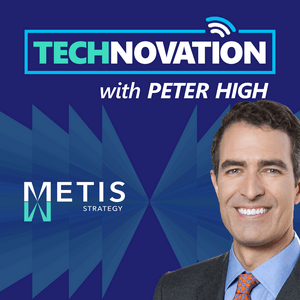
About Technovation with Peter High (CIO, CTO, CDO, CXO Interviews)
Twice-weekly conversations with top executives and thought leaders at the intersection of business, technology, and innovation. Each episode of Technovation explores the technology trends that are transforming business, and the leaders driving digital change inside their organizations. Produced by Metis Strategy and hosted by firm President Peter High, Technovation is the premier podcast for IT and technology professionals with the largest collection of interviews with elite CIOs, CTOs, and CDOs.
Podcast websiteListen to Technovation with Peter High (CIO, CTO, CDO, CXO Interviews), Kohler Media and many other podcasts from around the world with the radio.net app
Get the free radio.net app
- Stations and podcasts to bookmark
- Stream via Wi-Fi or Bluetooth
- Supports Carplay & Android Auto
- Many other app features
Get the free radio.net app
- Stations and podcasts to bookmark
- Stream via Wi-Fi or Bluetooth
- Supports Carplay & Android Auto
- Many other app features

Technovation with Peter High (CIO, CTO, CDO, CXO Interviews)
Scan code,
download the app,
start listening.
download the app,
start listening.
 Ireland

