
Listen to this podcast in the app for free: Download for free in the App Store
radio.net
Sleep timer
Save favourites
72 episodes
What Happens When the Jobs Stay but the Work Changes? Refounding Zapier with CEO Wade Foster
28/10/2026 | 54 mins.After 15 years of building Zapier, Wade Foster is inviting his team to rethink almost everything. What started as a “code red” response to AI has become an opportunity to rediscover what the company could be. Wade describes the feeling as “10 out of 10 anxiety, but 10 out of 10 fun.” The challenge is getting an entire organization to see the possibilities, especially when change can feel threatening.
Wade shares what this looks like inside Zapier, including an experiment to let AI agents handle customer support emails. It turns out that handing work over to AI is much harder than simply adding an assistant to an existing process. The team has spent months figuring out how to make it work, with humans still playing an important role.
Henrik, Jeremy, and Wade also explore what it takes to thrive when the old rules no longer apply. They discuss curiosity, resourcefulness, and the instinct to act instead of waiting for instructions. And while Wade is giving his team permission to question everything, the conversation raises a harder question: how do you get people to challenge the way things have always been done when that's exactly what they've been taught to follow?
Key Takeaways
The work is changing, even when the jobs aren't disappearing.
Henrik and Jeremy reflect on Wade's point that AI doesn't necessarily make a role obsolete, but it can fundamentally change what people do in that role.
Resourcefulness is becoming a superpower.
Henrik and Jeremy discuss why curiosity, adaptability, and the willingness to act without all the answers are increasingly valuable. Sometimes the most important step is realizing you can just build something.
Question everything, but bring a better idea.
Henrik points out that challenging the way things have always been done is only useful if you're willing to suggest or try something different.
You can't refound a company by announcement alone.
Jeremy wonders how leaders can make questioning old assumptions part of everyday work. He and Henrik explore why established habits, defaults, and organizational structures can be harder to change than the rules themselves.
Wade's LinkedIn: LinkedIn.com/wadefoster
Wade's X: X.com/wadefoster
Zapier: Zapier.com
Wade's articles: Zapier.com/wadefoster
00:00 Intro: The Work Is Changing
00:48 Meet Wade Foster
04:49 Is Your Strategy Too Small for AI?
06:14 From Code Red to Refounding Zapier
07:31 10/10 Anxiety, 10/10 Fun
08:50 How Much Has AI Actually Changed?
10:41 Getting People Excited About AI
13:56 Why Jobs Are Changing
15:34 Rethinking How Work Gets Done
16:39 Inside Zapier's AI Support Experiment
20:14 When Existing Workflows Break
21:45 Identity, Curiosity, and Adaptability
25:36 The Instinct to Act Without All the Answers
29:39 Stop Waiting for an Assignment
33:28 You Can Just Build Something
34:43 What Does Refounding Actually Mean?
36:40 Giving People Direction Without All the Rules
38:36 The Future of Automation at Zapier
39:18 Wade's Advice for Refounding a Company
41:45 What Would a New CEO Do?
43:23 The Debrief
📜 Read the transcript for this episode: Here!
For more prompts, tips, and AI tools. Check out our website: https://www.beyondtheprompt.ai/ or follow Jeremy or Henrik on Linkedin:
Henrik: https://www.linkedin.com/in/werdelin
Jeremy: https://www.linkedin.com/in/jeremyutley
Show edited by Emma Cecilie Jensen.Do You Know Yourself Well Enough to Let AI Make Decisions for You? - with Nicholas Skytland Former NASA chief technologist
14/10/2026 | 1h 7 mins.Nicholas Skytland spent 25 years at NASA, where he helped bring people from around the world together through hackathons. He joins Henrik and Jeremy to share what makes hackathons work, why different perspectives matter, and how to help people through the moment they want to give up.
Nick is now bringing that approach to kids. When his wife wanted to run an AI hackathon at her school, restrictions on AI tools led Nick and his team to build Launch.Kids. At one event, 36 teams created 500 applications in a single day.
Try Launch.Kids: If you're a student, parent, or teacher interested in learning how to build with AI, we'd love for you to try out Launch.Kids, mentioned on the show. The first 100 listeners can sign up at https://launch.kids/welcome/beyondtheprompt for a free month of credit.
The conversation then turns to a bigger question: how well do we really know our own values? Nick, Henrik and Jeremy explore how to communicate what matters to us when working with AI, and why we shouldn't hand over our judgment just because technology makes it easy.
Key Takeaways
Hackathons are an underused tool
Henrik and Jeremy reflect on how hackathons bring different people together, encourage experimentation, and create value even when they don't lead to a finished product.
Expect the moment of despair
Getting stuck is part of building something new. Nick explains why good hackathons need mentors, encouragement, and a bit of fun to help people push through it.
The better you know yourself, the better you can use AI
Henrik and Jeremy discuss why understanding your own values, preferences, and ways of thinking helps you give AI better direction and recognize when its answers don't fit.
Don't let AI do all the thinking for you
AI can make decisions easier, but that doesn't mean we should stop questioning its answers. Henrik and Jeremy reflect on the importance of bringing our own judgment to the conversation, especially when we're dealing with something we don't know much about.
Launch.Kids: Launch.Kids
Nicholas' LinkedIn: LinkedIn/NicholasSkytland
00:00 Intro: Don't Outsource Your Judgment to AI
00:20 Meet Nicholas Skytland
00:46 How NASA Opened Up Innovation
03:45 Measuring the ROI of Hackathons
05:04 Getting Past the Barriers to Open Innovation
07:51 Bringing Hackathons to Kids
09:19 Building Launch.Kids
14:44 Why “Just Play With AI” Isn't Enough
18:19 The Moment of Despair
21:36 How to Run a Hackathon
23:39 The Process, Not the Product
25:56 Inside Anthropic's Gathering of Faith Leaders
31:33 Be an Active Shaper of AI
34:36 Can AI learn good judgement?
39:00 Who Gets to Decide What's Good?
42:40 Communicating Your Values to AI
44:25 Don't Outsource Your Judgment
46:42 Henrik's Personal AI Playbook
51:10 The Debrief
📜 Read the transcript for this episode: Here!
For more prompts, tips, and AI tools. Check out our website: https://www.beyondtheprompt.ai/ or follow Jeremy or Henrik on Linkedin:
Henrik: https://www.linkedin.com/in/werdelin
Jeremy: https://www.linkedin.com/in/jeremyutley
Show edited by Emma Cecilie Jensen.What Will You Do With the Time AI Gives Back to You? - with Alex Kuilman, Founder of The Practice
30/09/2026 | 1h 4 mins.Alexander Kuilman works with CEOs and executive teams to bring more humanity into how they lead. He joins Henrik and Jeremy to explore why, if leaders know AI matters, getting people to actually use it can still be so difficult.
Using Bob Kegan and Lisa Lahey’s Immunity to Change framework, Alex argues that “I don’t have time” can mask deeper fears about competence, relevance, and what happens when AI can do work you previously thought made you valuable. They also explore why psychological safety matters if people are going to admit what they don’t know and actually experiment.
The conversation ends with the “AI vampire” and Alex’s idea of “corporate numbing”: AI makes us more productive, but instead of taking the time back, we often fill it with more work. Which leaves a bigger question: when AI gives us time back, what do we actually want to do with it?
Key Takeaways:
AI resistance may be about fear, not time
“I don’t have time” can mask deeper fears about competence, relevance, and what happens when AI can do work you thought made you valuable.
People need to feel safe enough to experiment
Psychological safety gives people room to admit what they don’t know, try something new, and risk looking incompetent.
How leaders make people feel matters
Henrik and Jeremy realize that some of the AI leaders they admire don’t just have good tactics. They make people around them feel safe enough to try.
Don’t let AI give you more work
The “AI vampire” turns productivity gains into more work. Alex’s idea of “corporate numbing” asks whether staying busy is sometimes easier than deciding what we actually want to do with the time AI gives back. Alex Kuilman (transcript - fina…
The Practice: bethepractice.com
Alex's LinkedIn: LinkedIn/AlexKuilman
Immunity to Change by Robert Kegan & Lisa Laskow
Amy Edmondson on Psychological Safety: Psychological Safety
00:00 Intro: The Problem of Corporate Numbing
00:23 Meet Alexander Kuilman
04:45 Why Aren’t People Using AI More?
06:49 The Hidden Assumptions Blocking Change
08:08 Jeremy’s Travel Problem
14:12 What Are People Really Afraid of With AI?
16:02 Stop Making Time to Experiment
22:25 Psychological Safety and AI Adoption
32:56 How to Hold Yourself
38:57 The Leaders Who Make People Feel Safe
40:33 What If AI Helps Us Think Less?
44:13 The AI Vampire
46:10 Corporate Numbing
54:08 Your Humanity Is the Advantage
58:05 The Debrief
📜 Read the transcript for this episode: Here!
For more prompts, tips, and AI tools. Check out our website: https://www.beyondtheprompt.ai/ or follow Jeremy or Henrik on Linkedin:
Henrik: https://www.linkedin.com/in/werdelin
Jeremy: https://www.linkedin.com/in/jeremyutley
Show edited by Emma Cecilie Jensen.How Do You Run a Company When You Can’t See Six Months Ahead? - with Axios CEO Jim VandeHei
16/09/2026 | 1h 2 mins.Jim VandeHei joins Henrik and Jeremy around the launch of his new book, Simplify: Do 50% More With 50% Less, co-authored with Mike Allen and Roy Schwartz. In the conversation, Jim shares how he’s leading Axios through AI, from turning himself into an “AI lab rat” to rethinking how the company works.
At Axios, Jim gave everyone access to ChatGPT, brought in training, and invited employees who took naturally to the technology to help others across the company. He also shares how AI fellows working directly with him prototype new ideas, why companies should delete unnecessary work before automating it, and how Axios is preparing for a world where more information moves from the open web into social platforms and personalized LLMs.
The conversation ends with a bigger question: what story are we telling people about an AI-enabled future? Jim worries that the negative case for AI is vivid and easy to understand, while the positive case often amounts to curing cancer or eliminating work. He makes the case for something more tangible: using AI to make people’s work and lives better while preserving human connection and the feeling that what people do still matters.
Jim's new book: Simplify: Do 50% more with 50% less
“Confessions of an AI Lab Rat”: Read here!
Axios: Axios.com
Jim's LinkedIn: LinkedIn.com/JimVandeHei
Key Takeaways
Leaders need to become AI lab rats
Leaders need firsthand experience with AI to understand what it can do and give others permission to experiment.
Give the CEO an AI “SEAL team”
Jim’s AI fellows help him prototype ideas quickly, stay current, and experiment outside the normal company processes.
Delete before you automate
Before using AI to make existing work faster, ask which meetings, processes, and activities shouldn’t exist at all.
AI needs a better story about what goes right
The negative future of AI is easy to picture. Jim argues we need a more tangible vision of how AI can improve people’s lives without losing purpose and human connection.
00:00 Intro: Predictions for the future
00:46 Meet Jim VandeHei
01:06 Becoming an AI Lab Rat
04:21 How Axios Got Everyone Using AI
05:46 Who Gets the Most Out of AI?
08:27 The AI Understanding Gap
11:04 How Jim Keeps Up With AI
14:20 Building Axios for an AI Future
20:47 The CEO’s AI “SEAL Team”
23:52 Writing for Humans and LLMs
26:49 Delete Before You Automate
30:46 The Monthly Mentality
35:58 AI-Assisted Writing and Authenticity
41:47 The Coming Political Backlash
47:42 A Better Story for AI
55:25 The Debrief
📜 Read the transcript for this episode: Here!
For more prompts, tips, and AI tools. Check out our website: https://www.beyondtheprompt.ai/ or follow Jeremy or Henrik on Linkedin:
Henrik: https://www.linkedin.com/in/werdelin
Jeremy: https://www.linkedin.com/in/jeremyutley
Show edited by Emma Cecilie Jensen.From Knowledge Worker to Intelligence Worker: Why Human Judgment Matters More With AI - with OpenAI’s Brice Challamel
02/09/2026 | 1h 13 mins.After helping lead AI adoption at Moderna, Brice Chalamel has a new goal at OpenAI: help create 1,000 AI adoption success stories across large organizations.
Brice takes Henrik and Jeremy inside how work happens at OpenAI, where Slack has largely replaced internal email, agents help process information and draft responses, and some workflows are already moving agent to agent. But as AI takes on more responsibility, Brice argues that trust can’t be mandated. It has to be earned.
The conversation goes beyond tools into what it actually takes to lead people through change. Brice explains why, in a ten-step journey, nine steps may only be halfway, why our existing mental models shape how we respond to AI, and why leaders need to listen before trying to change someone’s mind.
They also explore Brice’s idea that AI could move us from “knowledge workers” to “intelligence workers,” a personal story about his mother using ChatGPT while caring for his father with Alzheimer’s, and why the benefits of AI need to extend beyond the people already living in abundance.
Key Takeaways
Trust in AI has to be earned
As agents take on more responsibility, people need experience with them before they’re willing to hand over judgment and communication.
AI adoption is a mind game and a heart game
Successful change depends not just on what people know about AI, but on what they believe, fear, and care about.
Nine steps can be only halfway there
The final stage of transformation is often where the hardest work begins and assumptions need to be questioned.
We’re moving from knowledge workers to intelligence workers
As AI handles more information processing, human value shifts toward judgment, perspective, influence, and decision-making.
Listen before you think
Changing minds starts with understanding the experiences and mental models behind someone’s point of view, not simply making a better argument.
Brice's LinkedIn: linkedin.com/in/bricechallamel/
Website: powerofwhy.ai
00:00 Intro: From Knowledge Worker to Intelligence Worker
00:30 Meet Brice Chalamel
01:18 From Moderna to OpenAI
04:50 The Mission: 1,000 AI Success Stories
07:45 How Work Happens at OpenAI
08:59 When Agents Talk to Agents
10:56 Trust Has to Be Earned
15:22 Brice’s Principles for Change
16:45 Nine Steps Is Halfway There
25:21 The Mind Game
30:24 Why Leaders Resist AI
35:28 The Human Side of AI
37:37 When ChatGPT Became a Lifeline
41:56 From Knowledge Worker to Intelligence Worker
43:37 Agency in the AI Era
46:31 Who Gets to Benefit From AI?
51:39 What Our Fear of AI Reveals
56:18 Listen Before You Think
01:03:07 The Debrief
📜 Read the transcript for this episode: Here!
For more prompts, tips, and AI tools. Check out our website: https://www.beyondtheprompt.ai/ or follow Jeremy or Henrik on Linkedin:
Henrik: https://www.linkedin.com/in/werdelin
Jeremy: https://www.linkedin.com/in/jeremyutley
Show edited by Emma Cecilie Jensen.
More Business podcasts









Trending Business podcasts


























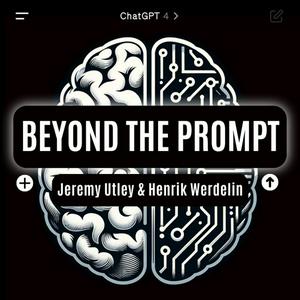
About Beyond The Prompt - How to use AI in your company
Beyond the Prompt dives deep into the world of AI and its expanding impact on business and daily work. Hosted by Jeremy Utley of Stanford's d.school, alongside Henrik Werdelin, an entrepreneur known for starting BarkBox, prehype and other startups, each episode features conversations with innovators and leaders to uncover pragmatic stories of how organizations leverage AI to accelerate success. Learn creative strategies and actionable tactics you can apply right away as AI capabilities advance exponentially.
Podcast websiteListen to Beyond The Prompt - How to use AI in your company, The Quinn Files and many other podcasts from around the world with the radio.net app
Get the free radio.net app
- Stations and podcasts to bookmark
- Stream via Wi-Fi or Bluetooth
- Supports Carplay & Android Auto
- Many other app features
Get the free radio.net app
- Stations and podcasts to bookmark
- Stream via Wi-Fi or Bluetooth
- Supports Carplay & Android Auto
- Many other app features

Beyond The Prompt - How to use AI in your company
Scan code,
download the app,
start listening.
download the app,
start listening.
 Ireland

