
Listen to this podcast in the app for free: Download for free in the App Store
radio.net
Sleep timer
Save favourites
259 episodes
BBC Radio 4 Extra closure: but what are the savings?
02/11/2026 | 14 mins.Got something to say to this podcast? Send a voicemail, and you might hear yourself on the next episode!
This is from my blog and podcast. You'll find the whole post here: https://james.cridland.net/blog/2026/demolition-of-am/
Here's the top story...
A Radioland reader suggests that the closure of BBC Radio 4 Extra (speech archive) is deliberately calculated to be politically awkward for the UK government, since it is so loved by middle England, and therefore will result in the BBC being spared the worst of the cuts. This is certainly a strategy that the BBC occasionally employs; especially, when a decision is the only thing covered on Feedback.
RAJAR last week showed BBC Radio 4 Extra’s audience as being 1.4 million, with a 1% market share. Radio 4 (news and speech) itself has 8.7 million listeners, a 10.3% market share, and is listened-to almost twice as long, per listener, as Radio 4 Extra. There appear to be only 340,000 Radio 4 Extra listeners who never listen to Radio 4.
Former Editorial Director of BBC News, Bill Rogers, calls it “wrongly-condemned” in his blog, adding: “The continuation of a linear channel as a lead display case for a national archive of radio programming is the very definition of essential public service broadcasting.”
To me, the availability of BBC archive content, where rights allow, is a key part of public service broadcasting. That is what BBC Radio 4 Extra is; and what BBC Sounds should give access to. Rights clearances (and editorial compliance for 2026 audiences) have a cost, but it’s not large in comparison with making new content, and it’s a job that only need be done once. And it often produces some real surprises.
I’d suggest that if we agree that archive content is part of what the BBC is funded to do - and it should be - then it costs very little to run a linear service showcasing some of that. Radio 4 Extra gets essentially a free ride on DAB, satellite and cable in the UK. I still don’t understand how it saves money to close the linear stream. I would suggest the number of staff required to run it is very low indeed. Feedback suggests that the BBC Annual Report claims that Radio 4 Extra costs £4mn a year to run. Firstly, that figure isn’t in the latest Annual Report - it’s in the 24/25 one (page 253), and, content-wise, it’s the cheapest radio station that the BBC runs - both in terms of the content costs and the cost-per-listener-hour (0.6p). If you’d like to close a radio station, close 1Xtra (urban) - with £9mn in content costs, 5p cost-per-listener-hour, and amply served by the commercial market.
It certainly sounds impressive that the BBC is “closing an entire radio station” as a cost-cutting measure. We shouldn’t forget that they opened Radio 3 Unwind (calming classical) and Radio 1 Anthems (recent oldies) in 2024, and Radio 1 Dance in 2020. But, unlike with the overnight newsroom move to Sydney, the BBC doesn’t appear to have shared its cost savings for closing BBC Radio 4 Extra publicly.
Is this because there aren’t any savings at all?BBC Radio 4 Extra to close, and other BBC services axed
27/10/2026 | 9 mins.Got something to say to this podcast? Send a voicemail, and you might hear yourself on the next episode!
This is part of my Radioland newsletter - the full version is here: https://james.cridland.net/blog/2026/radio-4-extra-to-close/
The BBC has announced, as part of its cuts, the closure of BBC Radio 4 Extra (which is mainly an archive station, playing reruns of BBC Radio 4 comedy, drama and documentary programmes from some years ago). “Some programmes” will be available on BBC Sounds, but one eye-catching change is that The Daily Service will be “on BBC Sounds and BBC Local Radio”. The Daily Service, a religious service that is mainly pre-recorded these days, was first carried on the BBC since 1928, being shunted to longwave only in 1991. In 2024, with the end of a specific longwave schedule, it shifted to BBC Radio 4 Extra. I can only assume that its current slot, 9.45am to 10.00am, won’t be the slot used on BBC local radio. While 46% of the UK identify as Christian, only 6% are actually practising, so it would be a strange move to broadcast something that could be a tune-out for 94% of the audience at one of the highest point of radio listening. My bet is that this mostly-unloved-but-tradition-think-of-the-tradition piece of broadcasting moves to 5.45am, and outcry ensues.
The closure of BBC Radio 4 Extra is an odd one, since I can’t quite see how much money it would actually save. A contributor to the Radio Times calls it a terrible mistake, highlighting the benefit of linear radio. But, more to the point - the closure of the radio station will save virtually nothing. It is wholly broadcast in places the BBC already owns - its own DAB multiplex, its own satellite space, and streaming - so there are little savings to be made there. Repeat payments for the programmes can’t, surely, be that much to make a meaningful saving. It has continuity announcements, but those are pre-recorded by existing staff. A small amount of programme costs; a few staff - what else is there to actually save? Has anyone done the maths?
(If you’ve not heard BBC Radio 4 Extra, here’s Jake Yapp performing, live, a taste of the station).
Mind, the ever-resourceful Boom Radio noticed an opportunity for a press release, and said that it would quite like the DAB spectrum vacated by BBC Radio 4 Extra, and would pay market rate for it. You’ve got to hand it to them!
The BBC is also stopping running a 24-hour radio newsroom for the BBC World Service in London, for the first time in its history. The overnight bulletins, which are also taken on BBC Radio 2, Radio 4 and BBC Radio 5 Live, as well as BBC Local Radio, will come from a new operation in Sydney, Australia. I got hold of the full email announcement. To be honest, for the BBC World Service, I think it’s fine.Time spent listening to Australian commercial radio
19/10/2026 | 13 mins.Got something to say to this podcast? Send a voicemail, and you might hear yourself on the next episode!
I write a decent newsletter called Radioland. Below is the top story; otherwise, it's all at https://james.cridland.net/blog/2026/time-spent-listening-australian-commercial-radio/
An email I got from the CRA, from the last survey, is interesting. The headline - Commercial Radio grows from breakfast to bedtime as more Australians listen for longer - got me wondering.
There are of course “more Australians” listening to commercial radio because there are more Australians - the last census showed a population growth of 8.6% in just five years. But that’s only half the story: the number of listeners to commercial radio is actually growing faster than the population growth: up 2.8% year-on-year.
However, “Australian listen for longer” was new: I’d not seen any data showing listening time for radio. The regular surveys don’t publish anything to do with listening time; and for a long time, I’ve wondered how Australian commercial radio compared.
So, I asked the CRA’s new PR person - expecting a polite no - whether they could share exactly how long Australians are spending with commercial radio every week, and how that compared with five years ago. Would it be like we are seeing in Europe?
And I got the above graph back. It’s a pretty rosy look for commercial radio - remaining remarkably steady over the last five years at around 12 hours 10 minutes over the last year. Worthwhile noting that there’s no appreciable difference after the departure of Kyle & Jackie O (S2/26 or thereabouts). In survey 6, the claim “Australians are also spending more time each week with commercial radio” is true - the total time spent listening was up from S5’s 12 hours 4 minutes to S6’s 12 hours 8 minutes.
If I take anything from this graph, it’s the recovery of radio post-COVID in 2022; and to learn more about whatever happened in 2025!
For comparison: Aussies are spending 12.1 hours a week with commercial radio; the British are only spending 9.7 hours with commercial radio in the UK (RAJAR Q2/26). Perhaps this is a story of the relative audience figures of the BBC (42.6% share in the UK) vs the Australian ABC (15.5% share in Brisbane).
Very interesting detail; and worthwhile reminding ourselves how resilient radio is. I’m grateful to the CRA for sharing this.
(Also - hat-tip to those doing charts that contain hours and minutes. Redrawing this graph was a bloody nightmare. That’s not fun, is it?)A look at 4BH - Brisbane's new #1 music station
11/10/2026 | 10 mins.Got something to say to this podcast? Send a voicemail, and you might hear yourself on the next episode!
My newsletter in full is over here: https://james.cridland.net/blog/2026/4bh-brisbane-number-one/
Here's the top story!
In my home town of Brisbane, 4BH (classic hits) made it to the #1 slot - with a share of 12.3%. The news even made it to local TV. It’s an oldies station, with a 31% share of listening by people over 65.
It’s particularly impressive when you remember what the station doesn’t have.
The station doesn’t have a licence of its own - it’s leasing the AM frequency from Tapt Media. It doesn’t have a sales team of its own - it’s sold by SCA, the owners of B105 and TripleM. It doesn’t have any studios of its own: the breakfast show is either presented from a rented studio in SCA in Brisbane, or from “BBQ” Bob Gallagher’s house. It doesn’t have its own news team - it buys that from Tapt Media. It doesn’t have any sports coverage - it buys that from SENQ. And it’s not live, with presenter breaks being voicetracked (normally voicetracked that day, though).
Nor is much of it local. While “BBQ” Bob Gallagher is a well-known Brisbane voice, he’s the only announcer on the station to be based here. Michelle Murphy (9am-12pm, 1pm-3pm) is in Adelaide SA; Gavin Miller (12pm-1pm) is in Melbourne VIC; Jon Vertigan (3pm-7pm, also Head of Music) is in Warrnabool VIC. The website also lists Jamie Row and Cathy Jubb, who broadcast over weekends - they both appear to be in Victoria as well. Breakfast newsreader Chloe Affleck in in Brisbane (working for 4BC); traffic reporter Liam Renton is also in Brisbane (working for ATN).
It also doesn’t have a great AM frequency. 4BH’s 1116 AM is such a poor frequency, the licence-owners (now Tapt Media) switched away from it in 2021, moving their own 4BC to 882, and giving the worse frequency to lessee 4BH. Listening is particularly hampered in Brisbane city centre, which has a notch in the transmitter to avoid interference.
Speaking on The Quarter Hour, boss Mark Taylor suggested the station has a great AM signal during the day with 17kW; but it’s switched down considerably overnight (to 7.5kW) - but also highlighting that listeners are listening in many other ways. “Educate your very loyal listeners on how to use the technology. You know, you won’t go more than five minutes on 4BH without us mentioning DAB or the LiSTNR app or to use your smart speaker at home.” Yes to all this. I’d be fascinated to know how many of the listeners use AM, and how many are using something else. (The average is 61% to analogue radio, 20% to DAB+, 18% streaming).
After all that, it’s the #1 radio station in Brisbane; #3 at breakfast, #1 from 9am-4pm, and #1 over the weekend. That’s quite an achievement.
It’s #1 in total share, mind you. Interestingly, it’s just #6 in terms of total cume (the total amount of people listening). People turn the station on, and leave it on - it’s clearly well programmed.
So, does a station need to be local - and does it need studios of its own? No. All it needs is a decent music policy, a clutter-free sound, and a warm, well-known personality with a bit of shared human connection.
PS: today I drove past an electronic billboard saying “thank you for making us Brisbane’s number one radio station”. A nice touch.To London and back: while Canada's CRTC sits on their hands
11/10/2026 | 9 mins.Got something to say to this podcast? Send a voicemail, and you might hear yourself on the next episode!
My full newsletter is here: https://james.cridland.net/blog/2026/to-london-and-back/
These are the first few stories.
To London, and then on to Germany. As a former trustee of the Radio Academy - now the Audio Academy - I never actually got to speak at the Radio Festival; so it was great to speak at the Audio Festival, in a full room. Always lovely to see so many friendly faces: though plenty of new, younger, faces in the crowd. They tell you that none of the kids are interested in radio these days; but the Audio Festival was clear that there are plenty of younger people. Good. And, also, good to see the Community Media Association later that weekend, with many more people who were enthusiastic and excited about the state of the medium.
It’s been very clear, from my LinkedIn feed, that Canadian radio is running out of patience with the CRTC, who promised a year ago to review parts of its regulation of the industry - regulation widely suspected to be holding the industry back - only to do absolutely nothing. I write a full piece, what’s the CRTC even doing?, elsewhere on my blog. The Canadian industry is in a mess; and the CRTC is partially responsible.
The Playdate, a little black and white games console, now has a radio player in it. The Peedee ICF-390 app, just $3, just lets you scan through the dial using the crank on the side of the device: no searching, just serendipitous discovery of radio stations. It’s rather fine.
Tom Webster writes Smart TV Killed the Smart Speaker Star, which is clearly a lazy Buggles headline - though he apologises for it - and to me - in the first paragraph. “As a conduit for podcasting, the smart speaker is objectively a failure.”
Apple Music opened a fancy new music recording space in London. Meanwhile, I was able to have a look round Bauer Media’s new “Playground” - which has the capability to become a recording space in the basement of The Lantern, its home in London. Someone I worked with in Germany this week was excited after visiting a public radio station in the US with its own performance space (“they get people in! hundreds of people!”). It’s interesting to see more broadcasters highlight what they’re good at - getting people together, a community of common interest. Of course, podcasting is doing similar too.
I realised something about advertising these days - the art of copywriting has disappeared from magazine ads, out of home, posters, and other parts of advertising. In a blog post I write a little about this - dimly realising that if the skills required for great copywriting are disappearing, what happens to those media that still require great copy: including radio and podcasting?
More Business podcasts





Trending Business podcasts















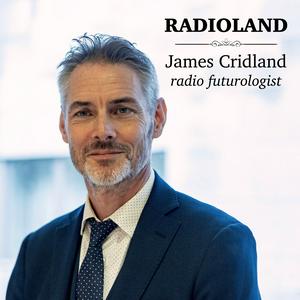
About Radioland, with James Cridland - radio futurologist
A regular audio column with the most interesting news about radio's future. James is a radio futurologist - a writer, speaker and consultant concentrating on the effect that new platforms and technology are having on the radio business across the world. He has a website at https://james.cridland.net where you can subscribe to Radioland, his newsletter.
Podcast websiteListen to Radioland, with James Cridland - radio futurologist, Planet Money and many other podcasts from around the world with the radio.net app
Get the free radio.net app
- Stations and podcasts to bookmark
- Stream via Wi-Fi or Bluetooth
- Supports Carplay & Android Auto
- Many other app features
Get the free radio.net app
- Stations and podcasts to bookmark
- Stream via Wi-Fi or Bluetooth
- Supports Carplay & Android Auto
- Many other app features
Radioland, with James Cridland - radio futurologist
Scan code,
download the app,
start listening.
download the app,
start listening.
Radioland, with James Cridland - radio futurologist: Podcasts in Family
 Ireland

