

Listen to this podcast in the app for free: Download for free in the App Store
radio.net
Sleep timer
Save favourites
42 episodes

THE ART OF DETACHMENT: CARING WITHOUT GOING BACK
27/08/2026 | 9 mins.Detachment does not mean you stopped caring.
It does not mean the relationship meant nothing, that every memory was fake, or that you need to hate someone before you can finally move forward.
In this free episode, Dominic breaks down the difference between love and access, why no contact should create space rather than punishment, and how checking someone’s social media can keep an ended relationship emotionally alive.
You can miss someone without contacting them. You can forgive without reopening the door. You can hope they heal without becoming responsible for their healing.
Detachment is not making them insignificant.
It is finally making your peace more significant.
Friday inside The Table: Break the Bond Without Breaking Yourself.
Pull up a chair.WHEN YOU ALMOST TEXT THEM AGAIN
25/08/2026 | 10 mins.The urge is a feeling. It is not an instruction.
At some point after a breakup, the phone ends up in your hand and their name is open.
You know why you left. You remember what the relationship cost you. But in that moment, you do not always want the relationship back—you just want the pain to stop.
In this free episode, Dominic breaks down why the urge to contact someone is often a search for temporary relief, not proof that you still belong together. He explores the pull of familiarity, the damage caused by monitoring an ex on social media, and why another conversation does not always create closure.
You will also learn a simple 30-minute practice that can help you slow the impulse, identify what you are truly seeking, and protect your peace before one text reopens the entire cycle.
You can miss somebody and still know they are not good for you.
Tomorrow inside The Table: You Miss the Version of Them That Never Stayed.
Available to subscribers on Spotify and Apple Podcasts.
Pull up a chair.The Relationship Survived. But Did You? | Sunday Recap
23/08/2026 | 15 mins.Some relationships survive because two people are willing to repair them.
Others survive because one person keeps disappearing.
In this Sunday recap, Dominic Michael examines the hidden cost of staying in a relationship that requires you to silence yourself, lower your standards, manage another person’s emotions, and slowly abandon your own identity just to maintain the appearance of peace.
This conversation explores the difference between love and emotional survival. It breaks down what happens when you begin walking on eggshells, studying somebody’s tone, anticipating their moods, and changing yourself before conflict even begins.
Dominic also addresses the exhaustion of overfunctioning—when one person becomes responsible for initiating every conversation, repairing every disagreement, carrying the emotional weight, and protecting their partner from accountability.
You will hear why relief in someone’s absence is important information, why being chosen is not always validation, and why a relationship cannot be considered healthy when honesty is repeatedly followed by punishment, silence, defensiveness, or accusations.
The relationship may have survived.
Now it is time to ask whether you did.
The difference between surviving and thriving in a relationship
How your nervous system recognizes emotional danger
Why walking on eggshells is not emotional safety
The physical and emotional cost of overfunctioning
How competence can protect a partner from accountability
Why some people are more comfortable giving than receiving love
The difference between being chosen and being valued
How silence can become a form of self-abandonment
Recognizing emotional manipulation, control, and unpredictability
Why healthy love requires honesty, accountability, and boundaries
“Some relationships survive because one person keeps disappearing.”
“Sometimes it is your nervous system saying, ‘I have been here before.’”
“Your silence did not make the relationship healthy. It made the dysfunction easier to manage.”
“Being chosen by someone who requires you to disappear is not validation.”
“The relationship may have survived. Now it is time to make sure you do.”
Next week, Project 24 begins a new conversation:
We are going deeper into lying by omission, secrecy versus privacy, betrayal before it becomes physical, modern dating, accountability, standards, and the truths people keep renaming because calling the behavior what it actually is would require a decision.
Listen to Project 24: The Table on Apple Podcasts and Spotify.YOU CHANGED THE OUTFIT TO AVOID THE COMMENT
20/08/2026 | 11 mins.When Their Reaction Starts Choosing for You
You put on the outfit.
Looked in the mirror.
And actually felt good.
Then you remembered the last comment.
“Are you really wearing that?”
“Who are you trying to impress?”
“That’s a little much.”
Before they even entered the room, you changed.
Not because you stopped liking the outfit.
Because their old reaction had already made today’s decision for you.
In this free episode of Project 24: The Table, Dominic Michael explores how self-abandonment can begin through ordinary decisions that appear small—changing what you wear, lowering your voice, hiding an accomplishment, avoiding a friend, delaying a dream, or refusing to say what you actually want.
This conversation is not really about clothing.
It is about the moment somebody else’s reaction moves inside your head and starts choosing for you.
Over time, you may become so skilled at preventing another person’s discomfort that they no longer have to directly control you. You begin anticipating the comment, the mood, the withdrawal, or the argument—and editing yourself before any of it happens.
You call it compromise.
But healthy compromise allows both people to remain present.
Self-abandonment requires one person to disappear.
How anticipation can become a powerful form of control
Why self-erasure usually happens through small, repeated compromises
The difference between healthy consideration and fear-driven compliance
How another person’s reaction can begin influencing your clothing, friendships, ambition, voice, and boundaries
Why becoming smaller rarely makes an insecure or controlling person satisfied
How guilt can become a leash inside relationships
Why another person’s disappointment does not automatically mean you are wrong
The questions that reveal whether you are compromising—or disappearing
How to begin reclaiming your identity through small, honest decisions
Dominic challenges listeners to ask one brutal question:
Would I still make this choice if I were not afraid of their reaction?
Healthy love can have preferences.
It can disagree.
It can experience disappointment.
But healthy love does not require you to shrink so another person can remain comfortable.
It makes room for a full person.
Yesterday’s premium episode, What Did Being Chosen Cost You?, calculated the emotional, physical, financial, and personal price people pay to remain chosen inside relationships that require self-erasure.
Tomorrow, the premium conversation continues with:
Because taking your life back does not begin when they apologize.
It begins when your own word starts meaning something to you again.
Put the outfit back on.
Not to provoke anybody.
Not to prove a point.
To make your own decision.
Project 24: The Table
Truth. Accountability. Standards. Service.
Pull up a chair.THE TEXT YOU DELETED TO KEEP THE PEACE
18/08/2026 | 11 mins.When Silence Becomes Self-Abandonment
You typed exactly what you felt.
Read the message back.
Then deleted every word.
Not because it was untrue.
Because you already knew what honesty was going to cost.
The defensiveness.
The argument.
The cold response.
The silence that might last the rest of the night.
So you replaced the truth with:
“It’s fine.”
“No problem.”
“Forget it.”
“Hope you have a good day.”
But it was not fine.
There was a problem.
And you did not forget it.
In this free episode of Project 24: The Table, Dominic Michael explores what happens when people repeatedly censor themselves to manage another person’s reaction—and how that silence slowly damages identity, communication, and self-trust.
Deleting the message does not delete the truth.
It only removes the witness.
The hurt still follows you into work, dinner, bed, and the next conversation. Over time, you may become so skilled at softening, translating, and minimizing what you feel that nobody ever gets to meet the complete version of you.
This episode examines the difference between choosing not to send a message from discipline—and deleting your truth because fear made the decision for you.
Sometimes silence is a boundary.
Sometimes no contact is self-respect.
Sometimes the other person has already heard the truth and no longer deserves another explanation.
But sometimes silence means you have learned that honesty will be punished.
That is not healthy communication.
That is emotional risk management.
Why deleting an honest message does not erase the emotional impact
How emotionally unsafe dynamics train people to censor themselves
The difference between thoughtful silence and fear-driven silence
Why people soften the truth until it no longer sounds like them
How repeated self-censorship damages self-trust
Why healthy relationships must be able to survive uncomfortable honesty
How to communicate clearly without attacking, begging, or disappearing
The three-sentence method for expressing what happened, its impact, and what you need
Dominic also gives listeners a practical challenge:
Write the message you keep deleting.
Do not send it immediately.
First identify:
What am I actually feeling?
What do I actually need?
What boundary or request would honor that truth?
Then rewrite the message in three sentences:
Name what happened.
Name the impact.
Name what you need—or what you will do next.
The goal is not to create another argument.
The goal is to stop creating temporary peace by erasing yourself.
Yesterday’s full premium episode, The Day “Never Mind” Became Your Answer, explores where this pattern begins, how fear of abandonment creates self-abandonment, and how to rebuild self-trust one honest decision at a time.
Tomorrow, the premium conversation continues with:
Your voice.
Your sleep.
Your friendships.
Your confidence.
Your body.
Your time.
Your dreams.
At what point does belonging become too expensive?
The next time your truth reaches your mouth…
Do not automatically say:
“Never mind.”
Pause.
Stay on your own side.
Finish the sentence.
Project 24: The Table
Truth. Accountability. Standards. Service.
Pull up a chair.
More Education podcasts
 Good Life ProjectBusiness, Education, Health & Wellness, Self-Improvement, Tutorials
 Gaeilge WeeklyEducation, Language Learning
 Begin Again with Davina McCallEducation, Health & Wellness, Mental Health, Self-Improvement, Society & Culture
 IT IS WHAT IT IS!Education, Self-Improvement
 Tom's TalksEducation, Health & Wellness, Mental Health, Self-Improvement
 Coffee Break SpanishCourses, Education, Language Learning
 The Mel Robbins PodcastEducation, Health & Wellness, Mental Health, Relationships, Self-Improvement, Society & Culture
 IMO with Michelle Obama and Craig RobinsonEducation, Self-Improvement, Society & Culture
 Immersive SpanishCourses, Education, Language Learning
 The Comeback with Brenda DennehyEducation, Health & Wellness, Mental Health, Self-Improvement
Trending Education podcasts
 How to Touch GrassEducation, Science, Self-Improvement, Social Sciences, Society & Culture
 The Tamsen ShowEducation, Health & Wellness, Self-Improvement, Society & Culture
 Dreaming Spanish Podcast – Chats in Beginner SpanishEducation, Language Learning
 Coffee Break GermanCourses, Education, Language Learning
 Learning English GrammarEducation, Language Learning
 The Middletown Centre for Autism PodcastEducation, Health & Wellness
 Zero to Finals Medical Revision PodcastEducation, Health & Wellness, Life Sciences, Medicine, Science
 Passerelles : a French podcast for intermediate learnersEducation, Language Learning
 Made In Chaos with Ryan CurtisEducation, Self-Improvement
 The Manifest MovementBusiness, Education, Religion & Spirituality, Self-Improvement, Spirituality
 The Jefferson Fisher PodcastEducation, Relationships, Self-Improvement, Society & Culture
 ALIGNED | The Path to PurposeAlternative Health, Education, Health & Wellness, Religion & Spirituality, Self-Improvement, Spirituality
 Английский язык по плейлистам. Английский язык с нуля. Полный курсEducation, Language Learning
 Coffee Break Italian AdvancedCourses, Education, Language Learning
 How to PhD - your academic survival guideEducation, Science, Tutorials
 Know ThyselfEducation, Self-Improvement
 Coffee Break FrenchCourses, Education, Language Learning
 80,000 Hours PodcastEducation, Technology
 The Art of DeclutteringEducation, Home & Garden, Kids & Family, Leisure, Parenting
 Breakthrough with Thais Gibson PodcastEducation, Self-Improvement
- IMO with Michelle Obama and Craig RobinsonEducation, Self-Improvement, Society & Culture
 BEING HER with Margarita NazarenkoEducation, Health & Wellness, Relationships, Sexuality, Society & Culture
About PROJECT 24 - The Table
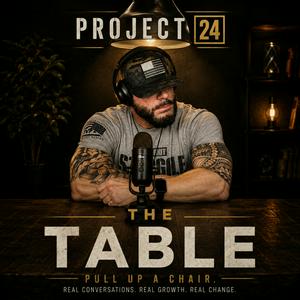
Project 24 | The Table is where real conversations happen. Hosted by Dominic Michael, a military veteran and former federal leader, this podcast challenges you to stop surviving and start living intentionally. We tackle identity, relationships, discipline, accountability, confidence, healing, purpose, and rebuilding your life through honest, direct conversations. No fluff. No filters. Just truth, growth, and the courage to become who you're meant to be. Pull up a chair. The conversation starts here.
Podcast websiteListen to PROJECT 24 - The Table, Good Life Project and many other podcasts from around the world with the radio.net app
Get the free radio.net app
- Stations and podcasts to bookmark
- Stream via Wi-Fi or Bluetooth
- Supports Carplay & Android Auto
- Many other app features
Get the free radio.net app
- Stations and podcasts to bookmark
- Stream via Wi-Fi or Bluetooth
- Supports Carplay & Android Auto
- Many other app features

PROJECT 24 - The Table
Scan code,
download the app,
start listening.
download the app,
start listening.
PROJECT 24 - The Table: Podcasts in Family
 Ireland