

Listen to this podcast in the app for free: Download for free in the App Store
radio.net
Sleep timer
Save favourites
38 episodes
#37 Cyrus Safaie: Inside DoorDash's Three-Sided Optimization Problem
09/09/2026 | 42 mins.Make better business decisions with data and AI—subscribe to The Decision Intelligence Lab Newsletter at https://decisionintelligencelab.substack.com/.
What does it actually take to run a marketplace across thousands of micro-markets in real time?
Cyrus Safaie, Former Director of Engineering and AI/ML at DoorDash joins Mike and Vijay to pull back the curtain on how DoorDash balances supply and demand, pays dashers, and predicts delivery times at massive scale. Cyrus shares why the company started with spreadsheets instead of algorithms, how a surprise Netflix boxing match drove a Super Bowl-sized demand spike with zero warning, and why the best automated systems treat human judgment as an input rather than an override. He also previews his new venture: using AI to build operationally heavy companies run by a single domain expert or tiny team.
Timestamps
0:00 - Preview
1:01 - Meet Cyrus Safaie
2:00 - What people underestimate about DoorDash: hyper-local markets
3:28 - Scaling by doing things that don't scale
6:48 - Optimizing a three-sided marketplace & the trade-offs
11:20 - Who resolves conflicts between dasher, merchant, and consumer teams
13:00 - Balancing supply/demand and dasher incentives in real time
16:48 - Reactive Real-time decisions and the Netflix Tyson fight
21:30 - Human input vs. human override: how to automate the right way
27:27 - Fixing ETAs by predicting your own model's errors
29:35 - Cyrus's new venture: AI-native operationally heavy companies
33:38 - Where the human stays in the loop: one-expert companies
36:36 - Advice for students: curiosity and "torturing your brain"
What You'll Learn
- Why DoorDash is really thousands of tiny, semi-isolated markets and why it optimizes locally before globally
- How DoorDash scaled by starting with spreadsheets and manual judgment before building algorithms
- How a three-sided marketplace balances dashers, merchants, and consumers
- The difference between proactive and reactive dasher incentives, and how real-time mobilization works
- Why human input into automated systems beats human overrides of them
- How DoorDash improved ETAs by building models that predict their own errors
- Cyrus's vision for AI-native, operationally heavy companies run by a single domain expert (or tiny team) plus an AI operating system
Follow the show
Apple: https://podcasts.apple.com/in/podcast/the-decision-intelligence-lab/id1811085064
Spotify: https://open.spotify.com/show/0lFoAVKqJHTYSZNpeN61ou?si=0ae973aab0174b3b
Connect with guest
Cyrus Safaie: https://www.linkedin.com/in/hsafaie/
Connect with hosts
Prof. Vijay Mehrotra (University of San Francisco): https://www.linkedin.com/in/vijay-mehrotra-ba9498/
Prof. Michael Watson (Northwestern University): https://www.linkedin.com/in/michael-watson-07600a1
About the podcast
The Decision Intelligence Lab podcast delivers real-world insights for data professionals, business leaders, and anyone seeking to leverage data & AI for smarter decision-making & successful business outcomes.
For business inquiries, email at decisionintelligencepodcast@gmail.com#35 William Swelbar: How Airlines Became the Ultimate OR Playground
19/08/2026 | 39 mins.Make better business decisions with data and AI—subscribe to The Decision Intelligence Lab Newsletter at https://decisionintelligencelab.substack.com/.
Airline veteran William Swelbar joins Vijay Mehrotra and Mike Watson for a tour through nearly 50 years of airline economics(from 1978 deregulation to today's premiumization era).
William Swelbar's path is one of a kind: flight attendant at North Central in 1979, local union president in Detroit within a few years, and part of a 1982 employee coalition that had all but raised the $400 million it needed in a bid to buy Republic Airlines.
The conversation digs into the analytics behind the industry: why hub-and-spoke networks turn 10 routes into 230 sellable city pairs, how Pan Am's $99 cabin became an early pricing wake-up call, why "capacity is a bad drug," and how Delta and United decommoditized flying through cabin segmentation, basic economy, and credit card revenue - while the end of labor arbitrage killed the low-cost carrier era.
Timestamps
0:00 - Preview
0:44 - Vijay's Caddy Master Turned Airline Veteran
5:10 - What deregulation actually changed
8:00 - The overnight flood of new entrants
9:30 - Pan Am's $99 cabin and ~120 bankruptcies
11:43 - The fall of TWA and Pan Am; American's innovations
14:23 - Network design: Hub-and-spoke vs. point-to-point
16:32 - Southwest and the Southwest Effect
19:40 - High-speed rail: too late for the US?
22:15 - Capacity is a "bad drug"
25:15 - How Delta and United segmented the cabins & won during COVID
29:05 - Airfares never covered the cost of flying
30:45 - Basic economy as a weapon against Spirit and Frontier
33:50 - The end of the value airline sector
36:55 - Wrap-up
Follow the show
Apple: https://podcasts.apple.com/in/podcast/the-decision-intelligence-lab/id1811085064
Spotify: https://open.spotify.com/show/0lFoAVKqJHTYSZNpeN61ou?si=0ae973aab0174b3b
Connect with guest
William Swelbar: https://swelbar.substack.com/
Connect with hosts
- Prof. Vijay Mehrotra (University of San Francisco): https://www.linkedin.com/in/vijay-mehrotra-ba9498/
- Prof. Michael Watson (Northwestern University): https://www.linkedin.com/in/michael-watson-07600a1
About the podcast
The Decision Intelligence Lab podcast delivers real-world insights for data professionals, business leaders, and anyone seeking to leverage data & AI for smarter decision-making & successful business outcomes.
For business inquiries, email at decisionintelligencepodcast@gmail.com#34 Geoffrey De Smet: Solving Real-Time Scheduling Problems
05/08/2026 | 41 mins.Make better business decisions with data and AI—subscribe to The Decision Intelligence Lab Newsletter at https://decisionintelligencelab.substack.com/.
Geoffrey De Smet built a scheduling solver as a side project and ended up with a NASA supplier, big telcos, and pest control companies running on it.
The Timefold co-founder and OptaPlanner creator joins Vijay and Mike to talk field service routing: hundreds of technicians, tens of thousands of jobs, and the chaos of a real day in the field. They also discuss why plans are useless but planning is essential, why a 90% feasible schedule is 100% useless, why operators reject schedules they can't interrogate and what it took to leave a steady job when his life's work became roadkill after the IBM–Red Hat acquisition.
If you've ever wondered why the world still runs on scheduling spreadsheets, this one's for you.
Chapters
0:00 - Preview & Introduction
1:00 - Meet Geoffrey De Smet, Co-founder Timefold
1:20 - What is field service routing?
3:05 - Non-disruptive replanning and uncertainty
10:25 - What-if simulations
11:35 - Who uses Timefold Users
14:45 - The telecom case: ROI and trade-offs of optimization
18:05 - Spreadsheets and scheduling problems
19:10 - From OptaPlanner to Timefold: The Origin story
26:23 - Customising the model
28:20 - Explainability deep dive
30:28 - Where LLMs fit
31:50 - Trust, feasibility, constraints and the operator's never-ending world
35:23 - The Leap: leaving a steady job, six months of burning savings
38:07 - Go-to-market challenges
40:40 - Closing thoughts
Follow the show
Apple: https://podcasts.apple.com/in/podcast/the-decision-intelligence-lab/id1811085064
Spotify: https://open.spotify.com/show/0lFoAVKqJHTYSZNpeN61ou?si=0ae973aab0174b3b
Connect with guest
Geoffrey De Smet: https://www.linkedin.com/in/ge0ffrey/
Timefold: https://timefold.ai
Timefold Solver: https://timefold.ai/solver
Connect with hosts
Prof. Vijay Mehrotra (University of San Francisco): https://www.linkedin.com/in/vijay-mehrotra-ba9498/
Prof. Michael Watson (Northwestern University): https://www.linkedin.com/in/michael-watson-07600a1
About the podcast
The Decision Intelligence Lab podcast delivers real-world insights for data professionals, business leaders, and anyone seeking to leverage data & AI for smarter decision-making & successful business outcomes.
For business inquiries, email at decisionintelligencepodcast@gmail.com#33 Connor Lawless & Madeleine Udell: What Really Slows Optimization Down
22/07/2026 | 36 mins.. Make better business decisions with data and AI—subscribe to The Decision Intelligence Lab Newsletter at https://decisionintelligencelab.substack.com/.
Optimization powers decisions in everything from healthcare to logistics, but for most practitioners it stays a "magical box": powerful, opaque, and locked behind PhD-level expertise. So what actually gets in the way of putting these models to work?
In this episode, hosts Vijay Mehrotra and Michael Watson sit down with Stanford's Postdoctoral Researcher Connor Lawless and Madeleine Udell (Assistant Professor at Management Science and Engineering Department, Stanford University) to unpack their paper "It Was a Magical Box": Understanding Practitioner Workflows and Needs in Optimization. Based on interviews with 15 optimization model developers, the research uncovers a surprising truth: the hardest part of operations research usually isn't the math. It's the people, the data, and the endless back-and-forth.
We dig into the six-stage workflow of building an optimization model, why nearly every project becomes an iterative "flywheel," why machine learning feels so much easier than OR, when "good enough" beats provably optimal solutions, and how LLMs might finally close the accessibility gap. Connor also shares what's next as he joins Percepta to work on the "last mile" of analytics.
Whether you build models for a living or just wonder why so many great models never make it into the real world, this conversation will change how you think about optimization in practice.
The Research Paper:
"It Was a Magical Box": Understanding Practitioner Workflows and Needs in Optimization (2025) - https://arxiv.org/abs/2509.16402
Timestamps
0:00 - Preview & Introduction
0:57 - Meet Connor Lawless and Madeleine Udell
2:04 - OR's accessibility problem vs. ML
3:07 - The six stages of building an optimization model
5:38 - Iteration as a flywheel: the "99% of the time" finding
7:45 - Why is ML so much easier than OR?
10:45 - The role of visualization and pattern recognition
12:00 - Optimization as a distribution-shift problem
13:24 - The big surprise: the human bottleneck, not the math
15:32 - Implications for teaching in the age of AI
18:00 - Handling uncertainty: data-scarce vs. data-rich problems
20:00 - Solver friction: Gurobi, CPLEX, and parameter tuning
22:20 - "Good enough" beats optimal
24:16 - Practitioner innovations: data and constraint validators
26:00 - Separating data from the model
27:37 - Preventing silent wrong answers
29:00 - Documentation, debugging, and LLMs as intermediaries
30:30 - Connor's next chapter: Percepta and the "last mile" of analytics
32:00 - If not us, then who?
Follow the show
Apple: https://podcasts.apple.com/in/podcast/the-decision-intelligence-lab/id1811085064
Spotify: https://open.spotify.com/show/0lFoAVKqJHTYSZNpeN61ou?si=0ae973aab0174b3b
Connect with guest
- Connor Lawless (Postdoctoral researcher, Stanford University): https://www.linkedin.com/in/connorlawless/
- Madeleine Udell (Assistant Professor, Management Science & Engineering, Stanford University): https://www.linkedin.com/in/madeleine-udell/
Connect with hosts
- Prof. Vijay Mehrotra (University of San Francisco): https://www.linkedin.com/in/vijay-mehrotra-ba9498/
- Prof. Michael Watson (Northwestern University): https://www.linkedin.com/in/michael-watson-07600a1
About the podcast
The Decision Intelligence Lab podcast delivers real-world insights for data professionals, business leaders, and anyone seeking to leverage data & AI for smarter decision-making & successful business outcomes.
For business inquiries, email at decisionintelligencepodcast@gmail.com#32 James Taylor: Why Your Decisions (Not Your Data) Are the Problem
08/07/2026 | 40 mins.Make better business decisions with data and AI—subscribe to The Decision Intelligence Lab Newsletter at https://decisionintelligencelab.substack.com/.
What if the biggest mistake organizations make isn't in their data or their AI, but in never actually defining the decision they're trying to make?
In this episode of the Decision Intelligence Lab, hosts Vijay Mehrotra and Michael Watson sit down with James Taylor, the author of Digital Decisioning, and Executive Partner at Blue Polaris. James traces the idea back 25+ years to a simple observation in financial services: fraud, origination, and collections systems all ran on the same technology stack yet were treated as entirely separate things. Naming that pattern changed how a whole industry approaches automation.
The conversation digs into why decisions should be isolated as their own unit of work, why you should aim to automate everything to discover the parts that truly need people, and how a disability-claims team once saved 15 months of work simply by understanding the decision before building the model. James also shares where decisioning is going next, why he partners so closely with IBM, and his three durable principles for anyone trying to improve how their organization decides.
Chapters
0:00 - Preview & Introduction
1:00 - Meet James Taylor & the origins of "decision management"
3:20 - Economies of scale and cross-team learning
5:25 - Task automation vs. true decisioning
11:35 - Decision maps and who successfully adopts them
13:25 - What to do when companies say "our data is no good"
18:26 - Why data science teams get undermined presenting without business input
19:35 - Automating decisions with uncertainty and multiple objectives
23:05 - The case for "automate first" as a default mindset
28:30 - Beyond financial services: healthcare payers and personalized care plans
32:45 - The Blue Polaris business story
38:15 - 3 principles for aspiring decision leaders
Follow the show
Apple: https://podcasts.apple.com/in/podcast/the-decision-intelligence-lab/id1811085064
Spotify: https://open.spotify.com/show/0lFoAVKqJHTYSZNpeN61ou?si=0ae973aab0174b3b
Connect with James
Email: james@bluepolaris.com
LinkedIn: https://www.linkedin.com/in/jamestaylor/
Website: https://bluepolaris.com/
James's Book: https://www.amazon.de/stores/James-Taylor/author/B001IOH7UI
Connect with hosts
Prof. Vijay Mehrotra (University of San Francisco): https://www.linkedin.com/in/vijay-mehrotra-ba9498/
Prof. Michael Watson (Northwestern University): https://www.linkedin.com/in/michael-watson-07600a1
About the podcast
The Decision Intelligence Lab podcast delivers real-world insights for data professionals, business leaders, and anyone seeking to leverage data & AI for smarter decision-making & successful business outcomes.
For business inquiries, email at decisionintelligencepodcast@gmail.com
More Business podcasts
 Money TalksBusiness
 A Bit of OptimismBusiness, Careers, Education, Self-Improvement
 Good Bad BillionaireBusiness, Documentary, Entrepreneurship, Society & Culture
 Working Hard with Grace BeverleyBusiness, Education, Health & Wellness, Marketing, Self-Improvement
 Prof G MarketsBusiness, Investing
 The Other HandBusiness, News, Society & Culture
 The Diary Of A CEO with Steven BartlettBusiness, Education, Society & Culture
 Inside Business with Ciaran HancockBusiness
 Think Fast Talk Smart: Communication TechniquesBusiness, Careers, Comedy, Education, Improv, Language Learning
 Aspire with Emma GredeBusiness, Entrepreneurship, Society & Culture
Trending Business podcasts
 Master Your Yoga Teaching with MaKenzie FlyBusiness, Education, Entrepreneurship, Health & Wellness, Self-Improvement
 The Ramsey Show HighlightsBusiness, Education, Investing, Self-Improvement
 Decoder with Nilay PatelBusiness, Technology
 Open Book with Anthony ScaramucciArts, Books, Business, Entrepreneurship
 Business Book ClubArts, Books, Business, Education, Entrepreneurship, Self-Improvement
 Hot Money: Agent of ChaosBusiness, Health & Wellness, Sexuality, Society & Culture, Technology
 HBR On LeadershipBusiness, Education, Entrepreneurship, Management, Self-Improvement
 IPI Planners PodcastBusiness, Management
 The Fifth CourtBusiness, Education, News
 Patrick Boyle On FinanceBusiness, Investing
 Podcasts from Irish FundsBusiness
 My First MillionBusiness, Entrepreneurship
 The Psychology of Money with Morgan HouselBusiness
 Job Interview Preparation SimplifiedBusiness, Careers
 The Best One YetBusiness, Business News, Investing, News
 The Hidden Hustle PodcastBusiness
 Business ClassBusiness, Management, Marketing
 Money Stuff: The PodcastBusiness, News, Society & Culture
 Business DailyBusiness
 The Twenty Minute VC (20VC): Venture Capital | Startup Funding | The PitchBusiness, Investing, News, Tech News, Technology
 World Business ReportBusiness, Business News, News
 Get Started InvestingBusiness, Education, Investing
 Motley Fool Hidden Gems InvestingBusiness, Investing
 David SenraBusiness
About The Decision Intelligence Lab
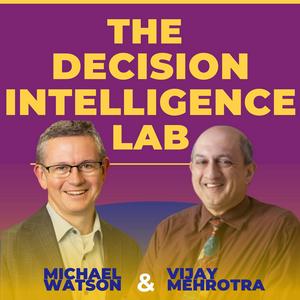
The Decision Intelligence Lab explores practical challenges of applying data science, analytics, and AI to drive real-world business outcomes.
Hosted by Prof. Michael Watson (Northwestern University) and Prof. Vijay Mehrotra (University of San Francisco) — both seasoned entrepreneurs, consultants, and researchers — this podcast delivers real-world insights for data professionals, business leaders, & anyone seeking to leverage data for smarter decision making. Each episode features leaders sharing how smarter decisions are reshaping business and technology. Subscribe to join the conversation.
Podcast websiteListen to The Decision Intelligence Lab, Money Talks and many other podcasts from around the world with the radio.net app
Get the free radio.net app
- Stations and podcasts to bookmark
- Stream via Wi-Fi or Bluetooth
- Supports Carplay & Android Auto
- Many other app features
Get the free radio.net app
- Stations and podcasts to bookmark
- Stream via Wi-Fi or Bluetooth
- Supports Carplay & Android Auto
- Many other app features

The Decision Intelligence Lab
Scan code,
download the app,
start listening.
download the app,
start listening.
 Ireland