

Listen to this podcast in the app for free: Download for free in the App Store
radio.net
Sleep timer
Save favourites
264 episodes
Three Questions Holding Triathletes Back From Dialling In Their Nutrition
08/10/2026 | 19 mins.Why is your triathlon nutrition strategy still not working when you already know what to do?
I asked the triathletes who just finished my Triathlon Fuel Camp what they had spent money on to improve their performance. 70% had paid for a bike fit, 66% had a coach and 50% had bought a power meter and faster wheels. Only 20% had ever invested in a dietitian or nutritionist, and 57% told me they were winging their nutrition. These are smart, driven athletes with more information at their fingertips than any triathlete in history. So why is it still not working?
IN THIS EPISODE, YOU WILL LEARN:
Why more information is not what is missing from your nutrition
What a strategy specific to you is actually built on (and why generic advice never holds for long)
The 3 ways triathletes try to build a nutrition strategy, and the only one that lasts your whole racing life
The 3 questions that keep triathletes on the precipice of dialling in their nutrition for years
How Kelly, Steve and Julia from the Triathlon Nutrition Academy finally got off the fence
TIMESTAMPS
02:02 Why your triathlon nutrition strategy isn't working
10:15 3 questions holding triathletes back
EPISODES MENTIONED
Episode 235 with Julia
Episode 237 on why DIY nutrition is not working
Episode 259 with Kelly and the TNA crew at the 70.3 World Championship in Nice
Episode 261 with Steve, Curt and Jade
READY FOR A STRATEGY THAT IS SPECIFIC TO YOU?
The Triathlon Nutrition Academy is my 9-month program where I teach you how to fuel your own training and racing, step by step, with an Advanced Sports Dietitian checking your work along the way. Find out more about the Triathlon Nutrition Academy here.
SUPPORT THE PODCAST HERE
CONNECT WITH TARYN
Website | Instagram | Facebook | YouTube
The Triathlon Nutrition Academy® is a podcast by Dietitian Approved®. All rights reserved.
See omnystudio.com/listener for privacy information.The Triathlon Nutrition Academy in Under 10 Minutes
06/10/2026 | 9 mins.If you have heard about the Triathlon Nutrition Academy and wondered what it actually is, this is your answer in under 10 minutes.
You already have a training system. You have a coach or a program, a week of sessions you love to turn green and the discipline to follow it. What most triathletes don't have is a nutrition system that is just as organised, and that is exactly what you walk out of TNA with. I take you through how my 9-month program works, the 4 things that change when your nutrition is dialled in and who it is genuinely for (and who it is not for).
WHAT YOU WILL TAKE AWAY
How TNA is built so you actually put it into practice, rather than buying something and never using it
Why being able to function like an adult after a long ride is one of my KPIs
How Stephen went from nearly quitting triathlon over cramps to taking 64 minutes off his 70.3 time, and why magnesium was never the fix
How the program fits into 1 to 2 hours a week, whatever your time zone and however full your life is
What changes when you become the expert on you, from every gel to every supplement ad in your feed
What Kelly Estes, 4 years in, says happens by the end
Who TNA is for, from your very first season to your 30th, and who should not join right now
TIMESTAMPS
03:00 What changes when your nutrition is dialled in
07:16 Is this triathlon nutrition program right for you
ATHLETE STORIES MENTIONED
Stephen Duquette and the TNA athletes who raced the 70.3 World Championship in Nice: Episode 259
Jade, Curt and Steve, 9 months after joining TNA: Episode 261
If you want to see everything that is included, head to dietitianapproved.com/academy. When doors are open you can join the next cohort there, and when they are closed you can add your name to the waitlist so you are the first to know when they open again.
SUPPORT THE PODCAST HERE
CONNECT WITH TARYN
Website | Instagram | Facebook | YouTube
The Triathlon Nutrition Academy® is a podcast by Dietitian Approved®. All rights reserved.
See omnystudio.com/listener for privacy information.He Ate 1,000 More Calories a Day and Lost 8kg: What 9 Months of Triathlon Nutrition Actually Changes
01/10/2026 | 47 mins.What happens when you eat 1,000 more calories a day? For Curt, a 54 year old triathlete from Texas, it meant losing 8kg, ditching the daily nap and finally making it through a training day without bonking. That is not a typo, and it is not a fluke.
Nine months ago, three brand new Triathlon Nutrition Academy athletes came on the show a few weeks into the program to share what it is really like on the inside. Now Curt, Jade and Steve have finished all three phases and they are back. Three different athletes, three different decades of life and three very different starting points: a 39 year old mum of three from WA in her second Ironman build, a scientist from Texas who watched from the sidelines for 4 years while his mate got faster and a 71 year old from San Diego with more than 300 races behind him and no formal nutrition education until now.
WHAT YOU WILL TAKE AWAY
Why Curt lost 8kg while going from around 2,000 to closer to 3,000 calories a day, and why underfuelling was the thing keeping the body fat on
The one change that eliminated Curt's post-workout naps and gave him back at least an hour a day
How Jade went from years of fasted sessions to fuelling every session, and what changed when she hit 90g of carbs an hour on the bike
Why Steve calls nutrition free speed after 30 years of hand waving it, and how a race week plan changed 5 national championship races in 3 days
What separating fluid from fuel does to a race day plan
The benefits nobody expected outside triathlon, from a happier marriage to more beach days and a kid who packs his mum's long run fuel
What all three would say to the version of themselves sitting on the fence 9 months ago
Nutrition is not something you fix in a week, and it is not something you fix for life by collecting free nuggets from AI, YouTube or podcasts. It is something you learn, practise and make your own. That is exactly what the Triathlon Nutrition Academy is built for: 9 months learning how to fuel your body for your own training, with me and a group of legends like Curt, Jade and Steve beside you.
Doors to the Triathlon Nutrition Academy are open right now. Join the October cohort here before doors close on Saturday 10 October.
TIMESTAMPS
00:00 Introduction: Curt, Jade and Steve 9 months on
01:45 One word for their nutrition now versus then
03:20 Curt: no more bonking, no more naps, 8kg down while eating more
08:40 Jade: fitting TNA around 3 kids, work and an Ironman build
10:50 Jade: from fasted training to every session fuelled
12:20 Steve: the biggest mistake of a 30 year career and why nutrition is free speed
14:30 Steve: 5 national championship races in 3 days with a plan
16:10 Curt: race day now, and separating fluid from fuel
17:55 Jade: the Busselton build, 90g of carbs an hour and the scribbled paper plan
22:30 A year of listening to the podcast versus a year inside the program
24:30 What changed the most in how they fuel and race
27:05 What changed outside triathlon: smoothie bags, a happier wife and more beach days
30:40 Steve on strength training and getting bigger at 71
31:30 What they learnt about themselves that they did not expect
36:20 What they would tell themselves 9 months ago, and was it worth the investment
41:20 What is next: Busselton, Edmonton and a possible full distance
SUPPORT THE PODCAST HERE
CONNECT WITH TARYN
Website | Instagram | Facebook | YouTube
The Triathlon Nutrition Academy® is a podcast by Dietitian Approved®. All rights reserved.
See omnystudio.com/listener for privacy information.How to Gain Muscle While Losing Body Fat
24/09/2026 | 25 mins.Can you gain muscle while losing body fat at the same time, or is body recomposition just a clickbait headline?
For years the advice has been that you have to pick one. Eat in a calorie deficit and lose body fat, or eat in a calorie surplus and build muscle. A brand new study published in the European Journal of Applied Physiology in April 2026 says the picture is more interesting than that, and it is already being butchered all over social media. I break the whole paper down for you. What the researchers did, what they actually measured, and the bits the headlines have quietly skipped over. Then I do the part that matters most, which is translating a study done on young resistance trained lifters into what it means for someone swimming, biking and running six days a week.
IN THIS EPISODE
- What body recomposition actually is, and why it is not the same thing as losing weight
- What the 2026 study did, and what happened to all three groups over 10 weeks
- Why an increase in fat-free mass does not automatically mean a kilo of new muscle
- The training detail that did just as much work as the nutrition did
- Whether you really need 2.5 grams of protein per kilo of body weight a day
- Why the size of the calorie deficit matters far more than most triathletes think
- Where this study stops transferring the moment you apply it to endurance training
- Who is well placed to recomp right now, and who is better off picking one goal
- The 4 things I would start with if body recomposition is your goal
TIMESTAMPS
00:00 Can you build muscle and lose fat at the same time
02:01 What body recomposition actually means
04:03 Inside the 2026 study
05:26 The results after 10 weeks
07:05 Why fat-free mass is not the same as muscle
08:43 The training that made it work
10:51 The big protein question
13:19 Why the deficit was only 250 calories
14:29 Where triathletes need a different approach
15:40 Who body recomposition actually suits
18:26 The 4 things I would focus on
21:07 The big takeaway
STUDIES MENTIONED
- Vargas-Molina, S., Garcia-Palumbo, A., Garcia-Sillero, M., Bonilla, D. A., Petro, J. L., Aragon, A. A., Schoenfeld, B. J., & Benitez-Porres, J. (2026). Comparison of two nutritional protocols in body re-composition of resistance-trained participants. European Journal of Applied Physiology, 126, 4019-4030. [doi.org/10.1007/s00421-026-06209-6](https://doi.org/10.1007/s00421-026-06209-6)
- Iraki, J., Fitschen, P., Espinar, S., & Helms, E. (2019). Nutrition recommendations for bodybuilders in the off-season: A narrative review. Sports, 7(7), 154. [doi.org/10.3390/sports7070154](https://doi.org/10.3390/sports7070154)
If body recomposition is one of your goals, this is a very good time to stop winging it and build a strategy around your training instead. The Triathlon Nutrition Academy is where I teach you how to work out your own numbers, against your own training program, in your own body, and then I am there every week while you actually do it. Doors only open a few times a year, so get your name on the list for the next cohort at [dietitianapproved.com/academy](https://www.dietitianapproved.com/academy).
SUPPORT THE PODCAST HERE
CONNECT WITH TARYN
Website | Instagram | Facebook | YouTube
The Triathlon Nutrition Academy® is a podcast by Dietitian Approved®. All rights reserved.
See omnystudio.com/listener for privacy information.How 5 Masters Triathletes Fuelled the Hilliest 70.3 in the World
17/09/2026 | 1h 1 mins.What does it take to fuel the hilliest 70.3 in the world?
Six Triathlon Nutrition Academy athletes lined up at the IRONMAN 70.3 World Championship in Nice, France on 12 and 13 September 2026. A 1.9km swim in the Mediterranean, 90km on the bike with around 1190m of climbing, a long grind up the Col de Vence, an 11km technical descent with both hands on the brakes, then a flat half marathon in the baking French sun along the Promenade des Anglais.
One day after the race, five of them sat down with me to talk through what they did, what they would change and what they would tell you if Nice is on your bucket list. Most of them are masters athletes racing in the 60 to 69 age groups. Not one of them raced on the same nutrition plan.
Joining me are Kathleen Gilton, Kelly Estes, Stephen Duquette, Stanford Skelton and Daniel Walker.
WHAT YOU WILL TAKE AWAY
Why the athlete who was most afraid of the bike had the best ride of her life
How bike choice and gearing change what you can carry, and when you can actually drink it
How to ride light on a long climb without under-fuelling the back half of your race
What it takes to run a hot half marathon with no cramping, four years after cramping nearly ended a triathlon career
The race week mistake that cost a well-prepared athlete 20 minutes on the run, and it had nothing to do with training
Why six athletes on the same course, in the same heat, all fuelled differently and all got it right
TIMESTAMPS
01:46 Meet the athletes who raced Nice
02:47 Kathleen on the bike leg she feared most
08:53 Road bike or TT bike, and gearing
11:36 Losing 8kg without losing bike power
15:24 Riding light on the climb without under-fuelling
17:53 A hot run and the cramps that never came
23:02 When race day does not go to plan
31:54 Saturday women, Sunday men: the split day
40:05 What each athlete is most proud of
49:40 Would they have got there without nutrition
If you want to be the athlete who gets off a plane in a foreign country and knows exactly what they are doing, come and join us inside the Triathlon Nutrition Academy.
See omnystudio.com/listener for privacy information.
More Health & Wellness podcasts
 They Mess You Up with Dr. Ciara Kelly and Dr. Richard HoganHealth & Wellness, Mental Health
 Huberman LabHealth & Wellness, Life Sciences, Science
 UNTAPPED with Spencer MatthewsEducation, Fitness, Health & Wellness, Mental Health, Self-Improvement
 The High Performance PodcastEducation, Health & Wellness, Self-Improvement, Sports
 Feel Better, Live More with Dr Rangan ChatterjeeAlternative Health, Health & Wellness
 The Laura Dowling ExperienceHealth & Wellness, Mental Health, Society & Culture
 On Purpose with Jay ShettyBusiness, Health & Wellness, Mental Health
 ZOE Science & NutritionEducation, Health & Wellness, Nutrition, Science
 Ready To Be Real by Síle SeoigeHealth & Wellness
 Real Health with Karl HenryHealth & Wellness
Trending Health & Wellness podcasts
 Where is My Mind?Education, Health & Wellness, Mental Health, Self-Improvement
 Figuring It OutEducation, Health & Wellness, Mental Health, Personal Journals, Self-Improvement, Society & Culture
 12 Minute MeditationHealth & Wellness, Mental Health
 HSE Talking Health and WellbeingEducation, Health & Wellness, Mental Health, Self-Improvement
 The Midlife MentorsAlternative Health, Education, Health & Wellness, Self-Improvement, Tutorials
 Hypno-Zzz's | Sleep Hypnosis w/ Professional Hypnotist Kimberly Ann O'Connor | ConsultingHypnosis.CaHealth & Wellness, Mental Health
 ADHD Women's Wellbeing PodcastAlternative Health, Education, Health & Wellness, Mental Health, Self-Improvement
 Just As Well, The Women's Health PodcastHealth & Wellness
 NMBI VoiceBusiness, Careers, Health & Wellness
 Sober Motivation: Sharing Sobriety StoriesAlternative Health, Education, Health & Wellness, Mental Health, Self-Improvement
 But Are You Happy?Health & Wellness, Mental Health
 Beyond Survival - The Therapy Podcast with Katie McKennaEducation, Health & Wellness, Mental Health, Self-Improvement
 Full Of ItEducation, Health & Wellness, Mental Health, Self-Improvement
 The Dan Buettner PodcastHealth & Wellness
 ADHD ChatterEducation, Health & Wellness, Mental Health
 Dr. Berg’s Healthy Keto and Intermittent Fasting PodcastHealth & Wellness
 The Hunter Williams PodcastHealth & Wellness
 Being Well with Forrest Hanson and Dr. Rick HansonEducation, Health & Wellness, Mental Health, Self-Improvement
 Rain SoundsHealth & Wellness, Mental Health, Society & Culture
 Life At The Midpoint with Gabby LoganEducation, Fitness, Health & Wellness, Mental Health, Self-Improvement
 Yoga Nidrā: Guided SessionsHealth & Wellness, Mental Health
 The Naked Connection: Master Sex, Dating & RelationshipsHealth & Wellness, Relationships, Sexuality, Society & Culture
About Triathlon Nutrition Academy
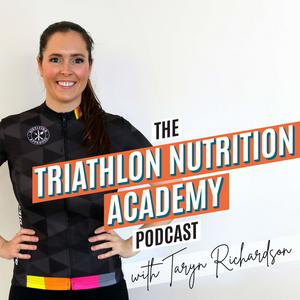
Welcome to the Triathlon Nutrition Academy Podcast! Brought to you by Advanced Sports Dietitian, Taryn Richardson. Listen as I break down the latest science to give you practical, easy to digest strategies to transform yourself into a Supercharged Triathlete! You have so much untapped potential...and I want to help you unlock that with the power of nutrition.
Podcast websiteListen to Triathlon Nutrition Academy, They Mess You Up with Dr. Ciara Kelly and Dr. Richard Hogan and many other podcasts from around the world with the radio.net app
Get the free radio.net app
- Stations and podcasts to bookmark
- Stream via Wi-Fi or Bluetooth
- Supports Carplay & Android Auto
- Many other app features
Get the free radio.net app
- Stations and podcasts to bookmark
- Stream via Wi-Fi or Bluetooth
- Supports Carplay & Android Auto
- Many other app features

Triathlon Nutrition Academy
Scan code,
download the app,
start listening.
download the app,
start listening.
Triathlon Nutrition Academy: Podcasts in Family
 Ireland