
Listen to this podcast in the app for free: Download for free in the App Store
radio.net
Sleep timer
Save favourites
85 episodes
Why Does Education Resist Scientific Evidence? (Ep 84)
13/11/2026 | 1h 9 mins.In this episode of Chalk & Talk, Anna is joined by returning guest Dr. Pamela Snow, Distinguished Professor of Cognitive Psychology at La Trobe University, to discuss why education needs to take scientific evidence more seriously.
Drawing on her recent blog post, The Dog Ate My Homework: Education's Evidence Excuses Echo Chamber, Pamela challenges common arguments used to dismiss rigorous research in education, such as claims that teaching is too complex to be studied scientifically, and that every child learns differently. They also discuss why experience and peer-reviewed publications alone aren't enough to establish which teaching practices are effective.
This episode raises an important question: if education is to be taken seriously as a profession, shouldn't evidence be taken more seriously, too?
Note: This episode is available in audio format only. Due to technical difficulties during recording, the audio quality is below our usual standard. We appreciate your understanding.
Chalk & Talk website: www.chalkandtalkpodcast.com
This episode is available in video at www.youtube.com/@chalktalk-stokke
TIMESTAMPS
[00:00:04] Introduction
[00:04:17] What is the purpose of education?
[00:08:11] What education can learn from evidence-based medicine
[00:13:46] Is teaching too complex to study scientifically?
[00:18:08] Every child is different but does every child learn differently?
[00:23:33] The influence of socioeconomic status on student achievement
[00:31:16] Experience versus research evidence
[00:38:32] Does peer review mean the research is reliable?
[00:45:37] Understanding the hierarchy of evidence
[00:52:52] Are randomized controlled trials appropriate in education?
[00:58:35] Should education have a regulatory body for quality assurance?
[01:01:29] Why classroom teachers are leading the push for evidence
[01:05:20] What should educators stand for?
[01:08:27] Closing remarks
EPISODE TRANSCRIPT
https://chalkandtalkpodcast.com/episodse/ep-84/
EPISODE RESOURCES
https://chalkandtalkpodcast.com/episodse/ep-84/
RELEVANT PREVIOUS EPISODES
Do timed tests cause math anxiety? with Robin Codding: https://chalkandtalkpodcast.com/episode/ep-17/
Red flags in education research with Ben Solomon: https://chalkandtalkpodcast.com/episode/ep-23/
Using evidence in education with Pamela Snow: https://chalkandtalkpodcast.com/episode/ep-27/
We know more about teaching than ever—so why is change so slow? with Joanna Barbousas
https://chalkandtalkpodcast.com/episode/ep-69/
What to do when 'Research Shows' shuts you down: A guide for parents and teachers: https://chalkandtalkpodcast.com/episode/ep-70/
The Story Behind Mississippi's Education Turnaround with Rachel Canter: https://chalkandtalkpodcast.com/episode/ep-76/
MUSIC
Intro & Outro: Funk Jazz Big Band - ColorFilmMusic
Website: http://www.chalkandtalkpodcast.com/
FB: Chalk & Talk
IG: @chalkandtalkpodcast
Tiktok: @chalkandtalkpodcast
X: @rastokke
LinkedIn: www.linkedin.com/in/anna-stokke-3a1b4c
Bluesky: @rastokke.bsky.socialHow Do We Learn? What Memory Research Means for Teaching with Héctor Ruiz Martín (Ep 83)
30/10/2026 | 58 mins.Why do students forget what they’ve learned, and why is it so difficult to apply knowledge in new situations?
Anna Stokke is joined by researcher and author Héctor Ruiz Martín to discuss what cognitive science tells us about learning and effective teaching. They explore the role of prior knowledge, why transfer is difficult, and how retrieval practice, spacing, assessment, motivation, and feedback can strengthen learning. They also tackle common edumyths, including learning styles and left-brain/right-brain thinking.
Chalk & Talk website: www.chalkandtalkpodcast.com
This episode is available in video at www.youtube.com/@chalktalk-stokke
TIMESTAMPS
[00:00:00] Introduction
[00:02:16] Confirmation bias and the importance of evidence
[00:08:10] How memory works and why prior knowledge matters
[00:12:03] Activating students’ prior knowledge
[00:14:20] Why transferring knowledge is difficult
[00:17:59] Is problem solving a transferable skill?
[00:22:38] Helping students transfer what they’ve learned
[00:24:24] Retrieval practice and assessment
[00:31:14] Forgetting, spacing, and long-term learning
[00:35:41] Emotion, motivation, and self-efficacy
[00:38:52] How can teachers increase student motivation?
[00:43:23] Sequencing learning and deliberate practice
[00:49:02] What makes feedback effective?
[00:51:27] Debunking common learning myths
[00:56:40] Final thoughts
EPISODE TRANSCRIPT
https://chalkandtalkpodcast.com/episode/ep-83/
RELEVANT PREVIOUS EPISODES
How we learn: Naive, purposeful, and deliberate practice with Stephen Chew
https://chalkandtalkpodcast.com/episode/ep-48/
Applying cognitive science to education with Daniel Willingham
https://chalkandtalkpodcast.com/episode/ep-16/
How to excel in math and other tough subjects with Barbara Oakley
https://chalkandtalkpodcast.com/episode/ep-7/
MUSIC
Intro & Outro: Funk Jazz Big Band - ColorFilmMusic
Website: http://www.chalkandtalkpodcast.com/
FB: Chalk & Talk
IG: @chalkandtalkpodcast
Tiktok: @chalkandtalkpodcast
X: @rastokke
LinkedIn: www.linkedin.com/in/anna-stokke-3a1b4c
Bluesky: @rastokke.bsky.socialThe Science of Clear Math Teaching with Kristopher Boulton (Ep 82)
15/10/2026 | 1h 9 mins.What if many of the errors students make in math are predictable consequences of the way we teach them? In this episode, Anna is joined by Kristopher Boulton, founder and CEO of Unstoppable Learning to explore how better instructional design can help prevent misconceptions and make difficult math concepts more accessible. Kris insists that it should be possible to achieve 100% success in math for 100% of the students.
They discuss how carefully chosen examples, better sequencing, atomisation, and careful instructional design makes misunderstandings less likely. Kris also shares insights from his experience as a teacher and school leader and his work helping schools improve outcomes in mathematics.
Chalk & Talk website: www.chalkandtalkpodcast.com
This episode is available in video at www.youtube.com/@chalktalk-stokke
TIMESTAMPS
[00:00:04] Introduction
[00:03:16] Logically faultless communication
[00:08:39] Identifying 4 types of mathematical knowledge make teaching easier
[00:10:13] Type 1: Categorical concepts
[00:12:25] Teaching with examples and non-examples
[00:14:52] The four principles for choosing effective examples
[00:19:59] Type 2: Transformations
[00:26:49] Example of a carefully sequenced math lesson
[00:31:44] Dealing with arithmetic difficulties
[00:39:13] Type 3: Facts
[00:43:23] Type 4: Cognitive routines
[00:44:56] How atoms are different from steps
[00:52:32] Mastering each atom before tackling the full routine
[00:54:11] Quadratic and linear equations
[00:57:51] How atomization is different from scaffolding
[01:02:24] Why this teaching approach is important
EPISODE TRANSCRIPT
https://chalkandtalk-beta.ubmepsilon.com/episode/ep-82/
RELEVANT PREVIOUS EPISODES
Teaching Math So Students Learn with Craig Barton
https://chalkandtalkpodcast.com/episode/ep-63/
The Power of Explicit Instruction with Anita Archer
https://chalkandtalkpodcast.com/episode/ep-57/
Project Follow Through: Direct Instruction’s Overlooked Success
https://chalkandtalkpodcast.com/episode/ep-39/
Cognitive Load Theory in Math Class with David Morkunas
https://chalkandtalkpodcast.com/episode/ep-26/
MUSIC
Intro & Outro: Funk Jazz Big Band - ColorFilmMusic
Website: http://www.chalkandtalkpodcast.com/
FB: Chalk & Talk
IG: @chalkandtalkpodcast
Tiktok: @chalkandtalkpodcast
X: @rastokke
LinkedIn: www.linkedin.com/in/anna-stokke-3a1b4c
Bluesky: @rastokke.bsky.socialMaking Sense of PISA 2025 with Montserrat Gomendio (Ep 81)
02/10/2026 | 1h 23 mins.In this episode, Anna is joined by Dr. Montserrat Gomendio, former Deputy Director for Education at the OECD, to discuss the newly released PISA 2025 results.
They explore why student achievement is falling in many countries. They discuss whether COVID, smartphones, and AI explain the declines, why some education systems are holding up better than others, and what policymakers can learn from countries that are seeing better results. They also answer questions from listeners that were submitted during a livestream version of the episode.
Chalk & Talk website: www.chalkandtalkpodcast.com
This episode is available in video at www.youtube.com/@chalktalk-stokke
TIMESTAMPS
[00:00:04] - Introduction: PISA 2025 and student achievement
[00:05:41] - Why did reading become the dominant PISA story?
[00:08:23] - Do phones, digital technology, and AI explain the decline?
[00:14:54] - Did COVID and school closures cause the decline?
[00:20:58] - What can England teach us about education policy after COVID?
[00:22:14] – Scores started declining before COVID
[00:27:35] - What do top-performing education systems have in common?[00:34:32] - What makes effective teacher training?
[00:39:59] - How can countries improve teacher quality in the short term?[00:45:24] - Why evidence-based professional development matters
[00:48:10] - What can countries learn from England’s approach to math?
[00:51:22] - What should teachers do when they disagree with their training?[00:56:10] – How to encourage teachers to change
[00:59:14] - How should schools design a knowledge-rich curriculum?
[01:03:35] - What makes an effective math curriculum?
[01:06:44] - Does PISA data hide differences between education systems?[01:10:41] - What does the OECD get wrong about interpreting PISA data?
[01:16:14] – Finland: PISA declines and bad advice about following Finland
[01:21:54] - Final thoughts
EPISODE TRANSCRIPT
https://chalkandtalkpodcast.com/episode/ep-81/
RELEVANT PREVIOUS EPISODES (linking to website)
The Story Behind Mississippi’s Education Turnaround with Rachel Cante
https://chalkandtalkpodcast.com/episode/ep-76/
The Finland myth, East Asia’s rise, and what makes education systems work with Montserrat Gomendio
https://chalkandtalkpodcast.com/episode/ep-68/
When a mathematician became education minister: Nuno Crato on transforming education
https://chalkandtalkpodcast.com/episode/ep-58/
From decline to top rankings: How England transformed education with Nick Gibb
https://chalkandtalkpodcast.com/episode/ep-49/
MUSIC
Intro & Outro: Funk Jazz Big Band - ColorFilmMusic
Website: http://www.chalkandtalkpodcast.com/
FB: Chalk & Talk
IG: @chalkandtalkpodcast
Tiktok: @chalkandtalkpodcast
X: @rastokke
LinkedIn: www.linkedin.com/in/anna-stokke-3a1b4c
Bluesky: @rastokke.bsky.socialHow Two Teachers Turned Math Achievement Around with Max and Todd (Ep 80)
11/09/2026 | 1h 18 mins.In this episode, Anna is joined by two elementary school teachers from California who are appearing anonymously so they can speak candidly about their experiences.
Both teach at a school where math achievement has remained consistently low.
After watching many of their students struggle with the curriculum they were expected to use (Illustrative Math), they began exploring research, learning about the science of learning and evidence-informed teaching practices, and rethinking what they had been taught about how children learn math. They changed the way they taught math and the results were remarkable. Their students began the year below the national average in math and finished well above it.
This inspiring conversation explores what happens when teachers refuse to accept poor outcomes and take the initiative to find better ways to help their students succeed.
Max and Todd are also interested in hearing your thoughts and questions.
Submit feedback and questions about this episode here: https://chalkandtalkpodcast.com/episode/ep-80/
Sept. 29, 11:00 AM CST Livestream for Making Sense of PISA 2025: Live with Montserrat Gomendio): https://www.youtube.com/live/g_VTy4q55zo?si=9CWypiuqR1GyHIWc
Chalk & Talk website: www.chalkandtalkpodcast.com
TIMESTAMPS
[00:00:04] Introduction
[00:04:03] Remarkable math gains in a struggling school
[00:07:05] What they learned in teacher education about math instruction
[00:14:49] A school facing years of poor math outcomes
[00:17:54] When classroom reality didn’t match what was being taught
[00:23:43] Illustrative Math and issues with problem-based instruction
[00:33:50] A close look at an Illustrative Math lesson
[00:43:14] Recognizing the teaching approach didn’t work
[00:46:35] How they transformed their math instruction
[00:54:28] What explicit instruction looks like in the classroom
[00:58:52] Creating more opportunities for students to respond
[01:01:54] How administrators responded to the results
[01:06:11] Evidence-informed teaching has a huge impact
[01:11:38] Advice for teachers
[01:15:03] When a teacher’s work feels hopeless
EPISODE TRANSCRIPT
https://chalkandtalkpodcast.com/episode/ep-80/
RELEVANT PREVIOUS EPISODES
Cognitive load theory and learning math with John Sweller
https://www.podbean.com/ew/pb-s2zyd-1a717d6
Teaching math so students learn with Craig Barton
https://www.podbean.com/ew/pb-vr69j-1a277a2
Using the Instructional Hierarchy to teach math with Brendan Lee
https://www.podbean.com/ew/pb-3zux7-193d0fc
Transforming education through behaviour science with Dr. Kimberly Berens
https://www.podbean.com/ew/pb-9tfz7-16f2e02
The Science of Math with Amanda VanDerHeyden
https://www.podbean.com/ew/pb-bksbz-13c732d
Math & the Myth of Ability with John Mighton
https://www.podbean.com/ew/pb-22c7a-139dc72
MUSIC
Intro & Outro: Funk Jazz Big Band - ColorFilmMusic
Website: http://www.chalkandtalkpodcast.com/
FB: Chalk & Talk
IG: @chalkandtalkpodcast
Tiktok: @chalkandtalkpodcast
X: @rastokke
LinkedIn: www.linkedin.com/in/anna-stokke-3a1b4c
Bluesky: @rastokke.bsky.social
More Education podcasts






Trending Education podcasts
















About Chalk & Talk
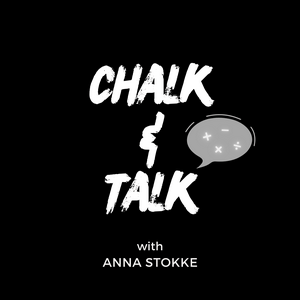
Everyone wants to see children and young adults succeed in math, but it can be difficult to sort myths from facts in education. Join math professor, Anna Stokke, for conversations with leading educators and researchers about the importance of math, effective teaching methods, and debunking common myths about math and teaching. Chalk & Talk is a podcast for anyone interested in education, including educators, parents, and students.
Podcast websiteListen to Chalk & Talk, Stretch Marks and many other podcasts from around the world with the radio.net app
Get the free radio.net app
- Stations and podcasts to bookmark
- Stream via Wi-Fi or Bluetooth
- Supports Carplay & Android Auto
- Many other app features

 Ireland

