

Listen to this podcast in the app for free: Download for free in the App Store
radio.net
Sleep timer
Save favourites
220 episodes
Creating Leverage in Negotiations with AI
24/07/2026 | 43 mins.John is joined by Rebecca Zung, a 23-year trial attorney and the creator of SLAY AI™, a patented AI platform for navigating high-conflict litigation and negotiation situations. They discuss how Rebecca created a groundbreaking business centered on negotiation training, artificial intelligence, and litigation strategy.
After years of handling high-net-worth divorce cases, Rebecca decided to stop trading time for money. She began creating educational content on effective negotiation strategies shortly before the pandemic and discovered an overwhelming demand for advice on negotiating with high-conflict personalities. That success led her to write several books, create online courses, develop a large social media following, and create an AI platform designed to help lawyers and clients prepare cases more efficiently.
Success in negotiation generally depends on leverage, preparation, and mindset. Effective negotiators define the outcome they want, understand the other side’s incentives, identify risks, and create meaningful consequences—or downside—if settlement fails. Negotiation should be approached proactively by controlling the narrative, anticipating conflicts, gathering complete facts before negotiating, and preparing for mediation as thoroughly as for trial. Mediations often require both sides to adjust unrealistic expectations before meaningful progress becomes possible.
Rebecca also believes that confidence begins with identity. Rather than believing success creates confidence, people must first adopt the mindset of the person they intend to become, then consistently act in ways that reinforce that identity. Internal narratives, disciplined thinking, and careful decision-making are essential tools for professional growth.
Rebecca also describes SLAY AI™, the patented platform she created to organize documents, create timelines, identify supporting evidence, generate exhibits, and help lawyers and clients collaborate more effectively. Attorneys subscribe to the platform, then allow clients access to folders related to their case. Clients may then upload their documents in bulk. SLAY AI™ then organizes the materials in response to the attorney’s prompts. This allows the attorney to review key documents organized by the legal and factual issues in the particular case.
The platform is private and walled off from outside observers. Because all communications are confidential between attorneys and clients, and all data is organized by attorney prompts, the data is protected by both the attorney-client privilege and the work product doctrine. By reducing time spent organizing information, the system lowers costs, improves case preparation, and gives legal teams more leverage throughout litigation and settlement negotiations.
Podcast Link: Law-disrupted.fm
Host: John B. Quinn
Producer: Alexis Hyde
Music and Editing by: Alexander RossiMajor Change in Copyright Law?
17/07/2026 | 30 mins.John is joined by Bill Patry, of counsel in Quinn Emanuel’s New York office and author of numerous treatises and law review articles, including Patry on Copyright and Patry on Fair Use. Bill also served as in-house counsel at Google for 17 years. During that time, Google never lost a copyright case. They discuss a pending Ninth Circuit copyright appeal that could reshape how courts determine substantial similarity, the central test for copyright infringement.
The dispute arises from a tattoo created by celebrity artist Kat Von D using a copyrighted photograph of Miles Davis taken by photographer Jeff Sedlik. She documented the process of creating the tattoo on social media and acknowledged copying the photograph exactly, creating the expectation that liability would be straightforward. Instead, the trial court denied the plaintiff’s motion for summary judgment, the case proceeded to a jury, and the jury found no infringement, prompting an appeal focused less on the facts than on the Ninth Circuit’s governing legal standard for infringement.
For decades, the Ninth Circuit has applied two separate tests for infringement: the extrinsic test and the intrinsic test. The extrinsic test attempts to identify objectively protectable elements, while the intrinsic test asks jurors to compare the overall concept and feel of the two works, even though neither “concept” nor “feel” is copyrightable.
The panel that heard the appeal affirmed the judgment in an unpublished opinion, concluding that the copying was fair use. However, the panel also issued three separate published opinions sharply criticizing the long-standing intrinsic test as confusing, overly subjective, and inconsistent with meaningful appellate review. The opinions suggested that the existing framework undermines copyright protection by making erroneous jury verdicts difficult to correct. They explain that copyright plaintiffs may lose cases even where copying is undeniable because the intrinsic test effectively shields jury decisions from appellate review.
The en banc rehearing, scheduled for September 29 or 30, 2026, will present an opportunity for the Ninth Circuit to reconsider decades of precedent and replace an unpredictable doctrine with a clearer, more reviewable framework that could significantly influence future copyright litigation.
The proposed alternative standard would require judges to determine, as a matter of law, which elements of a work are protectable before the case reaches a jury. Jurors would then decide only whether the defendant materially copied that protected expression.
Podcast Link: Law-disrupted.fm
Host: John B. Quinn
Producer: Alexis Hyde
Music and Editing by: Alexander RossiRe-release: A Conversation with Prof. Gao Xiqing
09/07/2026 | 51 mins.In this podcast, recorded before a live audience in China, John is joined by Professor Gao Xiqing, the former Vice Chairman, President, and Chief Investment Officer of the China Investment Corporation, China’s largest sovereign wealth fund.
They discuss Professor Gao’s extraordinary career, from his early days building a railroad in rural China during the Cultural Revolution to earning his JD at Duke University and becoming one of the first Chinese lawyers to pass the New York Bar and work at a major Wall Street law firm.
Professor Gao’s work on Wall Street led to him explaining, as a third-year associate, the causes of the Black Friday stock market crash to Chinese business and government leaders. He was later called back to China to help design the country’s first stock exchange and its securities regulator, the Chinese equivalent of the SEC.
They also discuss Professor Gao’s role in leading the China Investment Corporation (CIC), one of the world’s largest sovereign wealth funds. CIC invests exclusively in businesses outside China, typically acquiring stakes of less than 10%, and allocates its investments roughly equally between publicly listed companies and private equity.
Finally, they discuss Professor Gao’s perspective on Sino-American relations. He believes that, when viewed in historical context, the two countries have grown significantly closer since the Cold War and that shared cultural values, such as a strong work ethic and a drive to achieve, will help strengthen relations in the future.
Podcast Link: Law-disrupted.fm
Host: John B. Quinn
Producer: Alexis Hyde
Music and Editing by: Alexander RossiRe-release: Securing Justice for Victims of Terrorism: Inside $1 Billion Judgment Against Iran
02/07/2026 | 46 mins.John is joined by Michael Gottlieb, partner in the Washington, D.C., office of Willkie Farr & Gallagher, and Nicholas Reddick, partner in the San Francisco office of Willkie Farr & Gallagher. They discuss the landmark $1.1 billion judgment Michael and Nicholas obtained against the Islamic Republic of Iran on behalf of U.S. service members and civilians harmed by Iran-backed terrorist groups, and the legal framework for suing state sponsors of terrorism and private organizations that support them.
Claims against sovereign states are based on the Foreign Sovereign Immunities Act (FSIA). FSIA claims require plaintiffs to prove that the foreign sovereign materially supported acts of terrorism, often through militia groups operating in conflict zones. The process is complex and time-consuming. Although Iran never appears to defend these cases, plaintiffs must still prove liability and damages with admissible evidence, often obtained through Freedom of Information Act requests, military reports, and expert testimony.
Because such judgments are rarely enforceable against Iran’s frozen or inaccessible assets, successful plaintiffs must seek compensation through the U.S. Victims of State Sponsored Terrorism Fund, which draws on congressional appropriations and settlements from unrelated sanctions violations. Payments from the fund are made annually and prorated based on judgment size, but disbursements have been inconsistent.
Recent developments, including circuit court rulings and a pending Supreme Court case, may reshape key legal standards for FSIA claims, such as the requirement of an actual death for certain terrorism-related claims. Several new legislative efforts seek to expand the cases that may be brought under the FSIA and increase the funds allocated for compensating victims.
Claims against private entities, such as banks, contractors, or companies that have evaded sanctions, rely on the Anti-Terrorism Act (ATA). Many such cases are currently being litigated. ATA claims require proof of the defendant’s material support and knowledge of terrorist outcomes. Defendants in ATA cases are likely to appear to defend against the claims, but only after plaintiffs navigate complex issues of jurisdiction and service of process.
Podcast Link: Law-disrupted.fm
Host: John B. Quinn
Producer: Alexis Hyde
Music and Editing by: Alexander RossiRare Federal White Collar Acquittal
26/06/2026 | 45 mins.John is joined by Avi Perry, partner in Quinn Emanuel’s Washington, D.C., office, and Brett Raffish, an associate in the same office. They discuss how the Quinn Emanuel team, led by Bill Burck and Avi Perry, achieved a rare federal white collar criminal defense victory on behalf of technology executive Charlie Kim.
The prosecution alleged that Mr. Kim and his co-CEO bribed four-star Admiral Robert Burke by offering him a lucrative post-retirement job at their company in exchange for using his position to help secure a multimillion-dollar Navy contract. They argued that the employment discussions and contract negotiations constituted an unlawful quid pro quo rather than legitimate, independent business conversations.
Avi and Brett explain the history of the case, from the initial whistleblower complaint through the indictment, pretrial strategy, two lengthy jury trials, and Mr. Kim’s ultimate acquittal. From the beginning, one of their central themes was that the parallel discussions about the Navy contract and the admiral’s post-retirement employment were conducted openly, not secretly. Mr. Kim repeatedly disclosed the conversations to investors, colleagues, family members, and others, demonstrating that he had no criminal intent, one of the essential elements of the charges. The trial team also showed that the job offer and the contract were not linked. Although the proposed multimillion-dollar contract never materialized, Mr. Kim still hired the admiral at Next Jump because the job offer was never contingent on the admiral securing the contract.
Before trial, the team moved to sever Mr. Kim’s trial from the admiral’s case because evidence against the admiral, including incriminating statements and unrelated misconduct, threatened to unfairly prejudice Mr. Kim. Mr. Kim also intended to, and ultimately did, present a defense that the admiral had lied to him during their relationship. After obtaining the rare severance, the admiral was tried, convicted, and sentenced to six years in prison. Mr. Kim’s first trial ended with a hung jury.
Using insights from juror interviews, the team refined its defense for the retrial, focusing on the absence of any true quid pro quo, Mr. Kim’s reliance on the admiral’s assurances that the discussions were ethically appropriate, and evidence showing that the admiral was hired despite the failure to secure the anticipated contract. The team also used the record from the first trial to sharpen its cross-examinations of the government’s witnesses.
Seven months later, the case was retried. At the second trial, the government repeatedly emphasized a statement in a text message that the deal was “no contract, no job.” However, the quote was taken out of context. During Avi’s cross-examination of the government’s case agent, he elicited an admission that the deal ultimately became “no contract, yes job.”
After a two-week trial, the jury deliberated for just one day before returning a verdict acquitting Mr. Kim on all charges.
Podcast Link: Law-disrupted.fm
Host: John B. Quinn
Producer: Alexis Hyde
Music and Editing by: Alexander Rossi
More Business podcasts
 Patrick Boyle On FinanceBusiness, Investing
 Understanding Money with Eoin McGeeBusiness, Education, Society & Culture
 Get Started InvestingBusiness, Education, Investing
 Inside Business with Ciaran HancockBusiness
 FoundersBusiness, Entrepreneurship, History, Technology
 The Diary Of A CEO with Steven BartlettBusiness, Education, Society & Culture
 The Other HandBusiness, News, Society & Culture
 Think Fast Talk Smart: Communication TechniquesBusiness, Careers, Comedy, Education, Improv, Language Learning
 Ask About WealthBusiness, Education, Entrepreneurship, Investing, Tutorials
 Better With MoneyBusiness, Education, Investing, Self-Improvement, Tutorials
Trending Business podcasts
 The Twenty Minute VC (20VC): Venture Capital | Startup Funding | The PitchBusiness, Investing, News, Tech News, Technology
 Informed Decisions Independent Financial Planning & Money PodcastBusiness, Education, Investing
 The Indicator from Planet MoneyBusiness
 Reuters Econ WorldBusiness, Business News, News
 The Irish FIRE PodcastBusiness, Investing
 Thriving Minds with Alberto ZandiBusiness, Entrepreneurship, Personal Journals, Society & Culture
- Patrick Boyle On FinanceBusiness, Investing
 Taking StockBusiness
 Merryn Talks MoneyBusiness, Investing
 Down To BusinessBusiness
- Get Started InvestingBusiness, Education, Investing
 PBD PodcastBusiness
 The Tim Ferriss ShowBusiness, Entrepreneurship
 Planet MoneyBusiness, News
 My First MillionBusiness, Entrepreneurship
- FoundersBusiness, Entrepreneurship, History, Technology
 Money For Couples with Ramit SethiBusiness, Investing, Relationships, Society & Culture
About Law, disrupted
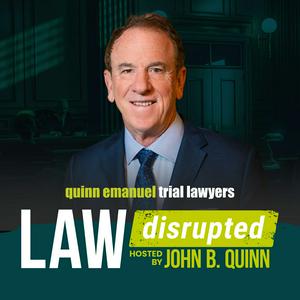
Law, disrupted is a podcast that dives into the legal issues emerging from cutting-edge and innovative subjects such as SPACs, NFTs, litigation finance, ransomware, streaming, and much, much more! Your host is John B. Quinn, founder and chairman of Quinn Emanuel Urquhart & Sullivan LLP, a 900+ attorney business litigation firm with 29 offices around the globe, each devoted solely to business litigation. John is regarded as one of the top trial lawyers in the world, who, along with his partners, has built an institution that has consistently been listed among the “Most Feared” litigation firms in the world (BTI Consulting Group), and was called a “global litigation powerhouse” by The Wall Street Journal. In his podcast, John is joined by industry professionals as they examine and debate legal issues concerning the newest technologies, innovations, and current events—and ask what’s next?
Podcast websiteListen to Law, disrupted, Patrick Boyle On Finance and many other podcasts from around the world with the radio.net app
Get the free radio.net app
- Stations and podcasts to bookmark
- Stream via Wi-Fi or Bluetooth
- Supports Carplay & Android Auto
- Many other app features
Get the free radio.net app
- Stations and podcasts to bookmark
- Stream via Wi-Fi or Bluetooth
- Supports Carplay & Android Auto
- Many other app features

Law, disrupted
Scan code,
download the app,
start listening.
download the app,
start listening.
 Ireland