
Listen to this podcast in the app for free: Download for free in the App Store
radio.net
Sleep timer
Save favourites
86 episodes
Ready Steady Sim! Baking organisational Readiness Into Simulation. With Helen Jarratt and Annie Constnat
14/10/2026 | 41 mins.In this episode of SimCast, Tony Jermy and Lawrence Hill welcome Helen Jarratt and Annie Constant from MPFT to explore organisational readiness for simulation-based learning. They trace the development of an early idea into a dedicated simulation suite, explaining how workforce engagement, leadership support and persistence shaped provision across a large, geographically dispersed community trust.
The discussion covers lessons from poorly attended sessions, the move towards bespoke support for clinical teams and the use of simulation within recruitment. Helen and Annie explain how SCORS provided an honest baseline, informed practical improvements and demonstrated progress in organisational readiness. They also explore faculty development, quality assurance, investment in staff and future plans for satellite facilities, streamed learning and simulation-informed career pathways.
#SimCast #podcast #simulation #clinicalsimulation #highereducationLive at Maudsley Learning
30/09/2026 | 38 mins.Recorded live at the Maudsley Learning Mental Health Simulation Conference, this special SimCast panel brings together speakers and faculty to reflect on some of the major issues shaping mental health simulation. Tony and Lawrence are joined by Liz, Nikki, James and Camilla to explore what prevents effective simulation from producing sustained change in healthcare systems, and how transformative simulation might move beyond education to influence systems, services and patient care.
The discussion examines the opportunities and risks associated with AI and technology-enhanced simulation, the importance of lived experience and inclusive design, and the role of multi-agency working in creating more representative learning. The panel also considers psychological safety in challenging mental health scenarios, how far simulation should stretch participants, and what they have taken away from two days of shared learning. The episode closes with a reminder that effective simulation does not depend on expensive facilities, and that creativity, collaboration and thoughtful design remain central to meaningful simulation practice.
#SimCast #MaudsleyLearning #Simulation #MentalHealth #HigherEducation #ClinicalSimulaiton #podcastThe Future of Healthcare Simulation With ASPiH President Sharon Weldon
15/09/2026 | 47 mins.What does the future of healthcare simulation look like, and are we thinking big enough about what simulation can actually achieve?
In this episode of SimCast, Lawrence Hill and Tony Jermy are joined by Professor Sharon Weldon, President of the Association for Simulated Practice in Healthcare (ASPiH), to explore the rapidly evolving future of simulation. Sharon reflects on her remarkable journey into healthcare and simulation before challenging us to think beyond simulation as purely an educational technique. The conversation explores transformative simulation, intentional simulation design, the role of theory, systems improvement, artificial intelligence and the potential for simulation to help us understand and change complex healthcare systems.
We also discuss the professionalisation of simulation practice, ASPiH’s developing professional development framework, the importance of standards and governance, and the challenge of maintaining an inclusive simulation community while establishing a stronger professional voice nationally and internationally. Looking ahead, Sharon argues that simulation could become increasingly embedded within healthcare and education, not simply as something clinicians participate in, but as a tool they routinely use to explore, test, redesign and improve the systems in which they work.
Episode Links:
Transformative Sumlation
https://aspih.org.uk/resources/transformative-simulation/
ASPiH Best Practice and Professional Standards
https://aspih.org.uk/professional-practice/aspih-standards/
#Simulaiton #SimCast #Podcast #ClinicalSimulation #highereducationHow Real is Too Real? Exploring Mixed Reality Simulation With Blueroom - With Keith Mills
01/09/2026 | 35 mins.In this episode of SimCast, Tony and Lawrence visit MKC Training at the Historic Dockyard Chatham to explore BlueRoom, an advanced mixed reality platform being used to create highly immersive simulation experiences. Joined by defence medical lead Keith Mills, they examine how mixed reality can place learners inside complex clinical and operational environments while still allowing them to interact with real equipment, patients and mannequins. They also explore how biometric monitoring, eye tracking and performance data could provide new ways of understanding decision-making, stress, situational awareness and human performance during simulation.
After experiencing the technology first-hand, the discussion moves beyond the initial appeal of immersive technology to consider its educational value. How realistic should simulation become? What happens when immersion is so powerful that learners need time before they are ready to debrief? And could mixed reality help bridge the gap between classroom learning and difficult-to-access environments such as helicopters, ambulances, field hospitals and other high-risk settings? The episode considers the opportunities, limitations, research potential and psychological safety implications of mixed reality, while returning to a fundamental principle: technology only adds value when it enhances good simulation design, facilitation and debriefing.
#SimCast #Podcast #Simulation #HigherEducation #highereducationEthical considerations in learning disabilities simulation - With Helen Needham
19/08/2026 | 39 mins.In this episode of SimCast, Lawrence Hill and Tony Jermy are joined by Helen Needham, a learning disability nurse and academic at Birmingham City University with more than 40 years of experience across clinical, community and educational settings. Helen explores how simulation can help healthcare students develop the communication, relational and interpersonal skills needed when working with people with learning disabilities and cognitive impairment. The conversation examines psychological safety, the importance of establishing genuine human connection, the challenges of creating authentic simulated experiences, and why seemingly everyday conversations can represent significant “bad news” for the person receiving them.
Helen also discusses her professional doctorate exploring learning disability student nurses’ experiences of breaking bad news through simulation, including emerging findings around anxiety, confidence, emotional responses and the opportunity to rehearse conversations that students may rarely be able to practise in clinical placements. The discussion moves into some of the more difficult territory surrounding authenticity and ethics, including the involvement of people with learning disabilities in simulation, the potential for simulation itself to cause harm, and whether greater realism is always desirable. The episode concludes by considering the future of learning disability simulation, interprofessional applications and the potential for this work to support educators beyond Helen’s own institution.
If you’d like to find out more about Helen’s work in learning disability nursing and simulation, you can connect with her via Helen.Needham@BCU.ac.uk or via LinkedIn.
#SimCast #Podcast #Simulation #HigherEducation #ClinicalSimulation
More Education podcasts




Trending Education podcasts














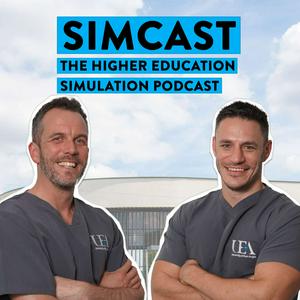
About SimCast
Welcome to SimCast. The higher education simulation podcast. Hosted by Tony Jermy and Lawrence Hill
Also available as a video podcast on YouTube
Podcast websiteListen to SimCast, Anseo.net - If I were the Minister for Education and many other podcasts from around the world with the radio.net app
Get the free radio.net app
- Stations and podcasts to bookmark
- Stream via Wi-Fi or Bluetooth
- Supports Carplay & Android Auto
- Many other app features
Get the free radio.net app
- Stations and podcasts to bookmark
- Stream via Wi-Fi or Bluetooth
- Supports Carplay & Android Auto
- Many other app features
SimCast
Scan code,
download the app,
start listening.
download the app,
start listening.
 Ireland
