
Listen to this podcast in the app for free: Download for free in the App Store
radio.net
Sleep timer
Save favourites
146 episodes
Psychologist Jamil Zaki: Empathy Is a Skill You Can Train
14/10/2026 | 1h 40 mins.Jamil Zaki was eight when his parents began a divorce that took four years. To stay close to both of them, he had to work, every day, to understand two people who could no longer understand each other. He calls it his empathy gym.
Jamil is a professor of psychology at Stanford University, where he directs the Stanford Social Neuroscience Lab. He has published over 100 peer-reviewed articles and two books, The War for Kindness and Hope for Cynics. His lab's experiments show that empathy can be trained: people who believe they can grow it work harder at it and improve over time. He also calls himself a recovering cynic.
I lived the era of stack ranking at Microsoft, when colleagues were graded against each other on a bell curve, and I was very glad when we retired it. Jamil explained what the science says such a system does to people, and why real empathy means holding people accountable rather than letting them off the hook. Then he turned the tables and asked me whether learning to ask questions instead of giving answers had been uncomfortable for me. It was, and I told him about the most embarrassing moment of my professional life.
In our conversation, we explore:
→ Empathy as a skill: what his lab found, and how to turn a belief into a plan and daily habits
→ Kind systems: why people think they are alone in wanting more empathy at work, and how leaders can change the norm
→ Stack ranking, cynicism and accountability: why pitting people against each other backfires
→ Artificial empathy: why chatbots now sound more caring than strangers, and the risk of AI that only tells us we are right
→ Young people, self-criticism and hope, and three practices to start tomorrow morning
"It's like a suit of armor that you put on, but instead of protecting you, it suffocates you." Jamil Zaki, on cynicism
If you have ever been told that empathy is soft, or felt that cynicism keeps you safe, this conversation is for you.
Jamil's work:
Website: https://www.jamil-zaki.com/
The War for Kindness: https://www.penguinrandomhouse.com/books/550616/the-war-for-kindness-by-jamil-zaki/
Hope for Cynics: https://www.hachettebookgroup.com/titles/jamil-zaki/hope-for-cynics/9781538743065/
🎧 Related episodes:
Daniel Goleman (2024), the three kinds of empathy and why empathic concern builds trust: https://www.buzzsprout.com/1798971/episodes/14940410
Kim Cameron (2022), positively energizing leaders: https://www.buzzsprout.com/1798971/episodes/10627686
Rana el Kaliouby (2025), human-centric AI and machines that read emotions: https://www.buzzsprout.com/1798971/episodes/16982786
New here? Subscribe to Positive Leadership & You for one edition a month, written for leaders who want to build companies and communities people thrive in. https://www.linkedin.com/newsletters/positive-leadership-you-6970390170017669121/
Want to go deeper? Listen to the Positive Leadership Podcast on your favourite platform. 130+ conversations with the leaders, founders and thinkers shaping a more human future of work.
🎧 Apple Podcast: https://podcasts.apple.com/fr/podcast/positive-leadership/id1574911588
🎤 Spotify: https://open.spotify.com/show/1EdnJcYgh9nXPTFJ5euOBfOlivier Goy: Invincible Hope
30/09/2026 | 1h 12 mins.In December 2020, a neurologist at the Pitié-Salpêtrière told Olivier Goy he had ALS, Charcot's disease. No cure. Three to five years. He spent four months on the floor. Then a sentence came to him, so simple it almost made him laugh: if I stay depressed, I punish myself twice.
Olivier founded 123Venture in 2000, with nine months of professional experience, to open private equity to ordinary savers, then co-founded October to finance small and medium businesses. Since his diagnosis he has become an ambassador of the Paris Brain Institute and has raised more than €4.5 million for research through a film, Invincible été, a book, Invincible, written with Anne Fulda, a concert at the Olympia, La Fresque Généreuse and now Invincible Hope. In this episode he speaks through Invincible Voice, a tool built with the researchers of Kyutai that rebuilt his voice from recordings made before the disease took it, and that he made open source for every patient.
Last year I took part in a campaign where leaders spoke publicly about the things we are trained to hide, and I shared my own story. It was one of the most liberating things I have done. Olivier has taken this further than anyone I know. I came to this conversation expecting to talk about courage. Olivier gave us something rarer: a method for loving life.
In our conversation, we explore:
→ From Annemasse to Paris: building two companies as an outsider, and why legitimacy comes from being useful
→ The diagnosis, the four months on the floor, and the decision that turned him into a fighter
→ Leading without a voice or a stride: how ALS rewrote his definition of leadership
→ Why people do not follow the invulnerable: leadership as a mission, visible cracks and generosity
→ AI that gives back: Invincible Voice, patient data at the Paris Brain Institute, and the Invincible Hope mural at Mount Sinai in New York
"The door that looks locked is usually just heavy. Push it. Legitimacy is not granted to you, you take it by being useful." Olivier Goy
If you have ever waited for permission to start something, or to tell someone what they mean to you, this conversation is for you.
Olivier's initiatives:
Invincible Hope: https://www.invincible-hope.com/
Invincible été, the film: https://www.invincible-ete.com/
Invincible, the book: https://www.invincible-ete.com/livre
The Invincible été research fund: https://institutducerveau.org/actualites/linstitut-cerveau-associe-au-lancement-fonds-philanthropique-invincible-ete-pour-recherche-sur-sla
Give to AI research at the Paris Brain Institute: https://don.institutducerveau.org/invincible_hope/~mon-don
RELATED EPISODES
Mo Gawdat, former Chief Business Officer of Google X (2021), engineering happiness through expectation management: https://www.buzzsprout.com/1798971/episodes/8944613
Gianpiero Petriglieri, INSEAD professor (2025), leadership, love, intention and freedom: https://www.buzzsprout.com/1798971/episodes/17854175
Dr Donna Hicks, Harvard (2026), dignity as the foundation of positive leadership: https://www.buzzsprout.com/1798971/episodes/19240650
New here? Subscribe to Positive Leadership & You for one edition a month, written for leaders who want to build companies and communities people thrive in. https://www.linkedin.com/newsletters/positive-leadership-you-6970390170017669121/
Want to go deeper? Listen to the Positive Leadership Podcast on your favourite platform. 130+ conversations with the leaders, founders and thinkers shaping a more human future of work.
🎧 Apple Podcast: https://podcasts.apple.com/fr/podcast/positive-leadership/id1574911588
🎤 Spotify: https://open.spotify.com/show/1EdnJcYgh9nXPTFJ5euOBfAtul Satija: Give Till It Hurts
16/09/2026 | 1h 39 mins.He kept promising himself he would fight poverty one day. First at retirement. Then in his fifties. Then his forties. Until the day it felt like he was lying to himself. So one weekend he started cold-calling nonprofits at random, and walked away from a career most people spend their lives chasing.
Atul Satija is the founder of The/Nudge Institute, one of India’s most ambitious anti-poverty organisations, and the “Founder 2.0” of GiveIndia. Before that, he spent nearly two decades in the front line of the tech industry: Google, then InMobi, where he sat in the room as it raised 200 million dollars from SoftBank and had to make the calls that come with that kind of money. He has pledged half his net worth to giving. He is the person JP wanted to talk to about the single hardest question in social impact: not how to care, but how to make caring actually work at scale.
I came to this conversation from my own leap. When I moved from leading teams at Microsoft to building Live for Good, I discovered something that still surprises me: it can be harder to raise a small grant for a good cause than to close an enormous enterprise deal. Atul has lived that gap for years, and he has thought harder than almost anyone about how to close it. What he taught me is that generosity is not enough. You have to engineer it.
In our conversation, we explore:
→ What extreme poverty actually is: families of five or six living on three hundred dollars a year, and why the loss of dignity cuts as deep as the loss of income
→ Why the model that lifts a family out of poverty for good worked everywhere and scaled nowhere, and his answer: shape the state, do not replace it
→ The jar, the rocks and the sand: “you don’t want to build a parallel railroad, you want to fix what’s broken so bigger trains run on the same track”
→ Give till it hurts: why the poorest communities give a larger share of what they have than the richest do
→ AI seen from the bottom: why, for those who have almost nothing, there is nothing left for it to take
“If you’re giving what does not change anything in your life, then it is not really giving. You’re buying something with some extra money.”
Atul Satija, founder of The/Nudge Institute
If you have ever told yourself you will do the meaningful thing later, once the timing is right, this episode is about the day later stops being an option.
🎧 Related episodes:
Nandan Nilekani, who wrote The/Nudge’s first cheque, “Achieving ambitious goals”: https://www.buzzsprout.com/1798971/episodes/13663342
James Chen, “Seeing the Future and Transforming Millions of Lives”: https://www.buzzsprout.com/1798971/episodes/16724860
Raj Sisodia, “How Conscious Capitalism Brings Love into Business”: https://www.buzzsprout.com/1798971/episodes/19005670
New here? Subscribe to Positive Leadership & You for one edition a month, written for leaders who want to build companies and communities people thrive in. https://www.linkedin.com/newsletters/positive-leadership-you-6970390170017669121/
Want to go deeper? Listen to the Positive Leadership Podcast on your favourite platform. 130+ conversations with the leaders, founders and thinkers shaping a more human future of work.
🎧 Apple Podcast: https://podcasts.apple.com/fr/podcast/positive-leadership/id1574911588
🎤 Spotify: https://open.spotify.com/show/1EdnJcYgh9nXPTFJ5euOBf[FR] Frédéric Laloux, Reinventing Organizations : 15 000 personnes, zéro manager
02/09/2026 | 1h 42 mins.Regrouper les infirmiers pour faire des économies. Leur retirer le téléphone, un centre d'appels s'occupera de tout. Chronométrer chaque geste : deux minutes trente pour un bas de contention, dix minutes pour une piqûre. Poser un code-barres sur la porte du patient, pour scanner à l'entrée et à la sortie. Chaque étape est raisonnable. Le résultat est un cauchemar, et c'était le vrai visage des soins à domicile aux Pays-Bas.
Frédéric Laloux est l'auteur de Reinventing Organizations, autoédité en 2014, vendu à plus d'un million d'exemplaires et traduit dans plus de vingt langues. Ancien associate partner chez McKinsey, il a tout quitté à 32 ans après une séance de coaching qui devait durer une heure et en a duré trois. Il a passé des années à étudier une douzaine d'organisations qui fonctionnent sans managers, puis a refusé la suite logique : les conférences à six chiffres, les sièges au conseil, le statut de gourou. Il vit aujourd'hui à Ithaca, dans l'État de New York, et a cofondé avec sa femme Hélène The Week, une expérience collective sur le climat suivie par plus de 75 000 personnes dans 500 entreprises.
Je suis venu à cette conversation avec un aveu à faire. « Predict and control », prévoir et contrôler : c'est un vocabulaire que j'ai moi-même utilisé, et sans doute abusé, pendant des années. Frédéric ne juge pas cela. Il montre simplement, exemple après exemple, qu'un autre regard existe, et ce qu'il libère quand on ose le porter. C'est l'une des conversations les plus dérangeantes, et les plus pleines d'espoir, que j'aie eues sur ce podcast.
Dans cette conversation, nous explorons :
→ Buurtzorg, fondé en 2006 par Jos de Blok avec quatre infirmières : aujourd'hui 15 000 soignants, zéro manager, et la moitié seulement des heures de soins que les médecins prescrivent, parce que le but n'est pas d'optimiser la minute de traitement mais de rendre le patient autonome
→ Les trois piliers de Reinventing Organizations : l'autogouvernance, la plénitude, la raison d'être évolutive, et le basculement de « predict and control » vers « sense and respond »
→ Pourquoi le problème n'est presque jamais les individus, mais la structure : ce que Frédéric a compris après quatre ans de coaching de comités de direction
→ L'IA comme révélateur : le même outil, les mêmes équipes, et deux regards qui mènent à deux mondes opposés
→ Douglas McGregor et les théories X et Y : les deux sont vraies, parce que les deux sont autoréalisatrices
« Quand on enlève la hiérarchie de pouvoir, on enlève une sorte de poison qui existe entre nous. »
Frédéric Laloux, auteur de Reinventing Organizations
Si vous avez déjà senti qu'une réunion cachait plus qu'elle ne disait, que personne n'osait nommer l'éléphant dans la pièce, cet épisode vous expliquera pourquoi, et ce qu'on peut faire d'autre.
🎧 Épisodes liés :
Jos de Blok, fondateur de Buurtzorg, « Transforming healthcare through self-management » : https://www.buzzsprout.com/1798971/episodes/10674003
Barbara Fredrickson, « Understanding love and positivity in leadership » : https://www.buzzsprout.com/1798971/episodes/9437036
Raj Sisodia, « How Conscious Capitalism Brings Love into Business » : https://www.buzzsprout.com/1798971/episodes/19005670
New here? Subscribe to Positive Leadership & You for one edition a month, written for leaders who want to build companies and communities people thrive in. https://www.linkedin.com/newsletters/positive-leadership-you-6970390170017669121/
Want to go deeper? Listen to the Positive Leadership Podcast on your favourite platform. 130+ conversations with the leaders, founders and thinkers shaping a more human future of work.
🎧 Apple Podcast: https://podcasts.apple.com/fr/podcast/positive-leadership/id1574911588
🎤 Spotify: https://open.spotify.com/show/1EdnJcYgh9nXPTFJ5euOBfMore Human Than Ever: Summer Special 2026
05/08/2026 | 1h 2 mins.Every August, I offer you something different. Not a new conversation, but a pause.
This was the year AI stopped being a headline and became part of our daily lives as leaders. I dedicated a whole series to it, from robotics to education to medicine to trust. And one paradox kept coming back, conversation after conversation: the more powerful the technology becomes, the more the difference is made by what is deeply, irreducibly human.
So for this summer special I went back through the season and selected seven moments around one conviction. This era demands that we show up with our humanity at its best. More human than ever.
We explore four powers together.
→ Power one, prepare your mind. Ethan Kross on chatter, the voice inside your head, and the toolbox to master it. The brain does not come with a user's manual, so you build your own.
→ Power two, own your story. Nicholas Thompson on recognising the generational patterns he inherited, and Raj Sisodia on why trauma cannot heal in silence and in shame. Know yourself, love yourself, be yourself.
→ Power three, magnify your purpose with AI. Stéphane Bancel on why the CEO has to be the chief AI officer and must not delegate it, and MacKenzie Price on the school where children learn academics in two hours a day.
→ Power four, keep humans at the center. Rana el Kaliouby on emotional intelligence and privacy by principle, and Raffi Krikorian on the hardest question of all: who owns your window to the world?
I close with four lessons, one per power, and one practice I want to leave you with for the summer. I call it the summer walk. Fifteen minutes a day, no phone, no podcast, not even mine. Just you and four questions.
Pick one tool, one idea from this episode, and practice it before September.
Thank you for listening, for your messages and your ideas for guests. This community of positive leaders across so many countries is what keeps this podcast alive and growing. If this episode resonates, share it with one person who needs a spark this summer.
I will see you in early September with a brand new season.
New here? Subscribe to Positive Leadership & You for one edition a month, written for leaders who want to build companies and communities people thrive in. https://www.linkedin.com/newsletters/positive-leadership-you-6970390170017669121/
Want to go deeper? Listen to the Positive Leadership Podcast on your favourite platform. 130+ conversations with the leaders, founders and thinkers shaping a more human future of work.
🎧 Apple Podcast: https://podcasts.apple.com/fr/podcast/positive-leadership/id1574911588
🎤 Spotify: https://open.spotify.com/show/1EdnJcYgh9nXPTFJ5euOBf
More Business podcasts


Trending Business podcasts


















About Positive Leadership
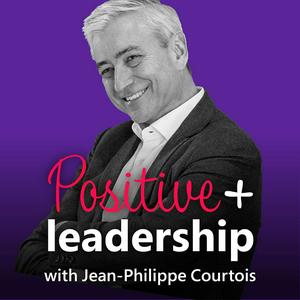
Positive Leadership has the power to change the world. By focusing on trust, empathy, authenticity and deep collaboration, leaders can energize their teams to achieve success for individuals, their organizations, and society as a whole. Yet, it remains relatively unknown outside positive psychology and neuroscience circles.Join Jean-Philippe Courtois, former member of the Microsoft senior leadership team alongside Satya Nadella and co-founder of Live for Good, as he brings Positive Leadership to life for anyone in a leadership capacity—both personally and professionally. With help from his guests, Jean-Philippe explores how purpose-driven leaders can generate the positive energy needed to drive business success, individual fulfillment, and societal impact across a range of industries—from technology and social enterprise to sports and coffee.Most importantly, you’ll learn practical tips to apply in your own life—so you can start making a positive difference in the world.
Podcast websiteListen to Positive Leadership, The Diary Of A CEO with Steven Bartlett and many other podcasts from around the world with the radio.net app
Get the free radio.net app
- Stations and podcasts to bookmark
- Stream via Wi-Fi or Bluetooth
- Supports Carplay & Android Auto
- Many other app features
Get the free radio.net app
- Stations and podcasts to bookmark
- Stream via Wi-Fi or Bluetooth
- Supports Carplay & Android Auto
- Many other app features

Positive Leadership
Scan code,
download the app,
start listening.
download the app,
start listening.
 Ireland
